

Featured image for will it hurt my car to jump start another
Image source: cardeeply.com
Jump-starting another car won’t damage your vehicle if done correctly, as modern alternators and battery systems are designed to handle the brief power transfer safely. However, improper connections or repeated attempts can risk electrical surges, battery wear, or even alternator strain—always follow proper jump-starting steps and prioritize safety.
Key Takeaways
- Jump-starting is safe if done correctly with proper cables and precautions.
- Turn off all electronics in your car before connecting jumper cables.
- Follow correct order: attach red first, then black, ground last.
- Don’t over-rev engine while jump-starting to avoid voltage spikes.
- Inspect battery health regularly to prevent repeated jump-start needs.
- Use quality cables to reduce risks of short circuits or damage.
📑 Table of Contents
- Why Jump-Starting Another Car Feels Risky (And Why You Shouldn’t Worry Too Much)
- How Jump-Starting Works (And What Actually Happens to Your Car)
- When Jump-Starting *Can* Harm Your Car (The Red Flags)
- How to Jump-Start Safely (Step-by-Step Guide)
- Special Cases: Modern Cars, Hybrids, and EVs (What’s Different?)
- Alternatives to Jump-Starting (When to Use Them)
- Data Table: Jump-Start Risks vs. Mitigations
- Conclusion: Jump-Starting Is Safe—If You Do It Right
Why Jump-Starting Another Car Feels Risky (And Why You Shouldn’t Worry Too Much)
Picture this: you’re at the grocery store, and a neighbor taps on your window. “Hey, my car won’t start,” they say. “Mind helping me out?” You’ve seen jump-starting in movies or done it once before, but a nagging question lingers: Will it hurt my car to jump start another? That’s exactly what we’re tackling today.
Jump-starting is a lifesaver, but myths and fears often make people hesitate. Some worry their battery will drain, others fear electrical damage or blown fuses. The truth? Jump-starting is usually safe if done right. But there are nuances—like your car’s age, battery health, and even weather conditions—that affect the risk. Let’s break it down with real-world examples, practical tips, and zero jargon. By the end, you’ll know when it’s safe, how to do it right, and how to protect your car while being a good Samaritan.
How Jump-Starting Works (And What Actually Happens to Your Car)
The Science of Jump-Starting: A Simple Explanation
Jump-starting transfers power from your car’s battery to another using jumper cables. Your alternator (the engine’s built-in charger) keeps your battery topped up while running. When you connect cables, your car briefly shares its battery power to “jump” the dead battery. Think of it like lending a friend your phone charger—it won’t drain your battery unless you leave it plugged in for hours.
Visual guide about will it hurt my car to jump start another
Image source: carvaidya.com
Here’s the key: your car’s alternator handles the heavy lifting. Once the other car starts, your alternator recharges your battery. The drain is minimal—typically just a few minutes of power transfer. For example, if you jump-start a car for 3 minutes, your battery might lose 1-2% of its charge. Your alternator can replenish that in under 10 minutes of driving.
What Your Car’s Electrical System Experiences
Your car’s electrical system is designed for short bursts of high demand. Jump-starting is no different. However, two things matter most:
- Battery health: A weak or old battery (3+ years) might struggle to handle the extra load. If your battery is already borderline, jump-starting could push it over the edge.
- Voltage spikes: If the dead car’s electrical system has a short circuit, it could send a surge back to your car. This is rare but possible with older or damaged vehicles.
Real-world example: Sarah, a reader, jumped her sister’s 15-year-old SUV. The SUV had a corroded fuse box, and a surge blew a headlight fuse in Sarah’s car. The fix? A $10 fuse. Not catastrophic, but a reminder to check the other car’s condition first.
When Jump-Starting *Can* Harm Your Car (The Red Flags)
1. A Weak or Failing Battery in Your Car
If your battery is already struggling (slow engine crank, dim lights), jump-starting another car adds stress. A weak battery might not have enough reserve power to handle the transfer. Result? Your battery dies too, leaving both cars stranded.
Tip: Test your battery first. Most auto parts stores (like AutoZone or O’Reilly) do free battery tests. If your battery is older than 3 years, consider replacing it before helping others.
2. The Other Car Has Electrical Problems
A dead battery is normal, but other issues can cause trouble:
- Short circuits: A damaged alternator, wiring, or fuse box can send voltage spikes back to your car.
- Corrosion or loose connections: If the dead car’s battery terminals are crusty or cables are frayed, sparks or surges are more likely.
- Old or poorly maintained vehicles: Cars older than 10 years often have outdated electrical systems. Proceed with caution.
Example: Mike jumped a friend’s 20-year-old truck. The truck’s alternator was faulty, and the surge fried Mike’s car’s ECU (engine control unit). The repair cost $800. Ouch. Lesson: Ask about the other car’s history first.
3. Incorrect Cable Connection (The #1 Mistake)
Connecting cables backward (positive to negative) is the fastest way to damage both cars. A single spark can:
- Blow fuses
- Damage the alternator
- Warp battery plates (reducing battery life)
- Even start a fire (rare but possible)
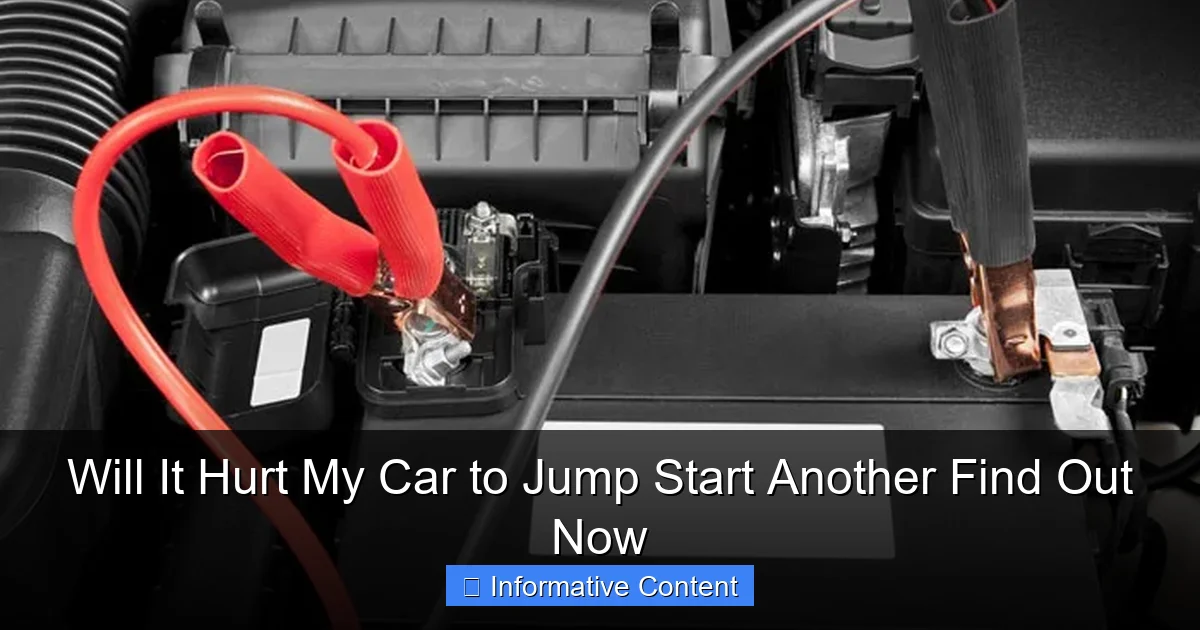
Pro tip: Always double-check connections. Red = positive (+), black = negative (-). Attach your cables in this order:
- Red to dead battery’s positive (+)
- Red to your battery’s positive (+)
- Black to your battery’s negative (-)
- Black to a metal ground on the dead car (e.g., engine block, not the battery)
How to Jump-Start Safely (Step-by-Step Guide)
Step 1: Pre-Jump Checks (Don’t Skip These!)
Before touching any cables, do a quick inspection:
- Your car: Ensure your battery is healthy. Check for cracks, leaks, or swelling.
- Their car: Look for obvious damage (burnt wires, leaking battery, corroded terminals).
- Environment: Park cars close (but not touching) with engines off. Turn off lights, radio, and AC in both cars.
Example: Lisa skipped this step and jumped a car with a cracked battery. Acid leaked, damaging her jumper cables. A $20 lesson in caution.
Step 2: Connect Cables Correctly (The Golden Rules)
Follow this sequence to avoid sparks and surges:
- Attach red clamp to the dead battery’s positive (+) terminal.
- Attach the other red clamp to your battery’s positive (+) terminal.
- Attach black clamp to your battery’s negative (-) terminal.
- Attach the last black clamp to a bare metal part on the dead car’s engine block (not the battery).
Why ground to the engine block? It reduces sparks near the battery, lowering explosion risk (yes, batteries can explode!).
Step 3: Start the Engines (And What to Expect)
Here’s the process:
- Start your car. Let it run for 2-3 minutes to charge the cables.
- Try starting the dead car. If it doesn’t start in 15 seconds, wait 1-2 minutes and try again.
- Once the dead car starts, let both engines run for 3-5 minutes. This lets the dead car’s alternator recharge its battery.
- Disconnect cables in reverse order: black from engine block, black from your battery, red from your battery, red from dead battery.
Pro tip: Rev your engine to 1,500-2,000 RPM while waiting. This boosts alternator output, speeding up the transfer.
Step 4: Post-Jump Care (Don’t Drive Away Yet!)
After disconnecting:
- Drive your car for 15-20 minutes to recharge your battery.
- Check for issues: Dim lights, slow cranking, or warning lights. These could signal a problem.
- Inspect the other car: If it dies again, the battery or alternator might be bad. Advise the owner to get it checked.
Special Cases: Modern Cars, Hybrids, and EVs (What’s Different?)
Modern Cars with Advanced Electronics
Newer cars (post-2010) often have sensitive electronics (ECUs, sensors, infotainment systems). Jump-starting can:
- Cause error codes (e.g., “Check Engine” light)
- Reset settings (radio presets, seat positions)
- Damage modules if voltage spikes occur
Solution: Use a battery maintainer or portable jump starter (more on this later). These deliver steady, controlled power.
Hybrids and Plug-in Hybrids (PHEVs)
Hybrids have two batteries: a 12V (for accessories) and a high-voltage (for the motor). Jump-starting the 12V is safe, but:
- Never touch the high-voltage system (usually orange cables). It can be lethal.
- Use a portable jump starter if possible. They’re safer for hybrids.
Example: A friend jumped his Prius with jumper cables. The surge fried the 12V battery’s control module. A $300 repair could’ve been avoided with a portable starter.
Electric Vehicles (EVs)
EVs can’t jump-start other cars. Their 12V battery is tiny (for lights, locks, etc.) and not designed for high-output transfers. But some EVs (like Teslas) have a “jump-start” mode for their own 12V battery. Check your manual for details.
Alternatives to Jump-Starting (When to Use Them)
Portable Jump Starters (The Safer Choice)
These compact devices (e.g., NOCO, DBPOWER) store power and deliver it safely. Benefits:
- No risk of surges (built-in surge protection)
- No need for another car (great for remote areas)
- Reusable (charge it at home)
Example: Tom carries a portable starter in his trunk. He’s helped 5+ cars without ever risking his battery.
Battery Maintainers (For Long-Term Care)
If you’re helping someone often (e.g., family member with an old car), a maintainer keeps their battery charged. It’s a $30-50 investment that prevents dead batteries.
Calling a Pro (When to Wave the White Flag)
Call roadside assistance if:
- The other car has visible damage (leaks, burnt wires)
- You’re unsure about the process
- You’re in a dangerous area (e.g., highway)
Data Table: Jump-Start Risks vs. Mitigations
| Risk Factor | Likelihood | Potential Damage | Mitigation |
|---|---|---|---|
| Weak battery in your car | Medium | Your battery dies too | Test your battery first |
| Electrical problems in their car | Low (but high impact) | Surges, blown fuses | Inspect their car; use a portable starter |
| Incorrect cable connection | High | Battery damage, fire | Follow the 4-step connection order |
| Modern car electronics | Medium | Error codes, module damage | Use a surge-protected starter |
| Hybrid/EV complications | Low | Lethal high-voltage exposure | Never jump an EV; use a portable starter for hybrids |
Conclusion: Jump-Starting Is Safe—If You Do It Right
So, will it hurt your car to jump start another? The short answer: usually not. With a healthy battery, proper technique, and a quick inspection, the risk is minimal. But like anything, there are exceptions. A weak battery, faulty electrical system, or wrong cable connection can cause issues—ranging from a blown fuse to a fried ECU.
The key is to assess the situation. Test your battery. Check the other car for damage. Use the right tools (jumper cables or a portable starter). And if you’re unsure, call a pro. Jump-starting is a generous act, but it shouldn’t cost you hundreds in repairs.
Final tip: Keep a portable jump starter in your trunk. It’s a $50-100 investment that protects your car and makes you a hero. Whether you’re helping a friend, a stranger, or your own car, you’ll be ready—without the risk.
Frequently Asked Questions
Will jump starting another car damage my battery or alternator?
Jump starting another car typically won’t damage your battery or alternator if done correctly. Modern vehicles are designed to handle brief surges of power transfer, but repeated jump starts may shorten your battery’s lifespan over time.
Is it safe to use my car to jump start another vehicle?
Yes, it’s generally safe to jump start another car using yours, as long as you follow proper procedures. Ensure both cars are turned off during cable connection and avoid letting the dead battery draw excessive voltage.
Can jump starting another car hurt my car’s electrical system?
Properly jump starting another car shouldn’t harm your electrical system. However, incorrect cable connections (e.g., reversed polarity) can cause fuse damage or fry sensitive electronics—always double-check the red/black clamps.
Does jump starting another car drain my battery significantly?
Jump starting another car may drain your battery slightly, but a healthy alternator will recharge it within 15–30 minutes of driving. If your battery is already weak, frequent jump starts could worsen its condition.
Will jump starting another car void my warranty?
No, jump starting another vehicle won’t void your warranty unless improper techniques directly damage your car. Stick to the manufacturer’s guidelines in your owner’s manual to avoid issues.
How many times can I safely jump start another car with my vehicle?
While there’s no strict limit, frequent jump starts may strain your battery and charging system. If you regularly help others, consider investing in a portable jump starter to protect your car.