
Featured image for will a bad starter start with a jump
Image source: everstartjumpstarter.com
A bad starter can sometimes start with a jump, but it’s not a reliable fix and often signals deeper issues. Jump-starting may bypass a weak starter motor temporarily, but if the starter is failing, the root problem—like worn brushes, a faulty solenoid, or internal electrical damage—will persist and likely worsen. Don’t rely on quick fixes—diagnose and replace a failing starter early to avoid getting stranded.
Key Takeaways
- Jump-starting may not fix a bad starter—it often needs replacement.
- Listen for clicking sounds—they signal starter motor failure clearly.
- Battery health matters—ensure it’s charged before diagnosing the starter.
- Corroded connections hinder jump success—clean terminals for better results.
- Intermittent issues suggest starter wear—test consistently before deciding.
- Professional diagnosis saves time and money—avoid guesswork repairs.
📑 Table of Contents
- Will a Bad Starter Start with a Jump? The Truth Revealed
- Understanding the Starter: How It Works and Why It Matters
- Jump-Starting a Car: How It Works and When It Helps
- When a Jump Won’t Help: The Real Reasons a Bad Starter Won’t Start
- Real-World Scenarios: Jump-Starting a Bad Starter (Success vs. Failure)
- How to Diagnose a Bad Starter (And Avoid Wasting Time on a Jump)
- Final Thoughts: The Verdict on Jump-Starting a Bad Starter
Will a Bad Starter Start with a Jump? The Truth Revealed
Picture this: You’re running late for work, you hop into your car, turn the key, and… silence. The engine doesn’t even crank. Your heart sinks as you wonder: Is it the battery or the starter? You’ve heard stories about jump-starting a car with a bad starter, but does it actually work? It’s a question that’s plagued drivers for decades, and the answer isn’t always straightforward. Whether you’re a seasoned mechanic or a first-time car owner, this dilemma hits close to home—especially when you’re stranded in a parking lot with no help in sight.
Jump-starting a car is often the first line of defense when your engine refuses to start. But what if the issue isn’t the battery at all? What if the real culprit is a failing or completely dead starter? This blog post will dive deep into the mechanics, myths, and realities of whether a bad starter can start with a jump. We’ll explore how starters work, why they fail, and when a jump might—or might not—save the day. Along the way, I’ll share personal anecdotes, practical tips, and hard truths to help you diagnose and fix the problem without wasting time or money.
Understanding the Starter: How It Works and Why It Matters
The Role of the Starter in Engine Ignition
The starter is like the unsung hero of your car’s ignition system. When you turn the key (or press the start button), the starter motor engages with the flywheel—a large gear attached to the engine’s crankshaft. It draws electrical power from the battery to spin the engine, which is essential for starting the combustion process. Without this initial rotation, your engine simply won’t fire up, no matter how strong the battery is.
Visual guide about will a bad starter start with a jump
Image source: everstartjumpstarter.com
Think of it like this: The battery is the energy source, but the starter is the muscle that uses that energy to get things moving. If the battery is weak, a jump can often provide enough power to kickstart the system. But if the starter itself is broken, even a fully charged battery won’t help—it’s like trying to run with a broken leg. You might have the will, but you lack the mechanism to move.
Common Signs of a Failing Starter
Before we dive into whether a jump can fix a bad starter, it’s important to recognize the symptoms. Here are the most common signs that your starter might be on its last legs:
- Clicking noise when turning the key: This often means the starter solenoid is getting power but the motor isn’t engaging.
- No noise at all: A complete silence when you turn the key usually points to a dead starter or a faulty connection.
- Intermittent starting: The car starts fine one day but won’t start the next—this is a classic symptom of a starter on the verge of failure.
- Grinding or whirring sounds: These indicate the starter gear isn’t properly engaging or disengaging with the flywheel.
- Smoke or burning smell: A serious red flag that the starter motor is overheating or has internal damage.
I remember one winter morning, I turned the key and heard a rapid clicking—like a metronome stuck on fast forward. I tried jumping the car, but it didn’t help. After some troubleshooting, I discovered the starter solenoid was faulty. The jump didn’t fix the issue because the power wasn’t reaching the starter motor properly. That experience taught me that not all starting problems are battery-related.
Jump-Starting a Car: How It Works and When It Helps
What Happens When You Jump-Start a Car?
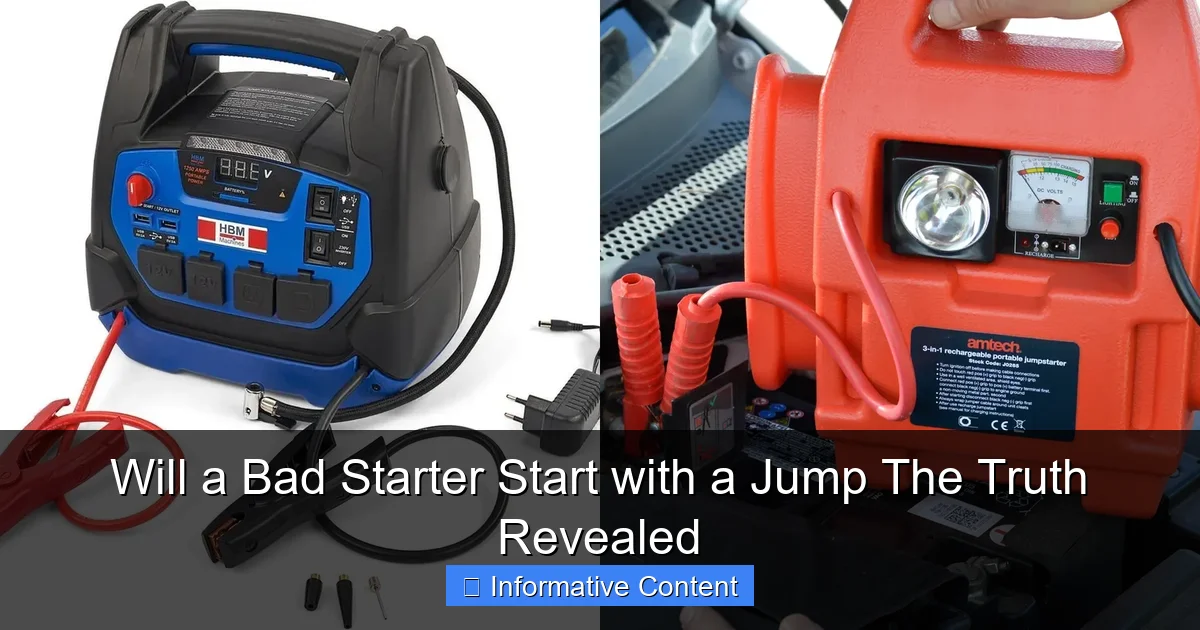
Jump-starting works by transferring electrical power from a good battery (usually in another vehicle or a portable jump starter) to a weak or dead battery. This boost provides enough voltage to power the starter motor and ignition system. The process typically involves connecting jumper cables in a specific order (positive to positive, negative to ground) to avoid sparks and electrical damage.
But here’s the catch: Jump-starting only works if the battery is the weak link. If the battery can’t hold a charge or has a short circuit, a jump gives it a temporary lifeline. However, if the starter motor, solenoid, or related wiring is damaged, the extra power won’t make a difference. It’s like giving a dehydrated person a glass of water when they actually have a broken leg—the symptom (not starting) might look similar, but the cause is different.
When a Jump Might Help a Failing Starter (Yes, It’s Possible!)
Now, before you write off jump-starting entirely, there’s a nuance: a jump can sometimes help a failing starter—but only in specific cases. Here’s when it might work:
- Low battery voltage is masking a weak starter: A starter motor needs a minimum voltage (usually around 9.6 volts) to operate. If the battery is weak, it might not provide enough voltage, making the starter appear dead. A jump can restore voltage, allowing the starter to function—at least temporarily.
- Corroded or loose connections: Sometimes, the issue isn’t the starter itself but the wiring between the battery and starter. A jump can overcome resistance in the cables, delivering more power to the starter.
- Starter motor brushes are worn but not completely failed: In older starters, worn brushes can cause inconsistent performance. A strong jolt of power from a jump might be enough to get them working one last time.
For example, my friend once had a starter that would only work after a jump. We tested the battery—it was holding a charge, but the voltage was low (around 11 volts, when it should be 12.6). After a jump, the starter cranked just fine. We replaced the battery, and the starter worked normally for another six months before finally failing completely. In that case, the jump was a temporary fix for a battery issue that was stressing an already weak starter.
When a Jump Won’t Help: The Real Reasons a Bad Starter Won’t Start
Internal Starter Motor Failure
If the starter motor’s internal components—like the armature, commutator, or windings—are damaged, no amount of external power will fix it. This is the most common reason a jump fails. The motor might have a short circuit, an open winding, or worn brushes that can’t make contact. In these cases, the starter is essentially a dead weight.
I once had a customer who insisted on jumping his car three times before finally calling me. The battery tested fine, and the jump provided plenty of power—but the engine still wouldn’t crank. When I opened the starter, I found that the armature was seized due to moisture corrosion. No jump in the world could’ve fixed that. The only solution was a full starter replacement.
Faulty Solenoid or Electrical Connections
The starter solenoid is the relay that connects the battery to the starter motor when you turn the key. If the solenoid is stuck, burned out, or has poor electrical contact, power won’t reach the motor—even with a jump. Similarly, damaged wiring, corroded terminals, or a blown fuse in the starter circuit can prevent the starter from receiving power.
Here’s a quick diagnostic tip: Listen for the solenoid click. When you turn the key, you should hear a single, sharp click from the starter area. If you hear nothing, the solenoid isn’t engaging. If you hear multiple clicks, it might be a weak battery or bad connections. If you hear one click but no cranking, the solenoid might be working, but the motor isn’t.
Mechanical Failure: Flywheel or Starter Gear Issues
Sometimes, the problem isn’t electrical at all. The starter gear (called the bendix) might be damaged, or the flywheel teeth could be broken or worn. In these cases, the starter motor spins freely but can’t engage with the engine. A jump won’t help because the issue is mechanical, not electrical.
I once worked on a truck that had a starter that spun but wouldn’t crank the engine. We replaced the starter, and the new one did the same thing. After further inspection, we found that three flywheel teeth were missing—likely due to a previous starter replacement that was misaligned. The fix required removing the transmission to access the flywheel, which was a major job. No jump would’ve saved that situation.
Real-World Scenarios: Jump-Starting a Bad Starter (Success vs. Failure)
Case Study 1: The Jump That Worked (Temporarily)
Vehicle: 2008 Honda Civic
Symptoms: No crank, rapid clicking
Battery voltage: 11.2 volts (low)
Jump result: Engine cranked and started
Diagnosis: Weak battery masking a failing starter solenoid
In this case, the jump provided enough voltage to overcome the weak solenoid. The car started, but the owner reported that the starter became noisier over the next two weeks. A follow-up test revealed that the solenoid contacts were pitted. The jump was a temporary fix, but the starter needed replacement soon after.
Case Study 2: The Jump That Failed (Permanently)
Vehicle: 2012 Ford F-150
Symptoms: No crank, no click
Battery voltage: 12.6 volts (good)
Jump result: No change
Diagnosis: Burned-out starter motor windings
Despite a strong battery and a successful jump, the starter remained unresponsive. We removed the starter and bench-tested it—spinning it with jumper cables showed no resistance, indicating an open circuit in the windings. The motor was completely dead. No jump could’ve revived it.
Case Study 3: The Intermittent Starter
Vehicle: 2015 Toyota Camry
Symptoms: Car starts fine in the morning but won’t start after a short drive
Battery voltage: 12.4 volts (good)
Jump result: Sometimes works, sometimes doesn’t
This is a classic sign of a starter with heat-sensitive failure. The starter works when cold but fails when hot—a common issue with failing internal components. A jump might work once, but the problem will return. The fix? Replace the starter before it fails completely.
How to Diagnose a Bad Starter (And Avoid Wasting Time on a Jump)
Step 1: Check the Battery First
Always start with the battery. Use a multimeter to check the voltage:
- 12.6+ volts: Battery is good
- 11.8–12.5 volts: Battery is weak—charge or replace
- Below 11.8 volts: Battery is likely dead
Even if the battery looks fine, try a jump. If the car starts, the battery was the issue. If not, move to the next step.
Step 2: Listen for Clicks and Check Connections
Turn the key and listen:
- No click: Check battery connections, fuse box, and starter relay
- Single click: Solenoid is engaging, but motor isn’t—likely a bad starter
- Rapid clicking: Usually a weak battery or poor connections
Inspect the starter wiring for corrosion, looseness, or damage. Tighten all connections and clean terminals with a wire brush.
Step 3: Test the Starter Directly
If you’re handy with tools, you can test the starter directly:
- Locate the starter (usually near the transmission)
- Use a jumper wire to connect the battery’s positive terminal to the starter’s main terminal
- Touch the starter’s smaller terminal (solenoid wire) with the other end of the jumper
- Warning: This bypasses the ignition switch—only do this if you’re experienced!
If the starter cranks the engine, the problem is in the ignition switch or wiring. If it doesn’t, the starter is likely dead.
Step 4: Tap the Starter (Old-School Trick)
Sometimes, a stuck starter can be freed by tapping it with a hammer while someone turns the key. This works if the starter motor is stuck due to worn brushes or a stuck armature. It’s not a permanent fix, but it can get you to the repair shop.
| Symptom | Likely Cause | Jump Likely to Help? |
|---|---|---|
| No crank, rapid clicking | Weak battery or connections | Yes |
| No crank, single click | Bad starter solenoid | Sometimes (if voltage is low) |
| No crank, no click | Dead starter motor or bad wiring | No |
| Grinding noise | Worn starter gear or flywheel | No |
| Intermittent starting | Failing starter or heat-sensitive components | Rarely |
Final Thoughts: The Verdict on Jump-Starting a Bad Starter
So, will a bad starter start with a jump? The answer is: it depends. A jump can help if the starter is failing due to low voltage, poor connections, or a weak solenoid—but only as a temporary fix. If the starter motor itself is damaged, the solenoid is dead, or there’s a mechanical issue like a broken flywheel, a jump won’t save the day.
The key is diagnosis. Don’t assume the battery is always the culprit. Listen to the sounds, check the voltage, and inspect the connections. If a jump doesn’t work, don’t keep trying—you’re just wasting time and risking further damage. Instead, focus on testing the starter directly or having it professionally diagnosed.
From personal experience, I’ve learned that the best approach is a balanced one: try a jump if the battery is weak, but don’t rely on it as a cure-all. Keep a multimeter and jumper cables in your car, but also know when to call a mechanic. A bad starter is a repair job, not a jump-start fix. And if you’re ever in doubt, remember: it’s better to spend a little on diagnostics now than a lot on a tow and a full replacement later.
At the end of the day, your car’s starter is a critical component—don’t ignore the signs. Whether it’s a jump, a tap, or a full replacement, addressing the problem early can save you time, money, and a lot of frustration. So next time your engine won’t start, take a breath, check the battery, and remember: sometimes, the truth is under the hood—not in the jumper cables.
Frequently Asked Questions
Will a bad starter start with a jump if the battery is fully charged?
Yes, a bad starter *might* start with a jump if the issue is low voltage, as the extra power can overcome weak internal resistance. However, if the starter motor or solenoid is damaged, a jump won’t help—the root problem remains. Diagnose further if jumping fails repeatedly.
Can a jump-start temporarily fix a failing starter?
A jump-start can temporarily revive a weak starter by providing higher voltage, but it’s not a long-term solution. If the starter is failing mechanically or electrically, the problem will likely return. Use a jump as a short-term workaround, not a repair.
Why does my car start with a jump but not with the key?
This often points to a weak battery or poor connection, but if the starter is failing, it may need extra voltage (from a jump) to engage. A bad starter with worn brushes or a failing solenoid can behave this way—get it tested to confirm.
Is it safe to jump-start a car with a bad starter?
Yes, it’s generally safe to jump-start a car with a bad starter, but avoid excessive attempts. Repeated jumping can strain the battery, alternator, or electrical system. If the starter doesn’t engage after 1–2 tries, seek professional help.
What’s the difference between a bad starter and a dead battery when jump-starting?
A dead battery will start after a jump, but a bad starter may still struggle even with extra power—listen for clicking (starter issue) vs. rapid cranking (battery issue). A bad starter often requires replacement, while a dead battery may just need a recharge.
How many times can I jump-start a car with a bad starter before causing damage?
Limit jump attempts to 1–2 tries to avoid overheating the starter or damaging the electrical system. If the car doesn’t start, the starter likely needs replacement. Repeated jumping risks costly collateral damage to wiring or the alternator.