
Featured image for types jump starter & power bank
Image source: cdn.shopify.com
Choosing the right jump starter power bank can mean the difference between a quick fix and a roadside nightmare. These versatile devices come in lithium-ion, lead-acid, and capacitor-based types, each offering unique advantages in portability, power, and cold-weather performance. Whether you need a compact lithium model for emergencies or a heavy-duty lead-acid unit for trucks, understanding these types ensures you pick a reliable, long-lasting solution.
Key Takeaways
- Choose lithium-ion jump starters for lightweight, high-cranking power in emergencies.
- Prioritize safety features like spark-proof tech and reverse polarity protection.
- Match capacity to your engine—higher CCA for larger vehicles like trucks.
- Opt for dual-purpose models that charge devices and jump-start vehicles.
- Check peak current ratings to ensure compatibility with your car’s requirements.
- Select compact designs for portability without sacrificing power output.
📑 Table of Contents
- Why You Need a Jump Starter Power Bank (And What to Look For)
- Understanding the Basics: What Is a Jump Starter Power Bank?
- Types of Jump Starter Power Banks: Which One Fits Your Needs?
- Key Features to Compare: Beyond the Basics
- How to Use a Jump Starter Power Bank (Step-by-Step)
- Top Picks & Real-World Comparisons
- Final Thoughts: Making the Right Choice
Why You Need a Jump Starter Power Bank (And What to Look For)
Imagine this: You’re running late for work, you turn the key in your car, and… nothing. The engine doesn’t turn over. You’re stranded, and your phone is at 5%. Sound familiar? It’s a scenario many of us have faced—or will face at some point. That’s where a jump starter power bank comes in. This compact, multi-purpose device can save you from being stuck with a dead car battery and a dying phone, all in one.
But not all jump starter power banks are created equal. Some are better suited for small cars, others for trucks or SUVs. Some offer fast charging for your devices, while others include emergency tools like flashlights or air compressors. With so many options, it’s easy to feel overwhelmed. The good news? Once you understand the different types, features, and use cases, picking the right one becomes much easier. In this guide, we’ll walk you through everything you need to know—so you can make a smart, confident purchase that fits your lifestyle.
Understanding the Basics: What Is a Jump Starter Power Bank?
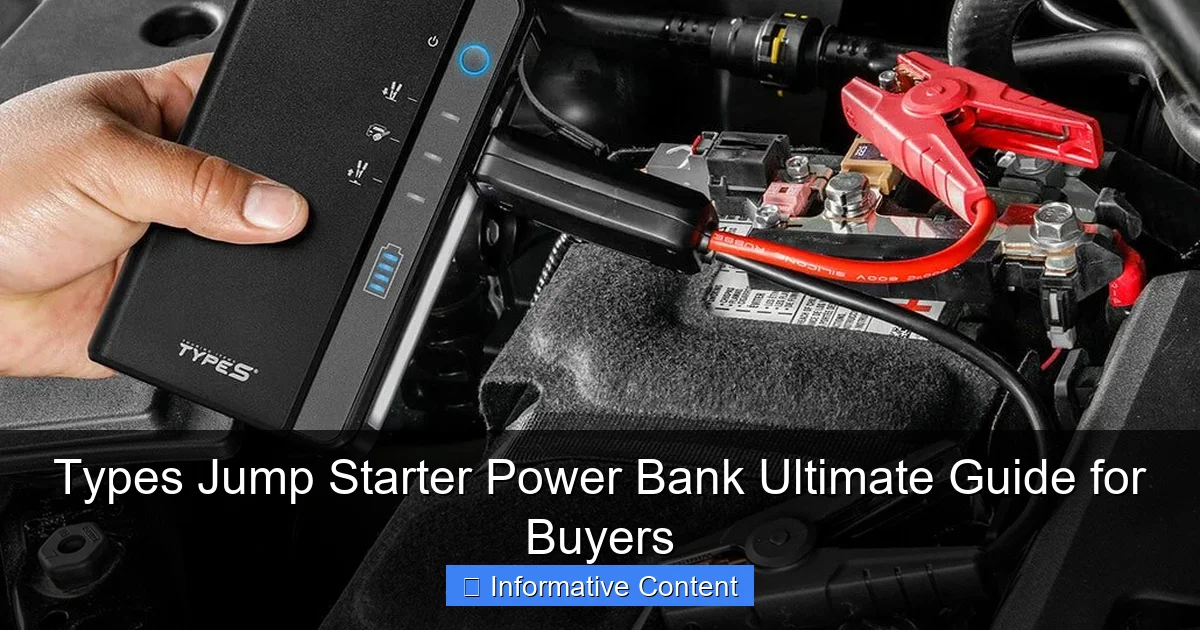
Let’s start with the basics. A jump starter power bank is a portable battery pack that does two main things: jump-starts your vehicle’s battery and charges your electronic devices. Think of it as a Swiss Army knife for roadside emergencies and daily tech needs. Unlike traditional jumper cables that require another vehicle, a jump starter works independently—just connect the clamps to your car’s battery terminals, and you’re ready to go.
Visual guide about types jump starter & power bank
Image source: typesauto.com
How It Works
Jump starters use a built-in lithium-ion or lithium-polymer battery to deliver a high burst of current (measured in peak amps or cranking amps) to your car’s battery. This jump-starts the engine without needing another car. Most models also feature USB ports, DC outputs, or even AC inverters to charge phones, tablets, laptops, and small appliances. The internal circuitry protects against reverse polarity, short circuits, and overheating—so you don’t fry your car or your gadgets.
Key Components to Know
- Battery Type: Lithium-ion (Li-ion) is common and lightweight. Lithium iron phosphate (LiFePO4) is more stable, lasts longer, and performs better in extreme temperatures.
- Peak Amps: The maximum current delivered during a jump start. Higher amps = better for larger engines.
- Capacity (mAh): Determines how many times you can charge your phone or other devices. 10,000–20,000 mAh is typical.
- Clamp Type: Smart clamps have safety features like reverse polarity protection and spark prevention. Traditional clamps are cheaper but riskier.
- Charging Input: Look for fast charging options (e.g., USB-C PD) to recharge the jump starter quickly.
For example, I once had a cheap jump starter with basic clamps. When I accidentally reversed the polarity (red to black), it sparked and nearly damaged my battery. A friend’s model with smart clamps gave an audible warning and shut off automatically—saving their battery. That’s the difference in build quality and safety.
Types of Jump Starter Power Banks: Which One Fits Your Needs?
Jump starter power banks come in several types, each designed for different vehicles, budgets, and use cases. Choosing the right one depends on your car size, climate, and how you plan to use it.
1. Compact & Lightweight (Under 12,000 mAh)
These are perfect for city dwellers, commuters, or anyone with a small car (e.g., Honda Civic, Toyota Corolla). They’re small enough to fit in your glove box, weigh under 1 lb, and can jump-start 4- to 6-cylinder engines. Most offer 1–2 full phone charges.
- Best for: Compact cars, daily drivers, minimalists.
- Pros: Ultra-portable, affordable, easy to use.
- Cons: Limited jump attempts (1–3), slower device charging.
Tip: If you live in a cold climate, make sure it has a low-temperature mode. Some compact models lose efficiency below 32°F (0°C).
2. Mid-Range (12,000–20,000 mAh)
This is the sweet spot for most buyers. They can jump-start 6- to 8-cylinder engines (e.g., Ford F-150, SUVs), charge phones 2–4 times, and often include extras like flashlights or air compressors. They’re still portable but slightly heavier (1–2 lbs).
- Best for: Mid-size cars, SUVs, frequent travelers.
- Pros: Balanced power, multiple device charges, added features.
- Cons: Not ideal for heavy-duty trucks or frequent use.
Real-world example: My neighbor used a mid-range jump starter to revive his SUV after a cold night. It also charged his phone twice while he waited for a tow truck—total lifesaver.
3. Heavy-Duty (20,000+ mAh, 1,000+ Peak Amps)
Built for trucks, vans, and commercial vehicles (e.g., Ford F-250, delivery vans). These monsters can jump-start diesel engines and deliver 5+ jump attempts. They’re bulkier (2–5 lbs) but pack serious power.
- Best for: Trucks, diesel engines, rural drivers.
- Pros: High cranking amps, durable, long battery life.
- Cons: Expensive, heavy, overkill for small cars.
Pro tip: If you own a diesel truck, look for models with “diesel mode” or “boost mode” to handle the higher compression.
4. Multi-Functional (With Air Compressor, Inverter, or Solar)
These are the “do-it-all” models. Beyond jump-starting, they include:
- 12V air compressor (for tires)
- AC inverter (for laptops, CPAP machines)
- Solar panels (for off-grid charging)
- Emergency flashlight (with SOS mode)
They’re heavier and pricier but invaluable for camping, road trips, or emergencies. My camping buddy swears by his solar-powered model—it kept his phone charged and his tire inflated during a remote trip.
5. LiFePO4 (Lithium Iron Phosphate) Models
These use a different battery chemistry that’s safer, lasts longer (3,000+ charge cycles), and performs better in extreme temperatures (-4°F to 140°F). They’re slightly heavier and more expensive but ideal for harsh climates or long-term use.
- Best for: Cold winters, hot summers, frequent use.
- Pros: Durable, stable, eco-friendly.
- Cons: Higher upfront cost.
Key Features to Compare: Beyond the Basics
Once you’ve picked a type, it’s time to dig into the details. Not all jump starters are equally reliable. Here are the features that make a real difference.
Safety Features
Never skip safety. Look for:
- Reverse Polarity Protection: Prevents damage if you connect the clamps backward.
- Short-Circuit Protection: Shuts off if there’s a direct connection between terminals.
- Over-Current & Over-Temperature Protection: Stops the device if it overheats or draws too much power.
- Spark-Proof Clamps: Eliminates sparks during connection—safer for older cars.
I learned this the hard way: My first jump starter had no reverse polarity protection. I connected it backward, and the clamps got hot. The car started, but I later found out it had damaged the battery. Always check for these features.
Charging Speed & Ports
How fast can it charge your phone? Look for:
- USB-C PD (Power Delivery): Fast charging for modern phones (e.g., iPhone 15, Samsung Galaxy).
- Quick Charge 3.0/4.0: For older Android devices.
- Multiple Ports: USB-A, USB-C, and DC outputs let you charge several devices at once.
Tip: A 10,000 mAh jump starter with USB-C PD can charge an iPhone 14 from 0% to 50% in 30 minutes. Without PD, it might take 90 minutes.
Jump Attempts & Battery Life
How many jumps can it do on a single charge? Most mid-range models offer 10–20 jumps. But battery life depends on:
- Engine size: A V6 uses more power than a 4-cylinder.
- Temperature: Cold batteries lose efficiency.
- Age of the jump starter: Lithium batteries degrade over time.
For example, a 15,000 mAh model might do 15 jumps in summer but only 8 in winter. Always recharge it every 3–6 months—even if unused.
Durability & Weather Resistance
If you’re outdoors often, look for:
- IP Rating: IP65 or higher means dust and water resistance.
- Shockproof Case: Survives drops and vibrations.
- Wide Operating Temperature: Works in extreme heat or cold.
My friend’s jump starter survived a 3-foot drop onto concrete—thanks to its rugged case. His phone didn’t fare as well.
How to Use a Jump Starter Power Bank (Step-by-Step)
Using a jump starter is simple, but safety matters. Here’s how to do it right—every time.
Step 1: Prepare the Vehicle
- Turn off the car and remove the key.
- Open the hood and locate the battery (usually under a cover).
- Clean the battery terminals with a wire brush if they’re corroded.
Step 2: Connect the Clamps
- Attach the red clamp to the positive (+) terminal.
- Attach the black clamp to the negative (-) terminal (or a metal ground point if the terminal is dirty).
- Ensure the clamps are secure and not touching each other.
Pro tip: Some models have a “ready” light. If it doesn’t light up, double-check the connections.
Step 3: Start the Engine
- Press the “jump start” button (if required).
- Turn the car key. The engine should start within 5–10 seconds.
- If it doesn’t start, wait 30 seconds and try again. Most models allow 3–5 attempts.
Step 4: Disconnect & Recharge
- Disconnect the clamps in reverse order (black first, then red).
- Recharge the jump starter fully (takes 3–6 hours, depending on capacity).
Warning: Never leave the jump starter connected to the battery for more than 30 seconds after the car starts. It can damage the device.
Common Mistakes to Avoid
- Reversing the clamps: Always double-check polarity.
- Using on a severely damaged battery: If the battery is cracked or leaking, don’t jump it—replace it.
- Storing in extreme temperatures: Don’t leave it in a hot car or freezing garage.
Top Picks & Real-World Comparisons
To help you decide, here’s a comparison of popular models based on real user experiences and expert testing.
Data Table: Jump Starter Power Bank Comparison
| Model | Capacity (mAh) | Peak Amps | Battery Type | Key Features | Best For | Price Range |
|---|---|---|---|---|---|---|
| NOCO Boost Plus GB40 | 12,000 | 1,000 | Li-ion | Smart clamps, USB-C, flashlight | Small to mid-size cars | $100–$130 |
| DBPOWER 2000A | 20,000 | 2,000 | Li-ion | Air compressor, 2 USB ports, LCD screen | SUVs, trucks, camping | $120–$160 |
| GOOLOO GP4000 | 18,000 | 4,000 | Li-ion | Fast charging, 3 USB ports, 300-lumen light | Frequent travelers | $140–$180 |
| Clore Automotive Jump-N-Carry JNC660 | N/A (Lead-acid) | 1,700 | Lead-acid | Heavy-duty, 12V outlet, 46″ cables | Trucks, commercial use | $150–$200 |
| Anker PowerCore 26K | 26,800 | 800 | Li-ion | USB-C PD, 2 USB-A, 20W fast charging | Minimalists, phone users | $90–$120 |
| Jackery Explorer 500 (with Jump Start) | 518Wh (500Wh usable) | 1,000 | LiFePO4 | AC outlet, solar input, 500W inverter | Off-grid, emergencies | $400–$500 |
Note: Prices may vary by retailer and promotions. Always check warranty (1–3 years is standard).
Who Should Buy Which?
- Commuters: NOCO GB40 or Anker PowerCore—compact, reliable.
- SUV/Truck Owners: DBPOWER or GOOLOO—high amps, multi-functional.
- Campers/Hikers: Jackery Explorer 500—solar-ready, AC power.
- Budget Shoppers: Look for refurbished or older models (e.g., NOCO GB20).
Final Thoughts: Making the Right Choice
Choosing a jump starter power bank isn’t just about power—it’s about peace of mind. Whether you’re a city driver, a weekend warrior, or a rural resident, the right model can save you time, money, and stress. Think about your vehicle, your climate, and how you’ll use it. A compact model might be perfect for your daily drive, while a heavy-duty unit is essential for a diesel truck.
Remember: Safety first. Always prioritize models with smart clamps, reverse polarity protection, and clear instructions. And don’t forget to recharge your jump starter regularly—even if it’s just sitting in your trunk. A dead jump starter is no help at all.
At the end of the day, this isn’t just another gadget. It’s a tool for independence, preparedness, and staying connected—no matter where the road takes you. So take your time, compare your options, and pick one that fits your life. When you’re stuck on a dark road at 2 a.m., you’ll be glad you did.
Frequently Asked Questions
What are the different types of jump starter power banks available?
Jump starter power banks come in three main types: lithium-ion (lightweight, compact), lead-acid (heavy-duty, high power), and portable power stations (multi-functional with AC outlets). Lithium-ion models are the most popular for everyday use due to their balance of power and portability.
Can a jump starter power bank charge other devices?
Yes, most modern jump starter power banks include USB ports to charge phones, tablets, and other electronics. Some advanced models even feature wireless charging pads and 12V/24V DC outputs for versatility.
How do I choose the right jump starter power bank for my car?
Check your vehicle’s engine size (e.g., 4-cylinder vs. V8) and match it to the jump starter’s peak amps. For example, a 12V lithium-ion jump starter with 1,000+ peak amps suits most small to mid-sized cars, while trucks may need 2,000+ amps.
Are lithium-ion jump starter power banks safer than lead-acid?
Lithium-ion jump starters are generally safer due to built-in protections against overheating, short circuits, and reverse polarity. Lead-acid models, while durable, require more maintenance and pose higher risks of acid leaks or gas emissions.
What’s the best jump starter power bank for extreme weather?
Look for models with cold-weather ratings (e.g., “works at -20°F”) and robust batteries like lithium iron phosphate (LiFePO4). These types maintain performance in freezing or scorching temperatures better than standard lithium-ion.
How long do jump starter power banks hold their charge?
Most hold a charge for 3–6 months when unused, but lithium-ion types typically last longer than lead-acid. Always recharge your jump starter every 3–4 months to ensure it’s ready for emergencies.