
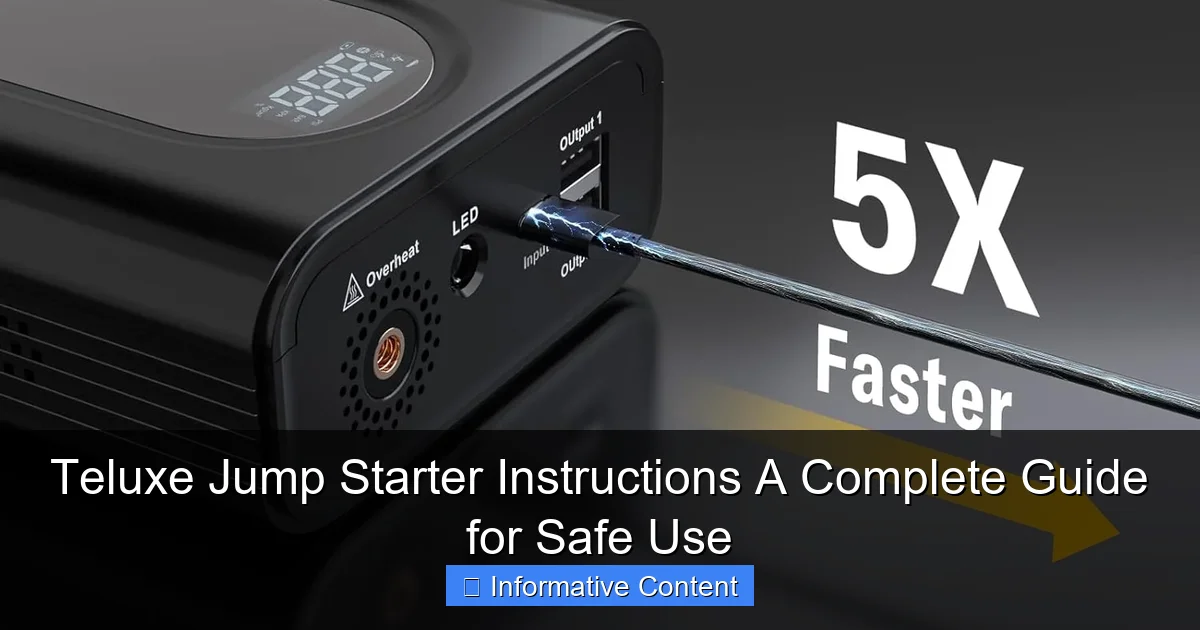
Featured image for teluxe jump starter instructions
Image source: autoboosting.com
Always read the Teluxe jump starter instructions thoroughly before use to ensure safe and effective operation. This guide walks you through every step—from connecting the clamps correctly to jump-starting your vehicle without risk of sparks or damage. Following the manufacturer’s guidelines helps prevent accidents and prolongs the life of your device.
Key Takeaways
- Always inspect cables for damage before connecting the Teluxe jump starter.
- Turn off the vehicle and accessories before jump-starting for safety.
- Follow polarity order: red to positive, black to negative terminals.
- Wait 30 seconds after connection before attempting to start the engine.
- Recharge after use to maintain battery health and readiness.
- Store in a cool, dry place to extend the jump starter’s lifespan.
📑 Table of Contents
- Why Every Driver Should Keep a Teluxe Jump Starter in Their Car
- Understanding Your Teluxe Jump Starter: What’s in the Box?
- Step-by-Step Teluxe Jump Starter Instructions for Jump-Starting a Vehicle
- Safety First: Critical Precautions When Using Your Teluxe Jump Starter
- Beyond Jump-Starting: Other Useful Functions of the Teluxe
- Maintenance, Storage, and Troubleshooting: Keeping Your Teluxe Ready
- Conclusion: Your Teluxe Jump Starter Is Only as Good as Your Knowledge
Why Every Driver Should Keep a Teluxe Jump Starter in Their Car
Imagine this: You’re late for a meeting, the rain is pouring, and you turn the key in your ignition—only to hear that dreaded click-click-click of a dead battery. It’s a scenario we’ve all faced or feared. That’s where the Teluxe jump starter comes in—a compact, powerful, and reliable tool that can save you from being stranded. Unlike traditional jumper cables that require another vehicle, the Teluxe jump starter is a self-contained powerhouse. It’s like having a portable superhero for your car, ready to jump-start your engine with just a few simple steps.
But owning a Teluxe jump starter is only half the battle. Knowing how to use it safely and effectively is what separates a smooth recovery from a potential hazard. Whether you’re a seasoned driver or a new car owner, understanding the Teluxe jump starter instructions is crucial. This guide will walk you through everything—from unboxing and charging to jump-starting your vehicle and troubleshooting common issues. Think of it as your personal cheat sheet for staying prepared, safe, and confident on the road.
Understanding Your Teluxe Jump Starter: What’s in the Box?
Before you even think about reviving a dead battery, it’s essential to get familiar with your Teluxe jump starter and its components. Unboxing your device should feel like meeting a new teammate—each part has a role to play.

Visual guide about teluxe jump starter instructions
Image source: mddcprint.com
What Comes with Your Teluxe Jump Starter?
Most Teluxe models come with the following:
- Jump starter unit – The main device, usually compact and lightweight (around 1–2 pounds)
- Smart jumper cables (clamps) – Heavy-duty, color-coded (red for positive, black for negative), with built-in safety features
- USB charging cable – For recharging the jump starter via wall adapter or USB port
- Wall charger and car charger – So you can charge at home or on the go
- Carrying case – Keeps everything organized and protected
- User manual – Always keep this handy; it includes model-specific Teluxe jump starter instructions
Key Features to Know Before Use
Not all jump starters are created equal. The Teluxe stands out for several reasons:
- High peak current (e.g., 1200–2000A) – Enough to start most 12V vehicles, including SUVs, trucks, and even small boats
- Built-in safety protections – Reverse polarity, short circuit, over-voltage, and over-current protection
- LED flashlight with SOS mode – A lifesaver in emergencies or dark parking lots
- USB ports for charging phones, tablets, or GPS – Turns your jump starter into a power bank
- Digital display – Shows battery percentage, voltage, and error codes (on advanced models)
Pro Tip: Take 10 minutes to read the manual thoroughly. Even if you’ve used other jump starters, Teluxe models may have unique features or button sequences. For example, some require you to press and hold the power button for 3 seconds to activate jump mode—skipping this step could lead to confusion when the device doesn’t respond.
Step-by-Step Teluxe Jump Starter Instructions for Jump-Starting a Vehicle
Now that you know your device, let’s get to the heart of the matter: how to use your Teluxe jump starter to bring a dead battery back to life. Follow these steps carefully—safety first, always.
Step 1: Prepare the Vehicle and Environment
Before connecting anything, ensure your surroundings are safe:
- Park the vehicle on a flat, dry surface away from traffic
- Turn off the ignition, headlights, radio, and all accessories
- Engage the parking brake and, if possible, place wheel chocks behind the tires
- Wear safety glasses and gloves (optional but recommended)
Real-Life Example: Sarah, a college student, once tried to jump-start her car in a busy mall parking lot. She forgot to turn off her radio and phone charger. The surge damaged her car’s ECU. Lesson learned: always power down completely.
Step 2: Charge the Teluxe Jump Starter
Never attempt to jump-start with a low battery. Your Teluxe device should be at least 50% charged, though 80–100% is ideal. Here’s how to charge it:
- Use the included USB cable and wall charger
- Plug into a standard 110V outlet
- Charging time: 3–5 hours (varies by model and battery level)
- Check the LED indicators or digital display for charge status
Tip: Charge your jump starter monthly, even if unused. Lithium-ion batteries degrade over time when left uncharged.
Step 3: Connect the Jumper Cables (Correct Order!)
This is where most mistakes happen. Follow the sequence exactly:
- Connect RED clamp to the positive (+) terminal on the dead battery
- Connect BLACK clamp to a grounded metal surface—not the negative (-) battery terminal. Use an unpainted metal part of the engine block or chassis. Why? To prevent sparks near the battery, which could ignite hydrogen gas.
- Double-check the connections—no loose wires, no touching clamps
Warning: If the Teluxe has a safety alarm, it will beep if connections are reversed. Never bypass this feature.
Step 4: Power On and Wait
Now it’s time to activate the jump starter:
- Press and hold the power button for 3–5 seconds until the LED lights up
- On models with a digital display, wait for “Ready” or “Jump Start” to appear
- Wait 30–60 seconds—this allows the jump starter to transfer power to the battery
Step 5: Start the Engine
Turn the key in the ignition. If the engine doesn’t start on the first try:
- Wait 15–30 seconds
- Try again
- Limit attempts to 3–4 to avoid overheating the jump starter
Pro Tip: If the engine turns over slowly, wait another minute for the jump starter to recharge the battery slightly.
Step 6: Disconnect in Reverse Order
Once the engine is running, disconnect safely:
- Turn off the jump starter (press and hold power button)
- Remove BLACK clamp first from the ground point
- Remove RED clamp from the positive terminal
- Stow cables neatly in the case
Let the engine run for 15–20 minutes to recharge the battery. If it dies again shortly after, the battery may be permanently damaged and need replacement.
Safety First: Critical Precautions When Using Your Teluxe Jump Starter
Jump-starting a car isn’t just about following steps—it’s about respecting the power involved. A 12V car battery can deliver hundreds of amps, and mistakes can lead to sparks, explosions, or damage to your vehicle’s electronics.
Top 5 Safety Rules You Must Follow
- Never connect red to black or black to red – Reverse polarity can fry your jump starter or car’s ECU
- Keep the jump starter dry – Water and electricity don’t mix. Avoid using in heavy rain unless the device is rated IP67 (waterproof)
- Don’t use on damaged or leaking batteries – Corrosion, cracks, or bulging mean the battery is unsafe. Replace it first
- Never leave the jump starter connected for more than 30 seconds after starting – Prolonged connection can overheat the unit
- Store in a cool, dry place – Avoid temperatures below -4°F or above 140°F. Extreme heat can degrade lithium batteries
What to Do If You Encounter an Error
Teluxe jump starters often have built-in diagnostics. Here’s how to interpret common alerts:
- Rapid beeping or flashing red LED: Reverse polarity or poor connection. Recheck clamps
- “Low Voltage” on display: Dead battery is too far gone. Try charging the jump starter fully and retrying
- “Overheat” warning: Let the unit cool for 10–15 minutes before retrying
- No response when pressing power: Battery is critically low. Recharge for at least 1 hour
Real-Life Example: Mark, a mechanic, once ignored a “Low Voltage” warning. He forced the jump start, and the Teluxe shut down. The battery was so dead it required a full replacement. The takeaway? Listen to your device—it’s smarter than you think.
Beyond Jump-Starting: Other Useful Functions of the Teluxe
The Teluxe jump starter isn’t just for emergencies. It’s a multi-tool for modern drivers. Here’s how to make the most of its extra features.
Using the LED Flashlight
Most Teluxe models include a bright LED flashlight with multiple modes:
- Standard beam: For general use
- Strobe: For visibility in fog or rain
- SOS mode: Flashes in a universal distress signal (three short, three long, three short)
Tip: Test the flashlight monthly. A dead jump starter flashlight defeats the purpose in a power outage.
Charging Your Devices On the Go
Got a dying phone or GPS? The USB ports come to the rescue:
- Use the USB-A or USB-C port (depending on model)
- Connect your device’s charging cable
- Press the “Power Bank” button (if separate)
Note: Charging devices drains the jump starter’s battery. A 10,000mAh model can charge a smartphone 2–3 times, but it will leave less power for jump-starting. Balance your needs.
Air Compressor Add-On (Select Models)
Some Teluxe models include a built-in air compressor for inflating tires. To use:
- Attach the nozzle to the tire valve
- Set the desired PSI (usually 30–35 for cars)
- Press start and wait
- Monitor the display until it shuts off automatically
Pro Tip: Check your tire pressure monthly. Underinflated tires reduce fuel efficiency and increase wear.
Maintenance, Storage, and Troubleshooting: Keeping Your Teluxe Ready
Like any tool, your Teluxe jump starter needs care to stay reliable. Neglect it, and you might find it useless when you need it most.
Monthly Maintenance Checklist
| Task | Frequency | Details |
|---|---|---|
| Charge the battery | Every 30 days | Even if unused. Prevents deep discharge |
| Inspect clamps and cables | Monthly | Look for fraying, corrosion, or loose connections |
| Test the flashlight | Monthly | Ensure all modes work |
| Clean the unit | As needed | Wipe with a dry cloth. Avoid liquids |
| Update firmware (if applicable) | Annually | Check Teluxe’s website for updates |
Storage Tips for Longevity
- Store at 40–80% charge – Ideal for long-term storage
- Keep in the carrying case – Protects from dust, moisture, and physical damage
- Avoid extreme temperatures – Don’t leave in a hot trunk or freezing garage
- Keep away from metal objects – Prevents accidental short circuits
Common Issues and Fixes
- Device won’t turn on: Try charging for 2+ hours. If still unresponsive, contact support
- Clamps spark when connected: Check for reverse polarity. Ensure the black clamp is on bare metal, not the battery terminal
- Jump start fails repeatedly: The car battery may be beyond recovery. Consider replacing it
- USB ports not working: Try a different cable. Some ports only work when the device is powered on
Real-Life Example: Lisa stored her Teluxe in her trunk for six months without charging. When her battery died, the jump starter had only 5% charge and couldn’t start the engine. She now charges it monthly—no more surprises.
Conclusion: Your Teluxe Jump Starter Is Only as Good as Your Knowledge
You’ve now got the full rundown on Teluxe jump starter instructions—from unboxing to emergency use and beyond. But here’s the truth: a jump starter sitting in your trunk is only as useful as your ability to use it correctly. This guide isn’t just a one-time read. Keep it bookmarked, share it with family, and review the steps before every long trip.
Remember, safety is paramount. Follow the connection order, respect the warnings, and maintain your device. The Teluxe isn’t magic—it’s a tool. And like any tool, it shines brightest when you know how to wield it. Whether you’re jump-starting a car, charging your phone in a blackout, or lighting the way during a roadside breakdown, your Teluxe has your back.
So next time you hear that click-click-click, don’t panic. Grab your Teluxe, follow these steps, and get back on the road—confident, prepared, and in control. Because when it comes to car emergencies, knowledge isn’t just power. It’s peace of mind.
Frequently Asked Questions
How do I use the Teluxe jump starter for the first time?
Before using your Teluxe jump starter, fully charge it using the provided adapter. Connect the clamps to your car battery (red to positive, black to negative), then turn on the device and start your vehicle.
What safety precautions should I follow with Teluxe jump starter instructions?
Always wear protective gear and ensure the jump starter is turned off when connecting or disconnecting clamps. Avoid touching metal parts of the clamps together to prevent sparks or short circuits.
Can the Teluxe jump starter be used in extreme weather?
Yes, the Teluxe jump starter works in temperatures ranging from -4°F to 140°F (-20°C to 60°C). However, extreme cold may reduce battery efficiency, so store it in moderate conditions when possible.
How long does the Teluxe jump starter take to charge fully?
The Teluxe jump starter typically requires 4–6 hours to reach a full charge. Use the included USB-C or wall adapter for optimal charging speed and monitor the LED indicators.
Why isn’t my Teluxe jump starter turning on?
Check if the battery is drained and recharge it for at least 30 minutes. If the issue persists, inspect the power button or contact customer support for troubleshooting help.
Can I use the Teluxe jump starter to charge other devices?
Yes! The Teluxe jump starter features USB ports to charge phones, tablets, and other electronics. Ensure the jump starter has sufficient charge before using it as a power bank.