
Always connect the Scatach jump starter to a compatible 12V vehicle battery with correct polarity to ensure safe, effective starts. Follow the manufacturer’s step-by-step instructions—attach red to positive (+), black to negative (−), power on, start the engine, then disconnect in reverse order to prevent sparks or damage. This quick guide ensures reliable performance and extends your jump starter’s lifespan.
Key Takeaways
- Read the manual first: Always review Scatach jump starter instructions before use.
- Check battery levels: Ensure both vehicle and jump starter are charged.
- Connect cables properly: Attach red to positive, black to ground, never reverse.
- Power on safely: Turn on the jump starter only after connecting cables.
- Start the engine quickly: Attempt ignition within 30 seconds of powering on.
- Disconnect in order: Remove black first, then red after engine starts.
- Store correctly: Recharge and keep in a cool, dry place post-use.
📑 Table of Contents
- Why Every Driver Needs a Scatach Jump Starter (And How to Use It Right)
- Understanding Your Scatach Jump Starter: Features and Components
- Step-by-Step Scatach Jump Starter Instructions: Jump-Starting Your Car
- Beyond Jump-Starting: Using Your Scatach as a Multi-Tool
- Safety First: Essential Precautions and Troubleshooting
- Maximizing Battery Life and Long-Term Care
- Final Thoughts: Your Reliable Roadside Companion
Why Every Driver Needs a Scatach Jump Starter (And How to Use It Right)
Picture this: You’re late for work, it’s freezing cold, and your car won’t start. The battery’s dead, your jumper cables are buried in the trunk, and the nearest gas station is a mile away. We’ve all been there—frustrated, helpless, and praying for a miracle. That’s where a Scatach jump starter comes in. It’s not just another gadget; it’s a lifeline for modern drivers.
Unlike traditional jumper cables that rely on another vehicle, a Scatach jump starter is a compact, portable power bank designed to revive your car battery without assistance. No waiting for a Good Samaritan, no tangled cables, just a simple, safe jump start in minutes. But here’s the catch: Even the best tool fails if you don’t know how to use it. That’s why I’ve put together this complete guide to Scatach jump starter instructions, covering everything from setup to troubleshooting. Whether you’re a new owner or just brushing up on safety, let’s get you confident and ready.
Understanding Your Scatach Jump Starter: Features and Components
Before diving into the instructions, let’s break down what makes the Scatach jump starter special. Think of it as the Swiss Army knife of car emergencies—packed with features beyond just jump-starting.
Visual guide about scatach jump starter instructions
Image source: m.media-amazon.com
Key Features That Set It Apart
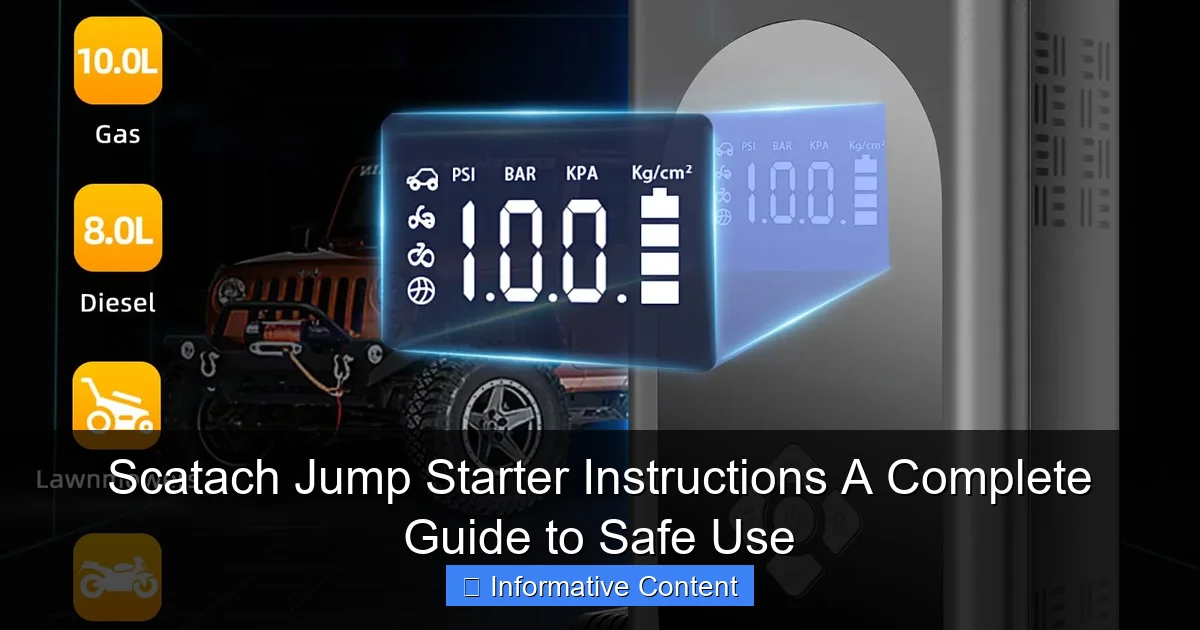
- High-Capacity Battery: Most Scatach models range from 12,000mAh to 20,000mAh, enough to jump-start cars, SUVs, and even small trucks (up to 7.0L gas or 5.0L diesel engines).
- Smart Safety Protections: Reverse polarity, short circuit, and over-current protection prevent damage to your vehicle or the device.
- Multi-Purpose Ports: USB-A/USB-C ports for charging phones, tablets, or even a laptop. Some models include a 12V outlet for tire inflators or coolers.
- Built-in LED Flashlight: Handy for emergencies—with strobe and SOS modes.
- Compact Design: Fits in your glove box or center console.
For example, my Scatach 18,000mAh model once revived a neighbor’s dead battery *and* charged my phone during a 3-hour power outage. It’s a true all-in-one solution.
What’s in the Box?
- Scatach jump starter unit
- Smart jumper clamps (red/black)
- USB-C charging cable
- 12V car charger
- Wall adapter
- Carrying case (on select models)
Pro tip: Always check the manual for your specific model. While most Scatach jump starters follow the same core instructions, minor differences (like port placement or button layouts) exist between versions.
Step-by-Step Scatach Jump Starter Instructions: Jump-Starting Your Car
Ready to revive your dead battery? Follow these steps carefully. Safety first, speed second.
Step 1: Prepare Your Vehicle
- Park on a flat, stable surface. Turn off the engine, lights, and radio.
- Engage the parking brake and set the transmission to “Park” (automatic) or “Neutral” (manual).
- Open the hood and locate the battery. Look for the positive (+) and negative (-) terminals. Note: Some cars have “jump-start posts” near the battery—use these if labeled.
Example: My Honda Civic has terminals tucked under a plastic cover. I always pop it off first to avoid accidental sparks.
Step 2: Charge the Jump Starter (If Needed)
- Check the power level via the LED indicator. If below 50%, charge it first.
- Use the USB-C cable and wall adapter (or car charger) for 3–4 hours. Never use a damaged cable—frayed wires are a fire hazard.
Tip: Charge your Scatach monthly, even if unused. Lithium batteries degrade faster when fully depleted.
Step 3: Connect the Jumper Clamps
- Attach the red (positive) clamp to the battery’s positive terminal. It should click securely.
- Attach the black (negative) clamp to an unpainted metal surface (e.g., a bolt, bracket, or the engine block). Never connect it to the negative battery terminal directly—this can cause sparks.
- Double-check the connections. Loose clamps can damage the jump starter or battery.
Safety Alert: If the clamps feel hot, disconnect immediately. Overheating means a short circuit or incorrect polarity.
Step 4: Power On and Start the Engine
- Press the jump starter’s power button. Most models have a “Boost” or “Jump Start” mode—activate it.
- Wait 30–60 seconds. This lets the jump starter stabilize power delivery.
- Start your car. If it doesn’t start on the first try, wait 3–5 minutes before retrying. Repeated attempts can overheat the jump starter.
Real-world tip: I once tried jump-starting a truck in -10°F weather. The engine cranked slowly, but after a 2-minute wait, it fired up. Cold batteries need more patience!
Step 5: Disconnect and Store
- Once the engine runs, disconnect the clamps in this order: black first, then red.
- Turn off the jump starter.
- Let your car run for 15–20 minutes to recharge the battery.
- Store the jump starter in its case, away from moisture and extreme temperatures.
Common mistake: Leaving the clamps connected after starting. This can drain the jump starter’s battery and shorten its lifespan.
Beyond Jump-Starting: Using Your Scatach as a Multi-Tool
Your Scatach isn’t just for dead batteries. It’s a versatile emergency kit. Here’s how to unlock its full potential.
Charging Devices on the Go
- Use the USB-A/USB-C ports to charge phones, tablets, or GPS devices.
- For laptops, check if your model supports PD (Power Delivery) charging. My Scatach 20,000mAh model charges my MacBook Air at 18W—enough for a quick boost.
Tip: Charge high-drain devices (like tablets) first. They’ll drain the jump starter faster than phones.
Using the 12V Outlet (If Available)
- Plug in a 12V tire inflator, cooler, or portable fridge.
- Check the outlet’s max amperage (usually 10A). Exceeding it can trip the internal fuse.
Example: During a camping trip, I used my Scatach to power a mini-fridge for 2 hours. It still had 70% charge left!
Emergency Lighting Modes
- Press the flashlight button to cycle through steady, strobe, and SOS modes.
- SOS mode flashes “S-O-S” in Morse code—perfect for roadside emergencies.
Pro tip: Test the flashlight monthly. A dead flashlight defeats the purpose!
Safety First: Essential Precautions and Troubleshooting
Jump starters are safe when used correctly, but mistakes happen. Here’s how to avoid common pitfalls.
Critical Safety Rules
- Never connect the clamps to the wrong terminals. The Scatach’s reverse polarity protection helps, but don’t rely on it. Double-check!
- Avoid jump-starting severely damaged batteries. Swollen, leaking, or corroded batteries can explode. Replace them first.
- Keep the jump starter away from water. Even “water-resistant” models aren’t fully waterproof.
- Don’t leave it in hot cars. Temperatures above 120°F can damage lithium batteries.
Real story: A friend once connected the clamps backward. The jump starter beeped and shut off instantly—thanks to its safety tech. No harm done, but it taught us to slow down.
Common Issues and Fixes
| Problem | Cause | Solution |
|---|---|---|
| Jump starter won’t power on | Low battery or faulty power button | Charge for 3+ hours. If still unresponsive, contact support. |
| Clamps get hot | Short circuit or loose connection | Disconnect immediately. Check for frayed wires or metal debris. |
| Engine cranks but won’t start | Weak battery or fuel issues | Retry after 3 minutes. If it fails, the battery may need replacement. |
| USB ports not charging | Low charge or port damage | Recharge the jump starter. Try different cables. |
Tip: Store the user manual in your glove box. It’s invaluable for troubleshooting on the road.
Maximizing Battery Life and Long-Term Care
Your Scatach jump starter is an investment. With proper care, it’ll last 5+ years. Here’s how to keep it in top shape.
Charging Best Practices
- Charge after every use. Even if you only used 10% of the battery.
- Use the right charger. A 5V/2A wall adapter is ideal. Avoid cheap knockoffs.
- Don’t fully drain it. Lithium batteries last longer when kept between 20% and 80% charge.
Example: I charge my Scatach to 80% before long road trips. It’s ready when I need it, but not stressed by full charge.
Storage and Maintenance
- Store in a cool, dry place (40°F–77°F).
- Clean the clamps monthly with a dry cloth. Corrosion reduces conductivity.
- Test the jump starter every 3 months. Even unused, batteries self-discharge.
Pro tip: Label the jump starter with the purchase date. Most have a 2-year warranty—know when yours expires.
When to Replace Your Scatach
- Physical damage (cracks, swollen battery).
- Fails to hold a charge after 3+ years.
- Repeatedly triggers safety shutdowns during use.
Note: Never open the jump starter yourself. Lithium batteries are hazardous if punctured or mishandled.
Final Thoughts: Your Reliable Roadside Companion
Let’s circle back to that freezing morning when your car won’t start. With a Scatach jump starter, you’re not helpless anymore. You’re prepared—with a device that’s as versatile as it is reliable. From jump-starting engines to charging phones and lighting dark roads, it’s the ultimate tool for modern drivers.
But remember: Tools are only as good as the person using them. By following these Scatach jump starter instructions, you’re not just learning a process—you’re building confidence. You’ll know exactly what to do when the lights go out, the battery dies, or the phone hits 1%. And that peace of mind? Priceless.
So charge it up, store it where you can reach it, and keep these instructions handy. Whether you’re commuting to work, camping in the woods, or stuck in a snowstorm, your Scatach will have your back. Drive safe, stay prepared, and never let a dead battery ruin your day again.
Frequently Asked Questions
How do I use the Scatach jump starter for the first time?
Begin by fully charging your Scatach jump starter using the included USB-C cable. Connect the clamps to the battery terminals (red to positive, black to negative), then start the vehicle while ensuring the device is powered on.
What safety precautions should I follow with Scatach jump starter instructions?
Always wear protective gloves and eyewear, and ensure the jump starter is away from flammable materials. Follow the Scatach jump starter instructions carefully to avoid short circuits or reverse polarity.
Can I use the Scatach jump starter on diesel engines?
Yes, the Scatach jump starter is compatible with both gasoline and diesel engines up to 8.0L. Ensure the engine size matches the device’s specifications to prevent overload.
How do I charge the Scatach jump starter properly?
Use the provided USB-C cable to connect the device to a power source (5V/2A or higher). The LED indicator will show charging progress and turn solid when fully charged.
What should I do if the Scatach jump starter doesn’t work?
Check the battery charge level and clamp connections, and ensure the vehicle’s battery isn’t damaged. Refer to the troubleshooting section in your Scatach jump starter instructions for error codes.
Can I use the Scatach jump starter while it’s charging?
No, avoid using the device during charging to prevent overheating or damage. Always unplug it from the power source before connecting to a vehicle’s battery.