
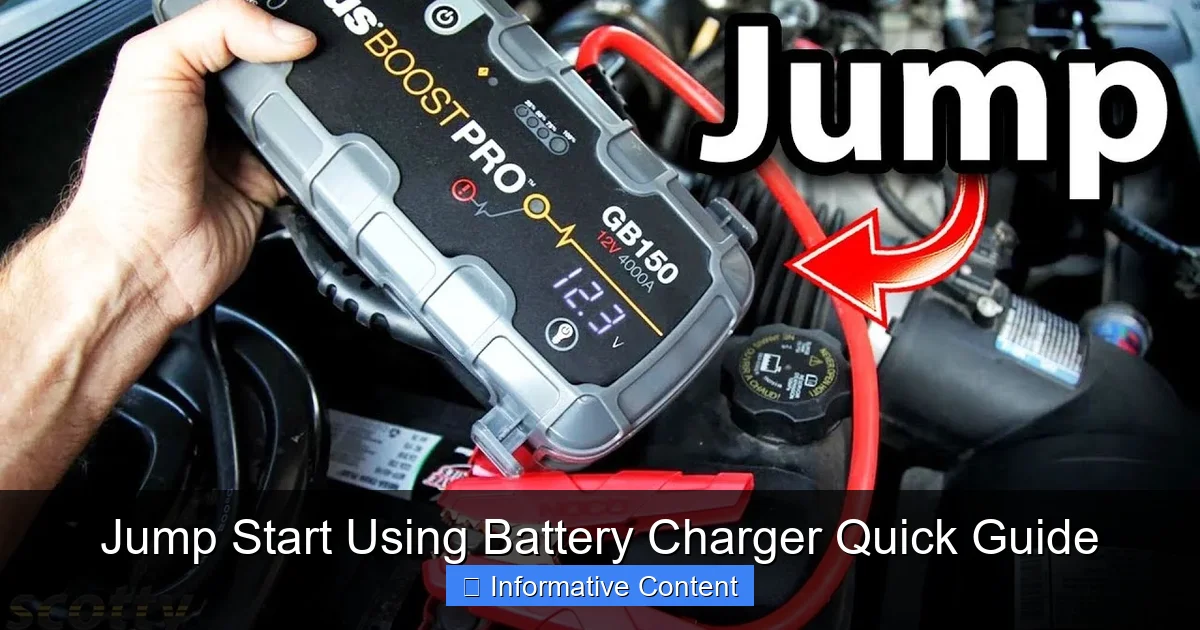
Featured image for jump start using battery charger
Image source: i.ytimg.com
Jump starting a car with a battery charger is a safe and reliable method when done correctly—always connect the charger’s red clamp to the positive terminal and black to a grounded metal surface to avoid sparks. Ensure the charger is set to the correct voltage and amperage before powering it on, and let it charge for several minutes to build enough cranking power for a smooth start.
Key Takeaways
- Ensure safety first: Wear gloves and goggles before connecting the charger.
- Match voltage correctly: Use a charger compatible with your vehicle’s battery voltage.
- Connect red to positive: Attach the red clamp to the battery’s positive terminal first.
- Ground the black clamp: Secure the black clamp to an unpainted metal surface, not the battery.
- Charge before jump starting: Partially charge the dead battery if possible for better results.
- Monitor charging progress: Avoid overcharging by checking the charger’s indicator lights.
- Disconnect in reverse order: Remove black clamp first, then red, after charging completes.
📑 Table of Contents
- Why Jump Starting a Car Is Easier Than You Think
- Understanding Your Car Battery and Why It Dies
- Choosing the Right Battery Charger for Jump Starting
- Step-by-Step Guide: How to Jump Start Using Battery Charger
- Maintenance Tips: Keep Your Battery and Charger Healthy
- Real-World Scenarios and Pro Tips
- Final Thoughts: Be Prepared, Not Panicked
Why Jump Starting a Car Is Easier Than You Think
We’ve all been there: you turn the key in the ignition, and instead of the familiar engine roar, you hear a faint click or nothing at all. Your heart sinks—your car battery is dead. But before you call a tow truck or start panicking, there’s a simple, cost-effective solution: jump start using battery charger. Whether it’s a cold winter morning or you accidentally left the headlights on, a dead battery can happen to anyone. The good news? With the right tools and a little know-how, you can get back on the road in minutes—without needing another vehicle or roadside assistance.
Jump starting your car using a battery charger isn’t just about convenience; it’s about empowerment. You don’t have to wait for help, pay for a service, or rely on a stranger with jumper cables. Modern battery chargers, especially jump starters and smart chargers, are compact, user-friendly, and packed with safety features. In this guide, I’ll walk you through everything you need to know—from choosing the right charger to safely jump starting your car, even if you’ve never done it before. Think of this as the friendly, no-nonsense manual I wish I had when I first faced a dead battery in the middle of a rainstorm.
Understanding Your Car Battery and Why It Dies
Before we dive into the mechanics of a jump start, it helps to understand what’s happening under the hood. Your car battery isn’t just a power source—it’s the heart of your vehicle’s electrical system. It starts the engine, powers the lights, and supports all electronics, from your radio to your climate control. But like any battery, it has a finite lifespan and can fail for various reasons.
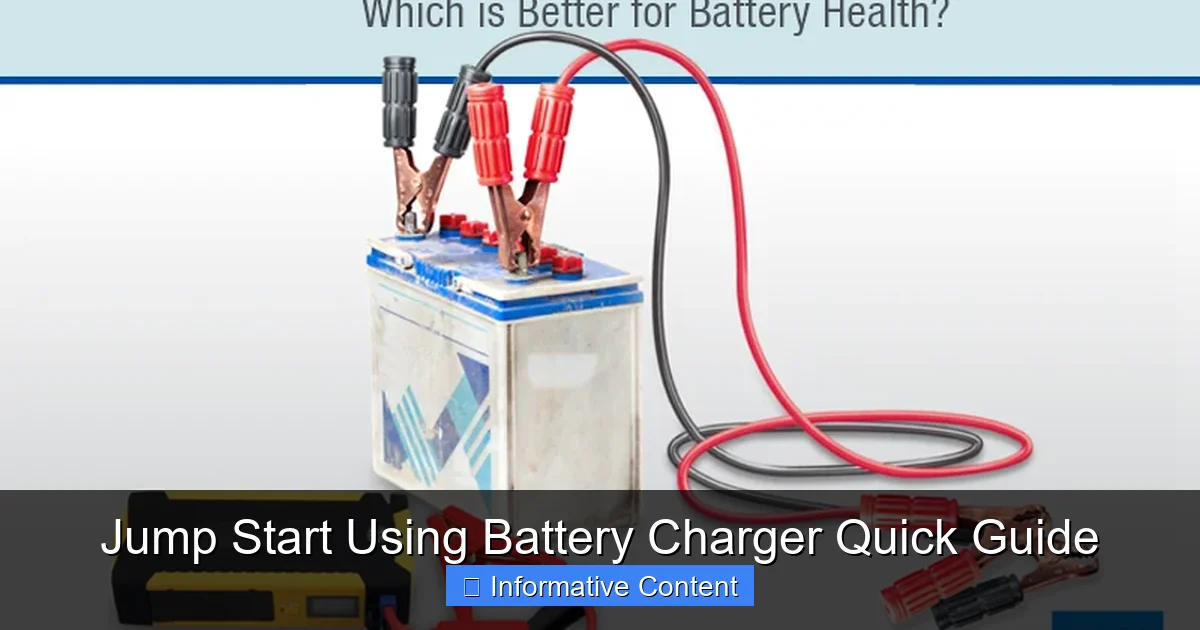
Visual guide about jump start using battery charger
Image source: midtronics.com
Common Causes of Battery Failure
- Age: Most car batteries last 3–5 years. After that, internal components degrade, reducing capacity.
- Extreme temperatures: Heat accelerates corrosion; cold reduces chemical reactions, making the battery sluggish.
- Parasitic drain: Leaving lights, phone chargers, or accessories on overnight can drain the battery.
- Faulty alternator: If the alternator isn’t charging the battery while driving, it will eventually die.
- Loose or corroded terminals: Poor connections prevent proper charging and starting.
For example, I once left my phone charger plugged in overnight. The next morning? A completely dead battery. A jump start using battery charger saved me from being late to work. But the real issue wasn’t the charger—it was the root cause. After that, I made it a habit to double-check all accessories before locking the car.
Signs Your Battery Is Failing
You don’t have to wait for a complete failure. Watch for these early warning signs:
- Slow engine crank (longer than usual to start)
- Dim headlights or dashboard lights
- Frequent need to jump start
- Swollen or bloated battery case
- Corrosion (white or blue crust) on terminals
When my sister noticed her car was struggling to start in the mornings, she ignored it—until one day it wouldn’t start at all. A jump start using battery charger got her going, but she ended up replacing the battery two weeks later. The lesson? Don’t wait for a full breakdown.
How a Jump Start Using Battery Charger Works
Unlike traditional jumper cables that require another car, a jump start using battery charger uses a portable power source to deliver a controlled burst of energy to your battery. There are two main types:
- Portable jump starters (lithium-ion): Compact, lightweight, and easy to store in your trunk. They often include USB ports and flashlights.
- Smart battery chargers: Plugged into a wall outlet, they slowly charge and condition the battery. Some can jump start too.
Both deliver voltage (usually 12V) to the battery, mimicking the charge from a running engine. But here’s the key difference: portable jump starters act like a “battery buddy”—they give a quick boost. Smart chargers are more like a “battery doctor”—they revive and maintain.
Choosing the Right Battery Charger for Jump Starting
Not all battery chargers are created equal. Picking the right one depends on your needs, budget, and how often you might need it. Let’s break down your options.
Portable Lithium Jump Starters
These are the go-to for most drivers. They’re small, powerful, and perfect for emergencies. Look for models with:
- Peak current: 1000–2000 amps for most cars. Higher for trucks/SUVs.
- Capacity: Measured in mAh (milliamp hours). 10,000–20,000 mAh is typical.
- Safety features: Reverse polarity protection, spark-proof clamps, over-current protection.
- Extra perks: USB charging ports, LED flashlights, air compressors.
I use a NOCO Boost Plus GB40 (1000A peak). It’s small enough to fit in my glove box but has enough power to jump start my 2.4L sedan multiple times on a single charge. Plus, it doubles as a phone charger—handy during road trips!
Smart Battery Chargers
If you want to maintain your battery long-term, a smart charger is a great investment. They:
- Charge slowly to avoid damaging the battery
- Use multi-stage charging (bulk, absorption, float)
- Detect battery health and adjust voltage
- Some models (like the CTEK MXS 5.0) can jump start weak batteries
My neighbor uses a smart charger every winter. He plugs it in overnight, and it keeps his battery at optimal health. No more cold-start surprises.
Traditional Battery Charger (Not Recommended for Jump Starts)
Old-school chargers plug into the wall and connect to the battery. They’re great for maintenance but not for jump starting a completely dead battery. Why?
- They charge too slowly to deliver the instant power needed to start an engine.
- Using one as a jump starter can damage the charger or battery.
I learned this the hard way. I tried to “trickle jump” my dead battery with an old 2-amp charger. After 30 minutes, it still wouldn’t start. A portable jump starter did the job in 30 seconds.
What to Look for When Buying
Here’s a quick checklist:
- Vehicle compatibility: Check your car’s battery voltage (usually 12V) and size (group size).
- Amperage: 1000A+ for compact cars; 1500A+ for larger vehicles.
- Clamp quality: Look for heavy-duty, insulated clamps.
- Warranty: At least 1–2 years.
- User reviews: Real-world performance matters more than specs.
Pro tip: Buy one with a built-in flashlight. You’ll need it when jump starting in the dark!
Step-by-Step Guide: How to Jump Start Using Battery Charger
Now for the main event: how to actually do it. Whether you’re using a portable jump starter or a smart charger with jump-start capability, follow these steps. Safety first!
Preparation: Safety Checks
Before connecting anything:
- Park on level ground and turn off the ignition, lights, and accessories.
- Wear safety glasses and gloves—batteries can leak acid or spark.
- Check the battery for cracks, leaks, or bulging. If damaged, do not jump start. Replace the battery.
- Ensure the charger is fully charged (for portable models).
I once skipped the glove step and got a tiny acid burn from a corroded terminal. Not fun. Now I always wear gloves.
Connecting the Charger: The Right Order
Here’s the golden rule: positive first, negative last. This prevents sparks near the battery, which could ignite hydrogen gas.
- Connect the red (positive) clamp to the battery’s positive terminal (+). It’s usually marked red or has a “+” sign.
- Connect the black (negative) clamp to a ground point—not the negative terminal. Use an unpainted metal surface like a bolt or bracket on the engine block. This reduces the risk of sparks.
- Double-check connections. Wiggle the clamps to ensure they’re secure.
Why ground instead of negative terminal? Batteries release flammable hydrogen gas. A spark near the terminal could cause an explosion. Grounding on the engine block keeps sparks away from the battery.
Jump Starting: Power On and Start the Engine
- Turn on the charger (if it has a power switch). Most portable jump starters auto-activate when connected.
- Wait 1–3 minutes to allow the battery to build charge. Some chargers have a “boost” mode—use it for severely drained batteries.
- Try starting the engine. Turn the key and listen for a smooth crank. If it doesn’t start, wait 30 seconds and try again.
- Once running, leave the engine on for at least 15–30 minutes to recharge the battery.
Example: My friend tried to start her car immediately after connecting the charger. It cranked slowly and died. She waited 2 minutes, then tried again—smooth start!
Disconnecting: Reverse the Order
When you’re done:
- Turn off the charger (if applicable).
- Disconnect the black (negative) clamp first, then the red (positive).
- Stow the charger in a dry, accessible place (e.g., glove box, trunk).
Pro tip: Keep the charger connected for a few minutes after the engine starts. This ensures the battery gets a good initial charge.
Troubleshooting Common Issues
- No power from the charger: Check the charger’s battery level. Recharge or replace.
- Engine cranks but won’t start: The battery might be too weak. Wait longer or try a second jump.
- Charger sparks: Disconnect immediately. Check for loose connections or reversed clamps.
- Charger overheats: Stop using it. Let it cool down. Never use a damaged charger.
One time, my jump starter sparked when I connected the clamps. Turns out, the positive and negative were reversed. I unplugged it, fixed the connection, and tried again—no problem.
Maintenance Tips: Keep Your Battery and Charger Healthy
A jump start using battery charger is a short-term fix. To avoid repeat failures, take care of your battery and charger.
Battery Care: Prevent Future Failures
- Drive regularly: Short trips (<15 minutes) don’t fully charge the battery. Take longer drives weekly.
- Clean terminals: Use a wire brush and baking soda/water solution to remove corrosion.
- Tighten connections: Loose terminals cause poor charging.
- Check voltage: Use a multimeter. A healthy battery reads 12.6V when off and 13.7–14.7V when running.
- Replace old batteries: Don’t wait for a complete failure. Test your battery every 6 months.
I test my battery every spring and fall. Last winter, it read 12.1V—time for a replacement before it died.
Charger Care: Extend Its Lifespan
- Recharge portable jump starters every 3–6 months, even if unused.
- Store in a cool, dry place. Avoid extreme temperatures.
- Inspect cables and clamps for wear. Replace if frayed.
- Clean the charger with a dry cloth. Don’t use water or solvents.
My neighbor left his jump starter in the trunk during a heatwave. The battery swelled and died. Now he stores it in the house.
When to Call a Professional
Sometimes, a jump start isn’t enough. Call a mechanic if:
- The battery won’t hold a charge after multiple jumps.
- You notice a rotten egg smell (sulfur from the battery).
- The alternator is faulty (check for warning lights).
- You’ve jump started more than 3 times in a week.
My sister ignored these signs. Her alternator failed, leaving her stranded. A $100 repair turned into a $500 tow and replacement.
Real-World Scenarios and Pro Tips
Let’s put theory into practice with common situations.
Jump Starting in the Cold
Cold weather is a battery killer. Here’s how to succeed:
- Pre-warm the battery: Park in a garage or use a battery blanket.
- Use a high-amp charger: Cold batteries need more power to start.
- Wait longer between attempts: Let the charger work for 3–5 minutes.
Last winter, I jump started my car in -10°C weather. I waited 4 minutes, and it fired right up.
Jump Starting Without Another Car
Portable jump starters shine here. But if you’re using a smart charger:
- Use the “jump start” mode (if available).
- Connect to a wall outlet and wait 10–15 minutes for a partial charge.
My friend used a smart charger to revive her battery while camping. No other cars, no problem!
Table: Battery Charger Comparison
| Type | Best For | Pros | Cons | Price Range |
|---|---|---|---|---|
| Portable Lithium Jump Starter | Emergency jump starts | Fast, compact, no other car needed | Requires recharging; limited lifespan | $80–$200 |
| Smart Battery Charger | Battery maintenance & recovery | Safe, long-term care; some can jump start | Slower; needs wall outlet | $50–$150 |
| Traditional Battery Charger | Long-term charging | Affordable; reliable | Not for jump starts; bulky | $30–$80 |
Pro Tips from Real Users
- Keep the charger in the car: Not in the house. You’ll need it when you’re on the road.
- Label the clamps: Use colored tape to avoid mix-ups.
- Test your charger: Try it every 6 months to ensure it works.
- Charge your phone: Many jump starters have USB ports—handy for emergencies.
My top tip: Keep a pair of gloves and safety glasses in your glove box. You’ll be glad you did.
Final Thoughts: Be Prepared, Not Panicked
A dead battery doesn’t have to ruin your day. With a jump start using battery charger, you’re in control. Whether you choose a portable jump starter for emergencies or a smart charger for long-term care, the key is preparation. Keep your charger charged, your battery maintained, and your knowledge sharp.
Remember, every jump start is a learning opportunity. Pay attention to why the battery died—was it old? Left the lights on? Addressing the root cause saves time and money. And if you’re ever unsure, don’t hesitate to call a pro. But for most cases, a little know-how and the right charger are all you need.
So next time you hear that dreaded click, take a deep breath. Grab your charger, follow the steps, and get back on the road. You’ve got this!
Frequently Asked Questions
How do I jump start a car using a battery charger?
To jump start a car using a battery charger, first ensure the charger is unplugged and set to the correct voltage. Connect the red clamp to the positive terminal and the black clamp to the negative terminal, then plug in and turn on the charger until the battery gains enough charge to start the engine.
Can I use a battery charger to jump start a dead battery?
Yes, you can use a battery charger to jump start a dead battery, but it works slower than jumper cables and another vehicle. It’s best for situations where you have time to slowly recharge the battery rather than needing an immediate start.
What’s the difference between a jump starter and a battery charger?
A jump starter delivers a quick burst of power to start a car immediately, while a battery charger replenishes the battery’s charge over time. Jump starters are portable and self-contained, whereas battery chargers require an outlet and longer charging periods.
Is it safe to jump start with a battery charger?
Yes, it’s safe to jump start with a battery charger if you follow the manufacturer’s instructions and wear protective gear. Always double-check polarity and avoid sparks near the battery to prevent accidents.
How long does it take to jump start a car with a battery charger?
The time varies by charger type and battery condition, but it typically takes 20 minutes to several hours. Trickle chargers take longer, while higher-amp chargers can provide enough power to start the engine more quickly.
Do I need to disconnect the battery to use a battery charger?
No, you usually don’t need to disconnect the battery to use a battery charger. Most modern chargers are designed to safely charge the battery while it’s still connected to the vehicle’s electrical system.