
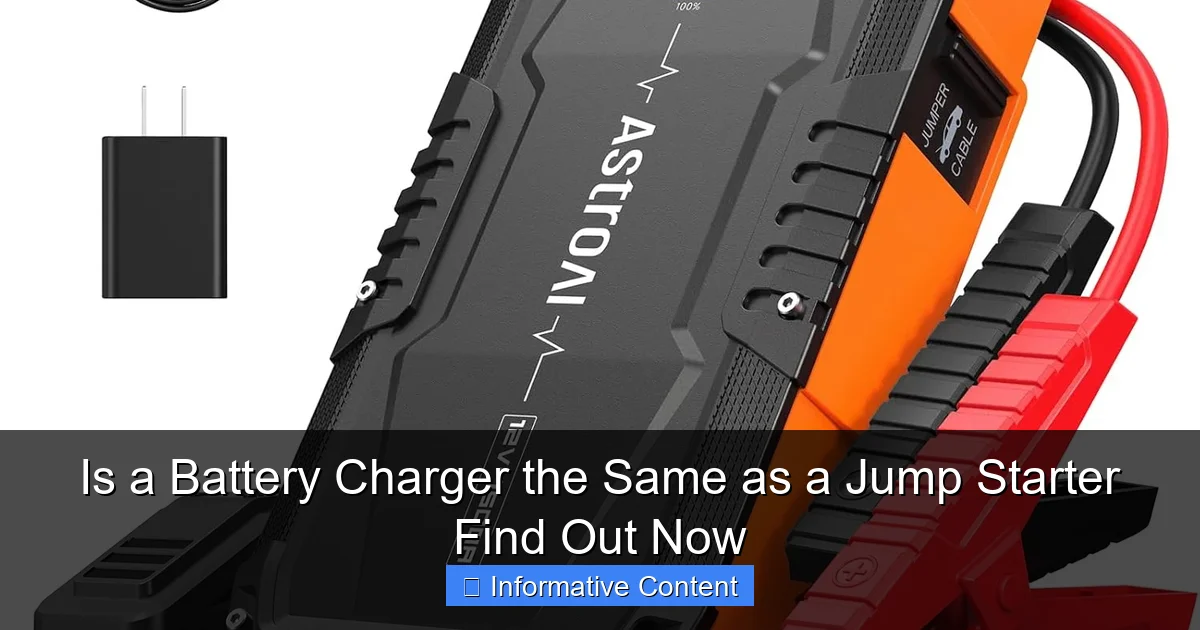
Featured image for is a battery charger the same as a jump starter
Image source: m.media-amazon.com
No, a battery charger and a jump starter are not the same—they serve different purposes and operate in distinct ways. While a battery charger replenishes a battery’s charge over time and requires a power source, a jump starter delivers an instant power boost to start a dead vehicle without needing an outlet. Understanding this difference ensures you choose the right tool for your situation, whether you’re maintaining your battery or facing an emergency roadside start.
Key Takeaways
- Jump starters deliver instant power to start dead batteries; chargers replenish slowly.
- Chargers require AC power to function; jump starters are portable and battery-operated.
- Jump starters prevent downtime in emergencies; chargers suit long-term maintenance.
- Chargers are cost-effective for regular use; jump starters are pricier but versatile.
- Use jump starters for quick fixes; chargers for restoring deeply discharged batteries.
- Check voltage compatibility for both devices to avoid damaging your battery.
📑 Table of Contents
- Is a Battery Charger the Same as a Jump Starter? Find Out Now
- What Is a Battery Charger?
- What Is a Jump Starter?
- Key Differences Between Battery Chargers and Jump Starters
- Can You Use a Jump Starter to Charge a Battery?
- Practical Tips for Choosing and Using These Tools
- Conclusion: Know the Difference, Stay Prepared
Is a Battery Charger the Same as a Jump Starter? Find Out Now
Picture this: It’s a cold winter morning, you’re running late for work, and you walk out to your car only to find it won’t start. The engine clicks weakly, the dashboard lights flicker, and your heart sinks. You pop the hood, peer at the battery, and wonder—should I grab my battery charger or my jump starter? If you’ve ever found yourself in this situation, you’re not alone. Many drivers confuse these two essential tools, assuming they do the same thing. But here’s the truth: a battery charger and a jump starter are not the same—and using the wrong one at the wrong time could cost you time, money, or even damage your vehicle.
Let’s be honest—most of us don’t think about car batteries until they fail us. We treat our vehicles like appliances: we expect them to work when we need them, and we rarely consider what’s happening under the hood. But understanding the difference between a battery charger and a jump starter isn’t just for mechanics or car enthusiasts. It’s practical knowledge that every driver should have. Whether you’re a daily commuter, a weekend road-tripper, or someone who just wants to avoid being stranded, knowing when and how to use these tools can make all the difference. In this guide, we’ll break down what each device does, how they work, and why choosing the right one matters—so you can stay prepared, confident, and in control.
What Is a Battery Charger?
A battery charger is a device designed to restore energy to a rechargeable battery by sending an electrical current through it. Think of it like plugging in your phone overnight—it slowly replenishes the power so it’s ready to go the next day. Car battery chargers work the same way, but they’re built specifically for the 12-volt lead-acid batteries found in most vehicles. These chargers connect directly to the battery terminals and use a controlled flow of electricity to recharge the battery over time.
How Battery Chargers Work
Battery chargers operate by converting AC power from a wall outlet into DC power that the battery can accept. Most modern chargers are “smart,” meaning they monitor the battery’s voltage and adjust the charging rate accordingly. This prevents overcharging, which can damage the battery or even cause it to leak or explode. For example, if your battery is at 10 volts, the charger will start with a higher current to bring it up quickly, then taper off as it nears full charge—usually around 12.6 to 12.8 volts for a healthy 12V battery.
Charging times vary depending on the charger’s amperage and the battery’s condition. A typical 10-amp charger might take 4 to 6 hours to fully recharge a dead battery, while a 2-amp “trickle” charger could take 12 to 24 hours. The slower charge is gentler on the battery and is often recommended for maintenance charging or long-term storage.
Types of Battery Chargers
Not all battery chargers are created equal. Here are the most common types you’ll find:
- Trickle Chargers: These deliver a low, steady current (usually 1–3 amps) and are ideal for maintaining a battery’s charge during long periods of inactivity, like over winter. They’re slow but safe and won’t overcharge if left connected.
- Smart Chargers: These are the most popular today. They automatically detect the battery’s state and adjust the charging process. Many include features like desulfation (to reverse battery aging), float mode (to maintain charge), and reverse polarity protection.
- Fast Chargers: These deliver higher amperage (10+ amps) to recharge a battery quickly. While convenient, they can generate heat and stress the battery if used improperly. Best for emergencies, not daily use.
- Solar Chargers: These use solar panels to generate power and are great for remote locations or eco-conscious drivers. However, they’re slow and depend on sunlight.
When to Use a Battery Charger
A battery charger is best used when you have time and access to an electrical outlet. For instance, if you know your car will sit unused for weeks—like during a vacation or seasonal storage—a trickle or smart charger can keep the battery topped up. It’s also useful if your battery is weak but not completely dead. Let’s say your car starts slowly in the morning; plugging in a charger overnight might give it the boost it needs to start reliably the next day.
One real-life example: My neighbor, Sarah, drives her classic Mustang only on weekends. She uses a smart charger every Friday night to maintain the battery. “It’s like giving the car a nightly vitamin,” she says. “I’ve never had a no-start issue in five years.” That’s the power of proactive maintenance.
What Is a Jump Starter?
A jump starter, also known as a jump box or portable jump starter, is a self-contained device that provides a quick burst of power to start a vehicle with a dead battery. Unlike a battery charger, it doesn’t recharge the battery—it gives it enough juice to crank the engine so the alternator can take over and recharge the battery while driving. Think of it as a portable “boost” that gets you moving again in minutes.
How Jump Starters Work
Jump starters contain an internal lithium-ion or lead-acid battery that stores electrical energy. When connected to your car’s battery terminals (or directly to the engine block and positive terminal), they deliver a high-current surge to jump-start the engine. Most modern jump starters are compact, lightweight, and include safety features like spark-proof clamps, reverse polarity alarms, and built-in flashlights.
For example, a typical portable jump starter might have a peak current of 1000 amps and a cranking current of 300–500 amps—enough to start most cars, SUVs, and even small trucks. Once the engine is running, the alternator recharges the car’s battery, and the jump starter can be disconnected.
Types of Jump Starters
Jump starters come in various sizes and capabilities:
- Portable Lithium Jump Starters: These are the most common today. They’re lightweight (often under 2 pounds), easy to store in a glove box, and powerful enough for most vehicles. Many include USB ports for charging phones or tablets.
- Heavy-Duty Jump Starters: Designed for larger vehicles like trucks, RVs, or diesel engines, these have higher cranking power (up to 3000+ amps) and larger internal batteries.
- Jump Starters with Air Compressors: Some models combine jump-starting with tire inflation, making them great for road trips or emergencies.
- Jump Starters with USB and LED Lights: These multifunctional devices double as power banks and emergency lights, adding extra value.
When to Use a Jump Starter
A jump starter is your go-to tool when your car won’t start and you need a quick fix. Imagine you’re at a remote trailhead, your battery dies, and there’s no other vehicle around. A portable jump starter can get you back on the road without waiting for roadside assistance. Or picture a freezing morning when your battery is too weak to turn over—pop the hood, connect the jump starter, and you’re off in under five minutes.
One practical tip: Always keep your jump starter charged. Many models have a built-in indicator to show battery level. I learned this the hard way when my jump starter died during a snowstorm because I hadn’t charged it in months. Now, I plug it in every few weeks—just like my phone.
Key Differences Between Battery Chargers and Jump Starters
Now that we’ve covered what each device does, let’s compare them side by side. While both deal with car batteries, their purposes, methods, and ideal use cases are fundamentally different.
Purpose and Function
The biggest difference is intent. A battery charger is designed to recharge a battery over time. It’s a long-term solution for maintaining or restoring battery health. A jump starter, on the other hand, is built to jump-start a vehicle instantly. It doesn’t recharge the battery—it just gives it enough power to start the engine.
Think of it like this: A battery charger is like a slow-cooker—it takes time but delivers a thorough result. A jump starter is like an espresso shot—fast, powerful, and meant for immediate use.
Power Source and Portability
Battery chargers require a wall outlet to function. They’re typically stationary devices that you plug in at home or in a garage. This makes them impractical for roadside emergencies. Jump starters, however, are self-powered and portable. They store their own energy and can be used anywhere—no outlet needed.
For example, if you’re camping 50 miles from the nearest town and your battery dies, a jump starter is your only option. A battery charger? Useless without electricity.
Speed and Convenience
Jump starters win on speed. Most can start a car in under 5 minutes. Battery chargers take hours. If you’re in a hurry—say, you’re late for a meeting or picking up your kids—waiting 6 hours for a charger isn’t feasible. But if you have time and want to restore your battery’s full capacity, a charger is the better long-term solution.
Battery Health and Longevity
Using a jump starter repeatedly without addressing the underlying issue can harm your battery. If your battery is old or damaged, jump-starting it won’t fix the problem—it’s like putting a bandage on a broken bone. Over time, this can lead to deeper discharge, sulfation, and premature failure.
A battery charger, especially a smart one, helps maintain optimal voltage and can even reverse some forms of battery degradation. It’s the healthier choice for long-term battery care.
Cost and Value
Battery chargers are generally more affordable, ranging from $30 for a basic trickle charger to $150 for a high-end smart model. Jump starters are pricier, typically $50 to $200, depending on power and features. However, a good jump starter can pay for itself by avoiding towing fees or emergency service calls.
Here’s a quick comparison table to summarize the differences:
| Feature | Battery Charger | Jump Starter |
|---|---|---|
| Primary Function | Recharges battery over time | Jump-starts engine instantly |
| Power Source | Wall outlet (AC power) | Internal battery (DC power) |
| Portability | Low (stationary) | High (portable) |
| Time to Use | Hours (slow charge) | Minutes (instant boost) |
| Best For | Maintenance, storage, weak batteries | Emergency starts, roadside use |
| Typical Cost | $30–$150 | $50–$200 |
Can You Use a Jump Starter to Charge a Battery?
This is a common question—and the answer is both yes and no. Technically, a jump starter can provide a short burst of power that might help a very weak battery start the engine. But it’s not designed to charge the battery in the way a charger does. Once the engine is running, the alternator takes over recharging. If the battery is deeply discharged or damaged, the jump starter won’t fix it—you’ll just end up with a dead battery again once the engine stops.
The Risks of Misusing a Jump Starter
Using a jump starter as a substitute for a charger can lead to problems. For one, repeated jump-starts without proper charging can cause the battery to lose capacity over time. Sulfation—the buildup of lead sulfate crystals—can occur when a battery isn’t fully recharged, reducing its lifespan.
Also, jump starters have limited capacity. Most portable models can jump-start a car 3 to 10 times on a full charge, depending on the vehicle and battery condition. If you rely on it too often, you’ll drain its internal battery and be left with two dead batteries—your car’s and the jump starter’s.
When It’s Okay to Use a Jump Starter for Charging
There’s one exception: some advanced jump starters come with a “charge” or “maintain” mode that slowly tops up a weak battery. These are essentially hybrid devices—part jump starter, part smart charger. If you have one of these, you can use it to gently recharge a battery over several hours. But this is rare, and most jump starters don’t offer this feature.
My advice? Use a jump starter only for emergencies. If your battery is consistently weak, invest in a proper charger or have your battery tested at an auto shop.
Practical Tips for Choosing and Using These Tools
Now that you know the difference, how do you decide which tool to buy—or whether you need both? Here are some practical tips to help you make the right choice.
Assess Your Driving Habits
If you drive daily and park in a garage with electricity, a battery charger might be all you need. But if you take long trips, live in a cold climate, or drive an older vehicle, a jump starter is a smart backup. I keep both in my car: a smart charger at home for maintenance and a portable jump starter in the trunk for emergencies.
Check Your Battery’s Health
A weak battery isn’t always dead—it might just need a recharge. Use a multimeter to check voltage. A reading below 12.4 volts means it’s undercharged. Below 12 volts? It’s likely dead or damaged. If your battery is more than 3–5 years old, consider replacing it instead of relying on chargers or jump starters.
Invest in Quality
Don’t buy the cheapest option. A $20 jump starter might fail when you need it most. Look for reputable brands like NOCO, Schumacher, or Battery Tender. Read reviews and check for safety certifications like UL or CE.
Learn Proper Connection Techniques
Whether using a charger or jump starter, always connect the positive (red) clamp first, then the negative (black). For jump starters, attach the negative clamp to the engine block or a grounded metal part—not the battery’s negative terminal—to reduce sparking risk.
Maintain Your Tools
Keep your jump starter charged and store it in a cool, dry place. For battery chargers, inspect cables and clamps regularly for damage. And never leave a charger connected indefinitely unless it has a float or maintenance mode.
Conclusion: Know the Difference, Stay Prepared
So, is a battery charger the same as a jump starter? The short answer is no—they serve different purposes, work in different ways, and are used in different situations. A battery charger is for long-term care and recharging, while a jump starter is for quick, emergency starts. Understanding this distinction can save you from frustration, wasted money, and potential damage to your vehicle.
Think of it like this: A battery charger is like a doctor who helps you stay healthy with regular checkups and vitamins. A jump starter is like an ambulance—it gets you to the hospital when you’re in crisis. You need both in your life, but for very different reasons.
The best approach? Be proactive. Maintain your battery with regular checks and a smart charger when needed. Keep a reliable jump starter in your car for peace of mind. And most importantly, don’t wait until your car won’t start to think about these tools. Preparation is the key to avoiding stress, saving time, and staying safe on the road.
Whether you’re a daily driver or an occasional road-tripper, knowing when and how to use a battery charger versus a jump starter is essential knowledge. Now that you’re equipped with the facts, you can make informed decisions and keep your vehicle—and your plans—running smoothly.
Frequently Asked Questions
Is a battery charger the same as a jump starter?
No, a battery charger and a jump starter serve different purposes. A charger replenishes a battery’s charge over time, while a jump starter delivers a quick burst of power to start a dead battery immediately.
Can I use a jump starter as a battery charger?
Most jump starters aren’t designed to fully recharge a battery like a traditional charger. They’re best for emergency starts, though some models include trickle-charging features for limited charging.
What’s the key difference between a battery charger and a jump starter?
The key difference lies in their function: a battery charger slowly restores power, while a jump starter provides instant energy to crank the engine. Chargers are for maintenance, jump starters for emergencies.
Do I need both a battery charger and a jump starter?
It depends on your needs. A jump starter is ideal for on-the-go emergencies, while a charger is better for long-term battery maintenance. Owning both covers all scenarios.
How does a portable jump starter compare to a battery charger?
A portable jump starter is compact and delivers high current for quick starts, while a battery charger is bulkier but offers precise, slow charging. Jump starters are more convenient for roadside help.
Can a battery charger jump-start my car?
Some heavy-duty chargers have a “boost” mode to mimic a jump starter, but standard chargers lack the instant power needed. For reliable starts, a dedicated jump starter is safer and faster.