
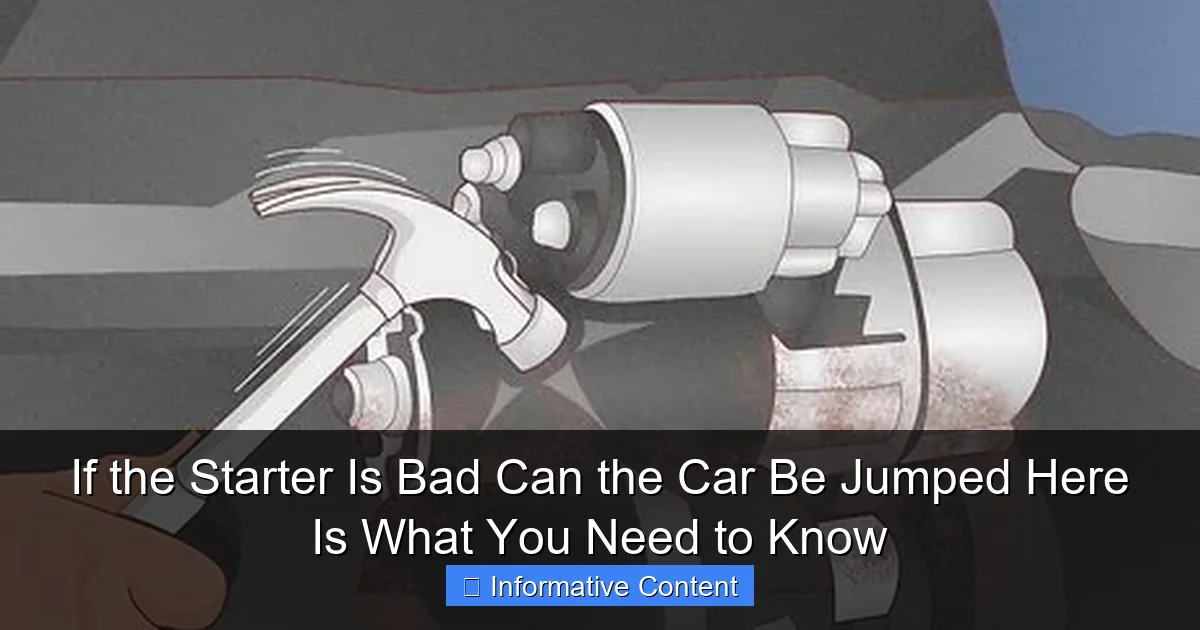
Featured image for if the starter is bad can the car be jumped
Image source: wikihow.com
No, a bad starter cannot be fixed by jumping the car — jump-starting only addresses a weak battery, not a failed starter motor. Attempting to jump a car with a faulty starter may lead to further electrical damage or safety risks, so proper diagnosis and repair are essential before assuming a simple jump will work.
Key Takeaways
- Jumping won’t fix a bad starter: It only powers the battery, not the starter motor.
- Check for clicking sounds: A rapid click often signals a failing starter, not a dead battery.
- Try tapping the starter: Light taps with a tool may temporarily restore function.
- Bypass ignition with a screwdriver: Use caution to test if the starter engages manually.
- Diagnose before jumping: Confirm battery health to avoid misdiagnosing starter issues.
- Call a mechanic: Persistent starter failure requires professional repair or replacement.
📑 Table of Contents
- Understanding the Starter: What It Does and How It Fails
- Can You Jump-Start a Car with a Bad Starter?
- How to Tell If It’s the Starter or the Battery
- Alternative Starting Methods When the Starter Fails
- Repair vs. Replace: What to Do When the Starter Fails
- Preventing Starter Failure: Maintenance and Best Practices
Understanding the Starter: What It Does and How It Fails
Let’s face it—few things are more frustrating than turning the key in your car’s ignition, only to hear nothing. No engine cranking, no lights flickering, just silence. Your first instinct? Maybe the battery’s dead. You grab jumper cables, find a good Samaritan, and give it a jump. The engine roars to life, and you breathe a sigh of relief. But then, the same thing happens the next morning. And the next. You start to wonder: if the starter is bad, can the car be jumped?
The short answer is: it’s complicated. Jumping a car is like giving it an energy boost—it can help if the issue is a weak or dead battery. But if the starter motor itself is failing, jumping won’t fix the root problem. Think of it like trying to wake someone who’s passed out from exhaustion with a cup of coffee. The coffee might help if they’re just tired, but if they’re unconscious due to a medical issue, it won’t solve the underlying condition. In this post, we’ll break down exactly how the starter works, when jumping helps, and when it doesn’t—so you can avoid wasting time, effort, and potentially damaging your car further.
How the Starter Motor Works
The starter is an electric motor that cranks the engine to begin the combustion process. When you turn the key (or press the start button), the ignition switch sends a signal to the starter solenoid. This small but powerful device connects the battery to the starter motor, which then spins the engine’s flywheel. Once the engine starts, the starter disengages. It’s a brief but critical process—without a functioning starter, your car simply won’t start, no matter how strong the battery.
Common Signs of a Failing Starter
- Silence when turning the key: No clicking, no cranking—just dead air.
- Intermittent starting issues: The car starts fine one day, not the next.
- Clicking noise: A single or rapid click, often indicating the solenoid is engaging but the motor isn’t turning.
- Grinding sounds: Could mean the starter gear is worn or misaligned with the flywheel.
- Smell of burning or smoke: A serious red flag—could mean the starter is overheating or has electrical damage.
One of my friends, Sarah, had a 2010 Honda Civic that would start sometimes and not others. She kept jumping it, thinking the battery was the issue. After three weeks of this, she finally took it to a mechanic who diagnosed a failing starter. “I wish I’d known sooner,” she told me. “I probably made it worse by forcing it to start with a jump every time.” Her story is more common than you’d think—many people confuse battery symptoms with starter problems.
Can You Jump-Start a Car with a Bad Starter?
Here’s the core of the question: if the starter is bad, can the car be jumped? The answer depends on *how* the starter is failing and whether the battery has enough power to send the signal. Let’s break it down.
Visual guide about if the starter is bad can the car be jumped
Image source: automotivegearz.com
When Jumping Might “Work” (Temporarily)
In some cases, a jump can make a car with a weak or failing starter start—but only if the battery is so low that the starter doesn’t have enough power to even attempt cranking. For example:
- The battery is at 8 volts (below the 9.6V minimum needed for the starter to engage).
- The starter is functional but sluggish due to low voltage.
- The solenoid clicks, but the motor barely turns the engine.
Jumping gives the system the extra amps needed to overcome the initial resistance. The engine starts, and the alternator recharges the battery. But here’s the catch: the next time you try to start the car, if the battery drains again (or the starter is deteriorating), the same problem returns. It’s a temporary fix, not a solution.
Think of it like using a defibrillator on a heart with a weak beat. It might restart the rhythm once, but if the heart muscle is damaged, the rhythm will fail again. Similarly, jumping a car with a bad starter is like giving a failing system a jolt—it might work once, but it won’t heal the problem.
When Jumping Won’t Help at All
If the starter is completely dead—meaning the motor won’t turn, the solenoid is broken, or there’s a wiring fault—jumping won’t help. Why? Because:
- The starter needs a functional circuit to receive power. If the internal windings are burned out, no amount of voltage will make it spin.
- A failed solenoid won’t close the circuit, so the starter motor never gets power, even with a jump.
- Corroded or broken connections in the starter circuit prevent electricity from flowing, regardless of battery strength.
I once had a 1998 Ford Taurus that wouldn’t start. I jumped it with a powerful truck, and the engine turned over—but then died immediately. The starter was spinning, but the flywheel wasn’t engaging. After inspection, the mechanic found the starter gear was stripped. Jumping didn’t fix the mechanical failure—it just made the problem more confusing.
The Risk of Repeated Jumping
Repeatedly jumping a car with a bad starter can cause more harm than good:
- Overloading the electrical system: High amperage from a jump can stress the alternator, battery cables, and fuses.
- Damaging the starter further: Forcing a failing motor to spin can burn out the armature or break the solenoid.
- Masking the real issue: You delay repairs, leading to a breakdown when the starter finally fails completely.
So while jumping might “work” in the short term, it’s not a reliable long-term strategy—especially if you suspect the starter is the culprit.
How to Tell If It’s the Starter or the Battery
One of the biggest challenges drivers face is diagnosing the real cause of a no-start condition. Is it the battery? The starter? The alternator? Here’s how to tell the difference—without a mechanic.
Step-by-Step Diagnostic Guide
- Check the lights and electronics: Turn on the headlights. If they’re bright, the battery likely has power. If they’re dim or flicker when you try to start, the battery may be weak.
- Listen for sounds:
- Click-click-click: Often a weak battery or poor connection.
- Single loud click: Could mean the solenoid is working, but the starter motor isn’t turning—likely a starter issue.
- No sound: Could be a dead battery, bad ignition switch, or faulty starter relay.
- Tap the starter (if accessible): With the car in park (or neutral, with the parking brake on), gently tap the starter motor with a tool (like a wrench or hammer handle). Sometimes, worn brushes inside the starter cause it to seize. A tap can free it temporarily. If the car starts after tapping, the starter is likely failing.
- Test the battery voltage: Use a multimeter. A healthy battery reads 12.6V when off and 13.7–14.7V when running. Below 12V? The battery may need charging or replacement.
- Jump the car and observe: If the car starts immediately after a jump but dies when the jumper cables are removed, the alternator might not be charging. If it starts and stays running, but won’t start again the next day, the battery or starter could be the issue.
Real-World Example: Diagnosing a No-Start
My neighbor Mark had a 2005 Toyota Camry that wouldn’t start. The headlights were bright, but turning the key produced only a single click. He jumped it—and the engine cranked right up. But the next day, the same thing happened. He repeated the jump three times before I suggested he try the tap test. He tapped the starter, and the car started without a jump. That was the clue: the starter was failing, not the battery. He replaced it for $300, and the problem vanished. “I saved a lot of hassle,” he said. “I wish I’d done that first.”
This example shows why diagnosis matters. A jump can mask symptoms, but a few simple tests can point you to the real issue.
Alternative Starting Methods When the Starter Fails
So what if the starter is bad and you can’t jump it? Are you stranded? Not necessarily. There are a few alternative methods to get your car running—especially in emergencies.
Push-Starting (For Manual Transmission Only)
If you have a manual transmission car, you can “push start” or “bump start” it. Here’s how:
- Turn the ignition to “on” (don’t start).
- Press the clutch and shift into second gear (second is better than first because it’s less jerky).
- Have a friend push the car (or roll it down a hill) to get it moving at about 5–10 mph.
- Quickly release the clutch. The engine should turn over and start.
- Press the clutch again to avoid stalling, then drive normally.
Important: This only works with manual transmissions. Automatic cars can’t be push-started without damaging the transmission.
I used this method once with a 1992 Mazda Miata when the starter failed on a remote road. We rolled it down a slight hill, and after a few tries, it fired up. It felt like something out of a movie—and it saved us from a long walk.
Using a Starter Relay Bypass
For advanced DIYers, you can bypass the starter relay to send power directly to the starter solenoid. This requires:
- A screwdriver or jumper wire.
- Access to the starter relay (usually in the engine fuse box).
- Caution: This can be dangerous if done incorrectly. Only attempt if you’re confident in your skills.
To do it:
- Locate the starter relay (check your owner’s manual).
- Use a jumper wire to connect the two large terminals on the relay socket (this sends power directly to the starter).
- The starter should crank. If it does, the relay or ignition switch is likely the issue. If not, the starter itself is probably dead.
Portable Jump Starters and Boosters
Modern lithium-ion jump starters (like NOCO Boost or DBPOWER) are compact and powerful. They can jump a weak battery—but again, they won’t fix a dead starter. However, they’re great for confirming whether the battery is the real issue. If the car starts with a jump starter but won’t start the next day without it, the battery or starter is failing.
Pro tip: Keep a portable jump starter in your trunk. They’re cheaper than a tow truck and can save you in a pinch—even if they don’t fix a bad starter.
Repair vs. Replace: What to Do When the Starter Fails
Once you’ve confirmed the starter is the problem, you have two choices: repair it or replace it. Let’s explore both.
Can You Repair a Bad Starter?
In some cases, yes—but it’s not always worth it. Starters are complex, and internal components like brushes, solenoids, and armatures can wear out. A mechanic might:
- Replace the solenoid (a common failure point).
- Rebuild the starter with new brushes and bearings.
- Fix wiring or connection issues.
However, a rebuilt starter often costs 60–80% of a new one. And if the housing or armature is damaged, repair isn’t possible. For older cars, a remanufactured starter (refurbished to factory specs) is a good middle ground—it’s cheaper than new but more reliable than a DIY fix.
Replacing the Starter: Costs and Considerations
Replacing a starter typically costs $300–$600, including parts and labor. DIY installation can save $100–$200, but it’s labor-intensive:
- Access is often under the engine, requiring jack stands or a lift.
- You’ll need basic tools (wrenches, sockets, extensions).
- Some starters are easy to reach; others (like in front-wheel-drive cars) are buried behind the exhaust or transmission.
Before buying, check your car’s make, model, and year. Starters vary widely. For example:
| Car Model | Average Starter Cost (New) | Labor Time | DIY Difficulty |
|---|---|---|---|
| Honda Civic (2010) | $120–$180 | 1.5–2 hours | Medium |
| Ford F-150 (2015) | $150–$220 | 2–3 hours | Hard |
| Toyota Camry (2008) | $100–$160 | 1–1.5 hours | Easy |
| BMW 3 Series (2012) | $200–$300 | 3+ hours | Very Hard |
As you can see, luxury and truck models tend to be more expensive and harder to replace. But even a $300 repair beats a $150 tow and days without a car.
When to Call a Mechanic
If you’re unsure, or if the starter is hard to access, it’s wise to call a pro. A mechanic can:
- Diagnose the issue accurately.
- Replace the starter safely and quickly.
- Test the entire charging system to prevent future issues.
Plus, many shops offer warranties on parts and labor—peace of mind you won’t get with a DIY job.
Preventing Starter Failure: Maintenance and Best Practices
The best way to avoid starter problems? Prevent them. Here’s how to keep your starter in top shape.
Regular Battery and Electrical Checks
Your starter relies on the battery and alternator. A weak battery forces the starter to work harder, shortening its life. Check:
- Battery age: Most last 3–5 years. Replace if it’s over 4 years old.
- Terminal corrosion: Clean with a baking soda and water mix, then apply anti-corrosion spray.
- Alternator output: Use a multimeter to check voltage while the engine runs. Below 13.5V? The alternator may be failing.
Avoid Short Trips and Excessive Cranking
Short trips (under 10 minutes) don’t give the battery time to recharge fully. Over time, this leads to chronic low voltage, which stresses the starter. Similarly, cranking the engine for more than 10–15 seconds at a time can overheat the starter. If it doesn’t start after two tries, wait 30 seconds before trying again.
Keep the Starter Clean and Dry
Dirt, oil, and moisture can damage the starter’s electrical connections. If you see grime buildup, clean the area with a degreaser (like brake cleaner) and a soft brush. Avoid spraying water directly on the starter.
Listen for Early Warning Signs
Don’t ignore that first click or slow crank. Addressing a failing starter early can prevent a complete breakdown. If you notice any symptoms, have it inspected before it leaves you stranded.
Final tip: Keep your car’s service records. Many starters have warranties (1–3 years). If yours fails within that period, you might get a free replacement.
So, to answer the original question: if the starter is bad, can the car be jumped? Sometimes, yes—but only as a temporary workaround. The real fix is diagnosing the issue and replacing or repairing the starter. By understanding the signs, testing properly, and acting early, you can avoid the frustration of repeated no-starts and keep your car running smoothly for years to come.
Frequently Asked Questions
Can you jump-start a car with a bad starter?
Jump-starting a car typically addresses a dead battery, not a faulty starter. If the starter is bad, the engine won’t turn over even with a jump, as the issue lies in the starter motor or solenoid, not the battery’s charge.
What are the signs that my starter is bad instead of just needing a jump?
A bad starter often produces a clicking noise when turning the key, while a jump-eligible car usually turns over slowly. If lights and electronics work but the engine doesn’t crank, the starter is likely the culprit.
If the starter is bad, can the car be jumped to bypass it?
No, jump-starting won’t bypass a defective starter. The starter requires electrical power to engage, and if it’s failed, no amount of jumping will fix the mechanical or electrical fault preventing it from working.
Can a bad starter drain my battery, making it seem like I need a jump?
Yes, a malfunctioning starter can draw excessive power, leaving the battery too weak to crank the engine. In this case, a jump might temporarily help, but the root issue is the faulty starter.
What’s the difference between a jump-start and fixing a bad starter?
A jump-start replenishes a dead battery, while a bad starter requires repair or replacement. Jump-starting won’t resolve starter-related issues like grinding noises, freewheeling, or complete failure to crank.
Is it safe to try jumping a car if I suspect the starter is bad?
It’s safe to attempt, but don’t expect success if the starter is truly faulty. If the engine doesn’t turn over after multiple jump attempts, have the starter inspected by a mechanic to avoid unnecessary battery strain.