

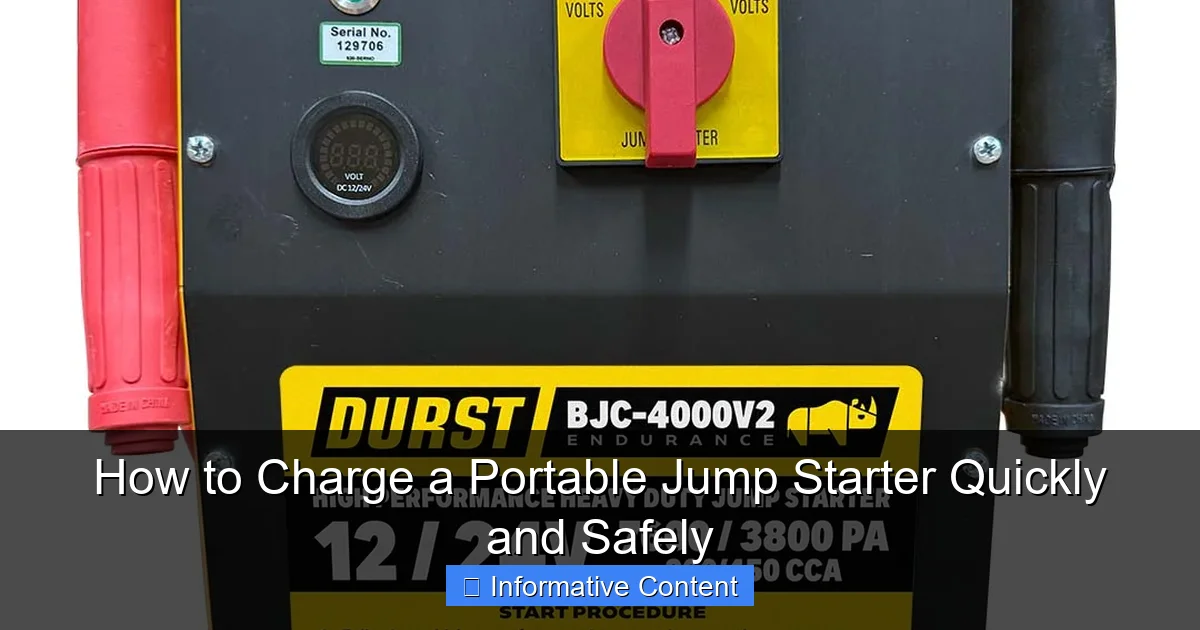
Featured image for how to charge a portable jump starter
Image source: i5.walmartimages.com
Charging a portable jump starter quickly and safely starts with using the correct charger and a stable power source to avoid damage or overheating. Always follow the manufacturer’s instructions, ensure the device is powered off during charging, and avoid overcharging by unplugging it once fully charged—typically indicated by an LED light. For optimal performance and longevity, store the jump starter in a cool, dry place and recharge it every 3–6 months, even when not in use.
Key Takeaways
- Use the right charger: Always match voltage and amperage to your jump starter’s specs.
- Charge fully before first use: Ensures optimal performance and battery longevity.
- Avoid extreme temperatures: Charge only in moderate environments (32°F–104°F).
- Monitor charging time: Never exceed manufacturer-recommended duration to prevent damage.
- Unplug promptly after charge: Reduces risk of overcharging and battery degradation.
- Store with partial charge: Keep at 50% if unused for extended periods.
📑 Table of Contents
- How to Charge a Portable Jump Starter Quickly and Safely
- Understanding Your Portable Jump Starter
- How to Charge a Portable Jump Starter: Step-by-Step Guide
- Charging Tips for Maximum Efficiency and Safety
- Common Mistakes to Avoid When Charging
- How Long Does It Take to Charge a Portable Jump Starter?
- Maintaining Your Jump Starter for Long-Term Use
- Conclusion
How to Charge a Portable Jump Starter Quickly and Safely
Picture this: You’re running late for an important meeting, your car won’t start, and you realize your battery is completely dead. You reach for your trusty portable jump starter—only to find it’s as dead as your car battery. Frustrating, right? It’s a scenario no one wants to face, especially when you thought you were prepared. That’s why knowing how to charge a portable jump starter properly isn’t just helpful—it’s essential.
Portable jump starters are lifesavers in emergencies, but they’re only as good as their charge. Unlike traditional jumper cables that rely on another vehicle, these compact devices store power in built-in lithium-ion or lithium-polymer batteries. That means they need regular charging to stay ready. Whether you’re a weekend warrior, a daily commuter, or someone who lives off the grid, keeping your jump starter charged ensures you’re never left stranded. The good news? Charging one is simple—if you know the right steps. In this guide, we’ll walk you through everything you need to know to charge your portable jump starter quickly, safely, and effectively.
Understanding Your Portable Jump Starter
Before you plug anything in, it helps to understand what you’re working with. Portable jump starters come in various shapes, sizes, and power levels, but they all share a few core components. Most models include a rechargeable battery, built-in cables with clamps, LED indicators, and sometimes additional features like USB ports, flashlights, or air compressors.
Visual guide about how to charge a portable jump starter
Image source: powerstartau.com
Types of Portable Jump Starters
There are two main types of portable jump starters based on battery chemistry: lithium-ion (Li-ion) and lithium polymer (LiPo). Li-ion models are the most common—they’re lightweight, affordable, and hold a charge well over time. LiPo versions are often more compact and can deliver higher peak currents, making them ideal for larger engines. Both types require similar charging methods, but it’s important to check your user manual to confirm compatibility.
Another thing to consider is the jump starter’s capacity, measured in milliampere-hours (mAh) or peak amps. A 10,000mAh unit might be perfect for compact cars, while trucks and SUVs may need 20,000mAh or more. Higher capacity usually means longer charging times, so keep that in mind when planning your charging routine.
Key Components to Know
When you open the box, you’ll typically find the main unit, a charging cable (usually USB-C or micro-USB), and sometimes a wall adapter. Some models include a car charger, which lets you top up the battery while driving. The LED indicators are your best friend—they tell you the current charge level and whether the device is charging, fully charged, or experiencing an issue.
For example, a green light often means fully charged, while red or blinking lights indicate low battery or charging in progress. Always refer to your specific model’s manual, as colors and patterns can vary. Knowing these basics helps you avoid confusion and ensures you’re interpreting the status correctly.
How to Charge a Portable Jump Starter: Step-by-Step Guide
Charging your portable jump starter is straightforward, but doing it right makes all the difference. Follow these steps to ensure a safe and efficient charge every time.
Step 1: Check the Current Charge Level
Before plugging in, check the battery level using the LED indicators. If the lights show it’s already at 75% or higher, you might not need a full charge. However, if it’s below 50%, it’s time to plug it in. Some models have a digital display that shows the exact percentage—this makes it even easier to decide.
Pro tip: Make it a habit to check your jump starter’s charge level once a month, especially if you don’t use it often. Batteries naturally lose charge over time, even when not in use.
Step 2: Use the Correct Charging Cable and Adapter
Always use the cable and adapter that came with your jump starter. While it might be tempting to grab any USB-C cable lying around, not all cables are created equal. The original cable is designed to deliver the right amount of power safely. Using incompatible chargers can lead to slow charging, overheating, or even damage.
For instance, if your jump starter supports fast charging via USB-C PD (Power Delivery), using a standard USB-A to USB-C cable won’t take advantage of that feature. Stick with the manufacturer-recommended setup for best results.
Step 3: Plug Into a Stable Power Source
Connect the charging cable to a wall outlet using the provided adapter. Avoid using extension cords or power strips with multiple high-draw devices, as this can cause voltage drops and slow down charging. A direct wall outlet ensures consistent power delivery.
If you’re on the road, you can use the car charger (if included). Just plug it into your vehicle’s 12V socket (cigarette lighter). Keep in mind that charging via car may take longer, especially if the engine is off, since the car’s battery has limited reserve power.
Step 4: Monitor the Charging Process
Once connected, watch the LED indicators. Most jump starters take between 2 to 4 hours to fully charge, depending on capacity and input power. A 10,000mAh model might charge in 2.5 hours with a 2A adapter, while a 20,000mAh unit could take closer to 4 hours.
Don’t leave it plugged in indefinitely. While many modern jump starters have overcharge protection, it’s still best to unplug once fully charged. Overcharging can reduce battery lifespan over time, even with safety features.
Step 5: Store Properly After Charging
Once charged, disconnect the cable and store your jump starter in a cool, dry place. Avoid extreme temperatures—don’t leave it in a hot car or a freezing garage. Heat accelerates battery degradation, while cold can reduce performance temporarily.
Store it in its original case or a protective pouch to prevent dust and physical damage. If you have a model with removable cables, coil them neatly to avoid tangling.
Charging Tips for Maximum Efficiency and Safety
Charging your jump starter isn’t just about plugging it in—it’s about doing it smartly. A few simple habits can extend battery life, improve performance, and keep you safe.
Use Fast Charging When Available
If your jump starter supports fast charging (look for terms like “Quick Charge,” “PD,” or “Turbo Charge”), take advantage of it. Fast charging can cut charging time by up to 50%, getting you back on the road faster. Just make sure your wall adapter supports the required output (e.g., 18W or higher).
For example, a jump starter with 15W input might charge in 3 hours normally, but drop to 1.5 hours with a 30W fast charger. Always verify compatibility to avoid damaging the device.
Avoid Charging in Extreme Temperatures
Never charge your jump starter in direct sunlight, inside a hot car, or in freezing conditions. Most lithium batteries perform best between 50°F and 86°F (10°C to 30°C). Charging outside this range can cause overheating, reduced efficiency, or even safety hazards.
If your jump starter has been in a cold car, let it warm up to room temperature before charging. Similarly, if it’s been in the sun, move it to a shaded area and wait 15–20 minutes before plugging in.
Don’t Charge While Jump-Starting
It might seem logical to charge your jump starter while using it to jump a car, but this is a bad idea. Most models aren’t designed to charge and discharge simultaneously. Doing so can overload the circuitry, cause overheating, or damage the battery.
Always charge your jump starter separately—before or after use—never during. If you’re in a pinch and need to jump-start a car, make sure your device is already fully charged.
Keep the Ports Clean
Dust, dirt, and lint can accumulate in the charging port over time, leading to poor connections and slow charging. Use a can of compressed air or a soft brush to gently clean the port every few months. Avoid using metal objects, which can scratch or damage the contacts.
A clean port ensures a solid connection and faster, more reliable charging. It’s a small step that makes a big difference in long-term performance.
Common Mistakes to Avoid When Charging
Even experienced users make mistakes when charging their jump starters. Avoid these common pitfalls to keep your device in top shape.
Using the Wrong Charger
We’ve all been tempted to use a random USB cable or phone charger in a pinch. But using an underpowered or incompatible charger can lead to slow charging or no charging at all. Worse, it can damage the battery or cause overheating.
For example, using a 5W phone charger on a jump starter that requires 18W input will take much longer and may not fully charge the battery. Always match the charger’s output to your device’s requirements.
Leaving It Plugged In Overnight
While modern jump starters have overcharge protection, leaving them plugged in for extended periods isn’t ideal. Continuous trickle charging can stress the battery over time, reducing its overall lifespan. Aim to unplug once the green light appears.
If you forget, don’t panic—most devices will stop charging automatically. But making it a habit to unplug promptly helps preserve battery health.
Ignoring the User Manual
Every jump starter is a little different. Skipping the manual means you might miss important details like charging voltage, recommended adapters, or safety warnings. Take five minutes to read it—it could save you from costly mistakes.
For instance, some models require a specific charging sequence or have unique LED patterns. The manual is your best guide for safe and effective use.
Charging a Damaged or Swollen Battery
If your jump starter shows signs of damage—like a swollen casing, leaking fluid, or a burning smell—do not charge it. These are signs of battery failure and can be dangerous. Stop using it immediately and contact the manufacturer or dispose of it safely at an e-waste facility.
Swollen batteries are especially risky—they can rupture or catch fire if charged. Safety always comes first.
How Long Does It Take to Charge a Portable Jump Starter?
Charging time depends on several factors, including battery capacity, input power, and the charger used. Here’s a general guide to help you estimate how long your jump starter will take to charge.
| Battery Capacity (mAh) | Input Power (Watts) | Estimated Charging Time |
|---|---|---|
| 5,000 | 10W | 1.5 – 2 hours |
| 10,000 | 18W | 2 – 2.5 hours |
| 15,000 | 18W | 3 – 3.5 hours |
| 20,000 | 30W | 3.5 – 4 hours |
| 30,000 | 45W | 4 – 5 hours |
These times are estimates and can vary based on the charger quality, ambient temperature, and battery health. Fast chargers can reduce times by 30–50%, while older or degraded batteries may take longer.
For example, a 10,000mAh jump starter with an 18W fast charger might charge in just 2 hours, while the same unit with a 10W charger could take 3 hours. Always use the highest compatible power source to speed up the process.
Maintaining Your Jump Starter for Long-Term Use
Charging is just one part of the equation. Proper maintenance ensures your jump starter stays reliable for years.
Charge Regularly, Even When Not in Use
Lithium batteries lose charge over time—typically 5–10% per month when idle. To prevent deep discharge, charge your jump starter every 2–3 months, even if you haven’t used it. This keeps the battery healthy and ready when you need it.
Think of it like charging your phone—just because you’re not using it doesn’t mean it can’t lose power.
Avoid Full Discharge
Don’t let your jump starter drain completely before recharging. Lithium batteries last longer when kept between 20% and 80% charge. Frequent full discharges can shorten battery life.
If you use it to jump-start a car, recharge it as soon as possible—don’t wait days or weeks.
Store in a Cool, Dry Place
Heat is the enemy of battery life. Store your jump starter in a climate-controlled area, away from windows, radiators, or direct sunlight. Ideal storage temperature is between 50°F and 77°F (10°C to 25°C).
Avoid basements with high humidity or attics that get extremely hot in summer. A closet or garage shelf (if temperature-controlled) works well.
Inspect Before Each Use
Before relying on your jump starter in an emergency, give it a quick check. Look for cracks, loose cables, or damaged clamps. Test the LED lights to ensure they’re working. A quick 30-second inspection can prevent surprises when you need it most.
If something looks off, don’t risk it—get it checked or replaced.
Conclusion
Knowing how to charge a portable jump starter quickly and safely is a small skill that can make a big difference in your daily life. Whether you’re preparing for winter, planning a road trip, or just want peace of mind, a fully charged jump starter is your best insurance against a dead battery.
By following the steps in this guide—using the right charger, monitoring the process, avoiding common mistakes, and maintaining your device—you’ll ensure your jump starter is always ready when you need it. Remember, it’s not just about charging it once and forgetting it. Regular care and attention keep the battery healthy and extend its lifespan.
So next time you reach for your jump starter, you won’t have to worry if it’s charged. You’ll know it is—because you took the time to do it right. Stay safe, stay prepared, and never let a dead battery catch you off guard again.
Frequently Asked Questions
How do I charge a portable jump starter for the first time?
For the first charge, use the included AC adapter or USB cable to connect the jump starter to a power outlet. Most models require 8–12 hours for a full initial charge, as noted in the manual.
Can I charge a portable jump starter in my car?
Yes, many models support 12V car charger ports. Plug the jump starter into your vehicle’s cigarette lighter socket while the engine is running for safe charging.
How long does it take to fully charge a portable jump starter?
Charging time varies by capacity (e.g., 10,000mAh vs. 20,000mAh) but typically takes 3–6 hours with a standard adapter. Fast-charging models may take less time.
Is it safe to leave my jump starter charging overnight?
Most modern jump starters have overcharge protection, making overnight charging safe. However, always follow the manufacturer’s guidelines to avoid potential risks.
What do the indicator lights mean when charging a portable jump starter?
LED indicators usually show charging progress (e.g., blinking for active charging, solid for full). Red may indicate low battery; green or blue often means fully charged.
Can I use a solar panel to charge my portable jump starter?
Yes, if the jump starter supports solar charging (check specifications). Use a compatible solar panel with the correct voltage and connect via the input port.