
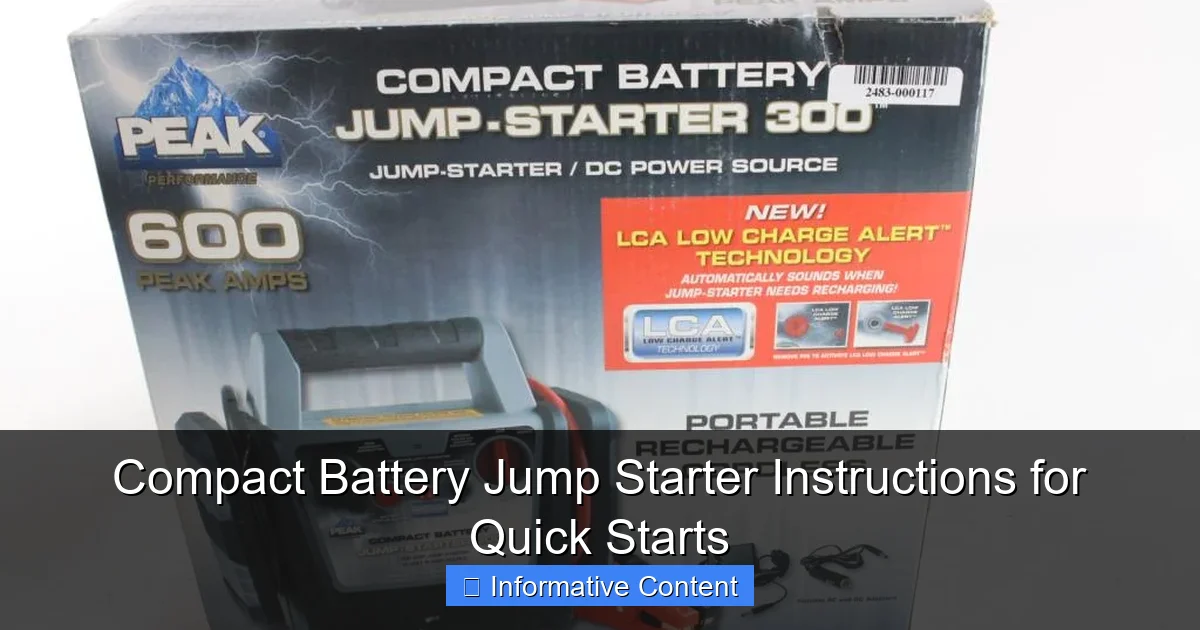
Featured image for compact battery jump starter instructions
Image source: content.propertyroom.com
Always connect the compact battery jump starter to the vehicle’s battery terminals in the correct order—red to positive (+) and black to negative (−)—to avoid sparks or damage. Ensure the device is fully charged and powered on before attempting a jump start, and disconnect it immediately once the engine starts. Follow the included safety instructions closely to prevent short circuits and ensure reliable, quick starts every time.
Key Takeaways
- Always check charge level before attempting a jump start.
- Connect red clamp first to the positive battery terminal.
- Attach black clamp last to a grounded metal surface.
- Wait 30 seconds after connecting before starting the vehicle.
- Disconnect in reverse order to prevent electrical hazards.
- Recharge after each use to maintain peak performance.
📑 Table of Contents
- Why Every Driver Needs a Compact Battery Jump Starter
- Understanding How Compact Jump Starters Work
- Choosing the Right Compact Jump Starter for Your Vehicle
- Step-by-Step Compact Battery Jump Starter Instructions
- Maintaining Your Jump Starter for Long-Term Reliability
- Beyond Jump-Starting: Other Uses and Real-World Examples
- Final Thoughts: Confidence in Every Crank
Why Every Driver Needs a Compact Battery Jump Starter
Imagine this: You’re running late for work, you hop in your car, turn the key, and—nothing. The engine doesn’t crank. The lights are dim. The silence is louder than any sound. Your heart sinks. You’re stuck, and the clock is ticking. This is a scenario no driver wants to face, yet it happens more often than we’d like. Dead batteries don’t care if you’re in a hurry or if the weather is freezing. But here’s the good news: You don’t have to wait for roadside assistance or rely on a stranger with jumper cables. A compact battery jump starter can get you back on the road in minutes—no help needed.
Over the past few years, these pocket-sized powerhouses have transformed from niche gadgets to essential car accessories. They’re not just for emergencies either. Whether you’re a daily commuter, a weekend road-tripper, or someone who leaves their car parked for weeks at a time, a compact jump starter is like having a spare tire for your battery. And unlike bulky traditional jump boxes, today’s models are lightweight, USB-powered, and smart enough to protect your vehicle’s electronics. But with so many options and features, knowing how to use one safely and effectively is just as important as owning it. In this guide, I’ll walk you through everything you need to know—from choosing the right model to mastering the compact battery jump starter instructions so you can start your car confidently, every time.
Understanding How Compact Jump Starters Work
The Science Behind the Spark
Let’s start with the basics. A compact battery jump starter is essentially a portable lithium-ion battery pack designed to deliver a high burst of current to your car’s starter motor when the main battery is dead or too weak. Unlike your car’s lead-acid battery, which stores a large amount of energy slowly over time, these jump starters use advanced lithium polymer (LiPo) or lithium iron phosphate (LiFePO4) cells. These batteries can release power quickly—perfect for jump-starting—without needing a full charge themselves.
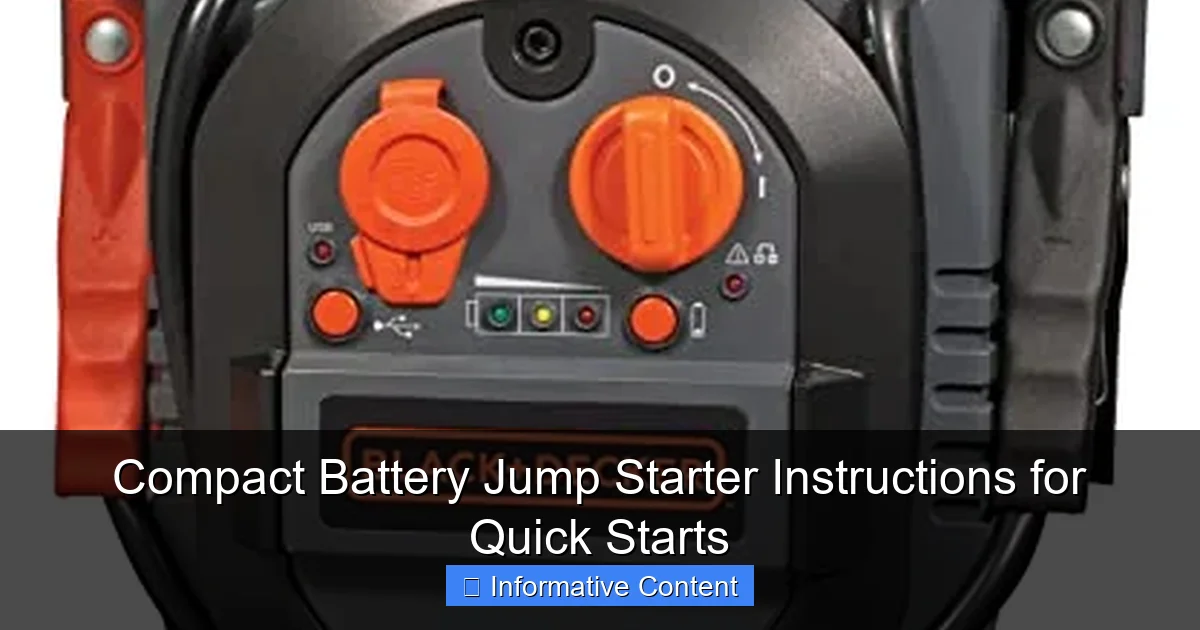
Visual guide about compact battery jump starter instructions
Image source: m.media-amazon.com
Think of it like a sprint versus a marathon. Your car battery is built for endurance—it powers lights, radio, and accessories for hours. But when it fails, it’s the sudden, high-demand “sprint” of cranking the engine that it can’t handle. The jump starter steps in for that sprint. It’s not meant to replace your car battery long-term, but to give it just enough juice to get the engine running so your alternator can take over.
Key Components and Safety Features
Modern compact jump starters come with several smart features that make them safer and more reliable than older models:
- Reverse Polarity Protection: Prevents damage if you accidentally connect the clamps backward. The device simply won’t turn on until the clamps are correctly attached.
- Spark-Free Clamps: Eliminates dangerous sparks, which is especially important near flammable fumes in older engines or poorly ventilated areas.
- Over-Current and Over-Voltage Protection: Prevents damage to your car’s electronics by limiting the power output.
- Low-Voltage Mode: Allows you to start a car even if the main battery is extremely weak (e.g., below 2 volts).
- USB Ports and LED Lights: Many models double as power banks for phones and have built-in flashlights—great for nighttime emergencies.
For example, I once left my headlights on overnight while camping. The battery was so dead it wouldn’t even power the dashboard. But my jump starter had a “low-voltage mode” that let me start the car after a 30-second pre-charge. That feature alone has saved me from towing fees twice.
What Makes Them “Compact”?
The term “compact” isn’t just marketing fluff. These devices are designed to fit in a glovebox, center console, or even your coat pocket. Most weigh between 1 and 3 pounds and are smaller than a paperback book. Despite their size, they pack enough punch to start engines up to 6.0L (gas) or 3.0L (diesel) in many cases. Some high-end models can even handle larger engines or multiple jump-starts on a single charge.
The secret? Advanced battery chemistry and efficient power management. Unlike lead-acid jump boxes, which are heavy and degrade over time, lithium-based starters hold their charge longer and recharge faster—often in 3–5 hours via a standard USB-C port.
Choosing the Right Compact Jump Starter for Your Vehicle
Matching Power to Your Engine
Not all compact jump starters are created equal. The key spec to look at is peak current, measured in amps. For most compact cars (under 4.0L gas engines), a starter with 1,000–1,500 peak amps is sufficient. For mid-size sedans, SUVs, or trucks with engines up to 6.0L, aim for 1,500–2,000 amps. Diesel engines require more power—look for 2,000+ amps, especially in colder climates.
But don’t just rely on peak amps. Also check the cranking amps (CA) and cold-cranking amps (CCA) ratings. These tell you how well the starter performs in real-world conditions, especially in winter. A model with 1,800 peak amps but only 500 CA might struggle in freezing temperatures. I learned this the hard way during a ski trip—my 1,200-amp starter barely turned over a 4.6L V8 in -10°F weather. Now I always check the CA/CCA specs, not just peak.
Battery Capacity and Recharge Time
Battery capacity (measured in milliamp-hours, or mAh) affects how many jump-starts you can get on a single charge. A 12,000 mAh starter might give you 10–15 starts for a small car but only 3–5 for a large SUV. Most models will list the estimated number of starts per charge, which is more useful than raw mAh.
Recharge time matters too. Some starters take 8+ hours with a basic wall adapter. Others support fast charging via USB-C and can be ready in 3 hours. If you’re a frequent traveler, consider one with a car charger or solar compatibility.
Additional Features to Consider
- USB Outputs: Useful for charging phones, tablets, or GPS devices. Look for at least one USB-A and one USB-C port.
- LED Flashlight: A must-have for nighttime emergencies. Some have SOS modes or strobe lights for signaling.
- Jump-Start Cable Design: Clamps should be sturdy and insulated. Some models have built-in cables; others use detachable ones (easier to replace if damaged).
- Smart Indicators: LED displays or app connectivity can show battery level, charge status, and even error alerts.
- Water Resistance: A rating of IP65 or higher is ideal for outdoor use or rainy climates.
For example, my current model has a built-in flashlight with an SOS mode. When I got a flat tire on a dark country road last year, I used the strobe to signal a passing truck—no cell service, no problem. It’s these small extras that turn a simple tool into a true emergency kit.
Step-by-Step Compact Battery Jump Starter Instructions
Before You Start: Safety First
Even though compact jump starters are safer than traditional cables, you still need to follow basic safety rules:
- Park on a flat surface: Engage the parking brake and turn off the engine (if running).
- Check for damage: Inspect the starter, cables, and clamps for cracks, frayed wires, or corrosion.
- Wear gloves and eye protection: Especially important if you suspect battery leakage.
- Keep the starter charged: Aim for at least 50% charge before use. A fully depleted starter won’t help you.
I keep a small microfiber cloth in my glovebox to wipe down the clamps after each use—it prevents dirt buildup that can affect conductivity.
Connecting the Jump Starter (Standard Method)
Follow these compact battery jump starter instructions for a safe and successful jump:
- Turn off the jump starter (if it has a power switch).
- Locate your car’s battery: Usually under the hood, but some cars have it in the trunk or under a seat. Refer to your owner’s manual if unsure.
- Identify the positive (+) and negative (-) terminals: The positive is usually red and marked with a “+” sign. The negative is black and marked with a “-“.
- Connect the red clamp to the positive terminal. Make sure it’s snug and metal-to-metal.
- Connect the black clamp to a grounded metal surface: Not the negative terminal. Instead, pick a clean, unpainted metal part of the engine block or chassis (e.g., a bolt or bracket). This prevents sparks near the battery, which could ignite hydrogen gas.
- Turn on the jump starter: Some models power on automatically; others need a button press. Check the LED indicators—most will show a green light when ready.
- Attempt to start the car: Turn the key or press the start button. If it doesn’t start on the first try, wait 30 seconds and try again. Avoid cranking for more than 5 seconds at a time.
- Once the engine runs, disconnect in reverse order: Turn off the starter, remove the black clamp, then the red clamp. Store the starter safely.
Pro tip: If the engine turns over but doesn’t catch, try letting the starter “pre-charge” the battery for 30–60 seconds before cranking. This is especially helpful for deeply discharged batteries.
Troubleshooting Common Issues
- No power from the starter: Check if it’s charged. Try a different USB cable or power source for recharging.
- Clamps get hot: Disconnect immediately. This could mean a short circuit or poor connection. Let cool before retrying.
- Car won’t start even with a good starter: The battery might be too far gone. Try jump-starting with another car first, then use the starter. Or, the issue might not be the battery—could be a bad starter motor or alternator.
- Reverse polarity alert: If the starter beeps or flashes red, double-check the clamps. Swap them if needed.
I once panicked when my starter wouldn’t turn on—until I realized I’d left it in the freezer overnight (don’t ask). Lithium batteries hate extreme cold. I warmed it under my arm for 5 minutes, and it worked perfectly. Moral of the story: Keep your starter at room temperature.
Maintaining Your Jump Starter for Long-Term Reliability
Charging and Storage Tips
Your compact jump starter is only as good as its battery. To keep it ready:
- Recharge every 3–6 months: Even if unused. Lithium batteries degrade when stored fully discharged.
- Use the right charger: Stick to the included USB-C or wall adapter. Avoid cheap third-party chargers that can overheat the battery.
- Store in a cool, dry place: Avoid direct sunlight, car interiors (which can hit 140°F+ in summer), or damp garages.
- Keep the clamps clean: Wipe with a dry cloth after use. For stubborn corrosion, use a baking soda paste (1 tsp baking soda + 1 tsp water) and a soft brush.
I set a phone reminder every 4 months to charge my starter. It takes 10 minutes and gives me peace of mind.
When to Replace Your Starter
Most compact jump starters last 3–5 years with proper care. Signs it’s time to replace:
- It takes longer to recharge.
- The battery level drops quickly during use.
- It fails to hold a charge for more than a few days.
- Physical damage (cracks, swollen casing, frayed cables).
I retired my first starter after 4 years. It still worked, but the capacity had dropped by about 30%. The new one has better cold-weather performance and a longer warranty—worth the upgrade.
Winter Care for Cold Climates
Freezing temperatures can reduce lithium battery performance by up to 50%. To combat this:
- Keep the starter in an insulated case or inside your vehicle (not the trunk).
- Warm it up before use: Hold it in your hands or place it near the heater vent for 5–10 minutes.
- Use a model with a “low-temperature mode” if you live in a cold region.
My neighbor in Minnesota keeps his starter in a small cooler in the backseat. The insulation helps retain heat, and it’s always ready when he needs it.
Beyond Jump-Starting: Other Uses and Real-World Examples
Power Bank for Electronics
Most compact jump starters double as portable power banks. With USB-A and USB-C ports, you can charge:
- Phones (10–20 full charges, depending on capacity)
- Tablets (2–5 charges)
- GPS devices, dash cams, or portable speakers
I used mine to power a Bluetooth speaker during a beach picnic. The kids loved it—and so did I when the car battery died later that day (oops).
Emergency Lighting and Signaling
The built-in LED flashlight is a game-changer. Use it for:
- Changing a tire at night
- Reading maps or documents
- SOS signaling in remote areas
During a power outage, I used my starter’s flashlight to navigate my basement and check the breaker panel. It was brighter and more reliable than my phone’s flashlight.
Boat, Motorcycle, and ATV Starts
Many compact starters work on small engines too. Just check the manual for compatibility. I’ve used mine to start:
- A friend’s motorcycle (250cc)
- A boat outboard motor (50 hp)
- A snowblower (after a long winter)
The key is matching the starter’s power to the engine size. A 1,000-amp model might work for a scooter but not a large diesel truck.
Data Table: Popular Compact Jump Starters (2024)
| Model | Peak Amps | Battery (mAh) | Weight | USB Ports | Special Features | Best For |
|---|---|---|---|---|---|---|
| NOCO Boost Plus GB40 | 1,000 | 12,000 | 2.4 lbs | USB-A, USB-C | Spark-proof, 100-lumen LED, 24-month warranty | Compact cars, motorcycles |
| DBPOWER 2000A | 2,000 | 20,000 | 3.1 lbs | 2x USB-A, USB-C | Jump-starts 8L gas/6L diesel, 12V outlet, app control | SUVs, trucks, boats |
| GOOLOO GP4000 | 4,000 | 40,000 | 4.2 lbs | 2x USB-A, 2x USB-C | Starts 10L engines, 1000-lumen flashlight, IP65 waterproof | Large trucks, diesel engines |
| TACKLIFE T8 Pro | 1,800 | 18,000 | 2.8 lbs | USB-A, USB-C | Low-voltage mode, 24-month warranty, 12V outlet | Winter climates, older batteries |
Final Thoughts: Confidence in Every Crank
Owning a compact battery jump starter isn’t just about convenience—it’s about confidence. It’s knowing that no matter where you are, no matter how dead your battery is, you have the power to get moving again. And with the right compact battery jump starter instructions under your belt, you can do it safely, quickly, and without stress.
But remember: A jump starter is a tool, not a cure-all. If your car won’t start repeatedly, the battery or alternator might need replacement. Use the starter to get home or to a mechanic—not as a permanent fix. And always keep it charged, stored properly, and inspected regularly.
Think of it as an insurance policy you hope never to use, but are glad you have. Whether you’re a city driver, a road-trip enthusiast, or just someone who hates being stranded, this little device can make all the difference. So tuck it in your glovebox, share these instructions with your family, and drive with peace of mind. Because the next time your car won’t start, you won’t be waiting for help. You’ll be on your way.
Frequently Asked Questions
How do I use a compact battery jump starter for the first time?
To use your compact battery jump starter, first ensure the device is fully charged. Connect the jumper cables to the battery terminals (red to positive, black to negative), then turn on the jump starter and start your vehicle. Always follow the compact battery jump starter instructions included with your model.
Can a compact battery jump starter work on all vehicle types?
Most compact jump starters are designed for 12V vehicles like cars, SUVs, and motorcycles, but verify your model’s voltage and peak amperage compatibility. Check the manual to confirm it supports your vehicle’s engine size (e.g., up to 6.0L gas engines).
How long does it take to charge a compact battery jump starter?
Charging time varies by model, but most take 3–5 hours via a wall outlet or USB port. Refer to your compact battery jump starter instructions for exact specs and avoid overcharging to prolong battery life.
Is it safe to leave the jump starter connected to the battery after starting?
No—disconnect the jump starter immediately after starting the engine to prevent overheating or damage. Leaving it connected unnecessarily drains the device’s battery and risks electrical issues.
What should I do if the jump starter doesn’t power on?
First, ensure the device is charged and the power button is held for 3–5 seconds (some models require a long press). If it still fails, check for fault codes in the manual or contact customer support.
How often should I recharge my compact jump starter when not in use?
Recharge every 3–6 months to maintain optimal battery health, even if unused. Lithium-ion batteries degrade over time, so regular charging preserves performance and readiness for emergencies.