
Featured image for can a power inverter jump start a car
No, a power inverter cannot jump start a car because it converts DC power from a battery into AC power for devices, not the high-current DC surge needed to crank an engine. Jump starters and inverters serve entirely different functions, so relying on an inverter for a dead battery will leave you stranded—always use a proper jump starter or jumper cables instead.
Key Takeaways
- Power inverters cannot jump start cars – they lack the required surge current.
- Use dedicated jump starters – designed for high-cranking amps and safety.
- Inverters convert DC to AC – not built for direct battery boosting.
- Check device specifications – ensure compatibility before attempting alternatives.
- Portable power stations work – if they feature jump-starting capabilities.
- Always prioritize safety – avoid makeshift solutions that risk damage.
📑 Table of Contents
- Can a Power Inverter Jump Start a Car? Let’s Settle This Once and for All
- How Jump-Starting a Car Actually Works
- What a Power Inverter Can (and Can’t) Do
- Safer, Smarter Alternatives to Jump-Starting
- Common Myths and Misconceptions
- When an Inverter *Might* Help (The Edge Cases)
- The Bottom Line: What You Should Do Instead
Can a Power Inverter Jump Start a Car? Let’s Settle This Once and for All
Imagine this: you’re rushing out the door for a meeting, or worse, you’re stranded on the side of a quiet road at night. You turn the key, and instead of the familiar hum of your engine, you’re met with silence—or worse, a weak, sputtering crank. Your car battery is dead. Panic sets in. You don’t have jumper cables or a helpful stranger nearby. But wait—you’ve got a power inverter in your trunk, the one you use to charge your laptop or power a small appliance. Could it save the day by jump-starting your car? It’s a question I’ve asked myself more than once, and if you’re reading this, you probably have too.
Power inverters are handy little devices, transforming your car’s 12-volt DC battery power into standard 120-volt AC power for household gadgets. But can they reverse the flow and give your car battery a jump? The short answer: **not directly, and not in the way most people think**. But there’s more to the story. In this post, we’ll break down exactly what a power inverter can and can’t do, explore the science behind jump-starting, and share smarter, safer alternatives. Whether you’re a weekend warrior, a daily commuter, or a road-trip enthusiast, knowing the limits of your gear could save you time, money, and a whole lot of frustration.
How Jump-Starting a Car Actually Works
The Basics of a Dead Car Battery
Before we dive into inverters, let’s talk about what happens when your car won’t start. A car battery stores electrical energy in chemical form. When you turn the key, the battery sends a surge of current to the starter motor, which cranks the engine. If the battery is dead, it can’t deliver that surge—no matter how many times you turn the key.
Visual guide about can a power inverter jump start a car
Image source: bestpowerinverter.com
A typical car battery operates at 12 volts and needs **at least 10.5 volts** to start the engine. But voltage isn’t the only factor—**amperage (current)** matters too. The starter motor might need 100 to 200 amps (sometimes more) for a few seconds to turn the engine over. This is why jump-starting works: a healthy battery from another car can deliver both the voltage and the high current needed to get your engine running.
The Role of Jumper Cables and External Batteries
Jump-starting relies on a simple principle: **direct electrical connection**. Jumper cables link the dead battery to a good one, allowing current to flow. The donor battery (or a jump starter pack) must be able to supply enough power to overcome the resistance in the starter motor and ignite the fuel-air mixture.
Here’s a real-world example: my friend once tried to jump-start his SUV with a tiny motorcycle battery. It had 12 volts, but the amperage was too low—no cranking. It’s not just about voltage; it’s about **power delivery under load**. A power inverter, as we’ll see, can’t provide this kind of raw, high-current output directly from a dead battery.
Why People Think Inverters Can Help
It’s an understandable mix-up. You see an inverter powering a coffee maker or a phone charger, and you think, “If it can run these devices, why not help start the car?” But here’s the catch: inverters work *from* the car battery, not *for* it. They’re like a middleman—they don’t generate power; they convert it. And they’re not designed to handle the massive current draw of a starter motor.
What a Power Inverter Can (and Can’t) Do
How Power Inverters Work
A power inverter takes the 12-volt DC (direct current) from your car battery and converts it into 120-volt AC (alternating current) so you can plug in household devices. Think of it as a translator between your car’s electrical system and your gadgets. Most inverters are rated by **wattage**—common sizes are 150W, 300W, 500W, or even 1000W+ for larger setups.
For example, a 300-watt inverter can power a laptop, a small TV, or a portable fan. But it can’t power a hairdryer or a space heater—those draw too much power. And crucially, it **can’t output more power than what the car battery provides**. If your battery is dead, the inverter has nothing to work with.
The Myth: Can an Inverter “Boost” a Weak Battery?
Some people wonder: “If I plug the inverter into my dead battery and then plug a device into it, will the device somehow ‘charge’ the battery or help start the car?” Nope. Here’s why:
- Direction of flow: Power flows from the battery → inverter → device. It doesn’t go backward. The inverter isn’t a charger or a generator.
- Low battery = no output: If your battery is below 10 volts, most inverters won’t even turn on. They have low-voltage protection to avoid draining the battery completely.
- No current boost: Even if the inverter runs, it can’t magically create the 100+ amps the starter needs. A 300W inverter, for example, can only deliver about 2.5 amps of 120V AC power—far less than what a starter motor demands.
I once saw a viral video where someone claimed they “jumped” their car by plugging a battery charger into an inverter, then into a dead battery. Spoiler: it didn’t work. The charger was designed for AC outlets, not DC input from a car battery. The inverter couldn’t power the charger without a working battery—classic circular logic.
Real-World Test: Can an Inverter Power a Jump Starter?
Here’s a more plausible idea: *Can I use my inverter to power a portable jump starter pack, then use that to start the car?* This is a **two-step process** that *can* work—but with caveats.
Let’s say you have:
– A 500-watt power inverter
– A portable jump starter (like a NOCO Boost or DBPOWER)
– A car with a completely dead battery
You plug the jump starter into the inverter, which is connected to your car’s battery (even if it’s dead). If the battery has *just enough* voltage (say, 9–10 volts), the inverter might turn on and charge the jump starter. Once the jump starter is fully charged, you disconnect it, connect it to the car battery, and use it to start the engine.
But there’s a catch: if your car battery is *too* dead (below 9 volts), the inverter won’t activate. And if the battery is completely flat, you’re back to square one. This method only works if the battery has a *minimal* charge—enough to power the inverter briefly.
Tip: Always check your inverter’s low-voltage cutoff. Most shut off around 10.5–11 volts. If your battery is below that, this method fails.
Safer, Smarter Alternatives to Jump-Starting
Portable Jump Starter Packs (The Real Hero)
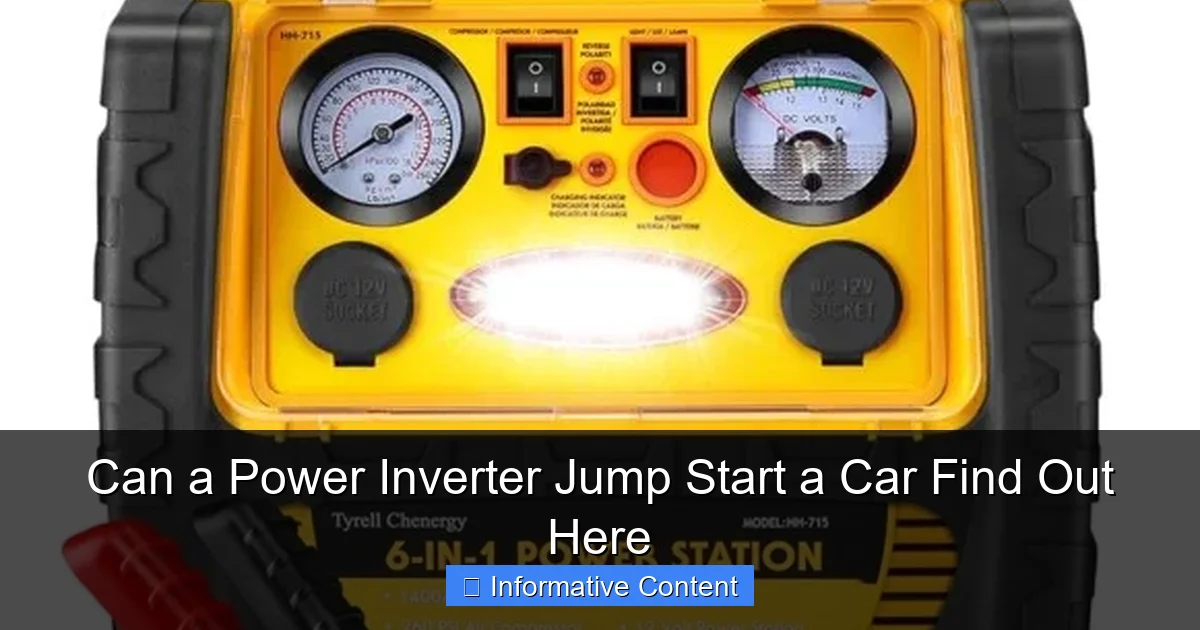
If you’re looking for a reliable way to start your car without another vehicle, **a portable jump starter is your best friend**. These are lithium-ion battery packs (like power banks for cars) that deliver 12V DC directly to your battery terminals. No inverter needed.
Here’s why they’re better than trying to hack an inverter:
– High cranking amps: Top models deliver 1000–2000 peak amps—enough to start most cars, trucks, and even small boats.
– Built-in safety features: Reverse polarity protection, spark-proof clamps, and overload alerts.
– Rechargeable and compact: Many can be charged via USB or a wall outlet. Keep one in your glovebox.
Example: I keep a 1200-amp jump starter in my trunk. Last winter, my battery died after leaving the lights on. I connected the jump starter, turned the key, and the engine roared to life in seconds. No cables, no waiting for help, no inverter involved.
Traditional Jumper Cables (When You Have Help)
Jumper cables are still the gold standard—if you have another car. They’re cheap, reliable, and deliver the high current your starter needs. Just remember:
– Use 4-gauge or thicker cables (thinner cables overheat and fail).
– Connect the cables in the right order: positive to positive, negative to negative (or engine block).
– Let the donor car run for a few minutes before attempting to start yours.
Pro tip: Keep a set of jumper cables in your car, even if you have a jump starter. You never know when you’ll need to help someone else—or when your jump starter will be out of juice.
Trickle Chargers and Battery Maintainers
If you’re not in a rush, a trickle charger can slowly revive a weak battery. These plug into a wall outlet and deliver a low, steady current to the battery. They’re great for:
– Long-term storage (e.g., winterizing a car)
– Batteries that are drained but not completely dead
– Preventing sulfation (a common cause of battery failure)
Example: My neighbor uses a smart trickle charger on his classic car. He leaves it connected all winter. In spring, the battery is as good as new.
Common Myths and Misconceptions
Myth #1: “Any Inverter Can Jump-Start a Car”
This is the biggest misconception. People see “1000W inverter” and assume it can power anything—including a car starter. But wattage is only part of the equation. A 1000W inverter might draw **80+ amps** from your battery to deliver 1000 watts of AC power. But a starter motor needs **100–200 amps at 12V DC**—and it needs it in a surge, not a steady draw.
Even if you could somehow convert AC back to DC (you can’t with a standard inverter), the efficiency losses and timing delays would make it useless for starting a car.
Myth #2: “I Can Use a Generator with an Inverter”
Some folks think, “What if I bring a portable generator, plug the inverter into it, and use that to jump the car?” This is *technically* possible but wildly impractical:
– You need a generator (heavy, noisy, requires fuel)
– The inverter converts AC → DC (inefficient)
– The jump starter (if you’re using one) then converts DC → AC → DC again (even more inefficient)
– Total energy loss: 30–50%
It’s like using a ladder to climb a single step. Just use the generator to power a trickle charger or a jump starter directly.
Myth #3: “Inverters Can Charge a Dead Battery”
Unless your inverter has a built-in battery charger (rare and not recommended for car batteries), it can’t charge a dead battery. Charging requires a **regulated, constant-current/constant-voltage (CC/CV) process**—something inverters aren’t designed for.
Plugging a standard battery charger into an inverter won’t work if the car battery is too dead to power the inverter. It’s a dead end.
When an Inverter *Might* Help (The Edge Cases)
Scenario 1: Weak Battery + Jump Starter + Inverter
As mentioned earlier, if your battery has *just enough* charge to power the inverter (say, 10 volts), you can use it to charge a portable jump starter. Once the jump starter is charged, use it to start the car.
Steps:
- Connect the inverter to the car battery.
- Plug in the jump starter and charge it for 15–30 minutes.
- Disconnect the inverter.
- Connect the jump starter to the battery and start the car.
Important: This only works if the battery isn’t completely dead. If it’s below 9 volts, the inverter won’t turn on.
Scenario 2: Inverter as a Power Source for a Smart Charger
Some advanced battery chargers can work with inverters, but they’re designed for this. For example, a “smart” 12V battery charger that accepts AC input (from the inverter) and outputs regulated DC to the battery. But again, the car battery must have enough charge to run the inverter first.
Example: A NOCO Genius 5 can be powered by an inverter, but it won’t charge a battery below 2 volts. So if your battery is that dead, you’re out of luck.
Data Table: Inverter vs. Jump Starter – What Works When
| Scenario | Power Inverter | Portable Jump Starter | Jumper Cables | Trickle Charger |
|---|---|---|---|---|
| Battery completely dead (0–2V) | ❌ Won’t turn on | ❌ Most can’t jump below 5V | ❌ Needs donor car | ✅ Works slowly |
| Battery weak (8–10V) | ⚠️ Can charge jump starter if battery >9V | ✅ Works (most models) | ✅ Works | ✅ Works |
| Battery very weak (10–11V) | ✅ Can power devices | ✅ Works | ✅ Works | ✅ Works |
| No other car available | ⚠️ Only if battery has minimal charge | ✅ Best option | ❌ Not possible | ✅ Works |
| Long-term battery maintenance | ❌ Not designed for this | ❌ Not designed for this | ❌ Not applicable | ✅ Ideal |
This table shows that while inverters have niche uses, they’re not a reliable jump-starting tool. A portable jump starter is the clear winner for emergency situations.
The Bottom Line: What You Should Do Instead
So, can a power inverter jump start a car? The honest answer is: **not directly, and not reliably**. It’s not designed for that purpose, and relying on it could leave you stranded when you need help most. But that doesn’t mean your inverter is useless in a pinch—it just has different strengths.
Here’s what I recommend:
- Keep a portable jump starter in your car. It’s lightweight, rechargeable, and can save you from calling for help.
- Carry jumper cables as a backup. They’re cheap and work when you have another car.
- Use your inverter for what it’s made for: powering gadgets, charging phones, or running small appliances when the engine is on.
- Invest in a smart trickle charger if you store your car for long periods.
- Check your battery health regularly. A weak battery is easier to jump than a dead one.
Think of your inverter as a multitool—great for small jobs, but not a hammer. And your jump starter? That’s the hammer. When you need brute force, you want the right tool for the job.
Next time your car won’t start, don’t waste time plugging in your laptop charger or trying to hack your inverter. Grab your jump starter, follow the instructions, and get back on the road. And if you’re still unsure, remember: the best time to prepare for a dead battery is when it’s still alive. Stay charged, stay safe, and keep moving forward.
Frequently Asked Questions
Can a power inverter jump start a car?
No, a power inverter alone cannot jump start a car. It converts DC power from a battery to AC power for devices but lacks the high current needed to crank an engine. You’d need a dedicated jump starter or jumper cables for this task.
What kind of power inverter would I need to jump start a car?
Even high-wattage power inverters (e.g., 3,000W+) can’t safely or effectively jump start a car. Jump-starting requires a surge of DC power (typically 300–1,500 amps), which inverters aren’t designed to deliver. Always use a proper jump starter or car battery booster.
Can I use a power inverter with a portable battery to jump start my car?
While some portable batteries have built-in inverters, they still won’t provide the direct DC current needed for jump-starting. Look for a power station with a dedicated jump-start port instead. These combine the right voltage and amperage for safe engine starts.
Why do people think power inverters can jump start a car?
Confusion arises because power inverters and jump starters both connect to car batteries. However, inverters only supply AC power for electronics, not the high-current DC output required to start an engine. The functions are entirely different.
Is it safe to try using a power inverter to jump start a car?
It’s unsafe and not recommended. Forcing an inverter to deliver jump-start current can damage the device, battery, or vehicle electronics. Always use equipment specifically designed for jump-starting to avoid hazards like sparks or battery explosions.
What’s the best alternative to a power inverter for jump starting a car?
Use a portable jump starter (lithium-ion booster pack) or traditional jumper cables connected to another vehicle. These deliver the necessary DC amperage safely. Many modern jump starters also include power inverter features for added versatility.