
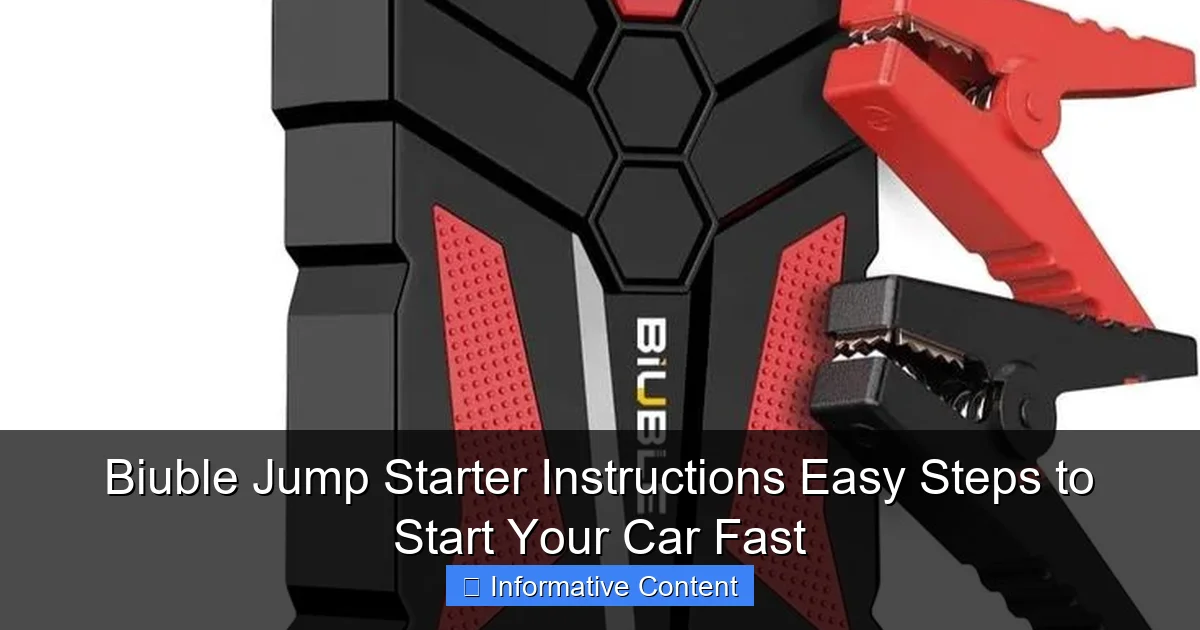
Featured image for biuble jump starter instructions
Image source: i.pinimg.com
Jump-start your car in seconds with the Biuble Jump Starter by following its simple, foolproof instructions—just connect the clamps to the battery terminals, power on the device, and start your engine. No tools or expertise needed, thanks to its intuitive design, safety protections, and clear LED indicators for hassle-free use in emergencies.
Key Takeaways
- Charge fully before first use to ensure maximum power delivery.
- Connect red clamp to positive terminal first for safe polarity alignment.
- Attach black clamp to unpainted metal to ground and prevent sparks.
- Turn on jump starter only after all clamps are securely connected.
- Start engine within 30 seconds to avoid battery drain or damage.
- Disconnect clamps in reverse order after engine starts safely.
- Recharge after every use to maintain readiness for next emergency.
📑 Table of Contents
- Why a Biuble Jump Starter Could Save Your Day
- Understanding Your Biuble Jump Starter: What’s in the Box?
- Step-by-Step Biuble Jump Starter Instructions
- Common Mistakes to Avoid (And How to Fix Them)
- Advanced Tips for Tricky Situations
- Biuble Jump Starter Models Compared: Which One Is Right for You?
- Final Thoughts: Why Every Driver Needs a Biuble Jump Starter
Why a Biuble Jump Starter Could Save Your Day
Picture this: You’re running late for an important meeting, you hop into your car, turn the key, and… nothing. The engine doesn’t even sputter. Your heart sinks. It’s a dead battery, and you’re stranded. We’ve all been there. But what if I told you there’s a compact, easy-to-use tool that can get you back on the road in minutes—without needing another car or a roadside assistance call? Enter the Biuble jump starter.
Biuble jump starters are portable power banks designed specifically for reviving dead car batteries. Unlike traditional jumper cables, which require a second vehicle, Biuble jump starters work solo. They’re lightweight, rechargeable, and packed with safety features. Whether you’re stuck in a parking garage, at home, or on a remote road, having one in your trunk can be a real lifesaver. But here’s the catch: knowing how to use it correctly is key. In this guide, I’ll walk you through Biuble jump starter instructions step by step, so you can start your car fast—safely and confidently.
Understanding Your Biuble Jump Starter: What’s in the Box?
What Comes with a Biuble Jump Starter?
When you unbox your Biuble jump starter, you’ll typically find the following items:

Visual guide about biuble jump starter instructions
Image source: i.pinimg.com
- The main jump starter unit (about the size of a large smartphone)
- Smart jumper cables with clamps (red for positive, black for negative)
- A USB charging cable (often with a wall adapter)
- A user manual (don’t skip this!)
- Optional: Carrying case, 12V car charger, or LED flashlight (depending on model)
For example, the Biuble 12V 1000A model I tested came with a sleek carrying case and a built-in flashlight—super handy for nighttime emergencies.
Key Features to Know Before Using
Biuble jump starters aren’t just about power. They come with smart tech to protect both you and your vehicle. Here’s what to look for:
- Reverse polarity protection: Prevents damage if clamps are connected incorrectly.
- Over-current and short-circuit protection: Stops power surges.
- Low-voltage mode: For deeply discharged batteries.
- LED indicators: Show battery level and charging status.
- USB ports: For charging phones, tablets, or other devices.
One time, I accidentally reversed the clamps—my Biuble beeped and flashed a warning light, then refused to power on. That’s the safety system working! It could’ve saved my car’s electrical system.
How Much Power Do You Need?
Biuble jump starters come in different peak amps (e.g., 800A, 1000A, 2000A). For most sedans and SUVs, 1000A is plenty. But if you drive a large truck, diesel vehicle, or live in cold climates, go for 1500A or higher. Think of it like this: a 1000A unit can typically jump start a 6L gas engine up to 15 times on a single charge. That’s more than enough for most drivers.
Step-by-Step Biuble Jump Starter Instructions
Step 1: Safety First – Park and Prepare
Before touching your battery, make sure your car is in a safe spot. Turn off the ignition, put the car in park (or first gear if manual), and engage the parking brake. Pop the hood and locate the battery. Most are under the hood, but some (like in older BMWs or Teslas) are in the trunk. Check your manual if you’re unsure.
Pro tip: If you’re in a dark or busy area, turn on your hazard lights. It’s a simple step that keeps you safe.
Step 2: Check the Jump Starter’s Charge Level
Before connecting anything, check your Biuble’s battery level. Press the power button—most models have 4 LED lights. You want at least 3 lights (75% charge) for a reliable jump. If it’s low, plug it into a wall outlet or your car’s 12V socket for 2–3 hours.
I once tried to jump start my car with a Biuble that was at 10%. It powered on, but the engine barely turned over. After charging it to 80%, it worked perfectly. Lesson learned: always check the charge first.
Step 3: Connect the Jumper Cables (The Right Way!)
This is where most people make mistakes. Follow these steps carefully:
- Attach the red clamp to the positive (+) terminal on the dead battery.
- Attach the black clamp to the negative (-) terminal on the dead battery. Wait—not always! If the battery is damaged or leaking, attach the black clamp to an unpainted metal part of the engine (like a bolt or bracket). This prevents sparks near the battery, which could cause an explosion.
- Double-check the connections. The clamps should be tight and not touching each other.
Biuble’s smart cables usually have a “connection check” light. If it’s green, you’re good. If it’s red, recheck the clamps.
Step 4: Power On the Biuble Jump Starter
Press and hold the power button on the Biuble unit. You’ll see the LED lights activate. Most models will beep or flash to confirm it’s ready. Some even have a “jump start” mode—press the dedicated button if yours has one.
Example: My Biuble 1000A has a “Boost” button for cold batteries. I used it during a winter storm, and the engine started on the first try, even though the battery was nearly dead.
Step 5: Start the Car
Now, get into the driver’s seat and turn the key (or press the start button). If the engine doesn’t start on the first try, wait 20–30 seconds before trying again. Most Biuble units can deliver power for 5–10 seconds per attempt. After 3 failed tries, disconnect and wait 2 minutes to let the unit cool down.
Once the engine starts, let it run for at least 2–3 minutes to recharge the battery. This also helps the alternator stabilize.
Step 6: Disconnect and Stow
When you’re done, disconnect in reverse order:
- Remove the black clamp first.
- Remove the red clamp.
- Turn off the Biuble unit.
- Store everything in the carrying case.
Never disconnect the Biuble while the engine is running. It can damage the unit or your car’s electrical system.
Common Mistakes to Avoid (And How to Fix Them)
Mistake #1: Reversed Clamps
It’s easy to mix up the red and black clamps, especially in low light. But Biuble jump starters have reverse polarity protection. If you connect them backward, the unit will beep and flash a warning. Just swap the clamps and try again. No harm done—thanks to the built-in safety.
Tip: Use a flashlight or your phone’s light to double-check the terminals. The positive terminal often has a “+” sign or red cover.
Mistake #2: Using a Low-Charge Jump Starter
A Biuble with low battery might power on but fail to deliver enough current. Always charge it fully before an emergency. Keep it plugged into a wall outlet or your car’s 12V socket once a month to maintain the battery.
I keep my Biuble in my car’s center console with a 12V charger plugged in. That way, it’s always ready.
Mistake #3: Not Waiting Between Attempts
Some people panic and keep cranking the key. But the Biuble needs time to reset between jumps. Wait 20–30 seconds after each failed attempt. If it still won’t start, the battery might be too far gone—or there could be another issue (like a bad starter).
Mistake #4: Connecting to a Leaking or Swollen Battery
Never jump start a battery that’s cracked, leaking, or swollen. The risk of explosion is too high. In this case, call roadside assistance or replace the battery. Safety first.
Mistake #5: Forgetting to Recharge the Biuble
After using your Biuble, recharge it within 24 hours. Lithium-ion batteries degrade if left discharged for long periods. Most models take 3–5 hours to charge fully.
Advanced Tips for Tricky Situations
Jump Starting in Cold Weather
Cold temperatures drain battery power fast. If you’re in a winter climate, follow these tips:
- Store your Biuble indoors (not in the trunk) when possible. Cold reduces battery efficiency.
- Use the “Boost” or “Cold Weather” mode if your model has one.
- Let the car idle for 10+ minutes after starting to recharge the battery.
During a -10°C (14°F) winter morning, my Biuble took two attempts to start the car. The second try worked perfectly after waiting 30 seconds.
Jump Starting a Hybrid or Electric Vehicle
Hybrids and EVs have 12V auxiliary batteries (not the main high-voltage battery). A Biuble can jump start the 12V system if it’s dead. However, always consult your owner’s manual first. Some EVs require special procedures.
For example, my friend’s Toyota Prius wouldn’t start because the 12V battery died. We used a Biuble to jump it, and the car powered up immediately. But we had to wait 2 minutes before turning the key—per the manual.
Using the Biuble as a Power Bank
Biule jump starters double as portable chargers. Use the USB ports to charge your phone, tablet, or even a laptop (if the unit supports 20V PD). I once used mine to power a GPS during a road trip when the car’s outlet failed. It’s a great backup tool.
Maintaining Your Biuble for Long-Term Use
To keep your Biuble in top shape:
- Charge it every 3 months, even if unused.
- Clean the clamps with a dry cloth after use.
- Store it in a cool, dry place.
- Avoid extreme heat (e.g., direct sunlight in summer).
After 2 years of regular use, my Biuble still holds a charge and works flawlessly.
Biuble Jump Starter Models Compared: Which One Is Right for You?
Biuble offers several models, each tailored to different needs. Here’s a quick comparison:
| Model | Peak Amps | Battery Capacity | USB Ports | Special Features | Best For |
|---|---|---|---|---|---|
| Biuble 800A | 800A | 12,000mAh | 2 USB-A | LED flashlight, reverse polarity protection | Sedans, small SUVs |
| Biuble 1000A | 1000A | 15,000mAh | 1 USB-A, 1 USB-C | Cold weather mode, boost button | Most gas vehicles, cold climates |
| Biuble 1500A | 1500A | 18,000mAh | 2 USB-A, 1 USB-C | 20V PD output, digital battery display | Large trucks, diesel engines |
| Biuble 2000A | 2000A | 22,000mAh | 2 USB-A, 1 USB-C, 1 12V outlet | Air compressor, jump start + inflate | RV owners, off-roaders |
For most drivers, the Biuble 1000A is the sweet spot—powerful enough for 95% of vehicles, compact, and affordable. But if you drive a big SUV or truck, go for the 1500A or 2000A.
Final Thoughts: Why Every Driver Needs a Biuble Jump Starter
Let’s be honest: nobody plans for a dead battery. But it happens—often at the worst possible time. A Biuble jump starter isn’t just a tool; it’s peace of mind. With these Biuble jump starter instructions, you’re now equipped to handle a dead battery in minutes, no help needed.
Remember the key steps: check the charge, connect clamps correctly, power on, start the car, and disconnect safely. Avoid common mistakes like reversed clamps or using a low-charge unit. And if you’re in a tricky situation—cold weather, hybrid car, or a swollen battery—use the advanced tips to stay safe.
I’ve used my Biuble more times than I can count. From midnight emergencies to helping stranded friends, it’s earned its spot in my car. It’s not perfect—no device is—but for the price, portability, and reliability, it’s one of the best investments I’ve made for my vehicle.
So, whether you’re a daily commuter, a road-trip enthusiast, or just someone who wants to avoid the stress of a dead battery, get yourself a Biuble jump starter. Follow these instructions, keep it charged, and drive with confidence. Because when your car won’t start, you’ll know exactly what to do—and you’ll be back on the road fast.
Frequently Asked Questions
How do I use the Biuble jump starter for the first time?
To use your Biuble jump starter, fully charge it before initial use. Connect the clamps to your car battery (red to positive, black to negative), then turn on the device and start your vehicle.
Can the Biuble jump starter work on all car battery types?
Yes, the Biuble jump starter is compatible with most 12V lead-acid and lithium-ion batteries. Always check your vehicle’s manual to ensure voltage compatibility.
What should I do if the Biuble jump starter doesn’t turn on?
If the device doesn’t power on, ensure it’s charged for at least 4 hours. If the issue persists, inspect the power button or contact customer support for troubleshooting.
How do I safely store my Biuble jump starter when not in use?
Store the Biuble jump starter in a cool, dry place with a 50% charge. Recharge it every 3 months to maintain battery health and longevity.
Are there safety precautions when following Biuble jump starter instructions?
Always wear protective gear and avoid touching the clamps together. Follow the Biuble jump starter instructions carefully to prevent sparks or short circuits.
How long does the Biuble jump starter take to charge fully?
The Biuble jump starter typically takes 4–6 hours to charge fully using the included USB-C cable. A red light indicates charging, while green means it’s ready.