
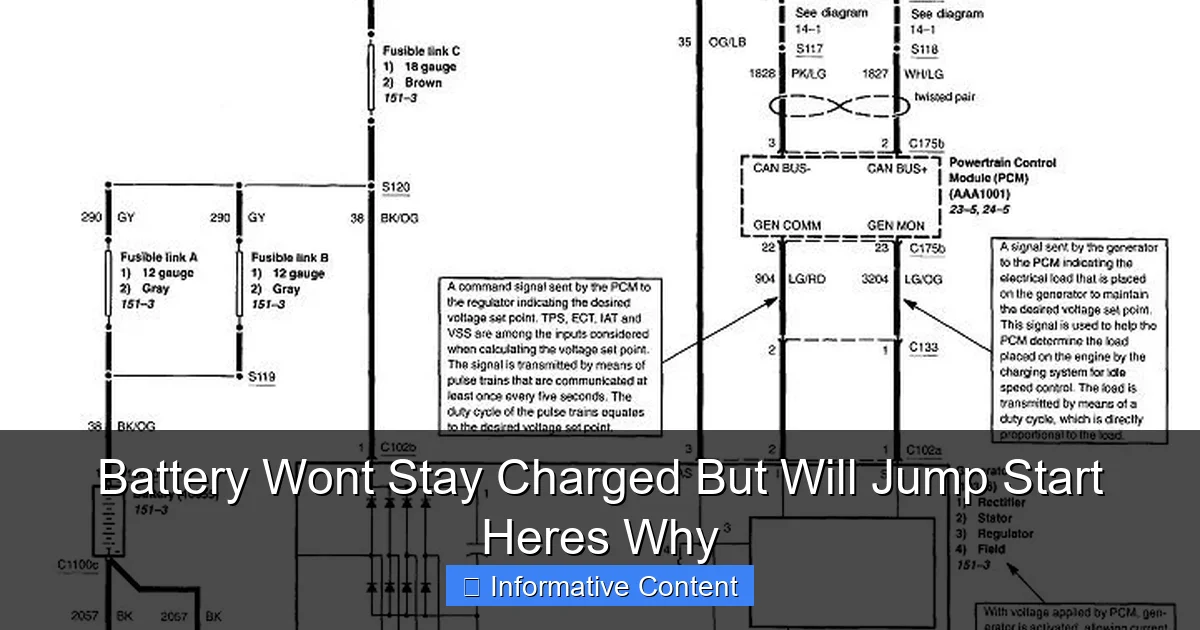
Featured image for battery wont stay charged but will jump start
Image source: 2carpros.com
If your battery won’t stay charged but will jump start, the issue is likely a failing battery, a faulty alternator, or a parasitic drain. Even if the engine starts after a jump, these underlying problems prevent the battery from holding a charge, leaving you stranded again. Addressing the root cause—such as replacing a worn battery, fixing the charging system, or diagnosing a hidden electrical draw—is essential for reliable performance.
Key Takeaways
- Check battery age: Replace if over 3-5 years old.
- Test alternator output: Ensure it charges at 13.5-14.5 volts.
- Inspect for parasitic drain: Disconnect devices when idle.
- Clean corroded terminals: Improve connection with a wire brush.
- Jump-start safely: Use proper cables and sequence to avoid damage.
- Monitor after jump: Recharge fully or drive immediately.
📑 Table of Contents
- Why Does My Battery Die But Jump Start Fine? Let’s Break It Down
- 1. The Battery Is Failing (Even If It Seems OK)
- 2. The Charging System Isn’t Doing Its Job
- 3. Parasitic Drain: The Silent Battery Killer
- 4. Corrosion or Loose Connections: The Invisible Blockers
- 5. Extreme Temperatures: The Battery’s Worst Enemy
- 6. Other Sneaky Culprits (Less Common but Important)
- Conclusion: Don’t Ignore the Warning Signs
Why Does My Battery Die But Jump Start Fine? Let’s Break It Down
Picture this: You’re rushing out the door, late for work, and your car won’t start. The engine clicks, the lights dim, and you groan—not again. But when you call a friend for a jump start, the car roars to life like nothing’s wrong. The battery seems fine… until the next morning, when you’re back to square one. Sound familiar? You’re not alone. This frustrating cycle—where your battery won’t stay charged but will jump start—is a common issue that leaves many drivers scratching their heads. The good news? It’s often fixable once you understand the root cause.
The truth is, a battery that jump starts but dies quickly is like a leaking bucket: it can hold water (charge) temporarily, but something’s draining it. Whether it’s a failing battery, a faulty charging system, or a sneaky electrical drain, the problem is almost always tied to one of a few key culprits. In this guide, we’ll walk through the most likely reasons behind this issue, how to diagnose them, and what you can do to get your car running reliably again—without relying on jumper cables every morning. Let’s dive in.
1. The Battery Is Failing (Even If It Seems OK)
Your first thought might be, “But the battery jump started fine!” That’s true, but a jump start only gives the battery a temporary boost—it doesn’t fix underlying health issues. Batteries degrade over time, and a weak or aging battery is one of the most common reasons why your battery won’t stay charged but will jump start.
Visual guide about battery wont stay charged but will jump start
Image source: 2carpros.com
Signs Your Battery Is on Its Last Leg
- Slow cranking after the jump—even if the engine starts, it may take longer than usual.
- Dim headlights or interior lights when the engine is off.
- Age: Most car batteries last 3–5 years. If yours is older, it’s likely losing capacity.
- Corroded terminals or a bloated battery case (a sign of overheating or overcharging).
Example: A friend of mine had a 4-year-old battery that jump started perfectly. But every time he parked for more than a day, the car wouldn’t start. A load test at the auto shop revealed the battery couldn’t hold a charge under stress—even though it showed 12.6 volts at rest.
How to Test Battery Health
- Voltage check: Use a multimeter. A healthy battery should read 12.4–12.7 volts when the car is off. Below 12.4 volts means it’s discharged or weak.
- Load test: Auto parts stores often do this for free. It simulates the battery’s performance under cranking conditions. If it fails, replace it.
- Hydrometer test (for older batteries with removable caps): Measures electrolyte specific gravity. Low readings mean the cells are sulfated (a sign of aging).
Tip: If your battery is over 3 years old and you’ve had charging issues, skip the guesswork—replace it. A new battery is cheaper than repeated jump starts and potential roadside assistance.
2. The Charging System Isn’t Doing Its Job
Even if your battery is healthy, it needs the alternator to recharge while the engine runs. If the charging system is faulty, your battery will drain over time—leading to the “jump start but won’t hold charge” cycle.
Common Charging System Problems
- Bad alternator: The alternator generates electricity to power the car and recharge the battery. If it fails, the battery runs down.
- Worn alternator belt (serpentine belt): A loose or frayed belt can’t spin the alternator properly.
- Faulty voltage regulator: This component controls how much voltage the alternator outputs. If it’s stuck open, the battery won’t charge.
- Bad wiring or connections: Corrosion or loose cables can interrupt charging.
Example: A reader once told me his car started fine after a jump, but the battery died after a 30-minute drive. A mechanic found the alternator was only outputting 12.2 volts (should be 13.5–14.5). The battery was fine—the alternator wasn’t charging it.
How to Check the Charging System
- Voltage test with engine running: Start the car and check battery voltage with a multimeter. It should read 13.5–14.5 volts. Below 13.5? The alternator isn’t charging.
- Listen for unusual noises: A failing alternator may make grinding or whining sounds.
- Inspect the belt: Look for cracks, fraying, or looseness. A belt that slips won’t turn the alternator efficiently.
- Check for warning lights: The battery or charging light on your dashboard may flicker or stay on.
Tip: If the voltage test shows low output, don’t wait—a failing alternator can leave you stranded. Replace it or have it repaired ASAP.
3. Parasitic Drain: The Silent Battery Killer
Imagine your car as a house. Even when you’re asleep, the fridge runs, the router stays on, and the alarm system hums. Similarly, your car’s electrical systems draw small amounts of power when it’s off. But if a circuit is stuck “on,” it can drain the battery overnight—even if it jump starts fine.
What Causes Parasitic Drain?
- Faulty modules: The radio, climate control, or body control module (BCM) may not shut down properly.
- Aftermarket accessories: GPS units, dashcams, or phone chargers left plugged in.
- Trunk or glove box lights that stay on due to a misaligned switch.
- Short circuits: Damaged wiring or a stuck relay.
Example: A neighbor had a battery that died every 2 days. After testing, we found her aftermarket dashcam was drawing 0.8 amps when the car was off—enough to kill the battery in 48 hours. Unplugging it fixed the issue.
How to Find and Fix Parasitic Drain
- Measure the drain: Use a multimeter in series with the negative battery terminal. A normal drain is 20–50 milliamps (mA). Over 100 mA is excessive.
- Pull fuses one at a time: If the drain drops when you remove a fuse, that circuit is the culprit. Check components in that circuit (e.g., radio, lights).
- Inspect aftermarket devices: Unplug them and test again.
- Check for lights: Open the trunk, glove box, and doors. Are any lights staying on?
Tip: Parasitic drain is tricky to diagnose. If you’re not comfortable with electrical work, visit a mechanic. They have tools to pinpoint the issue fast.
4. Corrosion or Loose Connections: The Invisible Blockers
Even if your battery and charging system are perfect, poor connections can starve the battery of power. Corrosion (a white, green, or blue crust on terminals) or loose cables act like kinks in a hose—they block the flow of electricity.
How Corrosion and Loose Cables Cause Problems
- High resistance: Corrosion increases electrical resistance, reducing charging efficiency.
- Intermittent contact: Loose terminals cause voltage drops, making the battery appear weak.
- Heat buildup: Poor connections can overheat, damaging the battery or cables.
Example: I once helped a friend with a battery that died after 1 day. The terminals looked clean, but when we wiggled the cables, the engine stalled. Tightening the connections fixed the issue.
How to Fix Corrosion and Loose Connections
- Clean the terminals: Disconnect the cables (negative first, then positive). Scrub terminals with a wire brush and a mix of baking soda and water. Rinse with water and dry.
- Tighten the cables: Use a wrench to secure the terminals. They should be snug, not wiggly.
- Apply anti-corrosion spray or grease: This protects terminals from future buildup.
- Check the ground connection: The negative cable connects to the car’s frame. Make sure this point is clean and tight.
Tip: Clean your terminals every 6–12 months, especially in humid climates. A little maintenance goes a long way!
5. Extreme Temperatures: The Battery’s Worst Enemy
Heat and cold are brutal on batteries. In winter, cold slows chemical reactions, reducing cranking power. In summer, heat accelerates corrosion and evaporation of the electrolyte. Both can make your battery won’t stay charged but will jump start problem worse.
How Temperature Affects Battery Health
- Cold weather: A fully charged battery works fine in the cold, but a weak one can’t deliver enough power to start the engine. Cold also thickens oil, making the engine harder to turn.
- Hot weather: Heat causes the battery fluid to evaporate, exposing the plates. It also speeds up corrosion and sulfation (a buildup that blocks charging).
Example: A reader in Minnesota had a battery that died every winter. A load test showed it was weak—but the real issue was cold reducing its effective capacity. Replacing it with a cold-cranking amps (CCA) battery solved the problem.
How to Protect Your Battery in Extreme Weather
- Park in a garage: This moderates temperature swings.
- Use a battery blanket or heater in cold climates (plugged in overnight).
- Choose the right battery: In cold areas, pick one with high CCA. In hot areas, look for a sealed, maintenance-free battery.
- Keep the battery charged: If you park for long periods, use a smart battery maintainer.
Tip: Batteries lose about 30% of their cranking power at 32°F (0°C). Below freezing, they lose 50% or more. If you live in a cold area, a high-CCA battery is worth the investment.
6. Other Sneaky Culprits (Less Common but Important)
Sometimes, the issue isn’t the battery, alternator, or drain—it’s something else entirely. Here are a few less obvious causes:
Faulty Starter Motor
- A worn starter draws more current, draining the battery faster. If your car cranks slowly even after a jump, have the starter tested.
Defective Battery Case or Internal Short
- Cracks in the battery case can leak electrolyte, reducing capacity. Internal shorts (rare) can cause rapid discharge.
Software Glitches in Modern Cars
- Some vehicles have modules that “sleep” improperly. A software update or module reset may fix this.
Table: Quick Diagnostic Checklist
| Issue | Test | Solution |
|---|---|---|
| Battery failure | Load test, voltage check | Replace battery |
| Alternator failure | Voltage test with engine running | Replace alternator |
| Parasitic drain | Amperage test with multimeter | Find and fix stuck circuits |
| Corrosion/loose terminals | Visual inspection, wiggle test | Clean and tighten |
| Temperature effects | Check CCA rating, inspect for leaks | Use battery heater, replace with high-CCA battery |
Conclusion: Don’t Ignore the Warning Signs
If your battery won’t stay charged but will jump start, don’t just keep reaching for the jumper cables. This issue is a symptom of a deeper problem—one that could leave you stranded or damage other components. Start with the simplest checks: battery age, corrosion, and loose connections. Then test the charging system and parasitic drain. Remember, a jump start is a temporary fix, not a solution.
Here’s the bottom line: Your car’s electrical system is like a team. If one player (battery, alternator, or wiring) is weak, the whole team suffers. By diagnosing the root cause, you’ll save time, money, and frustration. And the next time you turn the key, you’ll hear that satisfying roar—no jumper cables needed.
Frequently Asked Questions
Why does my battery won’t stay charged but will jump start?
If your battery won’t stay charged but will jump start, it’s often due to a failing alternator or parasitic drain. The alternator may not be recharging the battery properly, or an electrical component is drawing power when the engine is off.
Can a bad alternator cause a battery to drain overnight?
Yes, a failing alternator can lead to a dead battery because it doesn’t recharge the battery fully while driving. This often results in a battery that will jump start but won’t stay charged for long.
What causes parasitic drain on a car battery?
Parasitic drain occurs when electrical systems (like lights, radio, or sensors) continue drawing power after the engine is off. Excessive drain can leave your battery unable to stay charged but still capable of starting with a jump.
How do I know if my battery or alternator is the problem?
If your battery won’t stay charged but will jump start, test the alternator’s output with a multimeter—it should read 13.5–14.5 volts when running. Low voltage indicates alternator failure, not just a bad battery.
Is it safe to keep jump-starting a car with this issue?
Jump-starting is a temporary fix and risks stranding you if the underlying issue isn’t repaired. A battery that won’t stay charged but will jump start signals a deeper electrical problem needing professional diagnosis.
Can extreme weather affect my battery’s ability to hold a charge?
Yes, cold or hot weather stresses batteries, reducing their efficiency and lifespan. A weakened battery may still jump start but struggle to stay charged, especially if already nearing end-of-life.