
Featured image for battery will not jump start
Image source: images-na.ssl-images-amazon.com
A dead battery that won’t jump start often signals deeper issues like internal cell damage, extreme sulfation, or a complete loss of charge capacity—simple jump-starting won’t fix these failures. Even with proper connections and a good donor battery, a severely degraded or shorted battery may refuse to accept a charge, requiring replacement or professional testing. Always check for corrosion, secure terminals, and voltage levels before concluding it’s a jump-start problem.
Key Takeaways
- Check connections first: Ensure terminals are clean and tightly secured before jump-starting.
- Test the battery: Use a multimeter to confirm voltage is above 12.4V.
- Avoid repeated attempts: Excessive cranking can damage both battery and starter.
- Inspect for damage: Look for cracks, leaks, or swelling indicating battery failure.
- Charge or replace: Recharge deeply discharged batteries or replace if over 3 years old.
- Verify alternator health: A faulty alternator may prevent proper battery recharge.
📑 Table of Contents
- Why Your Battery Will Not Jump Start (And What You Can Do About It)
- Understanding Why a Battery Will Not Jump Start: The Core Reasons
- Jump Start Failures: Common Mistakes and How to Avoid Them
- Beyond Jump Starts: Diagnosing the Real Problem
- Step-by-Step: What to Do When Your Battery Will Not Jump Start
- Prevention: How to Avoid a “Battery Will Not Jump Start” Situation
- Data: Common Battery and Jump Start Issues (By Frequency)
- Final Thoughts: Don’t Rely on Jump Starts — Solve the Real Problem
Why Your Battery Will Not Jump Start (And What You Can Do About It)
You’re late for work, you hop into your car, turn the key, and… nothing. The engine doesn’t crank, the lights are dim, and the radio barely flickers. You grab your jumper cables, connect them to a friend’s battery, and try again. Still nothing. Frustrating, right? If your battery will not jump start, you’re not alone. It’s a common roadside nightmare, but the cause is rarely just a “dead battery.” In fact, jump-starting only works if the battery is *weak* but still functional. If it’s truly dead or something else is wrong, no amount of boosting will help.
Think of it like trying to restart a phone with a completely drained battery. A quick jolt might wake it up if it’s just low on power. But if the battery is swollen, damaged, or the phone has a hardware issue, charging it won’t fix the problem. Your car is the same. A jump start is a temporary boost, not a cure. In this guide, I’ll walk you through the real reasons your battery won’t jump start, how to diagnose them, and what you can do to get back on the road — safely and confidently. Whether you’re a DIYer or just want to understand your car better, this is the practical, no-nonsense advice you need.
Understanding Why a Battery Will Not Jump Start: The Core Reasons
1. The Battery Is Beyond Recovery (Deeply Discharged or Damaged)
Not all “dead” batteries are the same. Some are simply low on charge due to lights left on or cold weather. Others are *deeply discharged* — meaning the internal chemistry has degraded so much that even a jump can’t revive them. This often happens after prolonged inactivity, parasitic drain, or repeated deep discharges.
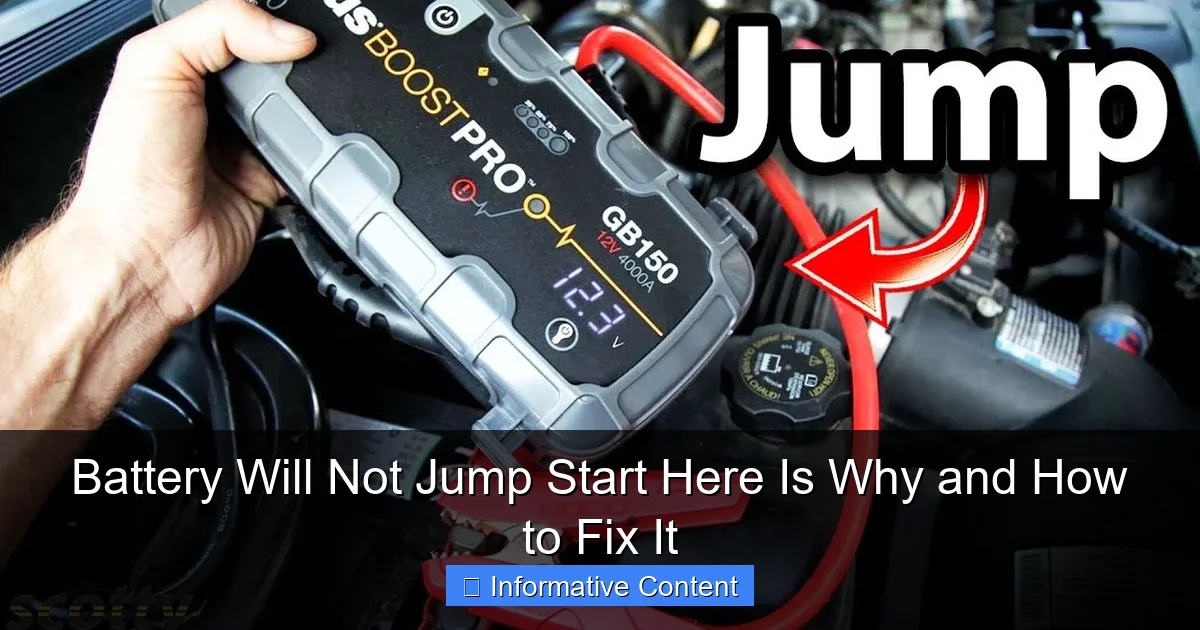
Visual guide about battery will not jump start
Image source: i.ytimg.com
For example, if your car sits unused for weeks, the battery slowly loses charge. After a few months, the lead plates can sulfate — a process where lead sulfate crystals harden and block the chemical reaction needed to produce electricity. At that point, the battery is essentially dead. No jump start will help.
Tip: If your battery is more than 3–5 years old, sulfation is likely. A battery load test at an auto shop can confirm this. If the voltage drops below 9.6V during the test, the battery is toast.
2. Poor Electrical Connection (Cables, Clamps, or Terminals)
Even if the battery has power, a bad connection can block the flow of electricity. Corrosion on battery terminals (that white, crusty buildup), loose cables, or damaged jumper cables can all prevent a successful jump start. I once spent 20 minutes trying to jump my car in the rain, only to realize the negative clamp wasn’t touching the metal properly because of rust. Rookie mistake, but it happens to everyone.
Here’s what to check:
- Terminal corrosion: Clean terminals with a baking soda and water mix (1 tbsp baking soda + 1 cup water). Use a wire brush to scrub until shiny.
- Loose cables: Wiggle the cables — if they move, tighten the clamps.
- Jumper cables: Look for frayed wires, broken clamps, or melted insulation. Cheap cables often fail under load.
Pro tip: When jumping, always connect the negative clamp to a bare metal part of the engine block (not the battery’s negative terminal) to avoid sparks near the battery, which can cause explosions if there’s a gas leak.
3. Internal Battery Failure (Short Circuits or Broken Plates)
Inside every lead-acid battery are lead plates and an electrolyte solution. Over time, the plates can crack, warp, or develop internal short circuits. This means the battery can’t hold a charge — even if it shows voltage, it can’t deliver current when needed. This is why a battery might read 12.6V at rest but drop to 6V when you try to start the engine.
Signs of internal failure:
- Battery swells or leaks
- Cracked casing
- Foul smell (rotten eggs — a sign of overcharging or overheating)
- Repeated jump starts within a few days
If you see any of these, replace the battery. No amount of charging or jumping will fix it.
4. Parasitic Drain (Something Is Drawing Power When the Car Is Off)
Your car’s computer, clock, alarm system, and other electronics draw a small amount of power even when the engine is off. But if a component is malfunctioning — like a stuck glove box light, a faulty alternator, or a short in the wiring — it can drain the battery overnight. This is called *parasitic drain*.
For example, a friend of mine had a trunk light that wouldn’t turn off. He didn’t notice it for a week. By then, the battery was dead. He jumped it, drove home, and it died again the next day. The jump worked *once*, but the root cause (the light) kept draining it.
How to test: Use a multimeter to check for current draw with the car off. A normal draw is 20–50 milliamps (mA). Anything above 100 mA needs investigation.
Jump Start Failures: Common Mistakes and How to Avoid Them
1. Incorrect Cable Connection Order
Connecting jumper cables in the wrong order can damage electronics, blow fuses, or even cause a fire. I’ve seen people connect both clamps to the dead battery first, then the live one — a big no-no.
Correct order:
- Connect red (+) clamp to dead battery’s positive terminal.
- Connect red (+) clamp to live battery’s positive terminal.
- Connect black (-) clamp to live battery’s negative terminal.
- Connect black (-) clamp to a bare metal ground point on the dead car (engine block, bracket, etc.).
- Start the live car, let it run for 1–2 minutes.
- Start the dead car. If it starts, let both run for 5–10 minutes.
- Disconnect in reverse order.
Why the ground point? It reduces the risk of sparks near the battery, which could ignite hydrogen gas.
2. Using Damaged or Undersized Jumper Cables
Not all jumper cables are equal. Thin cables (like 10-gauge) can’t carry enough current to start a large engine, especially in cold weather. They also overheat easily. I once used a set of 8-gauge cables on a V8 truck in winter — the cables got hot, and the car barely cranked.
What to look for:
- Gauge: 4-gauge or 6-gauge for best performance (thicker = better).
- Length: 12–20 feet — long enough to reach but not so long that voltage drops.
- Clamps: Heavy-duty, insulated, and spring-loaded.
Invest in a good set — it’s worth it.
3. Not Letting the Battery “Charge” Before Starting
After connecting the cables, many people try to start the dead car immediately. But the battery needs a minute or two to absorb some charge. Without it, the starter motor may not get enough current.
Tip: Turn the headlights on (on the dead car) while the cables are connected. If they get brighter after a minute, the battery is charging. That’s a good sign.
4. Jump Starting a Flooded Engine (It’s Not the Battery!)
Sometimes, the engine is *flooded* — too much fuel in the cylinders, preventing combustion. The battery is fine, but the starter can’t turn the engine over. If you hear a fast cranking sound but no start, it might be flooded.
How to fix: Turn the key to “on” (don’t crank), press the gas pedal to the floor, and hold it. Then turn the key to start. This tells the computer to cut fuel and clear the cylinders. Release the pedal once the engine starts.
Beyond Jump Starts: Diagnosing the Real Problem
1. The Alternator Is Failing (It’s Not Charging the Battery)
The alternator charges the battery while the engine runs. If it’s failing, the battery won’t get recharged, even after a jump. You might get the car started, but it will die again soon.
Symptoms of a bad alternator:
- Battery warning light on the dash
- Dimming headlights when idling
- Electrical systems acting erratic (radio cuts out, windows slow)
- Battery dies after driving for a short time
How to test: With the engine running, use a multimeter to check battery voltage. It should read 13.8–14.4V. If it’s below 13V or above 15V, the alternator is likely faulty.
I had a car that would jump start fine, but die after 10 minutes of driving. The alternator was only putting out 12.8V — not enough to keep the battery charged. Replacing it fixed the issue.
2. Starter Motor or Solenoid Failure
The starter motor turns the engine over. The solenoid is the switch that activates it. If either fails, the engine won’t crank — even with a good battery and jump.
Signs of starter issues:
- Clicking noise when turning the key (solenoid is working, but starter isn’t)
- Grinding noise (starter gear is damaged)
- No sound at all (no power to the starter)
Tip: Tap the starter lightly with a wrench while someone turns the key. Sometimes, a worn starter will work if jolted. But this is a temporary fix — replace it soon.
3. Bad Ignition Switch or Wiring
The ignition switch sends power to the starter and other systems. If it’s worn or the wiring is damaged, the starter won’t get power — even with a jump.
Symptoms:
- Key turns, but no dash lights or accessories
- Intermittent power loss while driving
- Starter clicks, but engine doesn’t turn over
This is less common but possible, especially in older cars.
Step-by-Step: What to Do When Your Battery Will Not Jump Start
1. Check the Basics First
Before assuming the worst, go through this quick checklist:
- Are the jumper cables connected correctly? (See earlier section)
- Is the live car running? (It should be)
- Are the terminals clean and tight?
- Is the battery old? (More than 4 years? Replace it.)
- Are the headlights or interior lights on in the dead car? (Turn them off — they drain power.)
2. Test the Battery Voltage
Use a multimeter to check the battery voltage:
- 12.6V or higher: Battery is good (if it won’t start, look elsewhere).
- 12.4V: Partially charged — try a jump.
- Below 12V: Deeply discharged or dead.
After jumping, check voltage again with the engine running. It should be 13.8–14.4V. If not, the alternator is the problem.
3. Inspect for Physical Damage
Look for:
- Cracked battery case
- Leaking fluid (acid or electrolyte)
- Swollen battery
- Corroded or broken cables
If you see any of these, replace the battery or repair the cables.
4. Rule Out Parasitic Drain
With the car off and doors closed:
- Wait 10–15 minutes for systems to sleep.
- Set your multimeter to DC amps (10A range).
- Disconnect the negative battery cable.
- Connect the multimeter between the cable and terminal.
- Read the current draw. If it’s over 100 mA, start pulling fuses one by one to find the culprit.
Common culprits: glove box light, trunk light, aftermarket stereo, alarm system.
5. Try a Battery Charger (If You Have One)
If you have a battery charger, try charging the battery overnight. A slow charge (2–10 amps) is better than a fast one for deeply discharged batteries. If it won’t hold a charge, replace it.
Prevention: How to Avoid a “Battery Will Not Jump Start” Situation
1. Regular Maintenance
Check your battery every 6 months:
- Clean terminals
- Tighten cables
- Test voltage and charge level
Replace the battery every 4–5 years — even if it seems fine. Batteries degrade over time.
2. Use a Battery Tender (For Long-Term Storage)
If your car sits for weeks or months (e.g., classic car, winter storage), use a battery tender. It keeps the battery charged without overcharging.
I use one for my motorcycle. It stays plugged in all winter, and the battery is always ready in spring.
3. Avoid Short Trips
Short trips (under 10 minutes) don’t give the alternator enough time to recharge the battery. Over time, this leads to sulfation. If you only make short trips, drive longer once a week or use a battery maintainer.
4. Check the Alternator and Charging System
Have your alternator tested every 2 years or when you replace the battery. A failing alternator can kill a new battery in months.
Data: Common Battery and Jump Start Issues (By Frequency)
| Issue | Likely Cause | Jump Start Works? | Solution |
|---|---|---|---|
| Battery deeply discharged | Parasitic drain, old age, cold weather | Sometimes (if not sulfated) | Charge or replace battery |
| Corroded terminals | Moisture, acid buildup | No | Clean terminals |
| Internal battery failure | Age, overcharging, vibration | No | Replace battery |
| Bad alternator | Worn bearings, faulty regulator | Yes (temporarily) | Replace alternator |
| Starter motor failure | Worn brushes, solenoid issues | No | Replace starter |
| Parasitic drain | Faulty switch, short circuit | Yes (but dies again) | Find and fix drain |
Final Thoughts: Don’t Rely on Jump Starts — Solve the Real Problem
If your battery will not jump start, don’t keep trying the same thing and hoping for a different result. Jump starts are a band-aid, not a fix. The real issue is often deeper — a bad battery, a failing alternator, a parasitic drain, or a mechanical problem.
Think of it like a fever. A cold can cause a fever, but so can an infection. Treating the fever with medicine won’t cure the infection. You need to find the root cause. The same goes for your car. Use the steps in this guide to diagnose the real problem. Test the battery, check connections, rule out alternator and starter issues, and address any drains.
And remember: safety first. Always wear gloves and safety glasses when working with batteries. Hydrogen gas is explosive, and battery acid is corrosive. If you’re unsure, call a professional. It’s better to spend a little money on a tow than risk injury or further damage.
Your car is more than a machine — it’s your freedom. Take care of it, and it will take care of you. The next time your battery won’t jump start, you’ll know exactly what to do. No panic, no guesswork — just a clear, logical plan to get back on the road.
Frequently Asked Questions
Why will my battery not jump start even with cables connected?
If your battery will not jump start despite proper cable connections, the issue may stem from a completely dead battery, corroded terminals, or a faulty alternator. Ensure the donor battery is fully charged and connections are clean and tight.
Can a bad alternator cause a “battery will not jump start” issue?
Yes, a failing alternator may prevent a jump start because it can’t maintain voltage to power the starter motor. Even if the battery accepts a temporary charge, a bad alternator won’t sustain it long enough to start the engine.
How do I know if my battery is too old to hold a jump start?
Most car batteries last 3–5 years. If yours is older or shows bulging, leaks, or slow cranking, it likely can’t retain a charge—even after a jump. Replace it to resolve the “battery will not jump start” problem.
What should I check first when my car battery won’t jump start?
Start by inspecting battery terminals for corrosion or looseness, then verify the jump cables are correctly connected (positive to positive, negative to ground). Poor connections are a common cause of failed jump starts.
Could a blown fuse or fuse box issue prevent a battery from jump starting?
Yes, a blown main fuse or damaged fuse box can interrupt power flow, making jump attempts ineffective. Check the fuse box for visible damage or use a multimeter to test critical fuses related to the ignition system.
Is it safe to keep trying to jump start a battery that won’t respond?
Repeated jump attempts can damage the battery, alternator, or electrical system. If the battery will not jump start after 2–3 tries, stop and diagnose deeper issues like parasitic drain, internal battery failure, or wiring problems.