
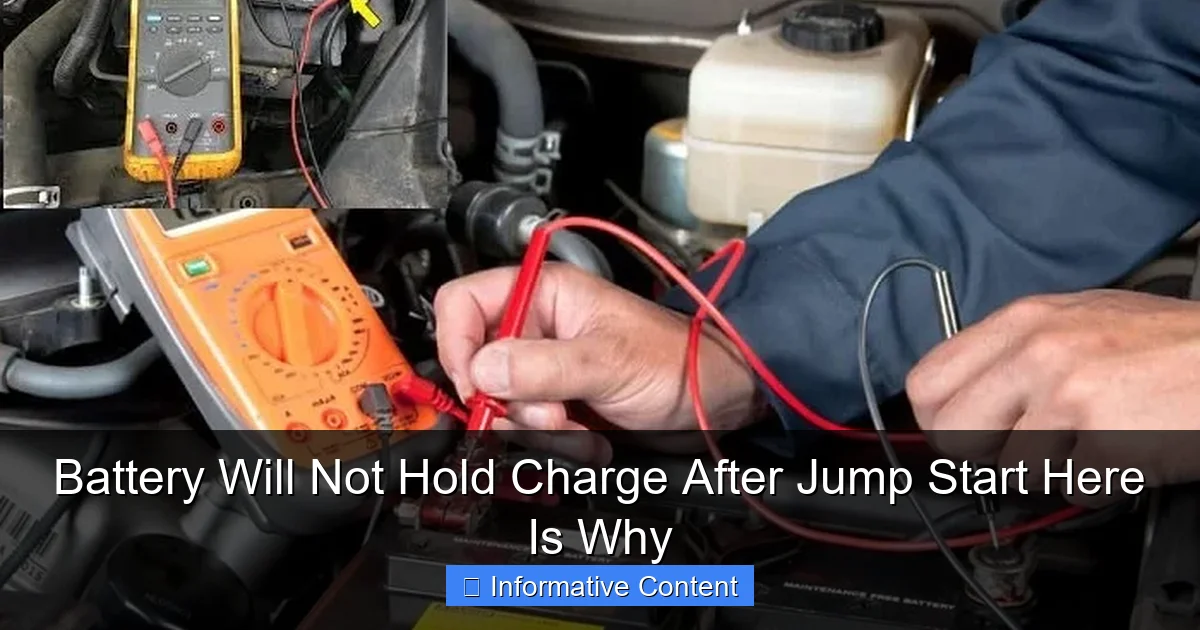
Featured image for battery will not hold charge after jump start
Image source: cararac.com
A dead battery that won’t hold a charge after a jump start often signals deeper issues like a failing alternator, sulfation, or internal battery damage. Even if the car starts, persistent charging problems mean the battery isn’t receiving or retaining power properly—common culprits include corroded connections, a faulty voltage regulator, or an old battery past its lifespan. Ignoring these signs risks sudden breakdowns and costly repairs.
Key Takeaways
- Test your battery after a jump start to confirm its health and charge retention.
- Inspect alternator output to rule out charging system failures.
- Check for parasitic drain that may deplete the battery overnight.
- Replace old batteries showing signs of wear or sulfation immediately.
- Ensure secure connections to prevent poor charging and voltage loss.
- Drive regularly to maintain charge and avoid deep discharge cycles.
📑 Table of Contents
- Why Your Battery Won’t Hold a Charge After a Jump Start: A Real Talk
- Understanding How Your Car’s Charging System Works
- Top Reasons Why Your Battery Won’t Hold a Charge After Jump Start
- How to Diagnose the Problem at Home (Without a Mechanic)
- What to Do If Your Battery Won’t Hold a Charge After Jump Start
- Prevention Tips: How to Avoid Future Battery Problems
- Data Table: Common Symptoms and Likely Causes
- Final Thoughts: Don’t Ignore the Warning Signs
Why Your Battery Won’t Hold a Charge After a Jump Start: A Real Talk
Ever been there? You’re running late, you turn the key, and—nothing. Just a weak click or silence. So you grab jumper cables, get a jump start from a friendly passerby or a neighbor, and the car roars to life. You think, “Phew, crisis averted.” But the next morning? Dead again. You jump it once more, and the same thing happens. Now you’re stuck in a cycle of jump-starting, and the battery won’t hold a charge after jump start. It’s frustrating, inconvenient, and honestly, a little scary. You start wondering: Is it the battery? The alternator? Or is something else silently draining your power?
This isn’t just a one-time glitch. If your battery won’t hold a charge after jump start, it’s a red flag. It means your car’s electrical system isn’t working as it should. And while it might seem like a simple fix—just replace the battery—it’s often not that straightforward. I’ve been in this exact spot. My old hatchback would start fine after a jump, but by the time I reached the grocery store 10 minutes later, it was dead again. Turned out, it wasn’t the battery at all. It was a faulty alternator and a parasitic drain. So before you spend money on a new battery or jump starter, let’s dig into what’s really going on. In this post, I’ll walk you through the most common reasons why your battery won’t hold a charge after jump start, how to diagnose the issue, and what you can do about it—without needing a mechanic’s degree.
Understanding How Your Car’s Charging System Works
To fix a problem, you’ve got to understand how things are supposed to work. Think of your car’s charging system like a team. The battery is the power source. The alternator is the generator that recharges the battery while the engine runs. And the voltage regulator makes sure everything stays balanced. When one part fails, the whole system suffers—and that’s when your battery won’t hold a charge after jump start.

Visual guide about battery will not hold charge after jump start
Image source: jeepzine.com
The Role of the Battery
The battery is like your car’s heart. It stores electrical energy and delivers it when you start the engine. It also powers accessories when the engine is off—like the radio, interior lights, and alarm system. A healthy battery should hold a charge of around 12.6 volts when fully charged. If it drops below 12.4 volts, it’s partially discharged. Below 12 volts, and it’s considered dead or deeply discharged.
When you jump start your car, you’re using another battery to “jump” energy into yours. But if your battery won’t hold a charge after jump start, it means it’s not retaining that energy. This could be due to sulfation (more on that later), internal damage, or simply old age. For example, I once had a 5-year-old battery that looked fine but couldn’t hold more than 11.8 volts after a jump. A load test confirmed it was beyond saving.
How the Alternator Keeps the Battery Charged
Once the engine is running, the alternator takes over. It generates electricity to power the car’s systems and recharge the battery. A good alternator produces between 13.5 and 14.5 volts while the engine is running. If the alternator is weak or failing, it won’t charge the battery properly. So even if you jump start the car, the battery drains faster than it can be replenished.
Here’s a real-life example: A friend had a 2010 sedan that kept dying after short drives. We jump-started it, checked the battery voltage with a multimeter, and saw it was only 12.1 volts at idle. At 2,000 RPM, it barely reached 12.8 volts. That’s not enough—normal is over 13.5. We replaced the alternator, and the problem vanished. The battery held a charge perfectly after that.
Voltage Regulator: The Silent Guardian
The voltage regulator controls how much electricity the alternator sends to the battery. Too much, and the battery overheats or boils the electrolyte. Too little, and the battery won’t hold a charge after jump start. Most modern alternators have built-in regulators, but they can still fail. Symptoms include flickering lights, erratic electrical behavior, or a battery that overcharges (bubbling or leaking).
Tip: If your battery is swollen or leaking, stop using it immediately. Overcharging can be dangerous and may damage other electronics.
Top Reasons Why Your Battery Won’t Hold a Charge After Jump Start
Now that we’ve covered the basics, let’s dive into the most common culprits. If your battery won’t hold a charge after jump start, one (or more) of these issues is likely to blame.
1. A Failing or Dead Battery
Batteries don’t last forever. The average lifespan is 3 to 5 years, depending on climate, driving habits, and battery quality. In hot climates, batteries degrade faster. In cold climates, they lose cranking power. If your battery is older than 4 years, it’s a prime suspect.
- Sulfation: When a battery sits discharged for too long, lead sulfate crystals form on the plates. These crystals reduce the battery’s ability to hold a charge. Jump-starting a sulfated battery may get you going, but it won’t last.
- Internal Short: A shorted cell can cause the battery to discharge rapidly. You might notice the battery is warm to the touch or has a strong sulfur (rotten egg) smell.
Real tip: If your battery is over 4 years old and you’ve had multiple jump starts, it’s time to get it tested. Most auto parts stores offer free battery and charging system tests.
2. Alternator Failure
As we mentioned earlier, a bad alternator won’t charge the battery properly. Signs include:
- Dim headlights when idling (brighten when you rev the engine)
- Battery warning light on the dashboard
- Whining or grinding noise from the engine bay
- Frequent jump starts after short drives
I once ignored a faint whine from my alternator for weeks. Big mistake. One rainy night, the battery died mid-drive, and the alternator seized up. Cost me a tow and a $300 repair. Don’t be like me.
3. Parasitic Drain (The Silent Thief)
Even when your car is off, some systems draw power—like the clock, alarm, or ECU. But if a component stays on when it shouldn’t, it creates a parasitic drain. This is a major reason why your battery won’t hold a charge after jump start, especially if the car sits for a few days.
Common culprits:
- Faulty interior lights (e.g., trunk or glove box light staying on)
- Aftermarket electronics (GPS, dash cam, stereo)
- Faulty relays or switches
- ECU or module malfunctions
How to check: Use a multimeter to measure current draw. A normal draw is under 50 milliamps (0.05 amps). If it’s higher, start pulling fuses one by one until the draw drops. That tells you which circuit is the problem.
4. Loose or Corroded Battery Connections
It sounds simple, but it’s often overlooked. Corrosion (white, green, or blue crust) on the battery terminals prevents good electrical contact. Loose cables can also cause intermittent charging issues.
I’ve seen cars that “fixed” their battery problem just by cleaning the terminals with baking soda and water and tightening the cables. It’s free, takes 10 minutes, and could save you $200.
Tip: After cleaning, apply a thin coat of petroleum jelly to prevent future corrosion.
5. Faulty Voltage Regulator or Wiring Issues
If the voltage regulator fails, the alternator may overcharge or undercharge the battery. Wiring issues—like frayed wires, bad grounds, or loose connections—can also disrupt the charging system.
For example, a friend’s truck kept killing batteries. We found a corroded ground wire near the engine block. Once we cleaned and reattached it, the alternator started charging properly.
How to Diagnose the Problem at Home (Without a Mechanic)
You don’t need to be a mechanic to figure out why your battery won’t hold a charge after jump start. With a few basic tools and some patience, you can narrow down the cause.
Step 1: Check the Battery Voltage
Grab a multimeter (under $20 at any hardware store). Set it to DC volts (20V range).
-
<
- Engine off: Voltage should be 12.6V (fully charged). Below 12.4V means it’s weak or discharged.
- Engine running: Voltage should be 13.5–14.5V. Below 13V? Alternator problem. Above 15V? Overcharging (bad regulator).
<
Example: I tested my car after a jump start. Engine off: 12.2V. Engine running: 12.8V. That told me the alternator wasn’t charging. We replaced it, and the voltage jumped to 14.2V at idle.
Step 2: Perform a Load Test
A load test simulates starting the engine. You can do this with a battery load tester or use a headlight (turn it on for 15 seconds and monitor voltage). The battery should maintain at least 9.6V under load. If it drops below 9V, it’s failing.
Most auto parts stores will do this for free. Just bring your battery in.
Step 3: Check for Parasitic Drain
Here’s how:
- Turn off all electronics and close all doors.
- Wait 15–30 minutes for the car’s systems to go to sleep.
- Set your multimeter to measure current (amp setting).
- Disconnect the negative battery cable and place the multimeter between the cable and terminal.
- Read the current draw. If it’s over 50mA, start pulling fuses one by one until the draw drops.
Pro tip: Some cars have “sleep mode” systems that take longer to power down. Refer to your owner’s manual if you’re unsure.
Step 4: Inspect Cables and Connections
Look for:
- Corrosion (clean with baking soda + water)
- Loose cables (tighten with a wrench)
- Damaged insulation or frayed wires
Don’t forget the ground connection—often the root of many charging issues.
Step 5: Listen for Clues
Turn on the engine and listen. A bad alternator may make a whining or grinding noise. A failing voltage regulator can cause flickering lights. These are early warning signs.
What to Do If Your Battery Won’t Hold a Charge After Jump Start
Now that you’ve diagnosed the issue, here’s how to fix it—or at least know what to tell your mechanic.
Replace the Battery (If It’s Old or Failed)
If your battery is over 4 years old or fails a load test, replace it. Choose a battery with the correct CCA (Cold Cranking Amps) and reserve capacity for your car. A higher CCA is better for cold climates.
Tip: Don’t just go for the cheapest option. A quality battery lasts longer and performs better. Look for brands like Optima, Interstate, or Bosch.
Repair or Replace the Alternator
If the alternator isn’t charging, you have two options:
- Replace it: A new or remanufactured alternator costs $150–$500, plus labor.
- Repair it: Some shops can rebuild alternators for less, but it’s not always reliable.
Always test the charging system after replacement to make sure it’s working.
Fix the Parasitic Drain
Once you’ve identified the circuit causing the drain (via fuse pulling), trace the wiring. Common fixes:
- Replace a stuck relay
- Repair a faulty switch (e.g., trunk light)
- Disconnect or reprogram aftermarket electronics
I once found a dash cam that was drawing power even when the car was off. Unplugging it fixed the drain.
Clean and Tighten Connections
This is a free fix. Clean terminals, tighten cables, and check the ground. It’s worth doing even if you replace the battery or alternator.
Check the Voltage Regulator
If the battery is overcharging (bubbling, leaking, or smelling like rotten eggs), the regulator may be faulty. In most cars, it’s built into the alternator, so you’ll need to replace the whole unit. Some older vehicles have external regulators—these can be replaced separately.
Prevention Tips: How to Avoid Future Battery Problems
Nobody wants to be stranded again. Here’s how to keep your battery and charging system healthy.
Regular Maintenance
- Clean terminals every 6 months: Use a wire brush and baking soda solution.
- Check belt tension: A loose alternator belt can slip and reduce charging.
- Inspect for corrosion: Look for green or white crust on terminals.
Drive Regularly
Batteries hate sitting. If you don’t drive often, use a battery maintainer (like a trickle charger). These keep the battery at full charge without overcharging.
I keep one on my weekend car. It’s plugged in 24/7 and has saved me from multiple jump starts.
Avoid Short Trips
Short drives don’t give the alternator enough time to recharge the battery. If you only drive 5–10 minutes at a time, the battery will slowly drain. Try to take longer drives occasionally, or use a maintainer.
Turn Off Accessories
Before turning off the engine, shut down lights, radio, A/C, and other electronics. This reduces the load on the battery when you restart.
Monitor the Battery Age
Keep track of when you bought the battery. Most have a date code on the case. Replace it before it hits 5 years, especially in hot climates.
Data Table: Common Symptoms and Likely Causes
| Symptom | Likely Cause | Quick Fix |
|---|---|---|
| Car starts after jump, dies after 10–20 minutes | Bad alternator | Test alternator voltage; replace if under 13.5V |
| Battery dies after sitting 2–3 days | Parasitic drain | Measure current draw; pull fuses to find source |
| Swollen battery case or rotten egg smell | Overcharging (bad regulator) | Check voltage; replace alternator if over 15V |
| Corrosion on terminals | Loose or dirty connections | Clean with baking soda; tighten cables |
| Whining noise from engine bay | Failing alternator | Listen and test charging; replace alternator |
| Battery fails load test | Dead or sulfated battery | Replace battery |
Final Thoughts: Don’t Ignore the Warning Signs
If your battery won’t hold a charge after jump start, don’t just keep jumping it. That’s like putting a band-aid on a broken arm. The real problem—whether it’s the battery, alternator, parasitic drain, or bad connections—needs to be fixed. And the sooner you address it, the less likely you are to be stranded on a cold winter night or late for an important meeting.
From my own experience, the best approach is to start simple: clean the terminals, check the voltage, and listen for odd noises. Most issues can be diagnosed with a $20 multimeter and some patience. If you’re unsure, get a professional test. Many shops offer free diagnostics. And remember: a battery that won’t hold a charge after jump start is rarely just a battery problem. It’s a symptom of a deeper issue in your car’s electrical system.
Take care of your car, and it’ll take care of you. Because no one wants to be that person waiting for a jump start in the rain—again.
Frequently Asked Questions
Why does my battery not hold a charge after a jump start?
A battery that won’t hold a charge after a jump start is often due to internal damage, sulfation, or a failing alternator. If the battery is old (3+ years), it may simply be at the end of its lifespan and unable to retain a charge.
Can a bad alternator cause the battery to not hold a charge after a jump start?
Yes, a faulty alternator may fail to recharge the battery while driving, causing it to drain again. Use a multimeter to check if the alternator outputs 13.5–14.5 volts when the engine is running.
How do I know if my battery is permanently dead after a jump start?
If the battery voltage drops below 12 volts within 24 hours of a full charge or fails a load test, it likely has dead cells and needs replacement. A “battery will not hold charge after jump start” issue often confirms irreversible damage.
Is it normal for a battery to drain overnight after a jump start?
No, rapid drainage indicates a short circuit, parasitic draw, or a battery that can no longer hold a charge. Test for parasitic draw (50mA or less is normal) or have the battery professionally evaluated.
Does cold weather cause a battery to not hold a charge after a jump start?
Cold temperatures reduce a battery’s capacity and can expose existing weaknesses, making it seem like it won’t hold a charge. However, if the problem persists in warm weather, the battery or charging system is likely faulty.
Can jump-starting too many times damage the battery and prevent charging?
Repeated jump starts can cause internal plate damage or sulfation, especially in older batteries, leading to a “battery will not hold charge after jump start” situation. Limit jump starts and recharge or replace the battery promptly.