
Featured image for battery is charged but car won’t start without a jump
Image source: motorverso.com
A fully charged battery doesn’t guarantee a working starter system—if your car won’t start without a jump, the issue likely lies with a failing starter motor, corroded connections, or a weak battery unable to sustain high cranking amps. Even “good” batteries can fail under load, masking deeper electrical or mechanical faults that prevent ignition.
Key Takeaways
- Check battery terminals: Clean corrosion to ensure proper electrical connection.
- Test alternator output: Verify it’s charging the battery correctly.
- Inspect starter motor: A faulty starter may need jump-starting.
- Scan for error codes: Hidden issues may trigger no-start conditions.
- Evaluate battery age: Replace if older than 3–5 years.
- Confirm parasitic drain: Excessive draw can deplete a charged battery.
📑 Table of Contents
- Why Your Car Won’t Start Even With a Charged Battery
- 1. The Starter Motor: The Silent Culprit Behind a No-Crank
- 2. Bad Ground Connections: The Invisible Power Drain
- 3. Faulty Ignition Switch or Starter Relay
- 4. Corroded or Loose Battery Cables
- 5. Weak or Failing Alternator (Yes, Really)
- Data Table: Common Causes and Diagnostic Steps
- Conclusion: Don’t Jump to Conclusions—Troubleshoot Smart
Why Your Car Won’t Start Even With a Charged Battery
You’ve done everything right. You plugged in the battery charger overnight, confirmed the voltage reads 12.6V, and even tried wiggling the ignition key—yet your car won’t start without a jump. No crank. No sputter. Just silence. Frustrating, right?
You’re not alone. This is one of the most confusing car problems drivers face. The battery *is* charged, the lights come on, the radio plays, and the dashboard glows like a Christmas tree—but the engine stays stubbornly silent. It feels like your car is playing a cruel trick on you. But don’t worry, this isn’t magic or bad luck. There are real, mechanical reasons behind this behavior, and most of them can be diagnosed and fixed without a full engine rebuild.
In this guide, I’ll walk you through the most common causes of a battery is charged but car won’t start without a jump, explain how each one works, and give you practical steps to troubleshoot and fix the issue. Whether you’re a DIYer with basic tools or just want to understand what your mechanic is talking about, this post has you covered.
1. The Starter Motor: The Silent Culprit Behind a No-Crank
When you turn the key, the starter motor is what physically turns the engine over. It’s a small but powerful electric motor that engages the flywheel to spin the crankshaft. If the starter is failing, it might draw power from the battery—so your lights and electronics work—but not deliver enough torque to start the engine.
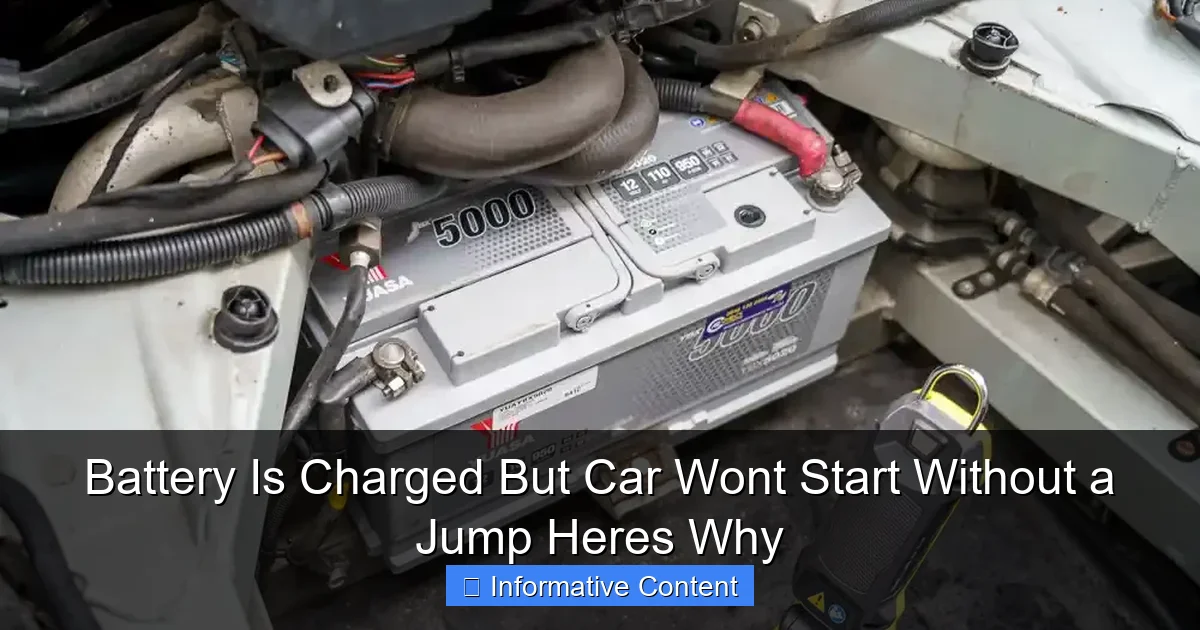
Visual guide about battery is charged but car won’t start without a jump
Image source: motorverso.com
Think of it like a weak flashlight: the batteries are full, but the bulb flickers because the connection inside is loose or corroded. Same idea with the starter—it might get power, but not enough to do its job.
How a Failing Starter Behaves
- Clicking sound when you turn the key: This is a classic sign. The solenoid (a small electromagnetic switch) is getting power and clicking, but the main starter motor isn’t turning.
- No sound at all: Could still be a starter issue, especially if there’s a broken internal connection or worn brushes.
- Intermittent starting: Works some days, not others—often due to heat expansion or loose internal components.
Real-life example: My neighbor’s 2008 Honda Accord would start perfectly in the morning but wouldn’t crank after sitting at work all day. Turned out, the starter had a cracked solder joint that expanded when hot, breaking the circuit. A jump would force it to work because the extra voltage from the donor battery pushed through the weak connection.
How to Diagnose a Bad Starter
- Tap test: With the car off, have someone turn the key while you gently tap the starter with a wrench or hammer. If it starts, the starter is likely failing. (Don’t hit it hard—just a light tap to jiggle internal parts.)
- Check voltage at the starter: Use a multimeter. When the key is turned, you should see close to 12V at the main terminal. If not, the issue is upstream (ignition switch, relay, etc.).
- Inspect wiring: Look for corroded or loose connections at the starter solenoid and ground points.
Tip: Starters often fail gradually. If your car has been harder to start recently—especially when hot—it’s a red flag.
2. Bad Ground Connections: The Invisible Power Drain
Even with a fully charged battery, your car won’t start if the ground connections are weak or corroded. Grounds complete the electrical circuit, allowing current to flow from the battery, through components, and back to the battery’s negative terminal. If that return path is broken, the starter won’t get enough current—even if the battery reads fine.
It’s like having a garden hose with a kink: water is in the hose, but it can’t flow to the sprinkler.
Common Ground Points to Check
- Battery to chassis ground cable: This thick black cable connects the negative terminal to the car’s frame. Corrosion or looseness here is a frequent culprit.
- Engine to chassis ground strap: Often overlooked. This strap connects the engine block to the frame. If it’s broken or corroded, the starter can’t complete its circuit.
- Starter mounting bolts: The starter grounds through its metal body. If the bolts are loose or the mounting surface is painted/rusted, the connection fails.
Real-life example: A friend’s 2012 Ford Focus wouldn’t start despite a new battery and alternator. We found the engine-to-chassis ground strap was frayed and barely touching. Replacing it fixed the issue instantly.
How to Fix Ground Issues
- Clean all connections: Remove the cables, scrub the terminals and contact points with a wire brush, and reinstall with anti-corrosion gel.
- Check continuity: Use a multimeter in continuity mode. Touch one probe to the negative terminal, the other to the engine block or starter housing. You should get a beep (indicating a solid connection).
- Replace damaged straps: Ground straps are cheap (usually $10–$25) and easy to install. Don’t ignore them!
Tip: If your car has multiple ground points, label them before disconnecting to avoid confusion during reassembly.
3. Faulty Ignition Switch or Starter Relay
The ignition switch doesn’t just “turn on” the car—it sends a signal to the starter relay, which then sends a large burst of power to the starter motor. If either the switch or relay is failing, the starter won’t engage, even with a good battery.
This is like a light switch that’s broken: you flip it, but the circuit isn’t completed, so the bulb stays off.
Ignition Switch Problems
- Worn contacts: Over time, the internal contacts in the switch can wear out, especially in older cars.
- Key wear: A worn key may not fully engage the switch, leading to intermittent starting.
- Steering lock interference: Some cars have a steering column lock that can prevent the switch from turning properly.
Diagnosis tip: If the dashboard lights dim when you turn the key to “start,” but the engine doesn’t crank, it could be the ignition switch not sending enough power to the starter circuit.
Starter Relay Failure
- Relays are simple but fail often: They’re small, cheap, and located in the fuse box (usually labeled “Starter” or “Crank”).
- Swap test: If you have another identical relay (like the horn or headlights), swap them. If the car starts, the relay was bad.
- Listen for a click: When you turn the key, you should hear a distinct “click” from the relay in the fuse box. No click? Relay or switch issue.
Pro tip: Relays are often overlooked. I’ve seen mechanics spend hours chasing battery and starter issues, only to fix it with a $15 relay swap.
4. Corroded or Loose Battery Cables
Even if the battery terminals look clean, corrosion can build up *under* the cable clamps or along the cable itself. This creates high resistance, preventing enough current from reaching the starter—even though the battery voltage reads normal.
Think of it like a clogged artery: blood is in the system, but it can’t reach the heart.
Hidden Corrosion Signs
- Green or white crust on terminals: Obvious, but often cleaned without checking deeper.
- Brittle or discolored cable insulation: Indicates internal corrosion.
- Loose terminal clamps: Can cause intermittent connections, especially when the car vibrates.
Real-life example: A 2005 Toyota Camry wouldn’t start after a jump. The battery tested fine, but when we removed the cables, we found green corrosion *inside* the clamps. Cleaning them restored full current flow.
How to Fix Cable Issues
- Remove and inspect cables: Don’t just clean the terminals—disconnect and check the entire cable for brittleness or discoloration.
- Use a battery post cleaner: A $5 tool that scrapes inside the clamps and terminals.
- Tighten properly: Use a wrench, not your hand. Loose connections can cause arcing and heat damage.
- Replace if damaged: Corroded cables can’t be fully restored. Replace them if they’re cracked or discolored.
Tip: Apply a thin layer of dielectric grease after cleaning to prevent future corrosion.
5. Weak or Failing Alternator (Yes, Really)
You might think a bad alternator only affects the battery, but it can cause a battery is charged but car won’t start without a jump issue too. Here’s how: a failing alternator may not maintain a stable voltage. When the battery is charged, the voltage reads fine—but when you try to start, the voltage drops too low because the alternator can’t support the load.
It’s like a water pump that can fill the tank but can’t maintain pressure when a faucet opens.
How to Tell If the Alternator Is the Problem
- Voltage drops when cranking: Use a multimeter. With the engine off, voltage should be 12.6V. When you try to start, it should stay above 10V. If it drops below 9V, the alternator or battery is weak.
- Dimming lights when cranking: Another sign of low voltage under load.
- Alternator warning light flickers: Especially when trying to start.
Real-life example: A 2010 Subaru Outback would start fine with a jump but die after 10 minutes. The alternator was putting out 11.8V instead of 13.5–14.5V. Replacing it fixed both the charging and starting issues.
Alternator Testing and Replacement
- Test output at the battery with the engine running. Should be 13.5–14.5V.
- Check for loose belts or worn bearings: A squealing noise when starting can mean the alternator is struggling.
- Consider a rebuilt alternator: Often cheaper and just as reliable as new.
Note: A bad alternator won’t *prevent* starting if the battery is fully charged—but it can cause voltage instability that mimics a bad starter or ground.
Data Table: Common Causes and Diagnostic Steps
| Issue | Key Symptoms | Quick Test | Estimated Fix Cost |
|---|---|---|---|
| Bad Starter | Clicking, no crank, intermittent starts | Tap starter while cranking | $150–$500 (parts + labor) |
| Bad Ground | No crank, dim lights when cranking | Check continuity from battery to engine | $10–$50 (straps + cleaning) |
| Faulty Relay | No click, no crank | Swap with known-good relay | $10–$30 |
| Corroded Cables | Intermittent starting, visible crust | Remove and inspect cables | $20–$100 (cable replacement) |
| Failing Alternator | Voltage drops when cranking, dimming lights | Test voltage with engine running | $200–$600 |
Note: Costs vary by vehicle and region. DIY can save 50% or more on labor.
Conclusion: Don’t Jump to Conclusions—Troubleshoot Smart
When your battery is charged but car won’t start without a jump, it’s easy to assume the battery or alternator is at fault. But as we’ve seen, the real issue could be a failing starter, corroded ground, bad relay, or even hidden cable damage. The key is to work methodically—start with the cheapest and easiest fixes (like checking grounds and relays) before moving to more expensive parts like the starter or alternator.
Remember: just because the battery lights up doesn’t mean it can deliver the high current the starter needs. And just because you can jump-start the car doesn’t mean the battery is the root cause. The jump provides a temporary boost, but it won’t fix a bad ground or worn starter.
Here’s your action plan:
- Step 1: Check battery cables and grounds. Clean and tighten everything.
- Step 2: Test the starter relay—swap it if possible.
- Step 3: Try the tap test on the starter.
- Step 4: Use a multimeter to check voltage at the starter during cranking.
- Step 5: If all else fails, have the alternator tested.
And if you’re ever unsure, don’t hesitate to consult a trusted mechanic. But now, you’ll know exactly what to ask for—and you won’t be sold a $1,000 repair for a $15 relay.
Your car isn’t broken—it’s just trying to tell you something. Listen carefully, and you’ll get back on the road in no time.
Frequently Asked Questions
Why does my car need a jump if the battery is charged?
Even if your battery shows a full charge, issues like corroded terminals, a failing alternator, or a defective starter can prevent the engine from turning over. A jump bypasses these problems temporarily by delivering extra power directly to the system.
Can a bad alternator cause my “battery is charged but car won’t start” issue?
Yes, a faulty alternator may not recharge the battery properly while driving, leaving it unable to deliver sufficient cranking power. This mimics a dead battery despite showing a charge when tested.
Could a parasitic drain be the reason my car won’t start without a jump?
Absolutely. A parasitic drain (e.g., from a malfunctioning module or light) can slowly deplete your battery overnight, even if it appears charged. This leaves too little energy to start the engine.
Is a failing starter motor a common cause when the battery is charged but the car won’t start?
Yes. A worn starter may not engage the flywheel correctly, preventing the engine from cranking—even with a fully charged battery. Listen for clicking noises, which often indicate starter issues.
How do corroded battery terminals affect a “charged battery but no start” problem?
Corrosion creates resistance, limiting the current flow from the battery to the starter. Cleaning the terminals often resolves this, as it restores proper electrical contact.
When should I suspect the ignition switch if my car won’t start without a jump?
If the dashboard lights work but the starter doesn’t engage, a faulty ignition switch could be interrupting the signal. This issue often worsens intermittently before failing completely.