
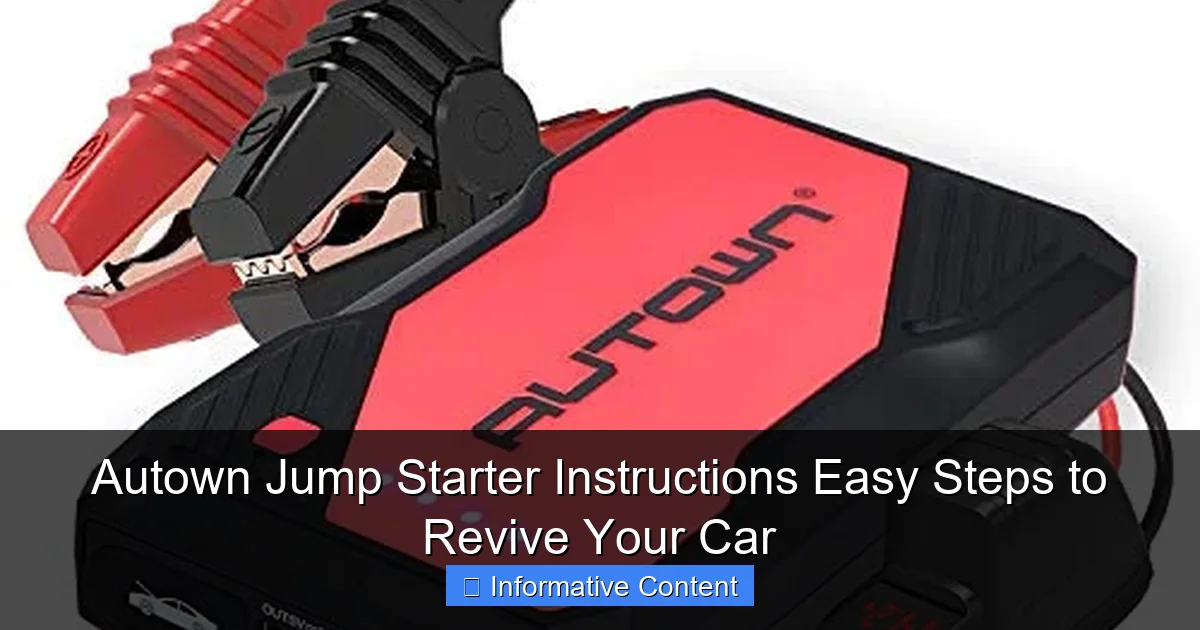
Featured image for autown jump starter instructions
Image source: promote-img.snagshout.com
Revive your car in minutes with the Autown Jump Starter by following these simple, foolproof steps: connect the clamps to your battery (red to positive, black to ground), power on the unit, and start your engine. No tools or expertise needed—this portable device delivers instant power, making it a must-have for roadside emergencies.
Key Takeaways
- Read the manual first: Always review Autown jump starter instructions before use to ensure safety and efficiency.
- Check battery levels: Fully charge the jump starter prior to emergencies for reliable performance.
- Connect cables properly: Attach red to positive (+) and black to negative (-) terminals to prevent damage.
- Start the vehicle quickly: Crank the engine within 3–5 seconds to avoid overheating the device.
- Use safety features: Enable reverse polarity and overload protection for added security during jumps.
- Store in cool, dry places: Maintain device longevity by avoiding extreme temperatures and moisture.
📑 Table of Contents
- Why Every Driver Needs to Know How to Use an Autown Jump Starter
- What Is an Autown Jump Starter and How Does It Work?
- Step-by-Step Autown Jump Starter Instructions
- Common Mistakes and How to Avoid Them
- Maintenance Tips to Keep Your Autown Jump Starter in Top Shape
- Real-Life Scenarios: When the Autown Jump Starter Saved the Day
- Comparison: Autown Jump Starter vs. Traditional Jumper Cables
- Final Thoughts: Be Prepared, Stay Safe
Why Every Driver Needs to Know How to Use an Autown Jump Starter
Imagine this: You’re running late for work, the sun is barely up, and you turn the key in your car’s ignition—only to hear that dreaded click-click-click. Your battery is dead. Again. You look around, hoping someone will stop to help, but the parking lot is empty. Sound familiar? If you’ve ever been stranded because of a dead battery, you’ll know how stressful and frustrating it can be. That’s where a reliable jump starter like the Autown jump starter comes in—it’s like carrying your own personal mechanic in the trunk.
Unlike traditional jumper cables that rely on a second vehicle, the Autown jump starter is a compact, portable powerhouse. It doesn’t need another car to get you going. Whether you’re at home, on a remote highway, or in the middle of a grocery store parking lot, it gives you the freedom to revive your car on your own. But owning one isn’t enough—you need to know how to use it safely and effectively. That’s why I’ve put together this guide to walk you through Autown jump starter instructions in simple, easy-to-follow steps. No technical jargon, no confusing diagrams—just real-life advice from someone who’s been there, done that, and learned the hard way.
What Is an Autown Jump Starter and How Does It Work?
Understanding the Basics of Portable Jump Starters
A jump starter is a portable battery pack designed to deliver a powerful surge of electricity to your car’s dead battery, allowing the engine to start. The Autown jump starter is no ordinary power bank—it’s built specifically for automotive use, with features like high peak current (often 1200A or more), reverse polarity protection, and built-in safety alerts. Think of it as a supercharged version of the battery in your phone, but strong enough to crank a car engine.

Visual guide about autown jump starter instructions
Image source: mototabi.net
Unlike jumper cables, which require a second vehicle and a bit of mechanical know-how, the Autown jump starter is a standalone unit. You simply connect it to your car’s battery terminals, and it does the rest. Most models also double as power banks, letting you charge your phone, tablet, or even run a small air compressor—perfect for road trips or emergencies.
Key Features That Make Autown Jump Starters Stand Out
Autown jump starters are known for their reliability, but what really sets them apart are the safety and convenience features:
- Spark-proof clamps: Prevents sparks when connecting, reducing fire risk.
- Reverse polarity protection: Alerts you if you accidentally connect the cables the wrong way.
- LED flashlight: Handy for nighttime use or emergencies—some models even have SOS flashing modes.
- Multiple USB ports: Charge your devices while you’re on the go.
- LCD screen (on newer models): Shows battery level, voltage, and connection status.
- Compact and lightweight: Easy to store in your glove compartment or trunk.
For example, the Autown 1200A model has enough power to jump-start a 7.0L gas or 5.5L diesel engine—more than enough for most sedans, SUVs, and light trucks. I once used it to start my neighbor’s pickup truck in freezing winter weather, and it worked on the first try. That’s the kind of peace of mind these devices offer.
How It Works: A Simple Electrical Flow
When your car battery dies, it still holds some charge—but not enough to start the engine. The jump starter provides a high-current burst (measured in amps) that “kicks” the battery into action. Here’s how it flows:
- The jump starter’s internal battery stores energy.
- When connected correctly, it transfers that energy to your car’s battery via the clamps.
- The surge helps the starter motor engage, turning the engine.
- Once the engine runs, your alternator takes over and recharges the battery.
It’s like giving your car a jump-start with a shot of espresso—quick, effective, and no second vehicle needed.
Step-by-Step Autown Jump Starter Instructions
Step 1: Safety First – Park and Prepare
Before you even touch the jump starter, safety is key. Here’s what to do:
- Park on a flat, level surface. Turn on your hazard lights and engage the parking brake.
- Turn off the engine and all electronics. No radio, AC, or lights—this prevents power surges.
- Wear gloves (optional but recommended). Protect your hands from dirt, grease, or accidental sparks.
- Inspect the battery. Look for cracks, leaks, or corrosion. If the battery is damaged, do not attempt to jump-start—replace it instead.
I learned this the hard way when I once tried to jump a car with a cracked battery. The acid fumes were overwhelming, and it wasn’t worth the risk. Always check first.
Step 2: Power On the Autown Jump Starter
Grab your Autown jump starter and press the power button. Most models will light up with an LED indicator or LCD screen showing the charge level. Ensure it has at least 50% charge before use—a fully depleted jump starter won’t help anyone.
If the screen says “Ready” or “Good,” you’re good to go. Some models have a “Jump Start” mode—press that button to activate the high-current output. This is important: without enabling this mode, the jump starter might only charge your battery slowly, not deliver the burst needed to start the engine.
Step 3: Connect the Cables – Red First, Black Second
Now comes the crucial part: connecting the clamps. Remember this rule: Red to Positive (+), Black to Negative (–).
- Open the hood and locate the battery. Clean the terminals with a wire brush if they’re corroded.
- Attach the red clamp to the positive terminal of your car battery. It’s usually marked with a “+” sign and has a red cover.
- Attach the black clamp to an unpainted metal surface (like a bolt or bracket) near the battery—not the negative terminal. This acts as a ground and prevents sparks near the battery, where flammable gases may be present.
Pro tip: I always connect the black clamp to the engine block or a metal strut. Avoid anything plastic or painted. If you connect it to the negative terminal, some jump starters will trigger a safety alarm—so stick to the ground point.
Step 4: Wait and Start the Engine
Once the clamps are secure, wait 30 seconds. This allows the jump starter to stabilize and send power to the battery. Some models will beep or flash to confirm a good connection.
Now, get in your car and try to start the engine. Turn the key—or press the start button—and let it crank. Don’t pump the gas pedal—modern cars don’t need it. Just let the starter do its job.
If the engine doesn’t start on the first try, wait 10–15 seconds before trying again. Most jump starters allow 3–5 attempts in quick succession, but check your model’s manual to avoid overheating.
Step 5: Disconnect in Reverse Order
Once your car is running, it’s time to disconnect—but do it in reverse order:
- Remove the black clamp first (from the ground point).
- Then remove the red clamp (from the positive terminal).
- Close the jump starter’s clamps back into their protective case.
Never let the clamps touch each other while connected to the battery—it could cause a short circuit or spark. I once saw a friend accidentally drop the clamps on the battery and got a small flame. Scary? Yes. Avoidable? Absolutely.
Step 6: Let the Engine Run and Recharge
Keep your engine running for at least 15–20 minutes to let the alternator recharge the battery. If you turn it off right away, the battery might not hold enough charge and die again.
After that, drive for at least 30 minutes—preferably on the highway—to fully recharge. If your battery is old, consider getting it tested at an auto shop. A jump starter is a temporary fix, not a long-term solution for a failing battery.
Common Mistakes and How to Avoid Them
Connecting the Clamps Backwards (Reverse Polarity)
One of the most common—and dangerous—mistakes is reversing the red and black clamps. If you connect red to negative and black to positive, you risk:
- Damaging your car’s electrical system
- Blowing fuses
- Melting the jump starter’s internal components
Good news: most Autown jump starters have reverse polarity protection. If you connect them wrong, the device will beep, flash, or display a warning—and won’t deliver power. But don’t rely on this feature. Always double-check the terminals before attaching.
I once helped a friend who was in a panic and connected the clamps backward. The jump starter beeped like crazy, but he kept trying. After five attempts, it finally gave up. We had to wait 10 minutes before it would work again. Lesson learned: slow down and read the labels.
Using a Low-Charge Jump Starter
Imagine this: you’re in a hurry, grab your jump starter, and it only has 20% battery. You connect it, try to start the car—and nothing happens. The jump starter can’t deliver enough current.
Always charge your jump starter after every use. Most models take 3–5 hours to fully charge via a wall outlet or car charger. I keep mine plugged into a smart plug in my garage so it’s always ready. Some newer models even support USB-C fast charging—super convenient.
Ignoring the Ground Connection
Some people skip the ground step and connect the black clamp directly to the battery’s negative terminal. While this might work, it increases the risk of sparks near the battery, which can be dangerous if there’s any hydrogen gas buildup (common in older batteries).
Always use a clean, unpainted metal surface for the ground. It’s a small step, but it makes a big difference in safety.
Overusing the Jump Starter
Jump starters are designed for emergencies, not repeated use. If you’re jump-starting your car every week, your battery or alternator is likely failing. A jump starter can handle 3–5 attempts per session, but don’t keep trying if the engine doesn’t start after a few tries.
Instead, call a mechanic or get your battery tested. I once kept trying to jump a car with a dead alternator—after five attempts, the jump starter overheated and shut down. It took 30 minutes to cool off. Not fun.
Maintenance Tips to Keep Your Autown Jump Starter in Top Shape
Charge It Regularly – Even When Not in Use
Most lithium-ion batteries degrade if left discharged for long periods. To extend your jump starter’s lifespan:
- Charge it every 3 months if you haven’t used it.
- Store it at 50–80% charge if you plan to leave it unused for months.
- Avoid leaving it in extreme temperatures (below freezing or above 110°F).
I keep a reminder on my phone every three months to “charge the jump starter.” It’s saved me more than once.
Clean the Clamps and Cables
After each use, wipe the clamps with a dry cloth. If they’re dirty or corroded, use a wire brush to clean them. Dirt and corrosion reduce conductivity, making it harder to deliver power.
Also, check the cables for cracks or fraying. Replace the unit if the insulation is damaged—exposed wires are a safety hazard.
Store It Properly
Keep your jump starter in a dry, cool place—ideally in its carrying case. I store mine in the trunk, in a small bin with my jumper cables and flashlight. It’s protected from moisture and easy to find in an emergency.
Avoid leaving it in direct sunlight or in a hot car. High temperatures can damage the battery and reduce performance.
Check the Firmware (If Applicable)
Some newer Autown models have firmware that can be updated via USB. Check the manufacturer’s website occasionally for updates. These often include safety improvements or new features.
Real-Life Scenarios: When the Autown Jump Starter Saved the Day
Scenario 1: Winter Morning in the Grocery Store Parking Lot
It was -10°F outside, and my car wouldn’t start after shopping. I grabbed my Autown jump starter, followed the steps—red to positive, black to a bolt on the engine block—and within two minutes, the engine roared to life. No waiting for a stranger, no cold fingers from holding jumper cables. Just me, my trusty jump starter, and a warm cup of coffee waiting inside.
Scenario 2: Remote Roadside Breakdown
On a long road trip, my battery died on a rural highway with no cell service. I used the jump starter to get going, then used its USB port to charge my phone so I could call roadside assistance. The built-in flashlight also helped me change a flat tire later that night. It’s more than a jump starter—it’s a survival tool.
Scenario 3: Helping a Friend in Need
My neighbor’s SUV wouldn’t start before a road trip. I brought over my Autown, and we had it running in under five minutes. He was so impressed he bought one the next day. Now we both keep them in our trunks—just in case.
Comparison: Autown Jump Starter vs. Traditional Jumper Cables
| Feature | Autown Jump Starter | Traditional Jumper Cables |
|---|---|---|
| Requires another vehicle? | No | Yes |
| Portability | High (compact, lightweight) | Medium (bulky, heavy) |
| Setup time | 1–2 minutes | 3–5 minutes (plus finding another car) |
| Additional features | USB charging, flashlight, safety alerts | None (basic cables only) |
| Weather resistance | Good (sealed battery) | Low (exposed clamps, cables) |
| Cost | $80–$150 | $20–$60 |
While jumper cables are cheaper, the Autown jump starter offers unmatched convenience, safety, and versatility. For most drivers, the extra cost is worth the peace of mind.
Final Thoughts: Be Prepared, Stay Safe
Knowing how to use an Autown jump starter isn’t just about fixing a dead battery—it’s about independence, safety, and being prepared for the unexpected. Whether you’re a daily commuter, a road-tripper, or a parent running errands, this small device can make a huge difference when things go wrong.
Follow the Autown jump starter instructions carefully: charge it regularly, connect the clamps correctly, and use the ground point. Avoid common mistakes like reverse polarity or overuse. And remember—this is a tool, not a cure-all. If your battery keeps dying, get it checked by a professional.
I’ve used my Autown jump starter more times than I can count—from cold mornings to helping strangers on the side of the road. It’s saved me time, stress, and even a towing bill or two. And the best part? I never have to rely on someone else to get me going again.
So if you don’t already own one, consider adding an Autown jump starter to your emergency kit. It’s one of those things you hope you’ll never need—but you’ll be so glad you have when you do.
Frequently Asked Questions
How do I use the Autown jump starter for the first time?
Begin by fully charging your Autown jump starter using the provided USB-C cable. Connect the clamps to the battery terminals (red to positive, black to negative), then start your vehicle—the smart safety features will prevent reverse polarity damage.
Can I follow Autown jump starter instructions for a completely dead battery?
Yes, the Autown jump starter works even with deeply discharged batteries (as low as 1.2V). Ensure the clamps have secure contact, and wait 30 seconds before attempting to start—this allows the unit to stabilize the connection.
What safety features should I check before using my Autown jump starter?
Autown models include spark-proof clamps, reverse polarity alerts, and overload protection. Always verify the LED indicator shows a steady green light before starting your car to confirm a safe connection.
How long does it take to charge the Autown jump starter fully?
Most Autown jump starters reach full charge in 3–5 hours via the USB-C port. A built-in battery indicator will display four solid lights when ready for use.
Can I use the Autown jump starter as a power bank for devices?
Yes! The Autown jump starter has dual USB ports to charge phones, tablets, or GPS devices. Simply connect your device while the jump starter is powered on (no vehicle required).
What’s the correct way to store my Autown jump starter after use?
Recharge it to 50% if unused for 3+ months and store in a dry, room-temperature environment. The battery’s lifespan is prolonged by avoiding extreme heat or cold.