
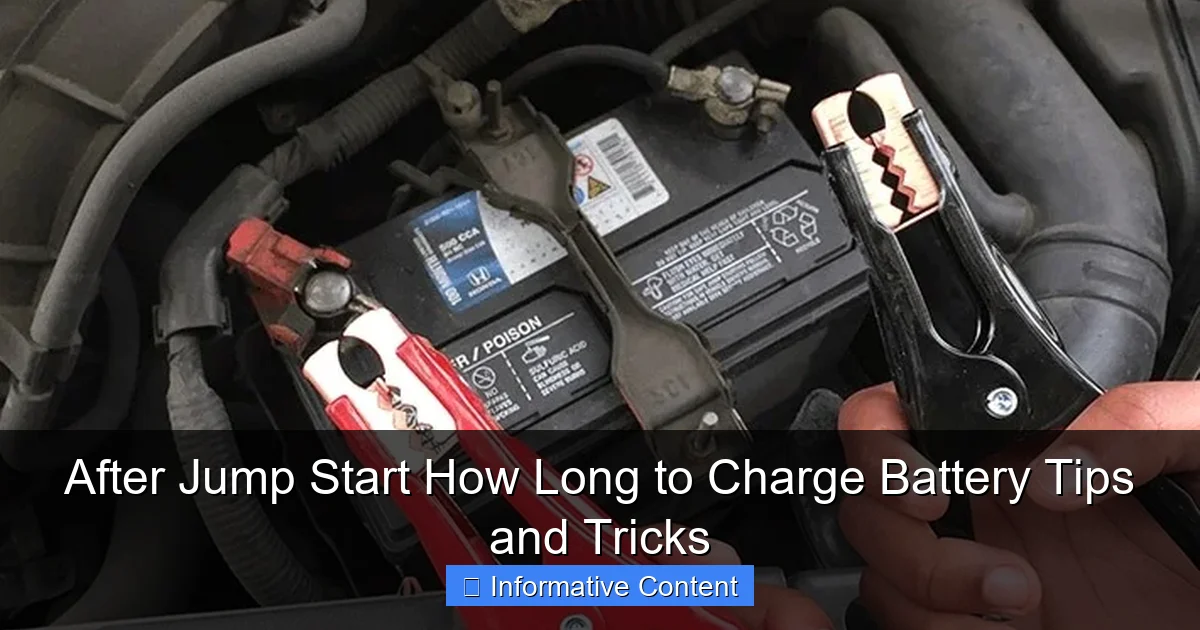
Featured image for after jump start how long to charge battery
Image source: motorspider.com
After a jump start, drive your vehicle for at least 30 minutes to allow the alternator to recharge the battery sufficiently—this is the fastest and most effective method. For optimal results, avoid short trips and consider using a battery charger if the vehicle won’t be driven regularly. Leaving a battery connected without driving for days can lead to undercharging, reducing its lifespan.
Key Takeaways
- Drive immediately after jump start: Run the engine 20-30 mins to recharge the battery.
- Use a battery charger: For a full recharge, connect a charger for 4-8 hours.
- Avoid short trips: Frequent short drives prevent proper battery recharging.
- Test battery health: Check voltage with a multimeter to confirm charge status.
- Inspect alternator: Ensure it’s charging the battery while the engine runs.
- Prevent future issues: Regularly maintain battery terminals and connections.
📑 Table of Contents
- Why Jump Starting Is Only the First Step
- How Car Batteries Work and Why They Need Time to Recharge
- After Jump Start How Long to Charge Battery: Real-World Timeframes
- Factors That Affect How Long Your Battery Takes to Recharge
- Best Practices: How to Recharge Your Battery After a Jump Start
- Common Myths and Mistakes to Avoid
- Data Table: Charging Times by Scenario
- Final Thoughts: Patience Pays Off
Why Jump Starting Is Only the First Step
Let’s be honest—getting a jump start is one of those car moments that feels like a small victory. You’re stranded, maybe late for work, and suddenly a kind stranger (or your trusty battery pack) swoops in with jumper cables like a roadside superhero. The engine turns over, you breathe a sigh of relief, and you’re back on the road. But here’s the thing: jump starting your car doesn’t fully recharge your battery. It’s like giving your phone a 10% boost to get home—it’s not a full charge.
After a jump start, your battery is still low on juice. The alternator, which charges your battery while the engine runs, needs time to replenish what was lost. If you don’t give it that time, you’ll likely end up right back where you started: dead battery, dim lights, and that dreaded click-click-click when you turn the key. So, the real question isn’t just “Can I jump start my car?” but “After jump start, how long to charge battery?” That’s what we’re diving into today—practical tips, real-world examples, and the science behind getting your battery back to full strength.
How Car Batteries Work and Why They Need Time to Recharge
The Basics of a Car Battery
Your car battery isn’t just a power bank for the starter motor. It’s a lead-acid battery (in most vehicles) that stores chemical energy and converts it to electrical energy. When you jump start, you’re using another battery (or power source) to deliver a quick burst of current to get the engine going. But that’s only the beginning.
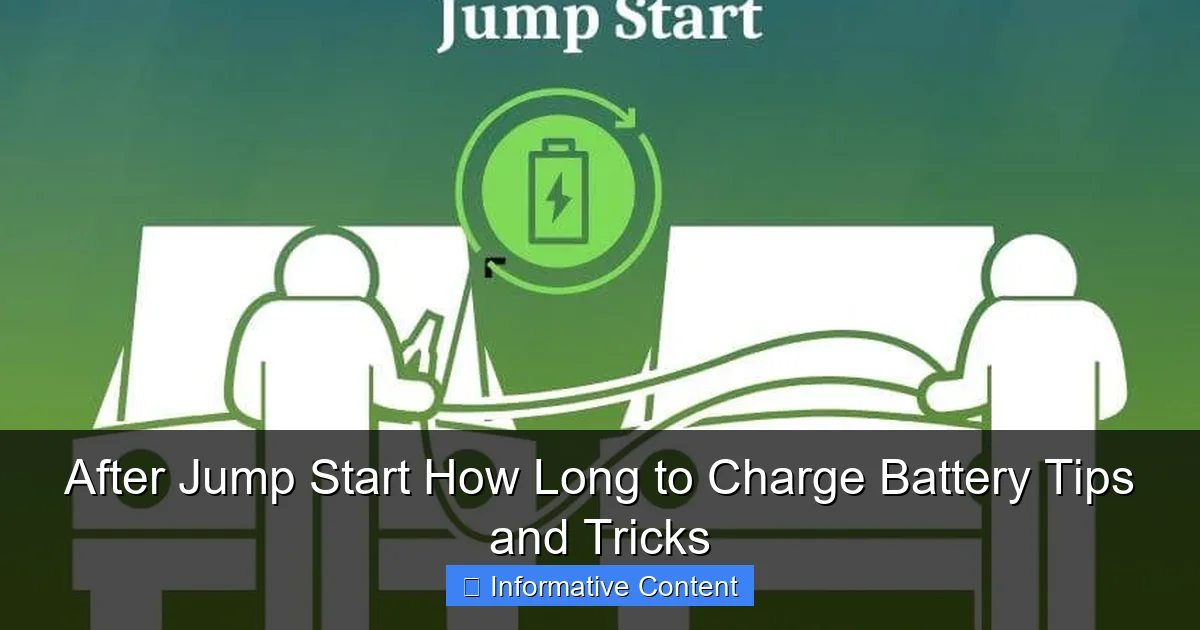
Visual guide about after jump start how long to charge battery
Image source: thepowerfacts.com
The battery’s real job starts after the engine runs. The alternator—a small generator powered by the engine—takes over and supplies electricity to the car’s systems while simultaneously charging the battery. Think of it like a water pump refilling a reservoir after a drought. But it can’t do it instantly.
What Happens During a Jump Start?
When you jump start, you’re bypassing the battery’s low state to get the engine running. The jump provides enough voltage (usually 12–14 volts) to crank the starter. Once the engine runs, the alternator kicks in. But here’s the catch: the alternator doesn’t charge at full speed right away. It starts slow, gradually increasing output as the engine warms up and the battery’s state of charge improves.
For example, let’s say your battery was at 20% charge before the jump. The alternator might take 10–15 minutes to bring it back to 50%. But to reach 80–100%, it needs much longer—often 30 minutes to several hours, depending on driving conditions.
Why Rushing the Process Is Risky
- Short drives won’t cut it: If you jump start and only drive 5–10 minutes, you’re barely scratching the surface. The alternator needs sustained runtime to recharge.
- Repeated jump starts shorten battery life: Every deep discharge (like letting a battery die) reduces its capacity over time. If you keep relying on jump starts without proper charging, you’ll shorten your battery’s lifespan.
- Alternator strain: A severely depleted battery forces the alternator to work harder, which can overheat it or cause premature failure.
So, while you might feel fine after a jump, the battery is still “hungry.” And like any good meal, it takes time to digest.
After Jump Start How Long to Charge Battery: Real-World Timeframes
General Charging Times Based on Battery State
There’s no one-size-fits-all answer to “after jump start how long to charge battery,” but here are some realistic estimates based on common scenarios:
- Lightly discharged (70–80% charge): 20–30 minutes of highway driving.
- Moderately discharged (40–60% charge): 45–60 minutes of mixed city/highway driving.
- Severely discharged (20–30% charge): 2–3 hours of continuous driving.
- Completely dead (0–10% charge): 4+ hours or consider using a battery charger.
These times assume your alternator is working properly and the battery is in decent condition. If the battery is old or damaged, it may never reach full charge, even after hours of driving.
City vs. Highway Driving: Which Is Better for Charging?
Here’s a common question: “Should I drive in the city or on the highway after a jump start?” The answer? Highway driving is far more effective.
- Highway: Steady engine RPM (revolutions per minute) means the alternator spins faster and produces more current. This is ideal for recharging. A 30-minute highway drive can add 20–30% charge to a moderately depleted battery.
- City: Frequent stops, idling, and low RPMs reduce alternator output. You might only gain 5–10% charge in the same 30 minutes. Plus, all the electrical loads (AC, lights, radio) are drawing power, which slows charging.
Real-life example: My friend jumped her car after leaving the lights on overnight. She drove 20 minutes in city traffic and thought she was good. Two days later, the battery died again. The second time, she took a 45-minute highway loop. The battery held up for weeks after that.
When You Should Use a Battery Charger Instead
If your battery is severely dead or you don’t have time for a long drive, a smart battery charger is the best solution. These chargers deliver a controlled charge, often with stages (bulk, absorption, float) that mimic what the alternator does—but more efficiently.
- Trickle charger: Adds 1–2 amps over 12–24 hours. Great for maintenance but slow for recovery.
- Smart charger: Adjusts voltage and current based on battery state. Can recharge a dead battery in 4–8 hours.
- Jump starter with charging mode: Some portable jump starters (like NOCO Boost Plus) can also charge your battery when plugged into an outlet.
Pro tip: If you use a charger, make sure to disconnect the battery or use a charger with a “maintenance mode” to avoid overcharging.
Factors That Affect How Long Your Battery Takes to Recharge
Battery Age and Condition
An old battery (3+ years) holds less charge and recharges slower. Sulfation—the buildup of lead sulfate crystals—reduces capacity and makes charging inefficient. If your battery is over 5 years old, even a long drive might not restore it fully.
Example: My dad’s 2015 SUV had a battery that died after a jump. We drove it for 2 hours, but the next morning, it was dead again. The battery was 7 years old—past its prime. We replaced it, and the new one charged fully in 30 minutes.
Alternator Health
If your alternator is weak or failing, it can’t charge the battery properly—even if it’s running. Signs of alternator issues include:
- Dimming headlights when the engine is running
- Battery warning light on the dashboard
- Strange smells (burning rubber) or noises (grinding)
A healthy alternator should produce 13.5–14.5 volts when the engine is running. You can test this with a multimeter or have a mechanic check it.
Electrical Load and Driving Habits
The more electrical devices you use, the harder it is for the alternator to charge the battery. Running the AC, heater, stereo, and phone chargers all draw power. If you’re stuck in traffic with the AC blasting, the alternator might be too busy powering those systems to recharge the battery.
Also, short trips (under 10 minutes) are the enemy of battery health. They don’t give the alternator enough time to work. If you only drive short distances, consider using a battery tender (a low-voltage charger) overnight to keep it topped off.
Temperature and Environment
Extreme cold slows chemical reactions in the battery, making it harder to charge. In winter, a battery that takes 1 hour to charge in summer might take 2+ hours. Conversely, extreme heat can evaporate battery fluid and damage internal components.
Tip: If you jump start in winter, let the engine run for 5–10 minutes before driving to warm up the battery and alternator.
Best Practices: How to Recharge Your Battery After a Jump Start
Step 1: Drive Smart (Highway, Not City)
As we covered, highway driving is your best bet. Aim for at least 30 minutes of continuous driving at 50+ mph. Avoid stop-and-go traffic. If possible, take a scenic loop or a longer route home.
Bonus tip: Turn off unnecessary electrical loads (AC, radio, heated seats) to reduce strain on the alternator.
Step 2: Monitor Battery Voltage
You don’t need a fancy tool—a $15 multimeter from Amazon or an auto parts store works. After driving, check the battery voltage:
- 12.6V+: Fully charged
- 12.4V: ~75% charged
- 12.2V: ~50% charged
- 12.0V or below: Needs more charging or may be failing
Pro tip: Test the voltage with the engine off. If it’s below 12.4V after a long drive, your battery or alternator may have an issue.
Step 3: Use a Battery Charger for Faster Results
If you’re short on time or the battery is very low, a smart charger is the way to go. Here’s how to use one:
- Disconnect the battery (optional but safer).
- Connect the charger to the battery terminals (red to positive, black to negative).
- Set the charger to “automatic” or “12V” mode.
- Let it run until it indicates a full charge (usually 4–8 hours).
- Disconnect the charger and reconnect the battery.
Example: My neighbor used a NOCO Genius10 charger to revive a completely dead battery in 6 hours. The next morning, the car started instantly.
Step 4: Test the Battery Before Relying on It
After charging, don’t assume it’s fixed. Test it:
- Turn the key and see if it cranks quickly (no slow turnover).
- Check voltage again the next morning (a healthy battery should hold ~12.4V+).
- Listen for the battery warning light or any strange sounds.
If it fails any of these, the battery may need replacement.
Step 5: Prevent Future Jump Starts
Once your battery is charged, take steps to avoid a repeat:
- Turn off all electronics when parking: Lights, phone chargers, etc.
- Use a battery tender for infrequent drivers: Keeps the battery charged when the car sits.
- Replace old batteries proactively: Most last 3–5 years.
- Check the charging system annually: Especially before winter.
Common Myths and Mistakes to Avoid
Myth: “Driving 10 Minutes Is Enough”
We’ve all heard it: “Just drive around the block and it’ll be fine.” Nope. Ten minutes is barely enough to warm up the engine, let alone recharge a dead battery. You need sustained runtime.
Myth: “The Alternator Should Charge the Battery Instantly”
Alternators charge gradually. They’re not designed to “fill up” a battery in minutes. It’s a slow process, especially if the battery is deeply discharged.
Mistake: Leaving the Engine Running for Hours
Some people think, “If I leave the car running in the driveway, it’ll charge faster.” Not really. The alternator produces less current at idle than at highway RPMs. Plus, you’re wasting fuel and risking overheating.
Mistake: Using a Trickle Charger Without Monitoring
Old-school trickle chargers can overcharge and damage batteries if left unattended. Always use a smart charger with automatic shutoff or a timer.
Mistake: Ignoring the Root Cause
A jump start is a band-aid. If your battery keeps dying, find the cause:
- Parasitic drain (something drawing power when the car is off)
- Failing alternator
- Old or damaged battery
Ignoring these issues leads to repeated jump starts and costly repairs.
Data Table: Charging Times by Scenario
| Battery State | Highway Driving Time | City Driving Time | Recommended Charger Time |
|---|---|---|---|
| 70–80% charge | 20–30 minutes | 30–45 minutes | 1–2 hours (smart charger) |
| 40–60% charge | 45–60 minutes | 1.5–2 hours | 2–4 hours (smart charger) |
| 20–30% charge | 2–3 hours | 3–4+ hours | 4–6 hours (smart charger) |
| 0–10% charge | 4+ hours (or not possible) | Not recommended | 6–12 hours (smart charger) |
Note: Times are approximate and depend on battery health, alternator output, and electrical load.
Final Thoughts: Patience Pays Off
So, after jump start how long to charge battery? The answer isn’t “just drive a bit” or “it’ll be fine.” It’s give your battery the time and conditions it needs to recover. Think of it like recovering from an illness—rest, proper care, and patience are key.
Whether you choose highway driving, a smart charger, or a combination, the goal is the same: a fully charged, healthy battery. And once it’s charged, take steps to prevent the problem from happening again. Because let’s face it—no one wants to be that person standing by the side of the road with jumper cables in hand.
Next time you jump start your car, remember: the real work starts after the engine turns over. Take the extra time. Your battery (and your future self) will thank you.
Frequently Asked Questions
How long should I charge my battery after a jump start?
After a jump start, drive your vehicle for at least 30 minutes to allow the alternator to recharge the battery. For a full charge, especially if the battery was deeply discharged, it may take several hours of driving or using a dedicated battery charger.
Can I just jump start my car and drive normally to charge the battery?
Yes, driving for 30 minutes or longer after a jump start helps recharge the battery via the alternator. However, frequent jump starts may indicate a failing battery or charging system that needs professional inspection.
After jump start how long to charge battery with a charger?
Using a battery charger, it typically takes 4–12 hours to fully recharge, depending on the charger’s amperage and the battery’s condition. Always follow the manufacturer’s guidelines to avoid overcharging.
Is it safe to leave my car running after a jump start to charge the battery?
Leaving the car running for 20–30 minutes is safe and effective for initial recharging. Avoid idling excessively, as it wastes fuel and may not fully restore a deeply drained battery.
Why does my battery die again after a jump start and short drive?
If the battery drains quickly, it may no longer hold a charge due to age or damage. Have the battery and alternator tested to ensure they’re functioning properly.
After jump start how long to charge battery before turning the car off?
Wait at least 5–10 minutes after the jump start before turning off the engine to stabilize the battery. For best results, drive for 30+ minutes to allow the alternator to restore charge.