
Featured image for difference between jump starter and battery charger
Image source: beadnova.com
Jump starters deliver a quick, high-current power boost to start a dead battery instantly, making them ideal for emergencies when you’re stranded. Battery chargers, on the other hand, provide a slow, steady charge to restore a battery’s full capacity over time, best used for maintenance or long-term recovery. Knowing when to use each can save time, protect your battery, and keep you moving.
Key Takeaways
- Jump starters deliver instant power to start a dead battery.
- Battery chargers slowly replenish charge for long-term battery health.
- Use jump starters for emergencies when time is critical.
- Choose battery chargers for maintenance and extended storage needs.
- Jump starters are portable; chargers often require a power outlet.
- Never leave chargers connected unattended to avoid overcharging.
📑 Table of Contents
- Jump Starters vs. Battery Chargers: Why the Right Choice Matters
- What Is a Jump Starter? (And When You Actually Need One)
- What Is a Battery Charger? (And Why It’s Not for Emergencies)
- Key Differences: Jump Starter vs. Battery Charger
- Data Table: Jump Starter vs. Battery Charger Comparison
- Which One Should You Buy? (A Realistic Buyer’s Guide)
- Pro Tips for Using Both Tools Safely and Effectively
- Final Thoughts: Choosing the Right Tool for Your Needs
Jump Starters vs. Battery Chargers: Why the Right Choice Matters
Let’s face it—few things are more frustrating than turning the key in your car and hearing nothing but a faint click. You’re late for work, it’s freezing outside, and now your battery’s dead. Panic sets in. You grab the nearest device in your garage, plug it in, and hope for the best. But what if that device isn’t actually the right tool for the job? That’s where the difference between jump starter and battery charger becomes critical. These two tools may look similar, but they serve entirely different purposes—and using the wrong one could leave you stranded or even damage your vehicle.
I learned this the hard way. A few winters ago, I tried using a basic battery charger to jump my car after a long weekend of inactivity. The charger hummed for 30 minutes, and when I tried the ignition—nothing. I later realized I needed a jump starter, not a charger. The confusion between the two cost me time, stress, and a tow truck call. That experience sparked my curiosity: why are these tools so often misunderstood? And more importantly, how can you avoid making the same mistake?
In this guide, I’ll walk you through the key differences, real-world applications, and practical tips to help you choose the right tool for your needs. Whether you’re a seasoned car enthusiast or a first-time driver, understanding the difference between jump starter and battery charger can save you time, money, and a whole lot of frustration.
What Is a Jump Starter? (And When You Actually Need One)
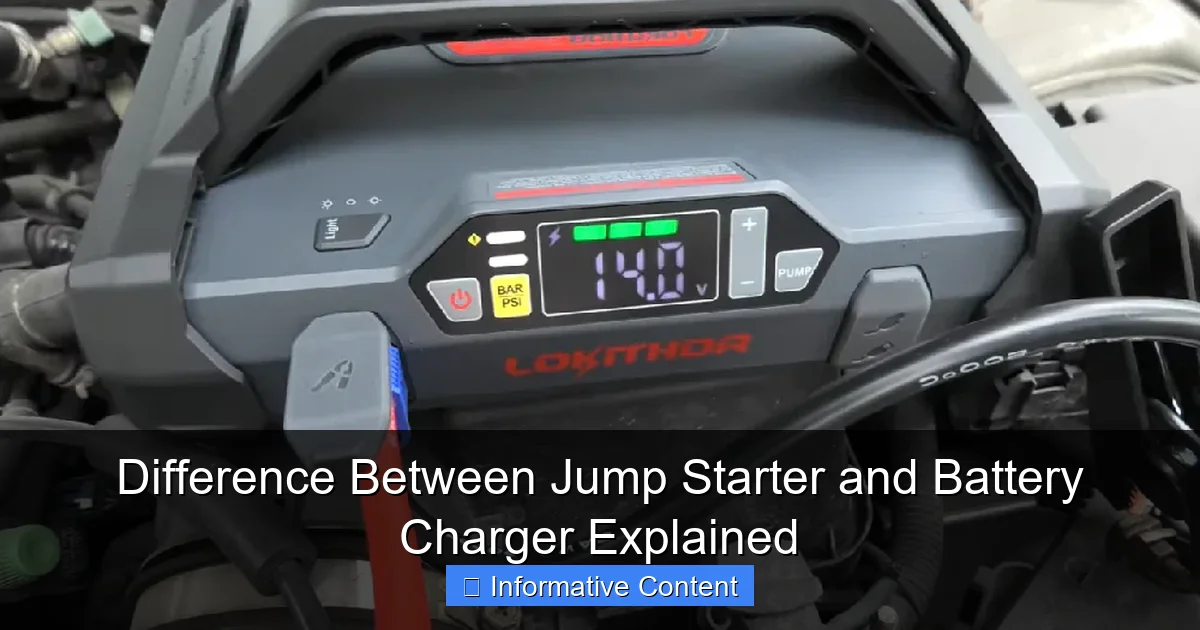
A jump starter—also known as a jump pack or portable battery pack—is a self-contained device designed to deliver a high burst of power to start a vehicle with a dead or weak battery. Unlike traditional jumper cables, which require a second vehicle, a jump starter operates independently. It’s essentially a portable power bank built specifically for car batteries.
Visual guide about difference between jump starter and battery charger
Image source: lokithorshop.com
How Jump Starters Work
Jump starters use a rechargeable lithium-ion or lead-acid battery to supply a large current (measured in amps) for a short duration—usually 5 to 10 seconds. This surge is enough to crank the engine and get your car running. Most models connect directly to your car’s battery terminals using heavy-duty clamps, similar to jumper cables.
Modern jump starters often include smart features like:
- Reverse polarity protection – prevents damage if clamps are connected incorrectly
- Spark-proof technology – reduces the risk of accidental sparks
- USB ports and LED lights – useful for charging phones or working in the dark
When to Use a Jump Starter
You need a jump starter when your car battery is too weak to start the engine, but not necessarily completely dead. This often happens due to:
- Leaving lights or accessories on overnight
- Extreme cold weather (batteries lose up to 50% capacity in freezing temps)
- Short trips that don’t fully recharge the battery
- Older batteries with reduced charge-holding ability
Real-world example: Last winter, my neighbor’s SUV wouldn’t start after being parked for three days. The battery voltage was around 9.5V (too low to crank). We used a 1200-amp jump starter, and the engine fired up in under 10 seconds. No second car needed. That’s the power of a good jump starter.
Jump Starter Limitations
While jump starters are incredibly useful, they have limits:
- They don’t recharge your battery—they only provide a temporary boost
- They can’t fix a permanently dead or damaged battery
- They require regular recharging themselves (most lose 15–20% charge per month when idle)
Tip: Always keep your jump starter charged. I recommend checking it monthly and topping it off every 3–6 months, even if you haven’t used it.
What Is a Battery Charger? (And Why It’s Not for Emergencies)
A battery charger is a device that slowly replenishes the charge in a car battery over time. Unlike a jump starter, it doesn’t deliver a high burst of power. Instead, it applies a controlled, low-current charge to restore the battery’s capacity safely.
How Battery Chargers Work
Battery chargers use a transformer and rectifier to convert AC wall current into DC power. They regulate the voltage and current to prevent overcharging, which can damage the battery. Most modern chargers use smart charging technology that automatically adjusts the charge rate based on the battery’s condition.
Chargers come in different types:
- Trickle chargers – deliver 1–2 amps for long-term maintenance (ideal for seasonal vehicles)
- Standard chargers – 4–10 amps, suitable for regular charging
- Fast chargers – 20+ amps, but risk overheating if not monitored
When to Use a Battery Charger
You need a battery charger when:
- Your battery is deeply discharged (below 11V)
- You’re storing a vehicle for weeks or months
- You want to maintain battery health during winter
- You suspect sulfation (a common cause of battery failure)
Real-world example: My classic motorcycle sits in the garage from November to March. I use a 2-amp trickle charger connected to a timer. It charges for 8 hours every 2 weeks, keeping the battery at optimal voltage without overcharging. This method extends battery life by 2–3 years.
Battery Charger Limitations
Here’s the catch: a battery charger won’t help in an emergency.
- Charging a dead battery can take hours—sometimes 12+ hours for a deeply discharged one
- It requires access to a power outlet (useless if you’re stranded in a parking lot)
- It can’t start your car instantly like a jump starter
Tip: Never try to “jump” a car with a charger. I’ve seen people plug in a charger, wait 10 minutes, then try to start the engine—only to find the battery still too weak. That’s not how it works. A charger needs time to do its job.
Key Differences: Jump Starter vs. Battery Charger
Now that we’ve covered the basics, let’s break down the difference between jump starter and battery charger in a clear, side-by-side comparison. This will help you understand which tool to reach for in any situation.
1. Primary Purpose
- Jump starter: Immediate engine start. Delivers high current (500–2000+ amps) for 5–10 seconds.
- Battery charger: Long-term battery recovery. Delivers low current (1–20 amps) for hours or days.
Think of it like this: a jump starter is the ambulance—it gets you to the hospital fast. A battery charger is the doctor—it heals the problem over time.
2. Power Source
- Jump starter: Internal rechargeable battery. No external power needed.
- Battery charger: Requires a wall outlet (110V/220V).
This makes jump starters far more portable and useful in emergencies. You can use them anywhere—parking garages, remote trails, even in heavy rain (with waterproof models).
3. Speed of Action
- Jump starter: Ready to use in seconds. Most models start a car in under 30 seconds.
- Battery charger: Charging time varies from 2 hours (for mild discharge) to 24+ hours (for deeply dead batteries).
Tip: If you need to leave in 10 minutes, a charger is useless. A jump starter is your best friend.
4. Battery Health Impact
- Jump starter: Safe for occasional use. Frequent jumping can stress the alternator.
- Battery charger: Promotes long-term battery health. Prevents sulfation and maintains capacity.
Using a charger regularly can add 1–2 years to your battery’s life. Jump starters, while safe, should only be used when necessary.
5. Cost and Portability
- Jump starter: $50–$200. Compact and lightweight (1–5 lbs).
- Battery charger: $30–$150. Heavier and bulkier (3–10 lbs), but often cheaper.
Jump starters win for portability. Many fit in a glove compartment. Chargers are better for home or garage use.
Data Table: Jump Starter vs. Battery Charger Comparison
| Feature | Jump Starter | Battery Charger |
|---|---|---|
| Primary Use | Emergency engine start | Battery recovery & maintenance |
| Power Source | Internal battery (portable) | Wall outlet (stationary) |
| Amperage Range | 500–2000+ amps (peak) | 1–20 amps (continuous) |
| Time to Start Car | 10–30 seconds | 2–24+ hours |
| Portability | High (fits in car) | Low (needs outlet) |
| Best For | Roadside emergencies, winter use | Home charging, storage, battery care |
| Typical Price | $50–$200 | $30–$150 |
| Lifespan | 500–1000 recharge cycles | 10+ years (with proper use) |
This table highlights the difference between jump starter and battery charger in practical terms. Use it as a quick reference when deciding which tool to buy or use.
Which One Should You Buy? (A Realistic Buyer’s Guide)
So, which tool do you actually need? The answer depends on your lifestyle, vehicle type, and how you plan to use it. Let’s break it down with real-world scenarios.
Scenario 1: You’re a Daily Driver in a Cold Climate
You live in Minnesota. Winters are brutal. Your car sits outside. You’ve had jump starts before.
- Buy a jump starter (1000+ amps, lithium-ion)
- Keep it charged and in your car
- Pair it with a smart battery charger for winter storage (if you have a second vehicle)
Recommended combo: NOCO Boost Plus GB40 (1000A jump starter) + CTEK MXS 5.0 (smart charger). Total cost: ~$200. Worth every penny for peace of mind.
Scenario 2: You Own a Seasonal or Collector Car
Your classic Mustang only drives in summer. It sits for 6 months.
- Buy a battery charger (2–5 amp, smart/maintenance mode)
- Use a battery maintainer with float mode
- Add a jump starter only if you’ve had starting issues
Pro tip: Connect the charger to a timer or smart outlet. Set it to run 8 hours every 2 weeks. Prevents overcharging and extends battery life.
Scenario 3: You Want One Tool for Everything
You’re on a budget. You want versatility.
- Buy a hybrid jump starter with charging capability
- Look for models with USB ports, air compressors, or built-in chargers
- Example: GOOLOO GP4000 (1500A jump starter + 12V/24V charger + 150PSI air pump)
Hybrid tools are great, but they’re not perfect. The charging function is often slower than a dedicated charger. Use it for light maintenance, not deep recovery.
Scenario 4: You’re a Renter or City Dweller
No garage. No outlet in your parking spot. You rely on public transport.
- Buy a compact jump starter (500–800A, lithium-ion)
- Store it in your car or apartment
- Skip the charger unless you have a garage
Bonus: Many jump starters double as phone chargers. Handy during power outages or camping trips.
Pro Tips for Using Both Tools Safely and Effectively
Whether you choose a jump starter, battery charger, or both, using them correctly is crucial. Here are my top tips from years of trial and error.
Jump Starter Safety Tips
- Read the manual – Not all models connect the same way
- Wear eye protection – Batteries can vent gas or spark
- Connect in this order: Red to dead battery (+), black to ground (engine block), then turn on jump starter
- Wait 3–5 minutes after connecting before starting the engine
- Don’t jump a frozen battery – It can explode. Warm it first
Battery Charger Best Practices
- Disconnect the battery if charging for more than 12 hours (prevents voltage spikes)
- Use a smart charger with automatic shutoff and desulfation mode
- Charge in a ventilated area – Batteries emit hydrogen gas
- Check voltage first – Use a multimeter. If below 6V, the battery may be damaged
- Clean terminals before connecting – Corrosion reduces charging efficiency
Maintenance for Both Tools
- Recharge jump starters every 3–6 months – Even when not in use
- Store chargers in a dry, cool place – Humidity damages electronics
- Inspect cables and clamps – Frayed wires are dangerous
- Update firmware – Some smart models have app-based updates
Remember: these tools are investments. Treat them well, and they’ll last for years.
Final Thoughts: Choosing the Right Tool for Your Needs
Understanding the difference between jump starter and battery charger isn’t just about avoiding confusion—it’s about being prepared. A jump starter gives you instant power when you’re stuck. A battery charger helps you prevent the problem in the first place.
Think of it this way: if you’re always on the go, live in a cold climate, or don’t have easy access to a second car, a jump starter is essential. It’s your roadside lifeline. But if you own a vehicle that sits for long periods, or you want to extend your battery’s lifespan, a battery charger is a smarter long-term investment.
And here’s my final piece of advice: own both if you can. They’re not mutually exclusive. I keep a 1200A jump starter in my trunk and a smart charger in my garage. Together, they’ve saved me from countless headaches—from dead batteries in freezing parking lots to keeping my motorcycle battery healthy all winter.
At the end of the day, the right tool depends on your situation. But now that you know the difference, you can make an informed choice. No more guessing. No more towing bills. Just reliable, stress-free driving—no matter what your battery throws at you.
Frequently Asked Questions
What is the main difference between a jump starter and a battery charger?
A jump starter delivers a high burst of power to start a dead battery quickly, while a battery charger replenishes the battery’s charge over time. Jump starters are for emergencies, whereas chargers are for maintenance or long-term recharging.
Can I use a jump starter instead of a battery charger for regular maintenance?
No, a jump starter is designed for immediate power delivery to start a vehicle, not for slow, sustained charging. Regular use of a jump starter for charging can damage the battery or reduce its lifespan.
How does a battery charger differ from a jump starter in functionality?
A battery charger gradually restores a battery’s charge using low, steady current, often with features like desulfation or trickle charging. In contrast, a jump starter bypasses the need for charging by providing instant power to crank the engine.
Is it safe to leave a jump starter connected to a battery like a battery charger?
No, jump starters lack the voltage regulation of chargers and can overheat or damage the battery if left connected. They’re meant for short bursts, while chargers are built for safe, prolonged use.
What’s the advantage of a portable jump starter over a traditional battery charger?
A portable jump starter is compact, requires no external power source, and works instantly in emergencies. Battery chargers need an outlet and take hours to recharge a battery, making them less convenient for roadside fixes.
Can a battery charger jump-start a car in an emergency?
Most standard battery chargers can’t deliver the sudden high current needed for jump-starting. However, some modern “smart chargers” with boost or jump-start modes can, but they’re slower than dedicated jump starters.