
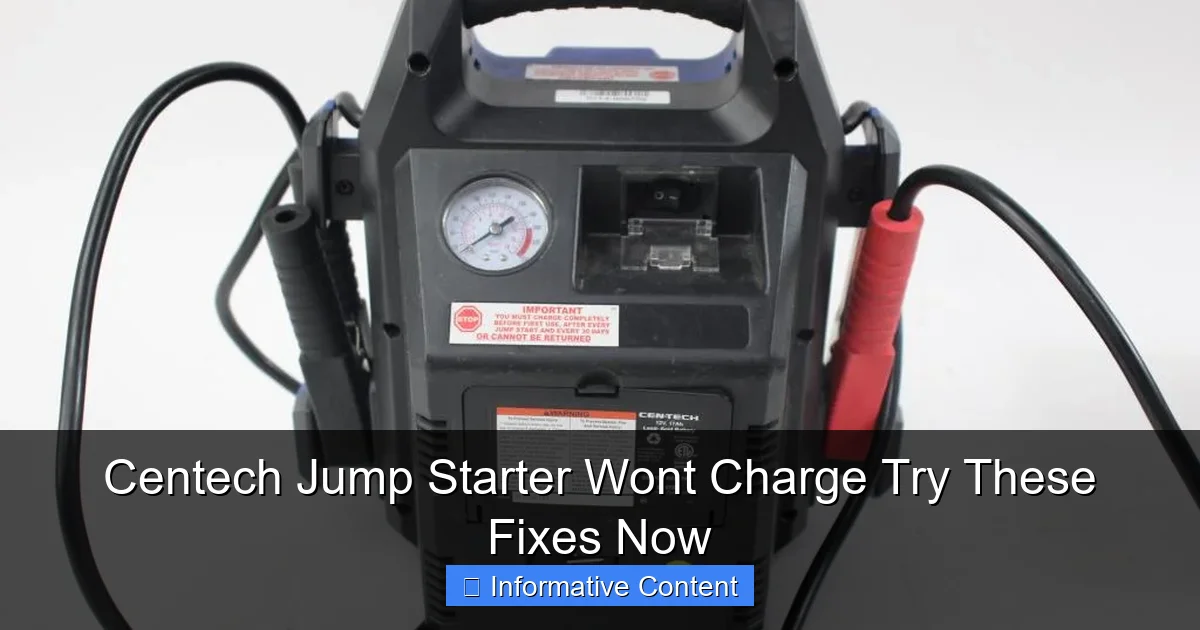
Featured image for centech jump starter won’t charge
Image source: content.propertyroom.com
If your Centech jump starter won’t charge, the issue is often a faulty power source, damaged cable, or drained internal battery—check these first. Ensure you’re using the correct adapter and inspect the charging port for debris or damage. Try a reset or alternate outlet, and if problems persist, contact Centech support for a potential replacement under warranty.
Key Takeaways
- Check the power source: Ensure your outlet or charger is working properly.
- Inspect cables and connections: Look for damage or loose links in the charging setup.
- Reset the device: Hold the power button for 10+ seconds to force a restart.
- Clean charging ports: Remove debris with a dry brush or compressed air.
- Update firmware: Visit the manufacturer’s site for the latest software fixes.
- Test with alternate cables: Use known-working cables to rule out accessory issues.
📑 Table of Contents
- Why Your Centech Jump Starter Won’t Charge (And What You Can Do About It)
- Understanding How Centech Jump Starters Work (And Why Charging Fails)
- Step 1: Check the Power Source and Charging Accessories
- Step 2: Reset the Jump Starter (Yes, It’s a Thing!)
- Step 3: Evaluate Battery Health and Age
- Step 4: Address Environmental and Usage Factors
- Step 5: When to Seek Professional Help (And What It Costs)
- Final Thoughts: Keep Your Centech Jump Starter Ready
Why Your Centech Jump Starter Won’t Charge (And What You Can Do About It)
Imagine this: It’s early morning, you’re running late for work, and your car won’t start. You reach for your trusty Centech jump starter, plug it in, and… nothing. The battery icon blinks weakly, or worse—there’s no sign of life at all. Frustrating, right? You’re not alone. Many Centech jump starter owners have faced the same issue: the device won’t charge, rendering it useless when they need it most.
Jump starters are designed to be lifesavers, but when they fail to charge, they become more of a paperweight than a tool. Whether it’s a Centech 2000A, 1200A, or another model, charging issues can stem from a variety of causes—some simple, others more complex. The good news? Most of these problems are fixable without needing to buy a new device. In this guide, we’ll walk you through the most common reasons why your Centech jump starter won’t charge and provide actionable, step-by-step solutions. Think of this as your troubleshooting buddy, here to help you get your jump starter back in action—fast.
Understanding How Centech Jump Starters Work (And Why Charging Fails)
The Basics of Jump Starter Charging
Before we dive into fixes, let’s quickly cover how a jump starter charges. Most Centech models use a lithium-ion battery pack that stores electrical energy. When you plug the jump starter into a power source—like a wall outlet, USB charger, or car’s 12V port—the internal circuitry regulates the voltage and current to safely charge the battery. A fully charged unit will show a solid LED light, while a blinking or off light often signals a problem.

Visual guide about centech jump starter won’t charge
Image source: content.propertyroom.com
Think of it like charging your phone. If your phone won’t charge, you’d check the cable, the adapter, the outlet, and the phone’s charging port. The same logic applies here. The charging process involves several components, and if any one of them fails, the entire system can stop working.
Common Signs Your Centech Jump Starter Won’t Charge
- No LED light when connected to a power source
- LED blinks erratically or turns off after a few seconds
- Charging progress stalls (e.g., stuck at 25% after hours)
- Device gets unusually hot during charging
- Charging takes much longer than usual (e.g., 12+ hours vs. 3–4 hours)
These symptoms point to different underlying issues, which we’ll tackle in the next sections. But first—don’t panic. In most cases, the problem isn’t with the battery itself but with the charging environment or accessories.
Step 1: Check the Power Source and Charging Accessories
Test Your Wall Outlet and Car Charger
It sounds obvious, but you’d be surprised how often the issue lies with the power source, not the jump starter. Start by testing your wall outlet with another device—like your phone or lamp. If that device doesn’t work, the outlet may be faulty or on a tripped circuit. Try a different outlet, preferably in another room.
If you’re using a car charger (via the 12V socket), make sure your car is running or in the “accessory” mode. Some vehicles cut power to the 12V port when the engine is off. Also, check if the socket is clean—dirt, lint, or corrosion can prevent a good connection. A quick wipe with a cotton swab and a drop of isopropyl alcohol can help.
Inspect the Charging Cable and Adapter
The charging cable is a common culprit. Look for:
- Frayed wires or bent connectors
- Loose fit when plugged into the jump starter
- Burn marks or discoloration on the adapter
Try a different USB cable and adapter. For example, if you’re using a Centech wall adapter, switch to a high-quality USB-C or USB-A charger you use for your phone. Make sure it delivers at least 5V/2A (10W) output—Centech jump starters need adequate power to charge properly.
Real-Life Example: Sarah’s “Dead” Jump Starter
Sarah, a Centech 1200A owner, thought her jump starter was broken when it wouldn’t charge. She tried three different outlets and even left it plugged in overnight. Nothing. Then she remembered she’d recently dropped the charging cable. On closer inspection, she found a tiny crack near the USB plug. She swapped it with a new cable—and the jump starter started charging immediately. Lesson? Always check the cable first.
Step 2: Reset the Jump Starter (Yes, It’s a Thing!)
What Is a “Reset” and When to Use It
Like many electronic devices, Centech jump starters have built-in protection circuits. These circuits can “lock” the device if they detect overcharging, overheating, or a voltage spike. This safety feature is great—but it can make the jump starter appear “dead” even when the battery is fine.
A “reset” forces the internal circuitry to restart. It’s not a physical button, but a specific sequence of actions. Here’s how to do it:
- Unplug the jump starter from any power source.
- Press and hold the power button for 10–15 seconds (even if the device shows no lights).
- While holding the button, plug the charging cable into the jump starter.
- Continue holding the button for another 10 seconds after plugging in.
- Release the button and wait 2–3 minutes. The charging LED should light up.
Why This Works (And When It Doesn’t)
This reset mimics a “soft boot” of the internal microcontroller. It clears temporary faults and reactivates the charging circuit. It’s especially effective if:
- The jump starter was left unused for weeks or months
- It was exposed to extreme temperatures
- It was overcharged or deeply discharged
However, if the battery is physically damaged (e.g., swollen or leaking), a reset won’t help. In that case, see the next section on battery health.
Tip: Use the Reset After Every Deep Discharge
If your jump starter was used to start a car and then left uncharged for days, it may have entered a “deep sleep” mode. Performing a reset before charging can prevent false “won’t charge” errors. Think of it like restarting your computer when it freezes—simple, but often effective.
Step 3: Evaluate Battery Health and Age
How Long Do Jump Starter Batteries Last?
Lithium-ion batteries degrade over time, even with proper care. Most Centech jump starters are rated for 300–500 charge cycles. A “cycle” is one full charge and discharge. If you use your jump starter once a month, it could last 25–40 years—but in reality, environmental factors (heat, cold, overcharging) shorten that lifespan.
Signs your battery is failing:
- Rapid discharge (loses charge in days)
- Swelling (the case bulges slightly)
- Overheating during use or charging
- Won’t hold a charge even after 12+ hours
If you’ve had your Centech jump starter for 2–3 years and it’s seen frequent use, the battery may be nearing the end of its life.
How to Test Battery Voltage (DIY Method)
You don’t need a multimeter, but it helps. If you have one:
- Fully charge the jump starter (if possible).
- Let it sit unplugged for 1 hour.
- Measure the voltage at the jump starter’s clamps using the multimeter.
- A healthy 12V battery should read 12.6V or higher.
- If it reads below 11.5V, the battery is likely degraded.
No multimeter? Try this: Fully charge the jump starter, then use it to start a car. If the car starts on the first try, the battery is probably still good. If it struggles or dies mid-start, the battery is weak.
Can You Replace the Battery?
Most Centech jump starters have non-removable batteries, so replacement isn’t user-friendly. However, some third-party repair services specialize in battery swaps. A typical replacement costs $30–$60. Before you go that route, ask yourself:
- Is the jump starter under warranty? (Centech offers 1–2 years on most models.)
- Would a new, upgraded model be a better long-term investment?
For example, if your current model is 1200A and you’re upgrading to a 2000A with faster charging and USB-C, the cost difference might be worth it.
Step 4: Address Environmental and Usage Factors
Temperature Matters: Cold Kills Lithium-Ion
Lithium-ion batteries don’t like extreme temperatures. Charging below 32°F (0°C) can permanently damage the battery. Similarly, leaving the jump starter in a hot car (over 100°F/38°C) can degrade the cells.
If your jump starter was left in a cold garage or trunk overnight, let it warm up to room temperature before charging. Place it indoors for at least 2 hours. Never charge a cold battery—it’s a recipe for failure.
Overcharging and Undercharging: The Goldilocks Zone
Leaving your jump starter plugged in for days isn’t harmful—most modern models have overcharge protection. But constantly draining it to 0% can stress the battery. Aim to keep the charge between 20% and 80% for optimal longevity.
Pro tip: If you’re storing the jump starter for weeks, charge it to 50% first. This minimizes stress on the battery during storage.
Physical Damage: Drops, Spills, and Cracks
Jump starters are tough, but they’re not indestructible. A hard drop can crack the internal battery or dislodge connections. Spilled coffee or water can corrode the charging port.
Inspect your unit for:
- Cracks in the casing
- Loose or wobbly charging port
- Corrosion around the port (green or white residue)
If you see corrosion, clean it with isopropyl alcohol and a cotton swab. For physical damage, consider professional repair—or replacement if it’s out of warranty.
Step 5: When to Seek Professional Help (And What It Costs)
Warranty vs. Out-of-Warranty Repairs
If your Centech jump starter is still under warranty (usually 1–2 years), contact the manufacturer. Most brands offer free repair or replacement for charging issues caused by defects. Have your receipt and model number ready.
For out-of-warranty units, third-party repair shops can help. Expect to pay:
- $20–$40 for diagnostic and basic fixes (e.g., port repair)
- $30–$60 for battery replacement
- $10–$20 for circuit board repairs (if the charging IC is faulty)
Compare that to a new jump starter, which ranges from $50 to $150. If repair costs exceed 50% of the new unit’s price, it’s usually better to buy new.
Data Table: Repair vs. Replacement Cost Comparison
| Issue | Repair Cost | New Unit Cost | Recommendation |
|---|---|---|---|
| Faulty charging port | $25 | $80 (1200A model) | Repair if under 2 years old |
| Degraded battery | $50 | $120 (2000A model) | Replace if over 3 years old |
| Damaged circuit board | $60 | $150 (premium model) | Replace—newer models have better safety |
| Under warranty defect | $0 | N/A | Always use warranty first |
How to Find a Reputable Repair Service
Look for shops that specialize in portable electronics or power tools. Avoid general electronics repair stores—they may lack experience with jump starters. Check reviews on Google, Yelp, or Reddit. Ask if they offer a warranty on their repairs (most do for 30–90 days).
Final Thoughts: Keep Your Centech Jump Starter Ready
Dealing with a Centech jump starter that won’t charge is stressful, but it’s rarely a dead end. In most cases, the fix is as simple as swapping a cable, resetting the device, or adjusting your charging habits. Start with the basics: check the power source, inspect the cable, and perform a reset. If those fail, evaluate the battery health and environmental factors.
Remember, prevention is key. Store your jump starter in a cool, dry place. Charge it every 3–6 months, even if you haven’t used it. And if you’re in a cold climate, bring it indoors during winter. A little care goes a long way in extending its life.
Finally, don’t ignore warning signs. If your jump starter is overheating, swelling, or failing to hold a charge, don’t risk it. Safety first. Whether you repair, replace, or upgrade, the goal is the same: a reliable jump starter that’s ready when you need it most.
So the next time your Centech jump starter won’t charge, don’t throw it out. Try these fixes. You might just save yourself time, money, and a lot of frustration. And who knows? You might even learn a thing or two about battery care along the way.
Frequently Asked Questions
Why won’t my Centech jump starter hold a charge?
This could be due to a depleted internal battery, faulty charging cable, or prolonged inactivity. Try using the original charger for at least 24 hours—if it still won’t charge, the battery may need replacement.
How do I fix a Centech jump starter that won’t charge after storage?
First, ensure the unit isn’t completely dead—plug it in for 2–3 days using the original adapter. If the Centech jump starter won’t charge after extended storage, the battery may have degraded and require professional service.
Can a damaged charging port cause my Centech jump starter to not charge?
Yes, a loose or damaged port can interrupt power flow. Inspect the port for debris or physical damage, and gently clean it with compressed air or a dry brush.
Why does my Centech jump starter show a charging light but never reaches 100%?
This often indicates a failing battery or a mismatched charger. Use only the manufacturer-recommended adapter and let it charge uninterrupted for 48 hours—if the issue persists, the battery may be defective.
Is it normal for a Centech jump starter to get warm while charging?
Some warmth is normal, but excessive heat suggests a problem. Unplug the unit immediately and let it cool; if the Centech jump starter won’t charge without overheating, contact customer support.
Can I use a USB cable to charge my Centech jump starter?
No—Centech jump starters require a high-output DC adapter, not standard USB. Using a USB cable may damage the unit or result in extremely slow/no charging.