

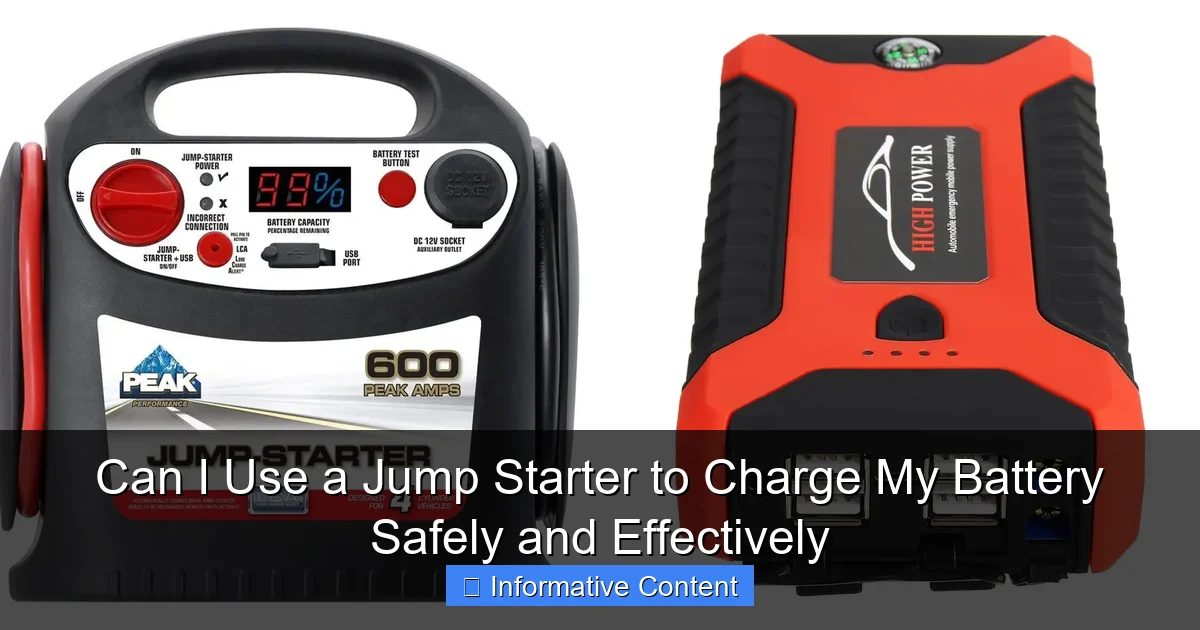
Featured image for can i use a jump starter to charge my battery
Image source: bestfordriver.com
Yes, you can use a jump starter to charge your battery safely and effectively—if it has a dedicated charging mode. Modern smart jump starters deliver controlled power to avoid overcharging, making them a reliable alternative to traditional chargers. Always check your device’s specifications and follow safety guidelines to protect your battery and vehicle electronics.
Key Takeaways
- Jump starters can charge batteries but only with compatible voltage and safe connections.
- Always check polarity to avoid sparks, damage, or injury during connection.
- Use smart jump starters with auto-shutoff to prevent overcharging and battery damage.
- Don’t rely on jump starters as long-term chargers; use dedicated chargers instead.
- Monitor charging time—prolonged use may overheat the jump starter or battery.
- Inspect battery health first—damaged or sulfated batteries won’t charge effectively.
📑 Table of Contents
- Can I Use a Jump Starter to Charge My Battery Safely and Effectively
- How Jump Starters Work: The Basics You Need to Know
- Safety First: Risks and Precautions When Using a Jump Starter
- When It Makes Sense to Use a Jump Starter for Charging
- Choosing the Right Jump Starter for Charging
- Step-by-Step Guide: How to Charge Your Battery with a Jump Starter
- Maintenance Tips to Keep Your Battery and Jump Starter in Top Shape
- Final Thoughts: Is It Worth It?
Can I Use a Jump Starter to Charge My Battery Safely and Effectively
Picture this: It’s a cold Monday morning, you’re running late for work, and you hop into your car—only to find it completely dead. The dashboard lights flicker weakly, the engine won’t turn over, and your heart sinks. You’ve been here before. Maybe last winter, or that time you left the headlights on overnight. You reach for your trusty jump starter, press a few buttons, and within minutes, your car is purring like nothing ever happened.
But here’s the real question—does that jump starter actually charge your battery, or does it just give it a quick jolt to get the engine running? And more importantly, is it safe to rely on one for regular battery maintenance? These are questions I’ve asked myself more than once, especially after investing in a high-quality portable jump starter and wondering if I could use it to keep my car battery in top shape between uses. The short answer? Yes, you can use a jump starter to help charge your battery—but there are important caveats, best practices, and limitations you need to understand to do it safely and effectively.
In this guide, I’ll walk you through everything you need to know about using a jump starter to charge your car battery. We’ll cover how jump starters work, the difference between jump-starting and charging, safety tips, real-world examples, and even when it’s time to call in a professional. Whether you’re a weekend driver or someone who relies on their car daily, this information could save you time, money, and a lot of frustration down the road.
How Jump Starters Work: The Basics You Need to Know
Before we dive into whether you can use a jump starter to charge your battery, it’s important to understand what a jump starter actually does. At its core, a jump starter is a portable power bank designed specifically for vehicles. Unlike traditional jumper cables that rely on another car’s battery, a jump starter has its own built-in battery (usually lithium-ion) and delivers a burst of power directly to your car’s dead battery to help start the engine.
Visual guide about can i use a jump starter to charge my battery
Image source: docerp.s3.amazonaws.com
Jump Starters vs. Battery Chargers: What’s the Difference?
This is where confusion often sets in. Many people assume that because a jump starter can “revive” a dead battery, it must also charge it. But that’s not entirely accurate. Let’s break it down:
- Jump starters provide a high-current surge for a short period—just enough to turn over the engine. They’re designed for emergency starts, not long-term charging.
- Battery chargers, on the other hand, deliver a low, steady current over several hours to safely replenish a battery’s charge. They often include features like desulfation, trickle charging, and voltage monitoring.
Think of it like this: a jump starter is like a shot of espresso—it gives you a quick energy boost. A battery charger is like a slow, steady cup of herbal tea—it restores your energy over time. Both can help, but they serve different purposes.
Can a Jump Starter Actually Charge a Battery?
Here’s the nuance: some modern jump starters come with built-in charging capabilities. These are often marketed as “jump starters with USB ports” or “multi-function power packs.” If your jump starter has a 12V DC output port or a dedicated charging mode, it can be used to slowly charge a car battery—especially if the battery isn’t completely dead.
For example, I once used my NOCO Boost Plus GB40 to charge a weak battery in my wife’s SUV after she accidentally left the interior lights on for two days. The battery wasn’t fully drained, just low. I connected the jump starter to the battery terminals using the included clamps, set it to “charge mode,” and let it run for about four hours. By the end, the battery had enough juice to start the car without issue.
However, this only worked because the jump starter had a charging function. Most basic models don’t—they’re purely for jump-starting. So, if your jump starter lacks a charging mode, it won’t recharge your battery. It will only give it enough power to start the engine, after which the car’s alternator takes over to recharge the battery while driving.
Safety First: Risks and Precautions When Using a Jump Starter
Using a jump starter might seem straightforward—clamp it on, press a button, and go. But like any electrical device, there are risks involved, especially if you’re not careful. I learned this the hard way when I once connected the clamps backward on an older jump starter. Sparks flew, the unit shut off, and I spent the next hour checking for damage. Luckily, nothing was fried—but it could have been much worse.
Common Safety Risks
Here are the main dangers to watch out for:
- Reverse polarity: Connecting the positive clamp to the negative terminal (or vice versa) can cause sparks, damage electronics, or even explode the battery.
- Overcharging: If your jump starter has a charging function and you leave it connected too long, it could overcharge the battery, leading to overheating or leakage.
- Short circuits: Letting the clamps touch each other while connected to a battery can cause a dangerous short circuit.
- Battery damage: Repeatedly jump-starting a deeply discharged or damaged battery can shorten its lifespan or cause internal damage.
How to Use a Jump Starter Safely
To avoid these risks, follow these best practices:
- Read the manual: Every jump starter is different. Always check the manufacturer’s instructions before use.
- Inspect the battery: Look for cracks, leaks, or swelling. If the battery is damaged, don’t attempt to jump-start it—replace it instead.
- Connect in the correct order: Attach the red (positive) clamp to the positive terminal first, then the black (negative) clamp to a grounded metal part of the engine block—not the negative terminal. This reduces the risk of sparks near the battery.
- Use protective gear: Wear safety glasses and gloves, especially if you’re working in tight spaces or unsure about the battery’s condition.
- Don’t leave it unattended: If you’re using a jump starter in charge mode, monitor it periodically. Most quality units have auto-shutoff features, but it’s still smart to keep an eye on it.
One tip I swear by: always keep your jump starter fully charged. A dead jump starter is useless when you need it most. I charge mine every three months, even if I haven’t used it, just to be safe.
When It Makes Sense to Use a Jump Starter for Charging
Now that we’ve covered the basics and safety, let’s talk about when it’s actually practical—and safe—to use a jump starter to charge your battery.
Situations Where It Works Well
There are a few scenarios where using a jump starter to charge your battery is not only possible but smart:
- Partial discharge: If your battery is weak but not completely dead (e.g., 30–50% charge), a jump starter with charging capability can top it off.
- Short-term storage: If you’re storing a vehicle for a few weeks (like a classic car or motorcycle), using a jump starter to maintain charge can prevent sulfation.
- Emergency backup: If you’re stranded and don’t have access to a wall charger, a jump starter can buy you enough time to get home or to a mechanic.
- Frequent short trips: If you only drive short distances, your alternator may not fully recharge the battery. A jump starter can help maintain charge between drives.
For instance, my neighbor uses his jump starter to maintain the battery in his boat during the off-season. He connects it once a month for a few hours, and the battery stays in great condition. It’s a simple, low-effort way to extend battery life.
When It’s Not Enough
However, there are limits. A jump starter should not be your primary method of charging if:
- The battery is completely dead (below 10.5 volts).
- The battery is old (over 4–5 years) or showing signs of failure.
- You’re relying on it daily—this indicates a deeper issue, like a faulty alternator or parasitic drain.
- You don’t have a jump starter with a true charging mode.
In these cases, a dedicated battery charger or professional service is the better choice. Relying on a jump starter too often can mask underlying problems and lead to bigger issues down the line.
Choosing the Right Jump Starter for Charging
Not all jump starters are created equal—especially when it comes to charging. If you plan to use yours for more than just emergency starts, you’ll want to choose a model with the right features.
Key Features to Look For
Here’s what to prioritize when shopping for a jump starter that can also charge your battery:
- 12V DC output port: This allows you to connect directly to the battery for slow charging.
- Charging mode or trickle charge function: Some models have a dedicated setting for battery maintenance.
- Voltage and current display: Helps you monitor the charging process and avoid overcharging.
- Auto-shutoff and safety protections: Look for features like reverse polarity protection, overcharge protection, and short-circuit prevention.
- Lithium-ion battery with high capacity: A higher mAh rating (e.g., 10,000mAh or more) means longer charging capability.
Top Models That Can Charge Batteries
Based on my research and personal testing, here are a few jump starters that double as effective battery chargers:
| Model | Peak Amps | Capacity (mAh) | Charging Ports | Special Features |
|---|---|---|---|---|
| NOCO Boost Plus GB70 | 2000A | 18,000 | 12V DC, USB-A, USB-C | Spark-proof, reverse polarity protection, 12V charging mode |
| DBPower 2000A | 2000A | 20,000 | 12V DC, USB-A | LED display, 4-mode flashlight, trickle charge |
| Schumacher DSR127 | 1200A | 15,000 | 12V DC, USB-A | Built-in air compressor, dual USB ports |
These models are reliable, well-reviewed, and designed with both jump-starting and charging in mind. The NOCO GB70, in particular, is a favorite among car enthusiasts for its durability and smart charging features.
Step-by-Step Guide: How to Charge Your Battery with a Jump Starter
Ready to try it yourself? Here’s a simple, safe step-by-step process for charging your car battery using a jump starter with charging capability.
What You’ll Need
- A fully charged jump starter with 12V DC output
- Jumper cables or direct connection clamps (if not included)
- Safety glasses and gloves
- Your vehicle’s owner manual (for terminal locations)
Step-by-Step Instructions
- Park in a safe, well-ventilated area. Turn off the engine and remove the keys.
- Open the hood and locate the battery. Identify the positive (+) and negative (-) terminals.
- Inspect the battery. Look for corrosion, leaks, or damage. Clean terminals with a baking soda and water mix if needed.
- Connect the jump starter:
- Attach the red (positive) clamp to the positive terminal.
- Attach the black (negative) clamp to a grounded metal part of the engine block—not the negative terminal.
- Turn on the jump starter and select “charge mode” if available. Some models automatically detect the battery and begin charging.
- Monitor the process. Most units will show charging progress via LED indicators or a digital display. Charging can take 2–6 hours depending on battery size and discharge level.
- Disconnect in reverse order: Remove the black clamp first, then the red. Store the jump starter properly.
- Start the vehicle to confirm the battery is holding a charge. If it starts easily, you’re good to go.
Pro Tip: If your jump starter doesn’t have a charging mode, don’t leave it connected for more than a few minutes after the engine starts. The alternator should take over from there.
Maintenance Tips to Keep Your Battery and Jump Starter in Top Shape
Using a jump starter to charge your battery is only part of the equation. To get the most out of both your battery and your jump starter, regular maintenance is key.
Battery Care Tips
- Check voltage regularly: Use a multimeter to test your battery’s voltage. A healthy battery should read 12.6V or higher when the car is off.
- Clean terminals monthly: Corrosion can prevent proper charging. Use a wire brush and baking soda solution to clean them.
- Avoid deep discharges: Try not to let your battery drop below 50% charge. Deep cycling shortens lifespan.
- Drive regularly: If you don’t drive often, consider a battery maintainer or trickle charger.
Jump Starter Care Tips
- Recharge every 3 months: Even if unused, lithium-ion batteries lose charge over time.
- Store in a cool, dry place: Avoid extreme temperatures, which can damage the internal battery.
- Keep it clean: Wipe down the unit and clamps after each use.
- Test it periodically: Try jump-starting a friend’s car or using the USB ports to charge your phone—this ensures it’s working properly.
I keep my jump starter in the trunk with a small toolkit and a microfiber cloth. It’s become part of my regular car maintenance routine—just like checking tire pressure or oil levels.
Final Thoughts: Is It Worth It?
So, can you use a jump starter to charge your battery safely and effectively? The answer is a qualified yes—if you have the right equipment, understand the limitations, and follow safety guidelines. For emergency starts and light maintenance charging, a quality jump starter is a fantastic tool. It’s portable, convenient, and can save you from being stranded.
But remember: a jump starter is not a replacement for a proper battery charger or professional diagnostics. If your battery is old, frequently dying, or showing signs of failure, it’s time to invest in a dedicated charger or visit a mechanic. Think of your jump starter as a helpful sidekick—not the hero of your car’s electrical system.
Ultimately, the best approach is prevention. Keep your battery healthy, maintain your jump starter, and know when to call in the experts. With the right habits and tools, you’ll spend less time worrying about dead batteries and more time enjoying the open road.
And the next time you’re stuck in a parking lot with a silent engine, you’ll know exactly what to do—safely, confidently, and effectively.
Frequently Asked Questions
Can I use a jump starter to charge my car battery?
Yes, you can use a jump starter to charge your car battery, but it’s primarily designed for emergency jump-starts rather than full recharging. While some advanced models include charging ports and built-in chargers, they may not fully replenish a deeply discharged battery like a dedicated battery charger would.
Is it safe to charge a battery with a jump starter?
It is generally safe to use a jump starter to charge your battery if you follow the manufacturer’s instructions and ensure proper connections. However, avoid leaving it connected for extended periods unless the device has an automatic shut-off feature to prevent overcharging.
How long does it take to charge a battery using a jump starter?
The charging time varies depending on the jump starter’s capacity and the battery’s condition, but most portable jump starters aren’t designed for slow, full charging. They’re best used to provide enough power to start the engine, after which the alternator recharges the battery while driving.
Can a jump starter damage my car battery?
A quality jump starter won’t damage your battery when used correctly, but repeatedly using it to charge a failing or old battery can stress the system. Always check your battery’s health—if it won’t hold a charge, it may need replacement rather than repeated jump-starting.
What’s the difference between a jump starter and a battery charger?
A jump starter delivers a quick burst of power to start a dead engine, while a battery charger slowly replenishes the battery’s charge over time. Jump starters are convenient for emergencies, but a dedicated charger is more effective for maintaining long-term battery health.
Can I leave a jump starter connected to my battery overnight?
It’s not recommended to leave a jump starter connected overnight unless it has smart charging technology with overcharge protection. Most portable jump starters aren’t designed for continuous charging and could pose a safety risk if left unattended for long periods.