
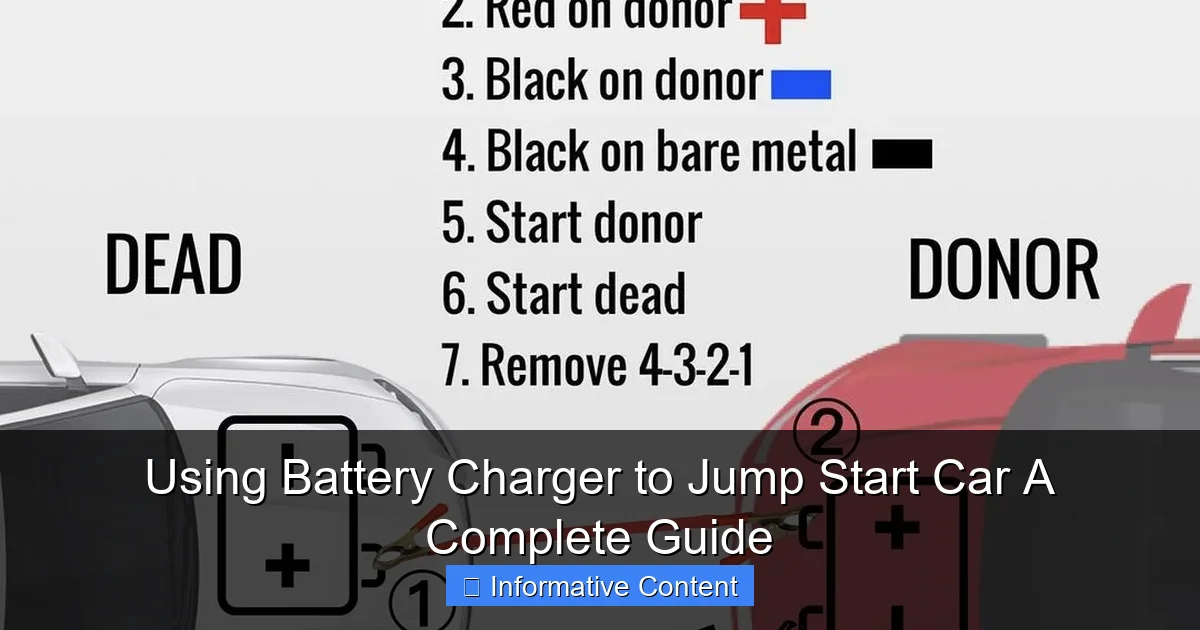
Featured image for using battery charger to jump start car
Image source: themanual.com
Using a battery charger to jump start a car is a safe and reliable alternative to traditional jumper cables when done correctly. Modern smart chargers deliver a controlled power boost, reducing the risk of electrical damage while reviving a dead battery—just ensure the charger is set to the correct voltage and polarity. Always follow manufacturer instructions and prioritize safety by wearing gloves and eye protection.
Key Takeaways
- Always check polarity first: Connect red to positive (+) and black to negative (-) terminals.
- Use a smart charger: Prevents overcharging and ensures safe, efficient jump starting.
- Turn off all electronics: Reduce strain on the battery and charger during connection.
- Charge before jumping: Give the battery 10-15 minutes of charge for better success.
- Never force connections: Loose or incorrect clamps can spark or damage systems.
- Monitor while charging: Watch for overheating or unusual sounds during the process.
- Disconnect properly: Remove cables in reverse order after the car starts successfully.
📑 Table of Contents
- Using Battery Charger to Jump Start Car: A Complete Guide
- Why Use a Battery Charger Instead of Jumper Cables?
- Types of Battery Chargers for Jump Starting
- How to Use a Battery Charger to Jump Start Your Car
- Safety Tips and Common Mistakes to Avoid
- Real-World Examples and Practical Tips
- Choosing the Right Battery Charger for Your Needs
- Conclusion
Using Battery Charger to Jump Start Car: A Complete Guide
It’s 7 a.m., and you’re rushing out the door to get to work. You hop into your car, turn the key, and… nothing. Just a faint clicking sound. Your heart sinks. You’ve been here before—your car battery is dead. Now what?
Most people immediately think of jumper cables and calling a friend or roadside assistance. But what if you’re alone, or no one’s available to help? That’s where a battery charger can be a real lifesaver. Yes, you can use a battery charger to jump start a car—and it’s often safer, more convenient, and just as effective as traditional jump-starting methods. In this guide, we’ll walk you through everything you need to know about using a battery charger to jump start your car, from how it works to step-by-step instructions, safety tips, and common mistakes to avoid. Whether you’re a seasoned driver or a new car owner, this guide will help you feel confident the next time your battery gives out.
Why Use a Battery Charger Instead of Jumper Cables?
When your car won’t start, the first instinct might be to grab jumper cables and flag down a passing motorist. While that method works, it comes with risks—especially if you’re not familiar with the process. Reverse polarity, sparks near the battery, or connecting the cables incorrectly can damage your car’s electronics or even cause injury.
A battery charger, especially a modern smart charger or jump starter with built-in safety features, offers a safer and often more reliable alternative. Unlike jumper cables, which require another vehicle and a working battery, a portable battery charger works independently. You don’t need help from anyone else, and you can use it anywhere—whether you’re in a parking lot, on a remote road, or in your own garage.
Advantages of Using a Battery Charger
- No second vehicle needed: You don’t have to rely on someone else’s car or wait for roadside assistance.
- Safer operation: Many modern chargers have built-in protections against reverse polarity, overcharging, and short circuits.
- Portable and convenient: Compact jump starters can fit in your glove compartment or trunk and are lightweight enough to carry around.
- Multi-functional: Some models double as phone chargers, flashlights, or even air compressors.
- Better for weak batteries: A charger can slowly revive a deeply discharged battery, whereas jumper cables deliver a quick burst that might not be enough.
When Jumper Cables Might Still Be Better
That said, jumper cables aren’t obsolete. If you’re in a hurry and have access to another vehicle, jumper cables can get you moving faster. They’re also useful in extreme cold, where a portable charger’s battery might lose efficiency. But for everyday use, especially if you’re often alone or want a backup plan, a battery charger is a smart investment.
Types of Battery Chargers for Jump Starting
Not all battery chargers are created equal. Some are designed for slow charging over several hours, while others are built for quick jump starts. Understanding the different types will help you choose the right one for your needs.
Traditional Battery Chargers
These are the classic plug-in units you connect to a wall outlet. They’re great for maintaining your battery during long periods of inactivity—like if your car sits in the garage for weeks. However, they’re not ideal for emergency jump starts because they require access to electricity and take time to charge the battery.
Best for: Home use, battery maintenance, and slow recharging.
Portable Jump Starters (Battery Boosters)
These are compact, self-contained units with built-in batteries. You charge them ahead of time (usually via USB or wall outlet), and when your car battery dies, you connect the jump starter directly to your battery terminals. Many models can deliver 400 to 2000 amps of power—enough to start most cars, SUVs, and even small trucks.
Best for: Emergency jump starts, travel, and roadside use.
Smart Chargers with Jump Start Function
These combine the features of a traditional charger and a portable jump starter. They can plug into an outlet for slow charging or use their internal battery to deliver a quick boost. Many include digital displays, automatic voltage detection, and safety alerts.
Best for: Drivers who want versatility and advanced safety features.
Solar-Powered Chargers
A niche but growing option, solar chargers use sunlight to slowly recharge your car battery. They’re eco-friendly and useful for long-term storage, but not practical for immediate jump starts unless paired with a battery backup.
Best for: Camping, off-grid vehicles, or battery maintenance in sunny climates.
How to Use a Battery Charger to Jump Start Your Car
Now that you know the types of chargers available, let’s walk through the actual process of using one to jump start your car. The steps vary slightly depending on the model, but the general procedure is straightforward.
Step 1: Prepare Your Vehicle and Charger
Before you begin, make sure your car is in park (or neutral for manual transmissions) and the ignition is off. Turn off all lights, the radio, and any other electrical accessories. This reduces the load on the battery and prevents power surges.
Next, locate your car’s battery. It’s usually under the hood, but in some models (like certain BMWs or Hondas), it’s in the trunk or under the rear seat. Check your owner’s manual if you’re unsure.
If you’re using a portable jump starter, make sure it’s fully charged. Most models have an indicator light—green means ready, red means it needs charging. If you’re using a plug-in charger, ensure you have access to a power outlet nearby.
Step 2: Identify the Battery Terminals
Your car battery has two terminals: positive (+) and negative (−). The positive terminal is usually red and marked with a “+” sign. The negative terminal is black and marked with a “−” sign. Some batteries have protective covers—gently remove them if needed.
Pro tip: If you can’t see the terminals clearly, use a flashlight. Never assume which is which—mixing them up can cause serious damage.
Step 3: Connect the Charger or Jump Starter
For a portable jump starter:
- Attach the red (positive) clamp to the positive terminal of your car battery.
- Attach the black (negative) clamp to the negative terminal—or, if your jump starter recommends it, to a grounded metal part of the engine block (like a bolt or bracket). This reduces the risk of sparks near the battery.
- Double-check that the clamps are secure and not touching each other.
For a plug-in smart charger:
- Connect the charger’s cables to the battery terminals in the same way.
- Plug the charger into a wall outlet.
- Turn on the charger and select the “jump start” or “boost” mode if available.
Safety note: Always connect positive to positive and negative to negative. Reverse connections can damage your car’s electrical system or cause the charger to fail.
Step 4: Start the Engine
Once everything is connected, turn on the jump starter (if it has a power button) and wait a few seconds for it to deliver power. Then, try starting your car.
If the engine doesn’t start right away, wait 30 seconds and try again. Some deeply discharged batteries need a minute or two to accept charge before they can deliver enough power to crank the engine.
If your car still won’t start after three attempts, disconnect the charger and wait 5 minutes. Then try again. If it still fails, the issue might not be the battery—it could be a faulty starter, alternator, or fuel system.
Step 5: Disconnect and Recharge
Once your car is running, carefully disconnect the charger in reverse order: black clamp first, then red. Avoid letting the clamps touch each other or any metal parts.
If you used a portable jump starter, recharge it as soon as possible. Most models take 3 to 6 hours to fully recharge via USB or wall adapter. Keep it charged so it’s ready for the next emergency.
Safety Tips and Common Mistakes to Avoid
Jump starting a car with a battery charger is generally safe, but it’s not without risks. A few simple precautions can prevent accidents and protect your vehicle.
Safety Tips
- Wear safety glasses: Battery acid can splash, and sparks can occur during connection.
- Work in a well-ventilated area: Car batteries can emit hydrogen gas, which is flammable.
- Never smoke or use open flames: Even a small spark can ignite gas around the battery.
- Check for damage: If your battery is cracked, swollen, or leaking, do not attempt to jump start it. Replace it instead.
- Use the right charger: Make sure your jump starter or charger is rated for your vehicle’s battery size (usually 12V for cars).
Common Mistakes to Avoid
- Connecting cables backward: This is the #1 cause of damage. Always double-check polarity.
- Using a weak or dead jump starter: A half-charged unit might not deliver enough power. Always keep it topped up.
- Leaving the charger connected too long: Once the car is running, disconnect immediately. Prolonged connection can overcharge the battery.
- Ignoring warning lights: If your jump starter flashes red or beeps, it may be detecting a problem—disconnect and troubleshoot.
- Trying to jump start a frozen battery: If the battery is frozen (common in winter), do not attempt to charge it. Thaw it first in a warm environment.
Real-World Examples and Practical Tips
Let’s look at a few real-life scenarios where using a battery charger to jump start a car made all the difference.
Example 1: Stranded at the Grocery Store
Sarah, a busy mom, parked her minivan at the grocery store. When she returned, the engine wouldn’t start. No one around had jumper cables, and she didn’t want to wait for roadside assistance with two restless kids in the car. Luckily, she had a portable jump starter in her trunk. She connected it in under two minutes, started the engine, and was on her way—no stress, no delay.
Lesson: A portable jump starter is perfect for urban drivers who need quick, independent solutions.
Example 2: Winter Breakdown on a Remote Road
Mike was driving through a snowy mountain pass when his truck died. Temperatures were below freezing, and his phone had no signal. He used his smart charger, which had a built-in flashlight and USB ports. He connected it to the battery, waited a few minutes, and got the engine running. He also used the charger to power his phone long enough to call for help.
Lesson: In cold weather, a multi-functional charger can be a true lifesaver.
Practical Tips from Experienced Users
- Keep it in the car: Store your jump starter in the trunk or under a seat. Don’t leave it at home—you never know when you’ll need it.
- Check it monthly: Even if you don’t use it, plug in your jump starter once a month to keep the internal battery healthy.
- Know your vehicle’s battery type: Some cars use AGM (absorbent glass mat) batteries, which require specific charging modes. Check your manual.
- Use a charger with safety features: Look for models with reverse polarity protection, spark-proof clamps, and automatic shutoff.
- Don’t rely on it forever: A jump start is a temporary fix. If your battery dies frequently, have it tested—it may need replacement.
Choosing the Right Battery Charger for Your Needs
With so many options on the market, how do you pick the best battery charger for jump starting? Here’s a quick comparison to help you decide.
| Feature | Portable Jump Starter | Smart Charger | Traditional Charger |
|---|---|---|---|
| Power Source | Internal lithium battery | Internal battery + wall outlet | Wall outlet only |
| Jump Start Speed | Fast (1–3 minutes) | Fast to moderate | Slow (requires pre-charge) |
| Portability | High (fits in glove box) | Medium (larger than jump starter) | Low (stationary) |
| Safety Features | Common (reverse polarity, spark-proof) | Very common | Basic |
| Best For | Emergency use, travel | Home and roadside use | Long-term maintenance |
| Price Range | $50–$200 | $80–$250 | $30–$100 |
For most drivers, a portable jump starter offers the best balance of power, portability, and safety. Look for one with at least 600 peak amps, USB charging ports, and a built-in flashlight. Popular brands include NOCO, Jump-N-Carry, and Tacklife.
Conclusion
Getting stranded with a dead battery is frustrating, but it doesn’t have to leave you helpless. Using a battery charger to jump start a car is a smart, safe, and effective solution—especially when you’re alone or in a hurry. Whether you choose a portable jump starter, a smart charger, or a traditional unit, having one in your vehicle can save you time, money, and stress.
Remember, the key to success is preparation. Keep your charger charged, know how to use it, and follow safety guidelines. And if your battery dies more than once a year, it might be time for a replacement—no amount of jump starting can fix a failing battery forever.
So next time you hear that dreaded clicking sound, don’t panic. Grab your battery charger, follow the steps in this guide, and get back on the road with confidence. After all, being prepared isn’t just smart—it’s peace of mind.
Frequently Asked Questions
Can you use a battery charger to jump start a car?
Yes, you can use a battery charger with a “jump start” or “boost” mode to start a car with a dead battery. However, traditional slow chargers may not deliver enough power instantly, so look for a charger with a high cranking amp (CA) rating for jump-starting.
How do I safely use a battery charger to jump start my car?
First, connect the charger’s red clamp to the positive terminal and the black clamp to the negative terminal (or a grounded metal surface). Turn on the charger, set it to “boost” or “jump start,” wait 3–5 minutes, then try starting the car. Always follow the manufacturer’s safety guidelines.
What’s the difference between a battery charger and a jump starter?
A battery charger replenishes a battery over time, while a jump starter provides immediate power to start the car. Some modern battery chargers combine both functions, letting you use a battery charger to jump start a car quickly.
How long should I leave the battery charger on before starting the car?
For most smart chargers with a jump-start feature, 3–5 minutes is sufficient. Older chargers may require 10–15 minutes to deliver enough charge. Never exceed the recommended time to avoid overheating or damaging the battery.
Is it safe to leave a battery charger connected while driving?
No, disconnect the charger immediately after the car starts. Leaving it connected can damage the vehicle’s electrical system or the charger itself. The alternator, not the charger, should maintain battery power while driving.
Can using a battery charger to jump start damage my car’s electronics?
If used correctly, modern battery chargers with surge protection won’t harm electronics. Avoid cheap, unregulated chargers, as voltage spikes can damage sensitive components. Always use a charger with safety features like reverse polarity and overload protection.