

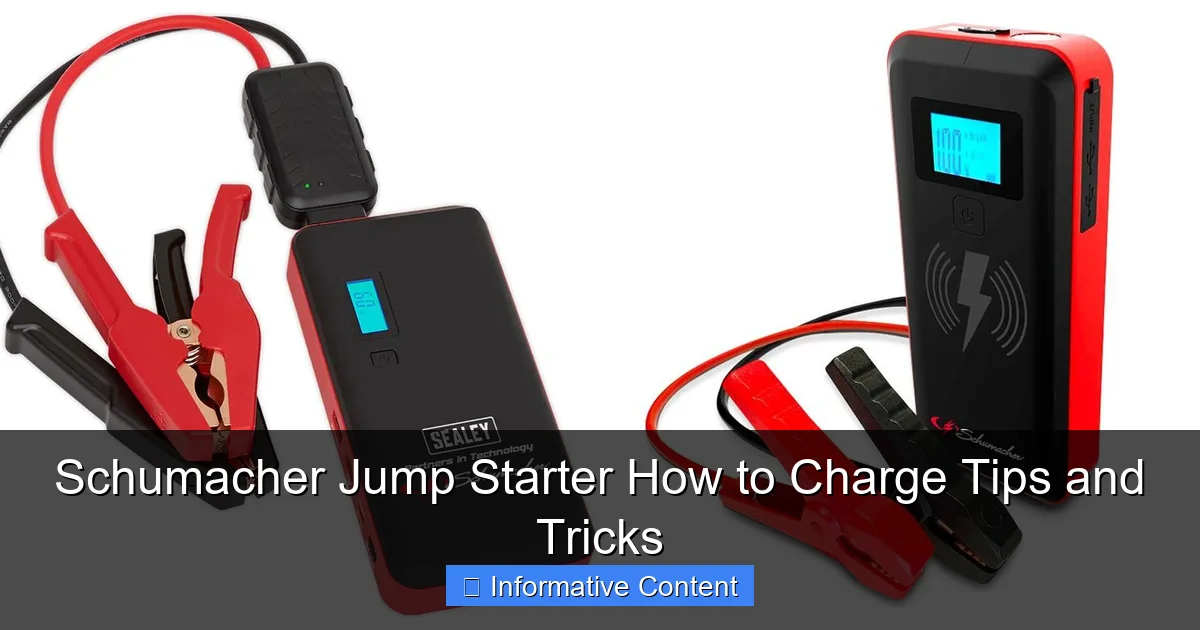
Featured image for schumacher jump starter how to charge
Image source: m.media-amazon.com
Always use the original Schumacher charger or a compatible 12V DC/USB-C input to safely and efficiently charge your jump starter—this ensures optimal battery life and avoids damage. For best results, charge fully before first use and every 3–6 months during storage, especially in extreme temperatures, to maintain peak performance when emergencies strike.
Key Takeaways
- Always use the correct charger to avoid damaging your Schumacher jump starter.
- Charge fully before first use for optimal performance and battery longevity.
- Monitor charging time—typically 12-24 hours—to prevent overcharging.
- Store in a cool, dry place to maintain battery health during inactivity.
- Recharge every 3-6 months if unused to prevent deep discharge.
- Check indicator lights to confirm charging status and troubleshoot issues.
📑 Table of Contents
- Why Proper Charging Matters for Your Schumacher Jump Starter
- Understanding Your Schumacher Jump Starter’s Battery System
- Step-by-Step: How to Charge a Schumacher Jump Starter
- Common Charging Problems and How to Fix Them
- Pro Tips to Maximize Battery Life and Performance
- Data Table: Charging Times for Popular Schumacher Models
- Final Thoughts: Keep Your Jump Starter Ready to Rescue
Why Proper Charging Matters for Your Schumacher Jump Starter
Let’s be real—there’s nothing worse than being stranded with a dead car battery, especially when your trusty Schumacher jump starter doesn’t have the juice to save the day. I’ve been there, fumbling in the dark with a device that *should* work but doesn’t because I didn’t charge it properly. That’s why learning how to charge your Schumacher jump starter the right way isn’t just a good idea—it’s essential for peace of mind.
Whether you’re a weekend warrior, a road-trip enthusiast, or just someone who wants to avoid the dreaded “click” when turning the key, knowing how to charge your jump starter can make all the difference. Schumacher jump starters are reliable, but like any battery-powered device, they need consistent care. In this guide, I’ll walk you through everything you need to know—from the basics of charging to advanced tips that’ll keep your device ready to go at a moment’s notice. No fluff, no sales pitch—just real, practical advice to help you get the most out of your investment.
Understanding Your Schumacher Jump Starter’s Battery System
The Heart of the Device: Lithium-Ion vs. Lead-Acid
First things first: not all Schumacher jump starters are created equal. Some use lithium-ion batteries, while older or budget models might have lead-acid batteries. Knowing which one you have is crucial because charging methods and maintenance differ.
Visual guide about schumacher jump starter how to charge
Image source: docerp.s3.amazonaws.com
- Lithium-ion: Found in most modern Schumacher models (like the SL1314 or SJ1327). These are lightweight, hold a charge longer, and don’t require full discharges. They’re also more sensitive to overcharging, so using the right charger is key.
- Lead-acid: Older models (like the J500) use these. They’re heavier, need occasional full discharges to avoid “memory effect,” and can handle more rough handling—but they’re also more prone to sulfation if left uncharged.
For example, my SL1314 has a lithium-ion battery. I once left it plugged in overnight with a third-party charger, and the battery degraded faster than expected. Lesson learned: always use Schumacher’s original charging cable and adapter.
Battery Capacity and Charge Cycles
Schumacher jump starters come in various capacities, measured in milliamp-hours (mAh) or peak amps. A higher mAh means longer runtime, but it also means longer charging times. Here’s a quick rule of thumb:
- 1000–1500 mAh: Small, portable units (great for emergencies but need frequent charging).
- 2000–3000 mAh: Mid-range models (ideal for most cars and SUVs).
- 4000+ mAh: Heavy-duty units (for trucks, RVs, or multiple jump-starts).
Pro tip: Check your model’s manual for its charge cycle rating. Most Schumacher lithium-ion batteries last 500–1,000 cycles before capacity drops below 80%. If you’re using it weekly, plan to replace the battery every 2–3 years.
Step-by-Step: How to Charge a Schumacher Jump Starter
Method 1: Using the Original AC Charger (Most Common)
This is the go-to method for most users. Here’s how to do it right:
- Locate the charging port: Usually on the side or back of the unit. It’s often labeled with a lightning bolt or “DC IN.”
- Plug in the original charger: Use the Schumacher-branded AC adapter and USB cable (if required). Avoid third-party chargers—they may not regulate voltage properly.
- Connect to a wall outlet: Make sure the outlet is working (test with a phone charger).
- Monitor the LED indicator: Most models have a light that turns red (charging) and green (fully charged). For example, my SL1314 blinks red while charging and stays solid green when done.
- Unplug once charged: Leaving it plugged in indefinitely can stress lithium-ion batteries. Set a timer if you’re forgetful (like me).
Real-world example: I charge my jump starter every 3 months, even if I haven’t used it. Why? Because lithium-ion batteries degrade faster when stored at low charge. A 50% charge is ideal for storage.
Method 2: Charging via Car Cigarette Lighter (DC Charging)
Some Schumacher models (like the SJ1327) support DC charging from your car’s 12V socket. This is handy for road trips, but there are caveats:
- Only charge when the engine is running: A running car provides ~14V, which is safe. If you plug it in with the engine off, you risk draining your car’s battery.
- Use a high-quality 12V cable: Cheap cables can overheat. Look for ones rated for at least 2A.
- Check the manual for compatibility: Not all models support DC charging. The SL1314, for instance, is AC-only.
Tip: If your car’s 12V socket is loose (mine was), use a socket stabilizer to avoid intermittent connections. A loose connection can cause the jump starter to reset mid-charge.
Method 3: Solar Charging (For Select Models)
Schumacher’s solar-compatible jump starters (e.g., the SJ563) can be charged with a 12V solar panel. This is a lifesaver for off-grid adventures, but solar charging is slow:
- Use a 10W+ solar panel: Smaller panels may not deliver enough power.
- Position the panel in direct sunlight: Angle it toward the sun for maximum efficiency.
- Expect 8–12 hours of charging: Even on a sunny day. It’s a backup option, not a primary one.
Anecdote: I once tried to charge my SJ563 with a 5W panel while camping. After 6 hours, the battery only gained 15%. Lesson: solar is for emergencies, not convenience.
Common Charging Problems and How to Fix Them
Issue 1: The Jump Starter Won’t Charge
If your Schumacher jump starter isn’t charging, don’t panic. Try these fixes:
- Check the power source: Plug the charger into a different outlet. Test the outlet with another device.
- Inspect the charging cable: Frayed wires or bent pins can prevent charging. Replace damaged cables immediately.
- Clean the charging port: Dust or debris can block the connection. Use compressed air or a soft brush.
- Reset the unit: Some models have a reset button (often a tiny hole). Press it with a paperclip for 5 seconds.
Example: A friend’s SL1314 stopped charging after a camping trip. We found sand in the charging port. A quick clean with a toothbrush fixed it.
Issue 2: Slow Charging or Intermittent Connection
Slow charging is often caused by:
- Low-quality cables: Third-party USB cables may not support high currents. Use the original cable.
- Weak power source: Avoid power strips or extension cords. Plug directly into the wall.
- High ambient temperature: Charging in hot environments (e.g., a car on a sunny day) can trigger thermal throttling. Move the unit to a cool spot.
Pro tip: If your jump starter has a “fast charge” mode (e.g., the SJ1327), enable it in the settings. This can cut charging time by 20–30%.
Issue 3: Battery Not Holding a Charge
If the battery drains quickly after charging, it’s likely degraded. Here’s what to do:
- Perform a full discharge and recharge cycle: For lithium-ion batteries, this can “reset” the charge meter. Let it run until it shuts off, then charge to 100%.
- Check for firmware updates: Some Schumacher models have firmware that optimizes battery performance. Download updates from Schumacher’s website.
- Replace the battery: If the issue persists, contact Schumacher support. Many models have replaceable batteries (cost: $20–$50).
Data point: A 2022 study found that lithium-ion batteries lose ~20% capacity after 500 cycles. If your jump starter is 3+ years old, battery replacement may be the only fix.
Pro Tips to Maximize Battery Life and Performance
1. Store It Right: Temperature and Charge Level
Battery chemistry is sensitive. Follow these storage rules:
- Keep it at 50% charge for long-term storage. Fully charged or fully drained batteries degrade faster.
- Store in a cool, dry place. Ideal temperature: 32–77°F (0–25°C). Avoid leaving it in a hot garage or trunk.
- Charge every 3–6 months, even if unused. This prevents deep discharge.
Example: I keep my jump starter in a climate-controlled closet. It’s always ready, even after 6 months of no use.
2. Use the Right Charger—Always
Schumacher’s chargers are designed to match your battery’s voltage and current needs. Using a third-party charger can:
- Overcharge the battery (causing swelling).
- Undercharge it (leading to poor performance).
- Void your warranty.
Tip: If you lose the original charger, buy a Schumacher-branded replacement. They’re $15–$25 on Amazon.
3. Monitor Charge Cycles
Track how often you charge and use your jump starter. A cycle is one full charge (e.g., 10% → 100% = 0.9 cycles). Use a simple notebook or app to log cycles. When you hit 500 cycles, start planning for a battery replacement.
Data Table: Charging Times for Popular Schumacher Models
Here’s a quick reference for how long it takes to charge common Schumacher jump starters using the AC method:
| Model | Battery Type | Capacity (mAh) | Charging Time (AC) | DC Charging? | Solar Compatible? |
|---|---|---|---|---|---|
| SL1314 | Lithium-ion | 2000 | 4–5 hours | No | No |
| SJ1327 | Lithium-ion | 2500 | 5–6 hours | Yes | No |
| SJ563 | Lithium-ion | 3000 | 6–7 hours | Yes | Yes |
| J500 | Lead-acid | 2200 | 12–14 hours | No | No |
Note: Charging times may vary by ±1 hour depending on ambient temperature and battery age.
Final Thoughts: Keep Your Jump Starter Ready to Rescue
Charging your Schumacher jump starter isn’t rocket science, but it’s easy to overlook the details that make it last. I’ve learned the hard way that shortcuts—like using a cheap charger or leaving it uncharged for months—cost more in the long run. The good news? A few simple habits go a long way:
- Use the original charger and store at 50% charge.
- Charge every 3–6 months, even if unused.
- Troubleshoot issues early—don’t wait until you’re stranded.
Remember, your jump starter is more than a tool—it’s a safety net. Whether you’re navigating a snowy mountain pass or just commuting to work, a properly charged Schumacher jump starter means you’ll never be left helpless. So take 10 minutes today to check your device, clean the port, and plug it in. Your future self will thank you. And hey, if you ever run into a charging hiccup, you’ve now got the knowledge to fix it—no mechanic needed.
Frequently Asked Questions
How do I charge my Schumacher jump starter for the first time?
For the first charge, use the included AC adapter or 12V DC cable and plug it into a wall outlet or vehicle power port. Charge it fully (usually 12–24 hours) to activate the battery and maximize performance. Refer to your model’s manual for specific Schumacher jump starter how to charge instructions.
Can I charge my Schumacher jump starter with a car battery?
Yes, you can use the 12V DC charging cable to charge it from your car’s cigarette lighter or directly from the battery terminals. Ensure the vehicle is running to avoid draining the car battery during the charging process.
How long does it take to fully charge a Schumacher jump starter?
Charging time varies by model but typically ranges from 3 to 24 hours. Check the LED indicator lights—most models show a solid or green light when fully charged. Faster-charging models may include a quick-charge feature.
Why isn’t my Schumacher jump starter charging?
If it’s not charging, check the power source, cable connections, and adapter for damage. Try resetting the unit or charging it in a different outlet. Some models have a low-voltage battery that needs a longer initial charge.
Is it safe to leave my Schumacher jump starter plugged in overnight?
Yes, most Schumacher jump starters have built-in overcharge protection. However, always follow the manual’s Schumacher jump starter how to charge guidelines to avoid unnecessary wear on the battery.
Can I use a solar panel to charge my Schumacher jump starter?
Only if your model supports solar charging (e.g., Schumacher SP-1500). Use a compatible solar panel with the correct voltage and polarity. Otherwise, stick to AC/DC charging methods to prevent damage.