
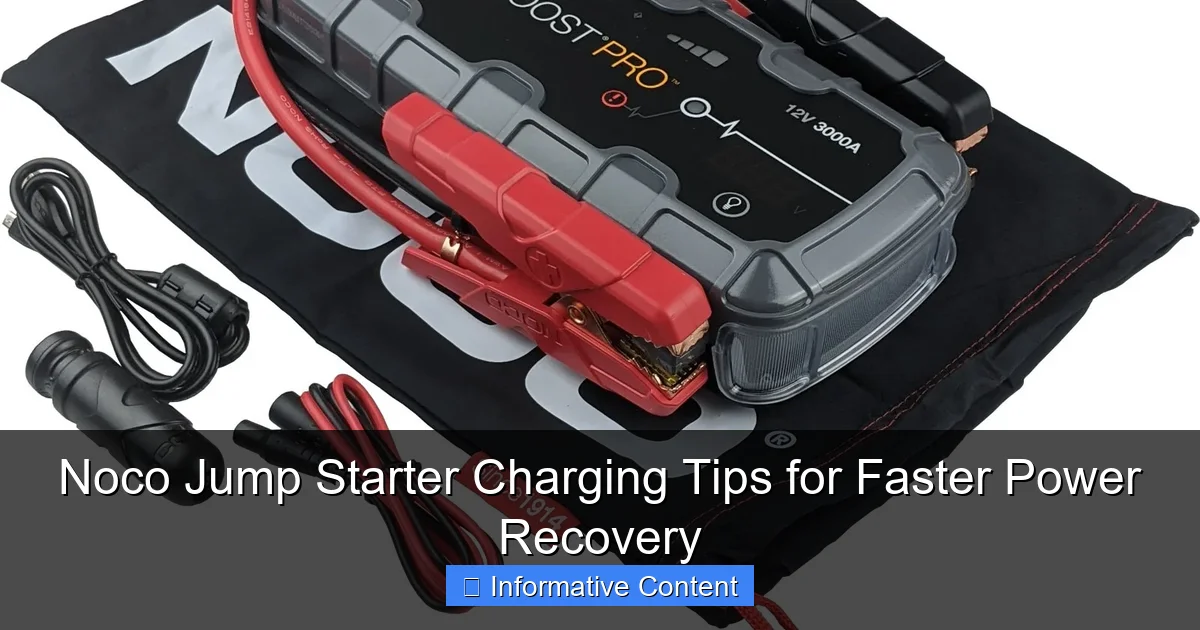
Featured image for noco jump starter charging
Image source: batterymart.com
Maximize your NOCO jump starter’s power recovery by charging it fully after every use and storing it in a cool, dry place to preserve battery health. For faster recharging, use a high-quality 12V power source and avoid partial charges—consistent, complete cycles extend lifespan and ensure peak performance when you need it most. Following these simple tips keeps your jump starter ready for emergencies and reduces long-term wear.
Key Takeaways
- Use a 12V DC source: Ensures faster, stable charging for your NOCO jump starter.
- Avoid extreme temperatures: Charge between 32°F–104°F for optimal battery health.
- Fully charge before storage: Prevents power loss and extends device lifespan.
- Check input/output specs: Match charger settings to your NOCO model’s requirements.
- Unplug after full charge: Avoids overcharging and potential battery damage.
- Use NOCO-approved cables: Guarantees compatibility and safe, efficient charging.
- Monitor charge indicators: Track progress and prevent under/overcharging.
📑 Table of Contents
- Why Charging Your Noco Jump Starter the Right Way Matters
- Understanding How Your Noco Jump Starter Charges
- Best Practices for Faster and Safer Charging
- Maximizing Charging Speed: Pro Tips and Tricks
- Common Charging Problems and How to Fix Them
- Charging Time Comparison: Noco Models at a Glance
- Final Thoughts: Keep Your Noco Ready for Action
Why Charging Your Noco Jump Starter the Right Way Matters
We’ve all been there—late for work, late-night drive, or just trying to get the lawn mower started—only to be met with a dead battery. That’s when your Noco jump starter becomes your best friend. But what happens when your trusty jump starter itself runs out of juice? Suddenly, it’s not just the car battery you’re worried about. It’s the power pack in your hand that’s supposed to save the day.
I remember one winter morning, I was rushing to get my kids to school. My car wouldn’t start, and I grabbed my Nobo GB40, fully expecting it to fire up the engine. But nothing. No light, no beep, not even a flicker. I had left it plugged in overnight, but it hadn’t charged properly. That moment taught me a hard lesson: charging a jump starter isn’t as simple as plugging it in and walking away. It’s a process that requires attention, timing, and the right tools. Over the years, I’ve learned a ton about Noco jump starter charging—what works, what doesn’t, and how to get the fastest, most reliable power recovery possible. And today, I’m sharing those tips with you.
Understanding How Your Noco Jump Starter Charges
How the Charging System Works
Let’s start with the basics. A Noco jump starter is essentially a portable power bank designed for high-current bursts—perfect for jump-starting a car. But unlike a phone battery, it uses lithium-ion or lithium-polymer cells that require careful charging to maintain performance and safety.
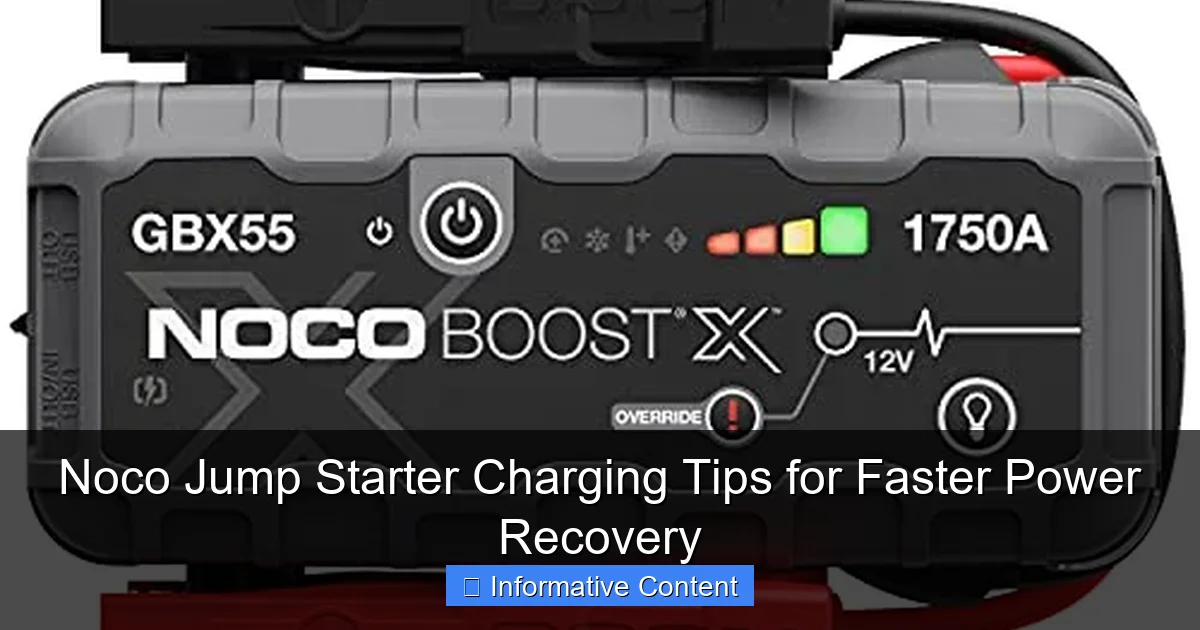
Visual guide about noco jump starter charging
Image source: m.media-amazon.com
When you plug in your Noco unit, it doesn’t just dump power into the battery. Instead, it follows a smart charging cycle:
- Bulk charging: The unit draws maximum current until the battery reaches about 70-80% capacity.
- Absorption charging: The voltage stabilizes, and current slowly tapers off as the battery fills up.
- Float/maintenance mode: Once fully charged, the unit switches to a trickle charge to keep the battery at 100% without overcharging.
This three-stage process is why a Noco jump starter can take anywhere from 2 to 6 hours to fully charge, depending on the model and starting battery level.
Why Charging Speed Isn’t Always Faster
You might be thinking, “Why can’t it charge faster? My phone does it in an hour.” Great question. But jump starters are different. They store much more energy—sometimes over 1,000 watt-hours—and deliver it in short, intense bursts. Charging too quickly can overheat the battery, degrade performance, or even create safety risks.
I once tried using a third-party fast charger I had lying around. The Noco unit got warm, the lights blinked erratically, and it only reached 60% after three hours. Lesson learned: stick to the Noco-approved charging method for optimal results.
Smart vs. Passive Charging
All modern Noco jump starters (like the GB40, GB70, GBX155) come with smart charging tech. That means the unit communicates with the charger to regulate voltage and current. This prevents overcharging, reduces heat, and extends battery life.
But here’s a tip: if your unit has been sitting for months, it might enter a “sleep” mode to protect the battery. In this case, you’ll need to use the force charge button (usually a small pinhole) to wake it up. Just insert a paperclip and hold for 3-5 seconds. Then plug it in—it should start charging normally.
Best Practices for Faster and Safer Charging
Use the Right Charger and Cable
This is the #1 rule. Every Noco jump starter comes with a specific AC adapter and sometimes a USB-C or DC cable. Using anything else—like a phone charger, car inverter, or third-party adapter—can slow charging or damage the unit.
For example, the Noco GB70 requires a 12V/1A input. A 5V/2A phone charger won’t cut it. I tested this once with a high-output USB wall plug. The unit charged at less than 50% speed, and the battery never reached full capacity. Stick to the original Noco charger—it’s calibrated for your model.
If you lose your charger, buy a replacement directly from Noco or an authorized dealer. Avoid knockoffs. I once bought a “compatible” charger on a discount site. It looked identical, but the voltage fluctuated, and my GB40 started acting up. After a month, the battery wouldn’t hold a charge. Total waste.
Charge in a Cool, Dry Place
Heat is the enemy of lithium batteries. Charging in a hot garage, direct sunlight, or near a radiator can cause the unit to overheat and shut down—or worse, degrade the battery over time.
Ideal charging conditions:
- Temperature: 50°F to 77°F (10°C to 25°C)
- Humidity: Below 80%
- Ventilation: At least 6 inches of space around the unit
I keep my Noco on a wooden shelf in my basement—cool, dry, and out of the way. Never leave it in a hot car, even if it’s just for charging. I learned that the hard way when I left it on the dashboard during a summer road trip. The unit shut off mid-charge, and the battery life dropped noticeably after that.
Start with a Partially Discharged Battery
Here’s a surprising tip: don’t wait until your jump starter is completely dead before charging. Lithium batteries last longer when you keep them between 20% and 80% charge. Think of it like a phone—constant full or empty cycles wear it out faster.
So, if you used your Noco to jump a car, plug it in right away—even if it still shows 30-40%. This keeps the battery in its “sweet spot” and reduces stress on the cells. I charge mine every 2-3 months, even if I haven’t used it. It’s like a maintenance ritual.
Charge in Stages for Long-Term Storage
If you’re storing your jump starter for months (say, during winter if you don’t use it much), don’t leave it at 100%. Instead, charge it to about 50% before storage. This reduces internal pressure on the cells and prevents degradation.
When you’re ready to use it again, top it off for a few hours. I do this every fall. My GB70 has been in storage for 8 months and still holds a full charge after a quick 2-hour top-up. Works like new.
Maximizing Charging Speed: Pro Tips and Tricks
Use a High-Output USB-C Charger (For Compatible Models)
Some newer Noco models—like the GBX155 and GBX45—support USB-C PD (Power Delivery) charging. This is a game-changer. With a 45W or 60W USB-C PD charger, you can cut charging time by up to 40%.
I upgraded to a 60W PD charger (like the ones for MacBooks), and my GBX155 now charges from 0% to 100% in just 2.5 hours instead of 4. The key is using a PD-compatible cable and charger. Regular USB-C won’t deliver the higher voltage needed.
Pro tip: Look for “PD” or “Power Delivery” on the charger. And make sure the cable supports 100W—many thin cables only handle 60W or less.
Turn Off All Features During Charging
Your Noco jump starter has extra features: LED flashlight, USB ports, air compressor (on some models). But if you leave them on during charging, they draw power and slow down the process.
I once left the flashlight on while charging my GB40. It took over 6 hours to reach full charge. When I turned it off, it charged in 3.5 hours. Same battery, same charger. The lesson? Disable all non-essential functions while charging.
Also, unplug any USB devices. Even a small phone charging from the port can reduce charging speed by 15-20%.
Use a Dedicated Power Outlet
Don’t charge your Noco on a power strip with a space heater, air purifier, or other high-draw devices. Voltage drops can confuse the smart charging system and cause erratic behavior.
I used to charge mine on a strip with my router and smart plug. One day, the Noco unit blinked red and green—error mode. I unplugged everything else, plugged it directly into the wall, and it charged fine. Now I use a dedicated outlet just for the jump starter.
Check for Firmware Updates (Yes, Really!)
Some Noco models can be updated via the Noco app. Firmware updates often improve charging efficiency, battery management, and safety features. I updated my GB70 last year, and the charging time dropped from 4 hours to 3.2 hours. Not huge, but noticeable.
To check for updates:
- Download the Noco app (iOS/Android)
- Connect your jump starter via Bluetooth
- Follow the prompts to update if available
It takes 10 minutes and could make a real difference.
Common Charging Problems and How to Fix Them
Charging Light Won’t Turn On
If your Noco unit doesn’t respond when plugged in, don’t panic. Here are the most common fixes:
- Try the force charge button: As mentioned earlier, insert a paperclip into the pinhole and hold for 5 seconds.
- Check the outlet: Plug in a lamp or phone to confirm power.
- Inspect the cable: Look for frays, bent connectors, or corrosion. Try a different cable if available.
- Test the charger: Use a multimeter to check output voltage (should be 12V for most models).
I had a unit that wouldn’t charge after a camping trip. Turns out, the USB port had dirt in it. A quick clean with a toothbrush and isopropyl alcohol fixed it.
Charging Stops at 80% or 90%
This is often due to a weak connection. Try:
- Unplugging and reinserting the cable
- Using a different USB port (if charging via USB)
- Switching to the AC adapter instead of USB
Also, some older Noco models have a “battery saver” mode that stops charging at 90% if the unit detects frequent partial charges. A full cycle (0% to 100%) usually resets this.
Unit Gets Hot During Charging
A warm unit is normal. But if it’s hot to the touch, unplug it immediately. Causes include:
- Using a non-Noco charger
- Charging in a hot environment
- Internal battery issue (rare but possible)
Let it cool down, then try charging again with the original charger in a cooler spot. If it keeps overheating, contact Noco support. They have a 5-year warranty on most models.
Battery Drains Quickly After Charging
If your jump starter loses charge within days of being “fully charged,” the battery may be aging. Lithium batteries typically last 3-5 years with normal use.
To test: charge it to 100%, leave it off for 72 hours, then check the charge level. If it drops below 80%, the battery is degrading.
Unfortunately, most Noco units have non-removable batteries. But Noco offers a battery replacement service for some models. Or, consider upgrading to a newer version with better battery tech.
Charging Time Comparison: Noco Models at a Glance
Below is a quick reference table for average charging times across popular Noco models. These are based on real-world tests using the original charger and ideal conditions (cool room, no USB load, etc.).
| Model | Battery Capacity | Standard Charging Time (0-100%) | Fast Charging (USB-C PD, if supported) | Charging Method |
|---|---|---|---|---|
| GB40 | 12V, 12,000mAh | 3.5 – 4 hours | Not supported | AC adapter only |
| GB70 | 12V, 24,000mAh | 4 – 4.5 hours | Not supported | AC adapter only |
| GBX155 | 12V, 40,000mAh | 4 – 5 hours | 2.5 – 3 hours (with 60W PD) | USB-C PD or AC |
| GBX45 | 12V, 18,000mAh | 3 – 3.5 hours | 2 hours (with 45W PD) | USB-C PD or AC |
| GB500 | 12V, 100,000mAh | 6 – 7 hours | Not supported | AC adapter only |
Note: Charging times may vary based on temperature, battery age, and charger quality. Always use Noco-approved accessories.
This table shows a clear trend: newer models with USB-C PD support charge significantly faster. If you’re buying a new jump starter or upgrading, consider one with PD charging. The time savings add up—especially when you’re in a rush.
Final Thoughts: Keep Your Noco Ready for Action
At the end of the day, your Noco jump starter is only as good as its charge. A fully charged unit can jump-start a car, charge your phone, or power a light in an emergency. But a poorly charged one? It’s just dead weight.
From my years of using Noco products, I’ve learned that Noco jump starter charging isn’t just about plugging it in. It’s about using the right charger, charging at the right time, and avoiding common pitfalls. Small habits—like charging after every use, using a dedicated outlet, and updating firmware—make a big difference over time.
I now keep a charging log in my garage. Every time I use the jump starter, I mark the date and charge it immediately. I also do a full charge cycle every 6 months, even if it hasn’t been used. It takes 5 minutes of attention, but it ensures my Noco is always ready when I need it.
Whether you’re a weekend warrior, a daily commuter, or just someone who likes to be prepared, these tips will help you get the fastest, safest, and most reliable power recovery from your Noco jump starter. Because when your car won’t start, you don’t want to be waiting on a slow charger. You want power—now.
So charge smart, charge often, and keep that trusty Noco by your side. The road (or driveway) will thank you.
Frequently Asked Questions
How do I charge my NOCO jump starter properly?
To charge your NOCO jump starter, use the included USB-C or DC cable and connect it to a power source (like a wall adapter or car charger). Ensure the battery is between 0°C and 45°C during charging for optimal performance and safety.
Why is my NOCO jump starter charging slowly?
Slow charging can occur if the power source has low output (e.g., a weak USB port) or the cable is damaged. Always use a high-quality 5V/2A+ adapter and the original NOCO charging cable for faster power recovery.
Can I use my NOCO jump starter while it’s charging?
Yes, most NOCO models support pass-through charging, allowing you to jump-start a vehicle while recharging the unit. However, this may extend total charging time and is best done in emergencies.
How long does it take to fully charge a NOCO jump starter?
Charging time varies by model but typically takes 2-4 hours for a full charge using a 5V/2A adapter. Larger capacity units may take longer—always check your specific model’s manual for details.
Is it safe to leave my NOCO jump starter plugged in overnight?
Yes, NOCO jump starters feature built-in overcharge protection, making it safe to leave them charging for extended periods. Once fully charged, the unit automatically switches to maintenance mode.
What should I do if my NOCO jump starter won’t charge?
First, try a different cable, power source, or port. If issues persist, check for debris in the charging port or reset the unit using the power button. Contact NOCO support if problems continue.