
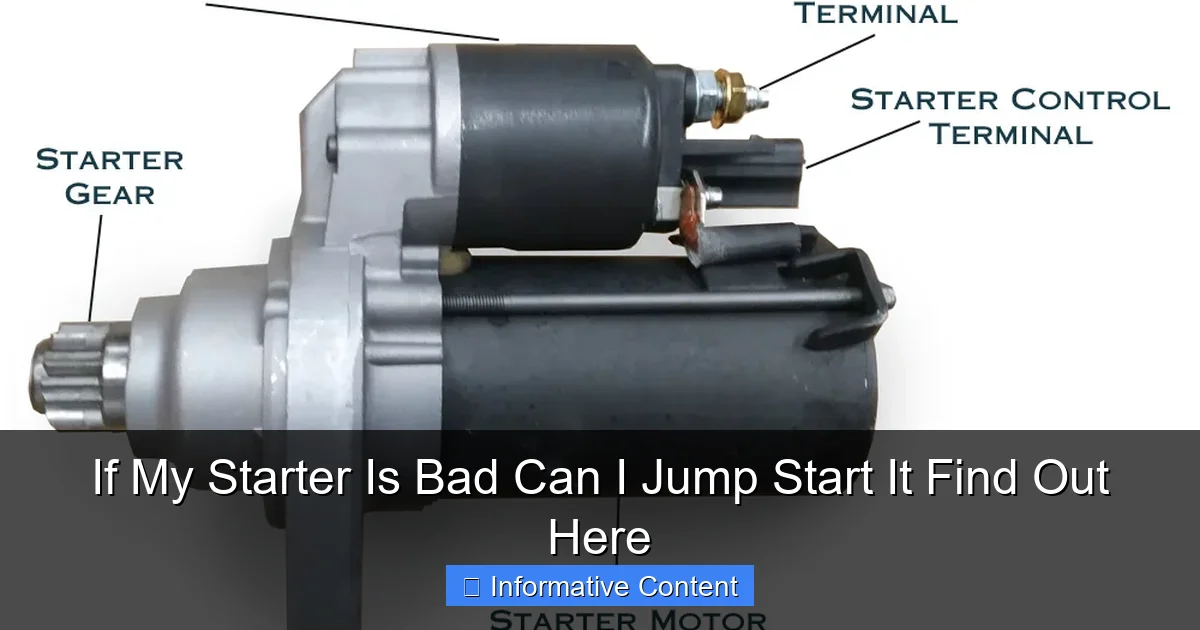
Featured image for if my starter is bad can i jump start it
Image source: samarins.com
No, you cannot jump start a car with a bad starter—jump starting only helps if the battery is dead, not when the starter motor or solenoid has failed. Signs like clicking noises or no crank at all point to a faulty starter, which requires replacement or repair, not a boost.
Key Takeaways
- Jump-starting won’t fix a bad starter: It only powers the battery, not the starter motor.
- Test the starter first: Use a multimeter to check voltage before attempting a jump start.
- Clicking sound means starter failure: A rapid click often confirms a faulty starter, not a dead battery.
- Jump starts may mask symptoms: Temporary power can hide starter issues until the battery drains again.
- Replace or repair immediately: A bad starter requires professional attention to avoid breakdowns.
📑 Table of Contents
- Understanding the Basics: What a Car Starter Does
- Signs Your Starter Is Failing (And Not Just the Battery)
- Can a Jump Start Temporarily Fix a Bad Starter?
- How to Diagnose Whether It’s the Starter or the Battery
- What to Do If the Starter Is Bad (Beyond Jump Starting)
- Conclusion: Jump Start as a Diagnostic Tool, Not a Cure
Understanding the Basics: What a Car Starter Does
Ever turned the key in your car and heard nothing? No click, no cranking—just silence. It’s one of those moments where your heart sinks. You’re late for work, or maybe you’re stranded in a parking lot. You’ve probably thought, “If my starter is bad, can I jump start it?” Let’s be honest—most of us have been there. I remember one cold winter morning when my old hatchback refused to start. I jumped in, turned the key, and… nothing. I panicked. Was it the battery? The alternator? Or was it the dreaded starter motor?
Before we dive into whether a jump start can fix a bad starter, it helps to understand what the starter actually does. Think of it as the “starter motor” for your engine. When you turn the key, the starter uses electrical power from the battery to crank the engine, which starts the combustion process. Without it, even the most powerful engine won’t fire up. The starter is a small but mighty component, and when it fails, your car becomes a very heavy paperweight. But here’s the big question: if the starter itself is broken, can a jump start—using jumper cables and another vehicle or a portable jump starter—actually help? The short answer: sometimes, but not always. And understanding why is the key to saving time, money, and frustration.
How a Jump Start Works
A jump start delivers a surge of electrical power to your car’s battery when it’s too weak to start the engine. This power comes from another car’s battery or a portable jump starter. The idea is simple: if the battery is low, a jump gives it enough juice to activate the starter and crank the engine. But this only works if the battery is the issue—not the starter.
Imagine your car is a human body. The battery is like your energy levels. The starter is like your legs. If you’re too tired (low battery), a quick energy drink (jump start) might get you moving. But if your legs are broken (bad starter), no amount of caffeine will help you walk. The same logic applies here. A jump start can’t fix a physically damaged starter motor, a seized gear, or a burnt-out solenoid. It only helps if the problem is electrical—like a weak or discharged battery.
Common Misconceptions About Jump Starting
Many people assume that if a car won’t start, a jump will fix it. That’s not always true. I once helped a neighbor jump his car three times in one week. Each time, it started, but the next day, same issue. After a trip to the mechanic, we found the starter was failing—it was drawing too much current, draining the battery overnight. The jump was a temporary band-aid, not a solution.
- Jump start = battery fix, not starter fix: A jump only helps if the battery is weak or dead.
- Starter failure requires replacement: If the starter is bad, it needs to be replaced or repaired.
- Jump starting won’t revive a seized starter: A physically damaged starter won’t respond to extra voltage.
So, if you’re asking, “If my starter is bad, can I jump start it?”—the answer depends on whether the starter is truly bad or if the battery is just weak. Let’s explore that further.
Signs Your Starter Is Failing (And Not Just the Battery)
One of the most common mistakes people make is blaming the starter when the battery is actually the culprit. But there are clear signs that point to a failing starter motor. Learning to recognize them can save you from unnecessary jump attempts and costly misdiagnoses.
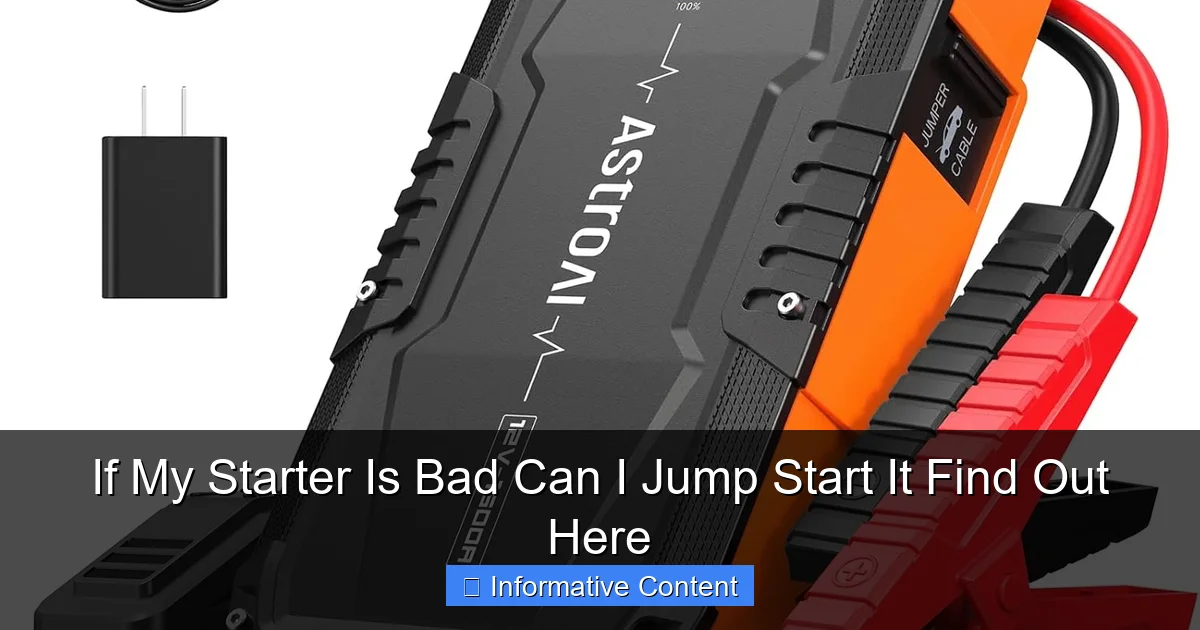
Visual guide about if my starter is bad can i jump start it
Image source: m.media-amazon.com
Clicking Sound When Turning the Key
You turn the key, and instead of the engine cranking, you hear a rapid clicking noise. This is a classic sign of a bad starter—or a dead battery. But here’s how to tell the difference: if the dashboard lights and electronics work fine (radio, lights, wipers), the battery is likely okay. The clicking sound usually comes from the starter solenoid—the part that engages the starter gear—trying to activate but failing to turn the motor. This often means the starter is seized or worn out.
Pro tip: Try tapping the starter motor lightly with a wrench or hammer while someone turns the key. Sometimes, a stuck starter gear can be freed with a gentle tap, allowing it to engage. This is a temporary fix, but it can get you to a mechanic. (I did this once with a 20-year-old pickup—worked like a charm!)
No Sound at All (Complete Silence)
If turning the key results in total silence—no clicking, no hum—the issue could be a bad starter, a blown fuse, a faulty ignition switch, or a dead battery. But if the battery is truly dead (no lights, no radio), then a jump start might help. However, if the battery is fine and you still get silence, the starter is likely the problem.
To test this, check the voltage at the battery terminals with a multimeter. A healthy battery should read 12.6 volts or higher. If it’s above 12 volts and the car is still silent, the issue is likely the starter or ignition system.
Grinding Noise During Startup
A grinding noise when starting—like metal-on-metal—is a serious red flag. This usually means the starter gear isn’t disengaging properly from the flywheel. It could be due to worn starter teeth or a damaged flywheel. In this case, a jump start won’t help. In fact, repeated attempts could cause further damage. If you hear grinding, stop trying to start the car and call a mechanic.
Intermittent Starting Issues
Your car starts fine one day, then not the next. Or it starts after several attempts. This “on-and-off” behavior is often a sign of a failing starter. The internal components (like brushes or windings) may be wearing out, causing inconsistent performance. Again, a jump start might get it going temporarily, but it won’t fix the underlying issue.
Real-life example: My sister’s sedan had this exact problem. It started fine in the morning but wouldn’t start after a 30-minute grocery run. We jumped it, and it fired up. But the next day, same issue. The mechanic found a failing starter that was overheating and seizing. A jump start bought her time, but the starter needed replacing.
Can a Jump Start Temporarily Fix a Bad Starter?
Now we get to the heart of the question: “If my starter is bad, can I jump start it?” The answer isn’t a simple yes or no. In some cases, a jump start can appear to fix a bad starter—but it’s not because the starter is repaired. It’s because the jump provides enough power to overcome certain types of starter issues.
When a Jump Might “Work” (But Isn’t a Fix)
There are a few scenarios where a jump start can temporarily revive a failing starter:
- Weak battery causing insufficient voltage: A weak battery may not deliver enough voltage to the starter, especially if the starter is already struggling. A jump provides the extra amps needed to activate a sluggish starter.
- Corroded or loose battery connections: Poor connections can mimic starter problems. A jump bypasses some of these issues by delivering power directly to the battery terminals.
- Cold weather effects: In winter, thick oil and low battery output make starters work harder. A jump gives the system a boost, helping a borderline starter crank the engine.
But here’s the catch: if the starter is physically damaged, worn out, or seized, no amount of voltage will make it work. A jump might get you started once or twice, but the problem will return—and likely get worse.
Why It’s Only a Temporary Solution
Think of it like trying to jump-start a broken leg. You can give the person energy (jump), but if the leg is fractured, they still can’t walk. The jump start doesn’t heal the starter. It just gives the electrical system a boost, which might be enough to overcome a minor resistance in the starter motor. But the root cause—worn brushes, a burnt solenoid, or a seized armature—remains.
I once had a customer who insisted his starter was fine because a jump always got it going. He kept jumping it for weeks. Then one day, the starter completely failed. The mechanic found the starter motor had overheated and melted internally. The repeated jump attempts actually accelerated the damage because the failing starter was drawing excessive current.
Risks of Repeated Jump Starting a Bad Starter
While a one-time jump is usually safe, repeatedly jumping a car with a bad starter can cause:
- Increased electrical strain: A failing starter draws more current, which can damage the battery, alternator, or wiring.
- Fire hazard: Overheating starters can melt insulation or ignite nearby fluids.
- Costly repairs: Ignoring a bad starter can lead to damage to the flywheel or other engine components.
So, while a jump might get you out of a tight spot, it’s not a long-term solution. Use it as a diagnostic tool, not a repair.
How to Diagnose Whether It’s the Starter or the Battery
Before you decide whether a jump will help, you need to figure out what’s actually broken. Misdiagnosing the problem can lead to wasted time, money, and frustration. Here’s a step-by-step guide to help you tell the difference between a bad starter and a weak battery.
Step 1: Check the Battery Voltage
Use a multimeter to test the battery. Here’s how:
- Set the multimeter to DC voltage (20V range).
- Connect the red probe to the positive terminal (+), black to negative (-).
- Read the voltage.
Voltage readings:
- 12.6V or higher = Good
- 12.4V = 75% charged
- 12.0V = 50% charged (needs charge)
- Below 11.8V = Weak or dead
If the battery is below 12V, a jump start is worth trying. But if it’s above 12V and the car still won’t start, the starter is likely the issue.
Step 2: Listen for Sounds
Have a helper turn the key while you listen near the engine. Pay attention to:
- Click-click-click: Usually a dead battery or weak starter.
- Single click, no crank: Often a bad starter solenoid.
- No sound: Could be ignition switch, starter, or battery.
- Grinding: Starter or flywheel damage.
Step 3: Test the Starter Directly (Advanced)
If you’re handy, you can test the starter by bypassing the ignition system. Warning: This should only be done by experienced DIYers.
- Locate the starter (usually near the transmission).
- Find the small wire (solenoid trigger) and the large power cable.
- Use a screwdriver to briefly touch the metal shaft of the screwdriver to both terminals.
If the starter cranks the engine, the starter is working, and the problem is likely the ignition switch or wiring. If it doesn’t, the starter is bad.
Step 4: Tap the Starter
As mentioned earlier, gently tapping the starter with a tool while someone turns the key can free a stuck gear. If this works, the starter is likely failing but not dead yet.
Step 5: Check for Power at the Starter
Use a test light or multimeter to check if power reaches the starter when the key is turned. If there’s power but the starter doesn’t crank, the starter is bad. If no power, the issue is upstream (ignition switch, relay, or fuse).
| Symptom | Likely Cause | Can Jump Help? |
|---|---|---|
| Clicking, lights work | Weak battery or bad starter | Yes, if battery is weak |
| No sound, lights dim | Dead battery | Yes |
| No sound, lights bright | Bad starter, ignition switch, or relay | No |
| Grinding noise | Starter or flywheel damage | No (stop attempting!) |
| Starter cranks slowly | Weak battery or failing starter | Yes, temporarily |
What to Do If the Starter Is Bad (Beyond Jump Starting)
If you’ve confirmed the starter is bad, jumping won’t fix it. So what’s next? Here are your options—ranging from DIY fixes to professional help.
Option 1: Replace the Starter Yourself
If you’re comfortable with car repairs, replacing a starter is doable. Most starters are located near the bottom of the engine and can be accessed from under the car. Here’s a general process:
- Disconnect the battery (safety first!).
- Jack up the car and secure it with jack stands.
- Remove the starter (usually 2-3 bolts).
- Disconnect the wiring (label the wires!).
- Install the new starter and reconnect everything.
Cost: $100–$300 for the part, plus your time. Labor at a shop can be $200–$400.
Tip: Buy a remanufactured starter—it’s cheaper than new and often comes with a warranty.
Option 2: Take It to a Mechanic
If you’re not confident doing the work yourself, a mechanic can diagnose and replace the starter in 1–2 hours. They’ll also check the flywheel and wiring to ensure everything is in good shape.
Ask for a detailed quote and make sure they include labor and parts. Some shops offer mobile services—they’ll come to you, which is great if the car won’t start at all.
Option 3: Temporary Workarounds (Not Recommended)
Some people try risky fixes, like “bump starting” a manual transmission car. This involves rolling the car in gear and popping the clutch to start the engine. It can work, but it’s dangerous and can damage the transmission or starter. Not recommended unless you’re in an emergency and know what you’re doing.
Option 4: Prevent Future Issues
Once the starter is replaced, keep these tips in mind to avoid repeat failures:
- Maintain your battery: Clean terminals, check voltage, replace every 3–5 years.
- Turn off accessories before starting: Lights, radio, A/C—reduce load on the starter.
- Don’t crank for too long: 10–15 seconds max. Let the starter cool between attempts.
- Get regular inspections: Mechanics can spot failing starters before they die.
Conclusion: Jump Start as a Diagnostic Tool, Not a Cure
So, if your starter is bad, can you jump start it? The answer is: only if the battery is weak, not the starter. A jump start is a powerful diagnostic tool—it can help you determine whether the issue is electrical (battery, connections) or mechanical (starter, flywheel). But it won’t fix a physically broken starter.
Think of it this way: a jump start is like a flashlight. It helps you see the problem, but it doesn’t fix it. If the battery is dead, the flashlight shines brightly. If the starter is broken, the light won’t help you repair the circuit.
From my own experiences—and countless roadside rescues—I’ve learned that patience and proper diagnosis save more time than panic and repeated jumping. If your car won’t start, take a breath. Check the battery. Listen for sounds. Try a jump—but only as a test. If the problem persists, it’s time to replace the starter.
Remember: cars are complex machines, but they follow logical patterns. A weak battery can mimic a bad starter. A failing starter can drain a good battery. But with the right tools and knowledge, you can make smart decisions—and avoid getting stranded again.
So next time you’re asking, “If my starter is bad, can I jump start it?”—you’ll know the answer: maybe, but only as a temporary fix. The real solution? Diagnose first, act second. Your car—and your wallet—will thank you.
Frequently Asked Questions
Can I jump start my car if the starter is bad?
Jump starting a car with a bad starter is generally ineffective because the issue lies with the starter motor, not the battery. While a jump start provides extra power, it won’t fix a mechanical or electrical failure in the starter itself.
What are the signs of a bad starter vs. a dead battery?
A dead battery often causes dim lights and slow cranking, while a bad starter typically produces a clicking noise or no sound at all when turning the key. If jump starting doesn’t work, the starter is likely the culprit.
Is it safe to jump start a vehicle with a faulty starter?
It’s safe to try, but don’t expect results. Jump starting won’t damage your car, but repeatedly cranking the engine with a failing starter may strain other components. Focus on diagnosing the starter instead.
How do I test if my starter is bad before trying a jump start?
Tap the starter lightly with a tool while someone turns the key—if the engine cranks, the starter is likely failing. Alternatively, check for power at the starter solenoid using a multimeter to confirm electrical issues.
Can a bad starter drain my battery, making jump starts necessary?
A malfunctioning starter can drain the battery over time due to excessive power draw. However, if the starter is bad, jump starting won’t resolve the root issue—replace or repair the starter first.
What should I do if jump starting doesn’t work?
If jump starting fails, have a mechanic inspect the starter, solenoid, and ignition switch. Persistent issues often require starter replacement, especially if the motor is worn or the electrical connections are corroded.