
Featured image for a trickle charger wont charge battery will a jump start
Image source: chargingoption.com
If your trickle charger won’t revive a dead battery, a jump start is often the quickest fix—but it’s not a permanent solution. Jump starters deliver a high-current burst to get your engine running, while trickle chargers are designed for slow, long-term charging that may fail if the battery is deeply discharged or damaged. Use a jump start to get back on the road, but test and recharge the battery properly to avoid future failures.
Key Takeaways
- Jump starts work instantly when a trickle charger fails to revive a dead battery.
- Trickle chargers need time—they can’t fix deeply discharged or damaged batteries fast.
- Check battery health first—jump starting won’t help if the battery is faulty.
- Use jumper cables properly to avoid sparks, damage, or unsafe connections.
- Drive after jump starting to recharge the battery fully—don’t idle.
- Prevent future issues by testing alternator and charging system regularly.
📑 Table of Contents
- Why Your Battery Isn’t Charging—And What to Try Instead
- Understanding Trickle Chargers: What They Do (and What They Don’t)
- Jump Starting: A Quick Fix or a False Hope?
- Why a Trickle Charger and Jump Start Might Both Fail
- Step-by-Step: What to Do When Your Battery Won’t Charge
- Prevention: How to Avoid Dead Batteries for Good
- Data Table: Common Battery Issues and Solutions
Why Your Battery Isn’t Charging—And What to Try Instead
Ever woken up to a car that just won’t start? You turn the key, and instead of the familiar hum of the engine, you’re met with silence—or maybe just a sad, clicking noise. You grab your trusty trickle charger, plug it in, and wait. And wait. And wait. But the battery still refuses to cooperate. Now you’re left wondering: If a trickle charger won’t charge the battery, will a jump start work? It’s a question that’s crossed the minds of countless drivers, especially during those cold winter mornings or after a long vacation away from the car.
Let me tell you, I’ve been there. One winter, I left my car parked in the driveway for two weeks while visiting family. When I returned, the battery was deader than a doornail. I hooked up my trickle charger overnight, expecting a full recovery by morning. But the next day? Still nothing. No lights, no clicks, not even a flicker. That’s when I realized: not all dead batteries are the same. Some are just tired and need a gentle nudge; others are so far gone that even a trickle charger can’t save them. And sometimes, the real issue isn’t the battery at all. So, what’s the solution? Can a jump start really save the day when a trickle charger fails? Let’s dive into the nitty-gritty and find out.
Understanding Trickle Chargers: What They Do (and What They Don’t)
How Trickle Chargers Work
At their core, trickle chargers are designed to provide a slow, steady charge to a battery over an extended period—often 12 to 48 hours. Unlike fast chargers that pump a lot of current in a short time, trickle chargers deliver a low amperage (usually 1 to 2 amps) to prevent overheating and overcharging. Think of them like a drip irrigation system for your car battery: gentle, consistent, and safe for long-term use.
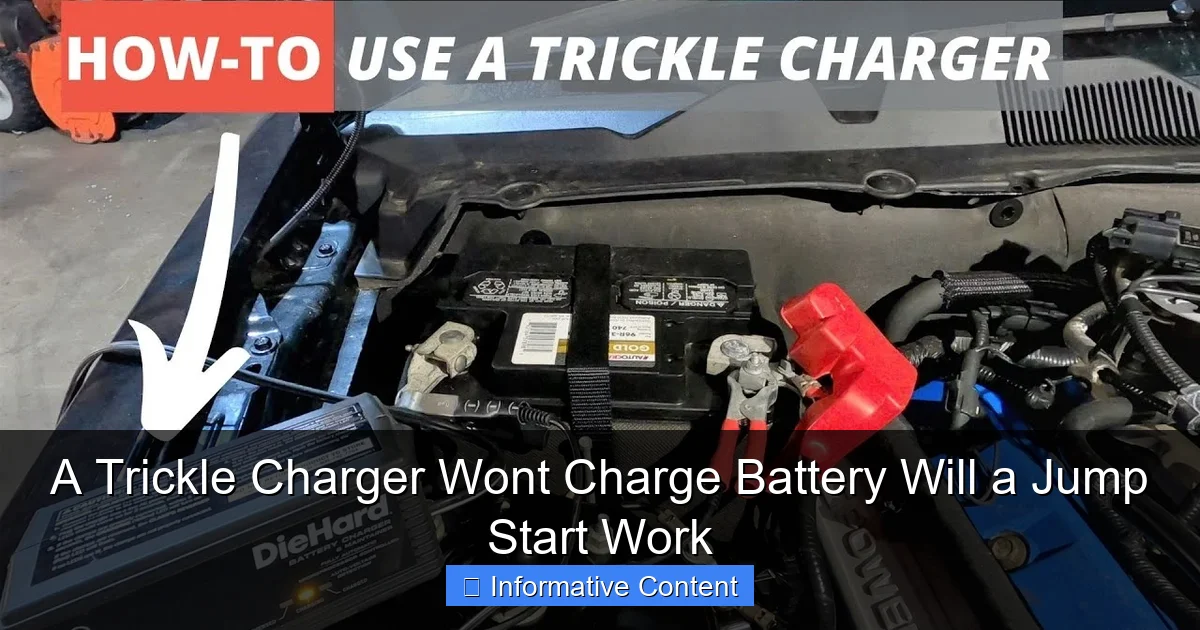
Visual guide about a trickle charger wont charge battery will a jump start
Image source: i.ytimg.com
They’re ideal for maintaining batteries in vehicles that aren’t driven often—like classic cars, motorcycles, or seasonal equipment. A trickle charger keeps the battery at a healthy voltage without stressing the internal chemistry. But here’s the catch: they work best on batteries that still have some life left. If the battery is deeply discharged, sulfated, or damaged, a trickle charger might not have enough “oomph” to bring it back.
When a Trickle Charger Fails
So, why might your trickle charger fail? Let’s break it down:
- Deep Discharge: If your battery voltage has dropped below 10.5 volts (for a 12-volt battery), the internal plates may have sulfated. This buildup of lead sulfate crystals blocks chemical reactions, making it hard for any charger to restore power.
- Internal Damage: Aging batteries or those with cracked cases, corroded terminals, or shorted cells won’t respond well to slow charging. The damage is too severe.
- Parasitic Drain: Sometimes, a battery dies not because it’s old, but because something in the car (like a glovebox light or faulty module) is slowly draining it even when the engine is off. A trickle charger can’t fix the underlying issue.
- Faulty Charger: Not all chargers are created equal. A cheap or malfunctioning trickle charger might not deliver the promised charge—or any charge at all.
For example, my neighbor once spent three days trying to revive a battery with a trickle charger. Turns out, the charger’s output was only 0.5 amps—half the recommended rate. By the time he realized it, the battery had already sulfated beyond repair.
The Bottom Line on Trickle Chargers
Trickle chargers are great for maintenance, but they’re not miracle workers. If your battery is severely drained, damaged, or suffering from a deeper electrical issue, a slow charge won’t cut it. That’s where jump starting comes in—but it’s not a guaranteed fix either. Let’s explore why.
Jump Starting: A Quick Fix or a False Hope?
How Jump Starting Works
Jump starting uses another vehicle’s (or a jump box’s) battery to deliver a high burst of current to your dead battery. The goal isn’t to fully charge your battery—it’s to give it enough juice to crank the engine and start the car. Once the engine runs, the alternator takes over, recharging the battery while driving.
Think of it like CPR: you’re not healing the patient, but you’re keeping them alive until professional help arrives. In this case, the “professional help” is the alternator.
When Jump Starting Succeeds
Jump starting works best when the battery is discharged but not damaged. Here are common scenarios where it’s likely to succeed:
- Left Lights On: You accidentally left your headlights on overnight. The battery is drained but healthy.
- Short Trip Syndrome: You only drove a few miles, so the alternator didn’t have time to recharge the battery after starting the car.
- Extreme Cold: Cold temperatures reduce battery efficiency. A jump start gives it a fighting chance until the engine warms up.
For instance, last winter, my sister’s car wouldn’t start after a 10-minute drive to the grocery store. We jump-started it, and it fired right up. After a 30-minute drive, the battery was back to normal—no further issues.
When Jump Starting Fails
But here’s the reality: jump starting won’t help if the battery is physically damaged or chemically degraded. Here’s why:
- Sulfated Battery: If sulfate crystals have formed on the plates, no amount of external power can dissolve them. The battery simply can’t hold a charge.
- Shorted Cell: A damaged cell creates a path for current to leak, making the battery ineffective.
- Open Circuit: If the internal connections are broken, electricity can’t flow—even from a jump.
- Alternator Failure: If the alternator isn’t working, the battery won’t recharge after the jump, leaving you stranded again.
A friend of mine tried to jump-start his truck after a month of inactivity. The engine turned over once, then died. The battery was so sulfated that it couldn’t sustain the load. We ended up towing it to a mechanic.
Jump Boxes vs. Jumper Cables: Which to Use?
If you’re considering a jump start, you’ve got two options:
- Jumper Cables: Require another vehicle. Pros: High current (can deliver 400–600 amps). Cons: Need a second car, and incorrect connection can damage electronics.
- Jump Box (Portable Starter): Self-contained battery pack. Pros: No second vehicle needed, safer for beginners. Cons: Limited capacity—may not work on large batteries (e.g., diesel trucks).
Tip: Always follow the correct order: connect the positive (red) clamps first, then the negative (black) to the dead battery’s terminal or a metal ground. Reverse the order when disconnecting.
Why a Trickle Charger and Jump Start Might Both Fail
The Hidden Culprits
If neither a trickle charger nor a jump start works, the problem likely goes beyond the battery. Here are the usual suspects:
- Faulty Alternator: The alternator charges the battery while driving. If it’s failing, the battery won’t recharge—even after a jump. Signs: dim lights, battery warning light on the dashboard, or a burning smell.
- Corroded or Loose Cables: Poor connections block current flow. Clean terminals with a wire brush and tighten clamps.
- Parasitic Draw: A component (like a trunk light or radio) is drawing power when the car is off. Use a multimeter to check for abnormal drain (more than 50 milliamps).
- Bad Starter Motor: If the starter is seized, the engine won’t turn over—even with a fully charged battery.
For example, a reader once told me their car wouldn’t start after a jump. We tested the alternator—it was putting out only 12 volts (should be 13.5–14.5). Replacing it fixed the issue.
Battery Age Matters
Car batteries typically last 3–5 years. After that, their capacity declines. A 5-year-old battery might show 12.6 volts when fully charged but still fail to start the car in cold weather. If your battery is old, it’s time to replace it—not keep trying to revive it.
Pro tip: Most auto parts stores offer free battery testing. They’ll check the voltage, load capacity, and internal resistance. It’s the most reliable way to diagnose a battery’s health.
Environmental Factors
Extreme temperatures take a toll. In winter, battery capacity drops by up to 50%. In summer, heat accelerates corrosion and evaporation of electrolyte. If you live in a climate with harsh seasons, consider a battery with a higher cold-cranking amp (CCA) rating.
Step-by-Step: What to Do When Your Battery Won’t Charge
Step 1: Diagnose the Problem
Before throwing money at the issue, do some basic checks:
- Inspect the Battery: Look for cracks, leaks, or bulging. Clean terminals with a baking soda and water solution.
- Check Voltage: Use a multimeter. A reading below 11.9 volts indicates a deep discharge. Below 10.5 volts? Likely sulfated.
- Test for Parasitic Draw: With the car off, disconnect the negative cable and place the multimeter between the terminal and cable. A draw over 50 milliamps is abnormal.
Step 2: Try a Jump Start (Safely)
If the battery seems intact:
- Position the working vehicle close (but not touching).
- Turn off both vehicles and engage parking brakes.
- Connect the red clamp to the dead battery’s positive terminal.
- Connect the other red clamp to the good battery’s positive terminal.
- Connect the black clamp to the good battery’s negative terminal.
- Connect the other black clamp to a metal ground on the dead car (e.g., engine block).
- Start the working vehicle and let it run for 3–5 minutes.
- Attempt to start the dead car. If it works, drive for at least 30 minutes to recharge.
Warning: Never touch the clamps together or let them touch metal while connected.
Step 3: Assess the Outcome
After the jump:
- If the car starts and runs normally: The battery was discharged but healthy. Keep an eye on it.
- If the car starts but dies after a few minutes: The alternator isn’t charging. Get it tested.
- If the car won’t start even after the jump: The battery is likely beyond repair. Replace it.
Step 4: Consider a Battery Replacement
If the battery is old or damaged:
- Choose a battery with the correct size, CCA, and reserve capacity (RC) for your car.
- Recycle the old battery—most auto shops accept them for free.
- Reset any battery-related warning lights (e.g., in modern cars with battery management systems).
Prevention: How to Avoid Dead Batteries for Good
Regular Maintenance
An ounce of prevention is worth a pound of cure:
- Clean Terminals Monthly: Corrosion reduces conductivity. Use a wire brush and terminal cleaner.
- Check Voltage Quarterly: A healthy battery should read 12.6 volts when off and 13.5–14.5 volts when running.
- Inspect Belts and Pulleys: A loose alternator belt won’t generate enough power to charge the battery.
Smart Habits
- Drive Regularly: Short trips don’t give the alternator time to recharge. Take a 20-minute drive weekly.
- Use a Battery Maintainer: For infrequently used vehicles, a smart trickle charger (like a Battery Tender) prevents discharge without overcharging.
- Turn Off Accessories: Double-check lights, radio, and USB ports before exiting the car.
Upgrade Your Setup
Consider investing in:
- AGM or Lithium Batteries: More resistant to vibration, temperature, and deep discharge. Ideal for modern cars with high electrical demands.
- Jump Box: A portable starter is a lifesaver in emergencies. Keep it charged and in the trunk.
- Voltage Monitor: A dashboard-mounted gauge shows real-time battery voltage.
Data Table: Common Battery Issues and Solutions
| Issue | Symptoms | Trickle Charger? | Jump Start? | Best Solution |
|---|---|---|---|---|
| Deep Discharge | No lights, slow cranking | May work (if not sulfated) | Yes (temporary) | Jump start + drive to recharge |
| Sulfated Battery | No response to charging | No | No | Replace battery |
| Alternator Failure | Battery dies after jump | No | Temporary fix | Replace alternator |
| Corroded Terminals | Intermittent starting | Yes (after cleaning) | Yes (after cleaning) | Clean terminals |
| Parasitic Draw | Battery dies when parked | No | Yes (temporary) | Locate and fix drain |
Remember, a trickle charger won’t charge a battery if the damage is too severe—and a jump start is just a band-aid. The key is understanding the root cause. Whether it’s a simple fix or a full replacement, acting early can save you time, money, and stress. So the next time your car won’t start, don’t panic. Grab your tools, follow the steps, and get back on the road—with confidence.
Frequently Asked Questions
Why won’t my trickle charger charge the battery?
A trickle charger may fail to charge a deeply discharged or damaged battery due to insufficient voltage output or internal battery faults. In such cases, the charger can’t overcome the battery’s resistance, leaving it seemingly “dead.”
Can a jump start work if a trickle charger won’t charge the battery?
Yes, a jump start can often work when a trickle charger won’t because it delivers a higher burst of voltage, temporarily “waking up” a severely drained battery. However, this is a short-term fix—have the battery inspected for underlying issues.
Is it safe to jump start a battery that a trickle charger couldn’t revive?
Generally, yes, but ensure the battery isn’t cracked, leaking, or frozen. Jump-starting a damaged battery risks sparks or explosions, so prioritize safety and professional evaluation.
What’s the difference between a trickle charger and a jump starter?
A trickle charger slowly delivers low amperage over hours, ideal for maintenance, while a jump starter provides a high-amp surge to start engines instantly. The latter is better for immediate recovery when a battery is too weak for a trickle charge.
How long should I wait after a jump start before using a trickle charger?
After a jump start, drive the vehicle for 15–20 minutes to stabilize the battery, then use a trickle charger overnight. This helps recharge the battery fully and prevents repeated jump-start needs.
Will repeated jump starts harm my battery if a trickle charger won’t work?
Yes, frequent jump starts can stress the battery and electrical system, accelerating wear. If a trickle charger fails repeatedly, the battery likely needs replacement—consult a mechanic to avoid further damage.