
Featured image for 2003 ford focus will not jump start
Image source: images.opinautos.com
If your 2003 Ford Focus won’t jump start, the issue is often a faulty battery, corroded terminals, or a failing alternator—not the jump itself. Check for visible damage, ensure clean connections, and test the battery voltage to pinpoint the root cause quickly. Simple fixes like reseating cables or replacing a dead battery can get you back on the road fast.
Key Takeaways
- Check battery connections: Clean and tighten corroded or loose terminals first.
- Test the battery: Use a multimeter to confirm voltage is above 12V.
- Inspect alternator: Ensure it’s charging the battery properly while running.
- Verify jump leads: Use thick, undamaged cables for effective power transfer.
- Try bump starting: Push-start in 2nd gear if the starter is faulty.
- Replace weak battery: Install a new one if it fails to hold a charge.
📑 Table of Contents
- Why Your 2003 Ford Focus Won’t Jump Start (And What You Can Do About It)
- Common Reasons Why a 2003 Ford Focus Will Not Jump Start
- How to Diagnose the Problem Step by Step
- Lesser-Known Causes That Prevent Jump Starting
- How to Fix the Most Common Issues (DIY Tips)
- Preventing Future Jump Start Problems
- When to Call a Professional
- Summary of Key Fixes and Costs
Why Your 2003 Ford Focus Won’t Jump Start (And What You Can Do About It)
Let’s be honest—few things are more frustrating than turning the key in your 2003 Ford Focus and hearing nothing but silence. You’ve got places to be, people to see, and instead, you’re staring at a car that refuses to wake up. You grab the jumper cables, hook everything up, and… still nothing. The engine doesn’t crank. The lights don’t flicker. It’s as if your car is giving you the silent treatment. Sound familiar?
If your 2003 Ford Focus will not jump start, you’re not alone. This is a common issue that many Focus owners face, especially as the vehicle ages. But here’s the good news: the problem isn’t always a dead battery or a faulty alternator. In fact, the root cause could be something far simpler—and far easier to fix—than you think. In this guide, I’ll walk you through the most likely reasons why your Focus isn’t responding to a jump start, how to diagnose the issue step by step, and what you can do to get back on the road without spending a fortune at the mechanic.
Common Reasons Why a 2003 Ford Focus Will Not Jump Start
The Battery Might Not Be the Real Culprit
It’s easy to assume that if your car won’t start, the battery must be dead. And sure, that’s often the case. But when your 2003 Ford Focus will not jump start, even with a healthy donor battery, the problem may be deeper than surface-level voltage.

Visual guide about 2003 ford focus will not jump start
Image source: i.pinimg.com
For example, I once helped a friend who swore his battery was fine because the headlights turned on. But when we tried to jump it, nothing happened. After testing, we discovered the battery had enough voltage to light the bulbs but not enough amperage to crank the engine—a condition called a “surface charge.” This is common in older batteries that have sulfated over time. The plates inside the battery develop a coating that prevents proper chemical reactions, so even with a jump, the power delivery is too weak.
Another possibility: the battery terminals are corroded or loose. A thin layer of white or green gunk on the terminals acts like insulation, blocking the flow of electricity. I’ve seen cases where simply cleaning the terminals with a wire brush and tightening the clamps solved the entire problem—no new battery needed.
Faulty Ground or Power Connections
Your Focus relies on a solid electrical connection from the battery to the starter, the engine block, and the chassis. If any of these ground paths are compromised, the jump start won’t work—even if the cables are connected correctly.
The main ground cable usually runs from the battery’s negative terminal to the engine block or chassis. Over time, this cable can corrode, fray, or become loose. I once spent 20 minutes troubleshooting a no-start condition only to realize the ground strap had rusted through near the firewall. Once we replaced it, the car fired up instantly.
Similarly, the positive cable from the battery to the starter motor can degrade. Look for signs of overheating, melting, or discoloration. A bad connection here means the starter can’t draw the high current it needs, even with a full jump.
Starter Motor Failure
If your 2003 Ford Focus will not jump start and you hear a single loud click but no cranking, the starter motor is a prime suspect. The starter is responsible for turning the engine over, and it requires a massive burst of current—often 100+ amps.
When the starter fails, it might still make a clicking sound (from the solenoid activating), but the motor itself doesn’t spin. This can happen due to worn brushes, a seized armature, or internal short circuits. I’ve had a Focus that would click once, then nothing. A quick tap with a hammer on the starter housing (while someone turned the key) got it going—temporarily. That’s a classic sign of a dying starter.
Another clue: if the car starts intermittently, or only after multiple attempts, the starter may be on its last legs. It’s not always a full failure—sometimes it’s just weak or misaligned.
How to Diagnose the Problem Step by Step
Step 1: Check the Battery Voltage and Connections
Before you even think about jump-starting, grab a multimeter and check your battery voltage. A fully charged battery should read around 12.6 volts when the car is off. If it’s below 12.4 volts, it’s likely too weak to start the car—even with a jump.
But here’s the key: if the voltage reads okay (say, 12.5 volts), but the car still won’t jump start, check the load voltage. Have someone try to start the car while you measure the battery voltage. If it drops below 9.6 volts during cranking, the battery is bad—even if it seems fine at rest.
Next, inspect the terminals. Look for:
- White, green, or blue corrosion
- Loose or wobbly clamps
- Cracked or melted terminal covers
Clean the terminals with a wire brush and baking soda/water solution. Tighten the clamps firmly. If the terminals are cracked or damaged, replace the battery or get a terminal repair kit. I once saved a $150 battery replacement just by cleaning the terminals and adding anti-corrosion spray.
Step 2: Test the Jump Start Process Properly
Many people mess up the jump start sequence, which can lead to false conclusions. Here’s how to do it right:
- Park the donor car close enough so the cables reach, but don’t let the cars touch.
- Turn off both vehicles and set the parking brakes.
- Connect the red (positive) clamp to the dead battery’s positive terminal.
- Connect the other red clamp to the donor battery’s positive terminal.
- Connect the black (negative) clamp to the donor battery’s negative terminal.
- Connect the last black clamp to a bare metal ground on the dead car—not the negative terminal. Use a bolt on the engine block or frame. This reduces the risk of sparks near the battery.
- Start the donor car and let it idle for 3–5 minutes.
- Try starting the Focus. If it doesn’t work, wait another 2–3 minutes and try again.
Why the ground on bare metal? Because a poor ground connection is a common cause of failed jump starts. I’ve seen people connect the final black clamp to the dead battery’s negative terminal, only to find out the ground path was blocked by paint or rust. A direct metal-to-metal connection ensures a solid circuit.
Step 3: Listen for Clicks and Check the Starter
If the jump still fails, listen closely when you turn the key. Pay attention to:
- No sound at all: Could be a bad ignition switch, neutral safety switch, or wiring issue.
- One loud click: Likely the starter solenoid engaging, but the motor isn’t turning. Points to a bad starter or power/ground issue.
- Rapid clicking: Usually a sign of low voltage—check battery, cables, and connections.
If you hear a single click, try tapping the starter lightly with a hammer or wrench while someone turns the key. If the car starts, the starter is failing and needs replacement. This is a temporary fix—don’t rely on it long-term.
Step 4: Check the Fuses and Ignition Switch
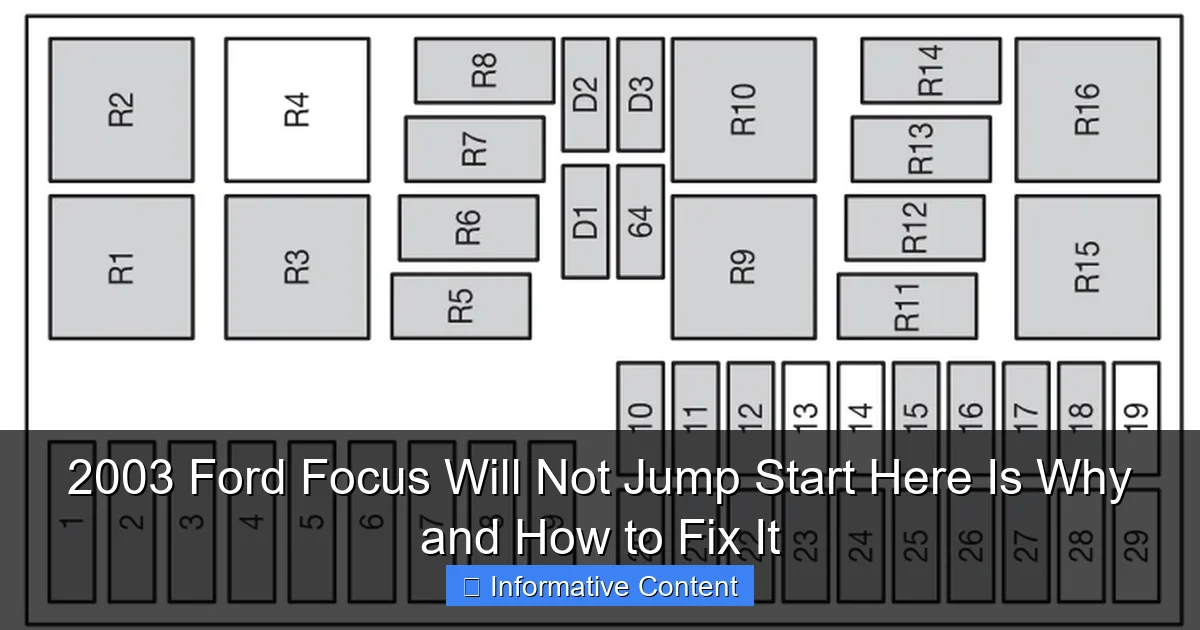
Sometimes, the issue isn’t mechanical—it’s electrical. The 2003 Focus has several fuses related to the starter circuit, including the starter relay and ignition system fuses. Check the under-hood fuse box (near the battery) for any blown fuses. Look for fuses labeled “Starter,” “Ignition,” or “PWR.”
Also, test the ignition switch. If the car’s interior lights and accessories work, but nothing happens when you turn the key, the switch might be faulty. You can test this by using a test light on the starter relay’s control wire (usually a thin wire) while turning the key. If the light doesn’t come on, the ignition switch isn’t sending the signal.
Lesser-Known Causes That Prevent Jump Starting
Neutral Safety Switch Failure
The neutral safety switch prevents the car from starting unless it’s in Park or Neutral. On the 2003 Focus, this switch is located on the transmission. If it fails, the starter won’t engage—even with a jump.
Signs of a bad neutral safety switch:
- Car won’t start in Park, but might start in Neutral (or vice versa)
- No crank in either gear, but lights and accessories work
- Intermittent starting issues
To test it, try starting the car in Neutral (with the brake on). If it starts, the switch is likely the issue. You can also bypass the switch temporarily with a jumper wire at the transmission harness (check your repair manual for the correct pins), but this is only a diagnostic step—not a permanent fix.
Bad Starter Relay or Solenoid
The starter relay is a small electrical switch that sends power to the starter motor. If it’s bad, the starter won’t get the signal to turn on—even with full voltage.
The relay is usually in the under-hood fuse box. Swap it with an identical relay (like the horn or A/C relay) to test. If the car starts after the swap, the relay is faulty. Replacement is cheap and easy—usually under $20 and takes 5 minutes.
The starter solenoid is a component on the starter itself. It’s the part that makes the loud “click” you hear. If the solenoid is stuck or burnt out, it won’t engage the starter gear with the flywheel. A solenoid can sometimes be replaced separately, but most mechanics recommend replacing the entire starter for reliability.
Wiring Harness or Ground Issues
Over time, the wiring harness near the starter can become damaged due to heat, vibration, or rodent chewing. Look for:
- Brittle or cracked insulation
- Discolored wires (signs of overheating)
- Loose connectors
Also, check the main ground strap from the engine to the chassis. This strap is crucial for completing the starter circuit. If it’s broken or corroded, the starter won’t work. I once found a ground strap that had been chewed by a squirrel—replaced it for $12 and solved the problem.
How to Fix the Most Common Issues (DIY Tips)
Cleaning Battery Terminals and Cables
This is the easiest and cheapest fix. Here’s how:
- Disconnect the negative cable first (to avoid sparks).
- Remove the positive cable.
- Scrub the terminals and cable ends with a wire brush.
- Mix a tablespoon of baking soda with a cup of water and apply with a toothbrush.
- Rinse with clean water and dry thoroughly.
- Reconnect the positive, then the negative.
- Apply anti-corrosion spray or petroleum jelly to prevent future buildup.
Pro tip: Use a battery terminal cleaning tool (under $10) for hard-to-reach spots.
Replacing the Starter Motor
If the starter is bad, replacement is straightforward on the 2003 Focus. You’ll need:
- Socket wrench set
- Extension and swivel joint
- Jack and jack stands (safety first!)
Steps:
- Disconnect the battery.
- Raise the front of the car and secure it.
- Locate the starter (driver’s side, near the transmission).
- Remove the electrical connectors (label them if needed).
- Unbolt the starter (usually two or three bolts).
- Remove and replace with the new starter.
- Reconnect everything and test.
Most aftermarket starters cost $80–$150. Labor at a shop can be $200+, so DIY saves big.
Replacing the Starter Relay or Neutral Safety Switch
The starter relay is a 2-minute job. Just pull the old one and plug in the new. The neutral safety switch is trickier but doable. You’ll need to:
- Drain the transmission fluid (or use a fluid extractor)
- Remove the shift linkage
- Unbolt the switch and replace it
It’s a bit messy, but YouTube has great tutorials. A new switch costs $30–$60.
Preventing Future Jump Start Problems
Regular Maintenance Tips
Prevention is always better than cure. Here’s how to avoid future issues:
- Check battery health annually: Use a battery tester or have it load-tested at an auto parts store.
- Clean terminals every 6–12 months: Especially if you live in a humid or salty environment.
- Inspect wiring and grounds: Look for corrosion, fraying, or loose connections during oil changes.
- Replace the battery every 4–5 years: Even if it seems fine, internal degradation happens over time.
- Use a battery tender in winter: Cold weather kills batteries. A trickle charger keeps it healthy.
Driving Habits That Affect Battery and Starter Life
Short trips are hard on your battery. The alternator doesn’t have time to fully recharge it, leading to sulfation. Try to take longer drives (30+ minutes) once a week.
Also, avoid leaving lights or accessories on when the engine is off. Even a small interior light can drain the battery overnight. I learned this the hard way when I left my dome light on and came back to a no-start car—twice.
Finally, don’t crank the engine for more than 10 seconds at a time. If it doesn’t start, wait 30 seconds before trying again. Overheating the starter can shorten its life.
When to Call a Professional
Some issues are beyond DIY, especially if you lack tools or experience. Call a mechanic if:
- You’ve checked everything and still can’t find the problem
- The car starts but dies immediately (could be fuel or ignition system)
- You hear grinding noises from the starter (sign of gear damage)
- There’s a burning smell or smoke (electrical short)
But remember: many shops will charge you just to diagnose the issue. Before you go, try the steps above. You might save $100+ in diagnostic fees.
Summary of Key Fixes and Costs
| Issue | Diagnosis Tip | Fix | Estimated Cost (DIY) |
|---|---|---|---|
| Dirty/Corroded Terminals | White/green buildup on terminals | Clean with baking soda and brush | $0–$10 (cleaning kit) |
| Bad Starter | Single click, no crank; tap helps temporarily | Replace starter motor | $80–$150 (part) |
| Faulty Starter Relay | Swap with known-good relay | Replace relay | $10–$20 (part) |
| Neutral Safety Switch | Starts in Neutral but not Park | Replace switch | $30–$60 (part) |
| Bad Ground Connection | Check engine-to-chassis strap | Replace ground strap | $10–$20 (part) |
| Worn Battery | Load test shows low amperage | Replace battery | $100–$200 (part) |
Dealing with a 2003 Ford Focus that will not jump start is stressful, but it’s rarely a hopeless situation. By understanding the common causes—from corroded terminals to failing starters—you can take control of the problem instead of feeling at the mercy of your car.
Remember, the key is methodical troubleshooting. Start simple (clean the terminals), then work your way up to more complex fixes (replace the starter). Most issues can be resolved in under an hour with basic tools and a little patience.
And if you’ve tried everything and still can’t get it going? Don’t beat yourself up. Sometimes, even experienced mechanics need a second opinion. The important thing is that you’re not ignoring the problem—you’re actively working to solve it.
Your 2003 Focus has been a reliable companion for years. With a little care and attention, it can keep going for many more. Whether you’re cleaning terminals, replacing a relay, or installing a new starter, you’re not just fixing a car—you’re building confidence, saving money, and learning something new. And that’s worth every minute.
Frequently Asked Questions
Why won’t my 2003 Ford Focus jump start even with good cables?
A faulty battery, corroded terminals, or a bad ground connection often prevent a 2003 Ford Focus from jump starting. Even with proper cables, these issues can block the necessary electrical flow to revive the engine.
Can a bad alternator cause a 2003 Ford Focus not to jump start?
Yes, a failing alternator may prevent the battery from holding a charge, causing the car to stall or fail to start even after a jump. If the alternator isn’t working, the battery won’t recharge properly, leading to repeated no-start conditions.
What are common reasons a 2003 Ford Focus won’t jump start?
Common causes include a completely dead battery, damaged starter motor, faulty ignition switch, or poor electrical connections. The 2003 Ford Focus won’t jump start if these components fail to engage despite external power.
How do I check if my 2003 Ford Focus battery is beyond jump starting?
Use a multimeter to check the battery voltage; anything below 12 volts (engine off) suggests a weak or dead battery. If it won’t hold a charge after jump-start attempts, replacement is likely necessary.
Is it safe to repeatedly jump start a 2003 Ford Focus that won’t start?
Repeated jump starts can damage the electrical system or battery if the root cause (e.g., alternator, parasitic drain) isn’t fixed. Address the underlying issue instead of relying on jump starts as a long-term solution.
What should I check first if my 2003 Ford Focus won’t jump start?
Inspect the battery terminals for corrosion or looseness and ensure the ground cable is securely connected. These simple fixes often resolve jump-starting problems in the 2003 Ford Focus.