
Featured image for lawn mower will only start when jumped
Image source: i.pinimg.com
A lawn mower that only starts when jumped typically points to a failing battery or poor electrical connection, preventing the starter motor from engaging properly. Corroded terminals, loose wiring, or a worn-out battery unable to hold a charge are common culprits that disrupt the starting circuit—even if the engine runs once jump-started. Addressing these electrical faults quickly can restore reliable ignition and extend your mower’s lifespan.
Key Takeaways
- Check the battery first: A weak or dead battery often causes jump-start dependency.
- Inspect spark plugs: Worn or fouled plugs prevent ignition without a jump.
- Test the starter solenoid: A faulty solenoid may require bypassing to start.
- Clean fuel system: Clogged lines or carburetors disrupt fuel flow and starting.
- Verify safety switches: Malfunctioning switches can block normal ignition processes.
- Consult a mechanic: Persistent issues may need professional diagnosis and repair.
📑 Table of Contents
- The Mystery of the Jumped Lawn Mower
- Understanding the Starting System: Why Jumping Works
- Common Causes of a Mower That Only Starts When Jumped
- How to Diagnose the Problem Step by Step
- Repair and Replacement: When to DIY vs. Call a Pro
- Prevention and Maintenance: Avoid the Problem Altogether
- Conclusion: Don’t Let Your Mower Hold You Hostage
The Mystery of the Jumped Lawn Mower
Ever been in that frustrating situation where your lawn mower refuses to start, no matter how many times you pull the cord or press the ignition? But then, like magic, it roars to life when you jump the solenoid with a screwdriver? If you’ve experienced this, you’re not alone. I’ve been there too, standing in my yard, sweat dripping down my face, wondering if my mower had suddenly developed a mind of its own. The good news? This isn’t a ghost story. It’s a mechanical issue with a few common causes—and even better, most of them are fixable.
When your lawn mower only starts when jumped, it’s usually a sign that something in the starting circuit is failing to do its job. The starter system relies on a chain of components working together: the battery, solenoid, starter motor, and safety switches. When one of these fails, the mower won’t turn over—unless you bypass the problem manually. But before you start tearing things apart, let’s walk through the most likely culprits. I’ll share my own experiences, practical tips, and even a few lessons learned the hard way.
Understanding the Starting System: Why Jumping Works
How the Starting Circuit Works
To fix the problem, you first need to understand how the starting system operates. Think of it like a relay race: each component passes the “baton” (electrical current) to the next. Here’s the sequence:
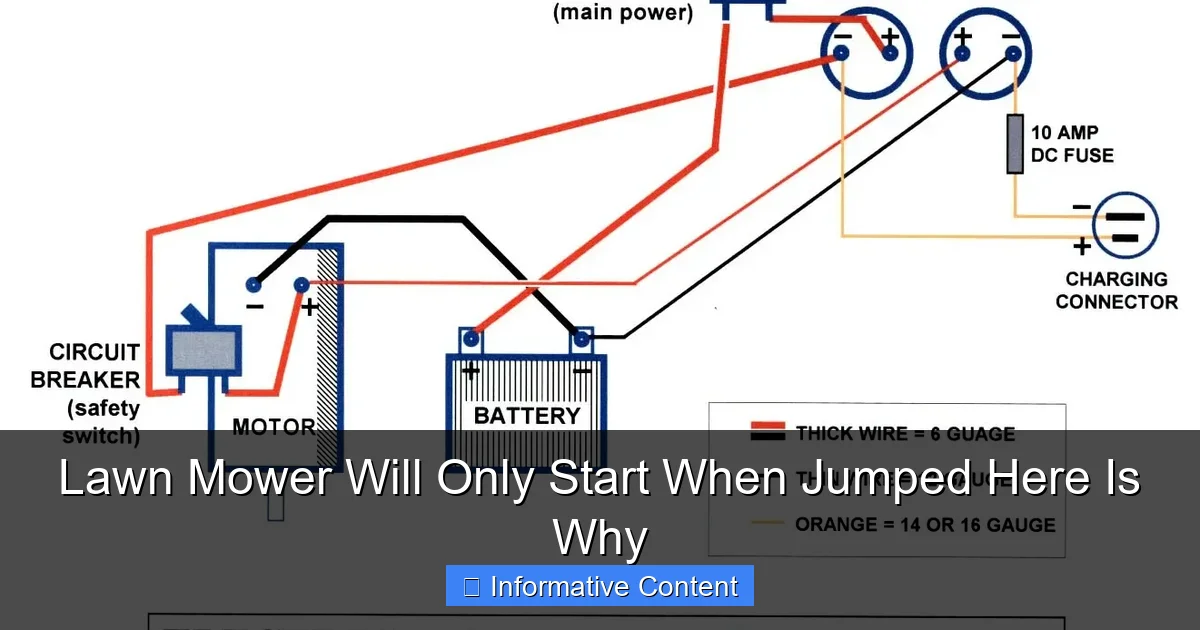
Visual guide about lawn mower will only start when jumped
Image source: i0.wp.com
- Battery provides power to the system.
- Solenoid acts as a switch, connecting the battery to the starter motor.
- Starter motor cranks the engine to life.
- Safety switches (like the seat switch or brake switch) prevent accidental starts.
When you turn the key or pull the recoil, the solenoid should engage, sending current to the starter motor. But if one component fails, the circuit breaks—and the mower won’t start. Jumping the solenoid bypasses the key and safety switches, directly connecting the battery to the starter motor. This is why it works, but it’s also a warning sign that something upstream is failing.
Why Jumping Bypasses the Problem
Jumping the solenoid is like cutting in line at the relay race. Instead of waiting for the key or safety switches to send the signal, you’re directly connecting the battery to the starter motor. This tells you the starter motor and battery are functional—the issue lies elsewhere in the circuit. Common causes include:
- A faulty solenoid.
- A weak or dead battery.
- Malfunctioning safety switches.
- Worn ignition switch.
For example, I once had a mower that would only start when jumped. After testing, I found the solenoid was corroded inside, preventing it from making proper contact. A quick clean and replacement fixed the issue.
Common Causes of a Mower That Only Starts When Jumped
1. Faulty Solenoid
The solenoid is the most common culprit. It’s a small, cylindrical component (usually near the starter motor) with two large terminals and one or two small ones. When the solenoid fails, it won’t close the circuit, preventing current from reaching the starter motor. Signs of a bad solenoid include:
- Clicking sound when you turn the key, but no cranking.
- No sound at all (indicating no power reaching the solenoid).
- Corrosion or burn marks on the terminals.
How to test it: Use a multimeter to check continuity between the large terminals when the key is turned. If there’s no continuity, the solenoid is dead. Replacement is usually straightforward—just match the old solenoid’s specs.
2. Weak or Dead Battery
A weak battery might not provide enough power to activate the solenoid, but enough to crank the motor when jumped. This happens because jumping bypasses the solenoid’s resistance. Signs include:
- Slow cranking even when jumped.
- Dim headlights (if your mower has them).
- Battery voltage below 12.4 volts (measured with a multimeter).
Tip: I once wasted hours troubleshooting a solenoid, only to realize the battery was at 11.8 volts. A quick charge solved the problem.
3. Malfunctioning Safety Switches
Modern mowers have safety switches to prevent accidents. These include:
- Seat switch (requires you to be seated).
- Brake switch (requires the brake to be engaged).
- Blade switch (requires the blade to be disengaged).
If any of these switches fail, the circuit won’t complete. For example, a worn seat switch might not detect your weight, preventing the mower from starting—even if you’re sitting down.
How to test: Bypass the switch temporarily (check your manual for instructions) and see if the mower starts. If it does, the switch is faulty.
4. Worn Ignition Switch
The ignition switch sends the signal to the solenoid. If it’s worn or corroded, it won’t send enough current. Signs include:
- Intermittent starting issues.
- No response when turning the key.
Example: A friend’s mower wouldn’t start unless jumped. We traced it to a corroded ignition switch. A $20 replacement fixed it.
How to Diagnose the Problem Step by Step
Step 1: Check the Battery
Start with the simplest fix. Use a multimeter to test the battery voltage. A healthy battery should read 12.6+ volts when fully charged. If it’s below 12.4 volts:
- Charge the battery for 4-6 hours.
- Retest. If it still won’t hold a charge, replace it.
Pro tip: Clean the battery terminals with a wire brush to remove corrosion. Poor connections can mimic a weak battery.
Step 2: Test the Solenoid
With the battery charged, turn the key to the “start” position and listen for a click near the solenoid. If you don’t hear it:
- Check for power at the small terminal (should have 12V when the key is turned).
- If there’s power but no click, the solenoid is faulty.
- If no power, the issue is upstream (ignition switch, safety switches, etc.).
Example: My mower had a clicking solenoid but wouldn’t start. I found a loose connection at the small terminal. A quick tighten fixed it.
Step 3: Bypass Safety Switches
Safety switches are often the sneakiest culprits. To test them:
- Refer to your mower’s manual to locate the switches.
- Bypass one switch at a time (e.g., disconnect the seat switch connector).
- Attempt to start the mower. If it starts, that switch is faulty.
Caution: Never permanently bypass safety switches. They’re there for your protection.
Step 4: Inspect the Ignition Switch
If the solenoid has power but doesn’t click, the ignition switch might be the issue. Test it with a multimeter for continuity in the “start” position. No continuity? Replace the switch.
Repair and Replacement: When to DIY vs. Call a Pro
DIY Fixes You Can Handle
Most starting issues can be fixed at home with basic tools. Here’s what I’ve successfully repaired:
- Solenoid replacement: $20-$50, takes 15 minutes.
- Battery replacement: $50-$150, 10-minute job.
- Ignition switch: $15-$40, 30-minute install.
- Safety switches: $10-$30 each, 20-minute replacement.
Tools you’ll need: Multimeter, screwdrivers, wrenches, wire brush.
When to Call a Professional
Some issues require specialized knowledge or tools. Consider a pro if:
- The starter motor itself is faulty (rare but possible).
- Wiring is damaged or melted.
- You’ve replaced all components but the problem persists.
Real talk: I once spent $200 on parts trying to fix a mower, only to realize the wiring harness was damaged. A mechanic fixed it for $100.
Prevention and Maintenance: Avoid the Problem Altogether
Regular Battery Care
A healthy battery is the foundation of a reliable starting system. To extend its life:
- Charge it after every use if possible.
- Store it indoors during winter.
- Clean terminals monthly.
Data Table: Battery Maintenance Schedule
| Task | Frequency | Notes |
|---|---|---|
| Check voltage | Monthly | Below 12.4V? Charge it. |
| Clean terminals | Monthly | Use baking soda and water. |
| Store indoors | Winter | Prevents freezing. |
Inspect Safety Switches
Test safety switches annually. For example:
- Sit on the mower and press the brake. Try starting.
- Stand up while holding the brake. The mower should shut off.
Pro tip: If a switch fails, replace it immediately. Don’t rely on jumping the solenoid as a permanent fix.
Keep Connections Clean
Corrosion is the enemy. Inspect all electrical connections (solenoid, battery, ignition) and clean them with a wire brush. Apply dielectric grease to prevent future corrosion.
Conclusion: Don’t Let Your Mower Hold You Hostage
A lawn mower that only starts when jumped isn’t just annoying—it’s a sign of a deeper issue. By understanding the starting system and following a systematic approach, you can diagnose and fix most problems yourself. Whether it’s a $20 solenoid or a $150 battery, the solution is usually simpler than you think.
Remember, regular maintenance is the best way to avoid these headaches. A few minutes of battery care or switch testing each season can save you hours of frustration later. And if you’re ever in doubt, don’t hesitate to consult a professional. Your mower—and your sanity—will thank you.
Next time your mower refuses to start, take a deep breath. Grab your multimeter, follow the steps above, and remember: you’ve got this. Happy mowing!
Frequently Asked Questions
Why does my lawn mower only start when jumped?
If your lawn mower will only start when jumped, it’s likely due to a weak or dead battery, faulty charging system, or corroded connections. These issues prevent the battery from holding a charge, requiring an external power source to start the engine.
Can a bad solenoid cause a lawn mower to only start when jumped?
Yes, a malfunctioning solenoid can prevent the starter from receiving power, making your lawn mower seem like it only starts when jumped. The solenoid acts as a relay for the starter circuit, and if it fails, the mower may not crank without an external boost.
How do I fix a lawn mower that only starts when jumped?
First, check the battery voltage and connections, then test the alternator or stator to ensure it’s charging properly. Cleaning terminals, replacing the battery, or repairing the charging system often resolves the issue when a lawn mower will only start when jumped.
Is a failing alternator why my lawn mower needs a jump?
Absolutely. A failing alternator won’t recharge the battery while the engine runs, causing it to drain over time. This leads to a situation where your lawn mower will only start when jumped because the battery can’t hold a charge.
Why does my lawn mower start with a jump but not on its own?
This typically points to a weak battery or poor electrical connection. Even if the battery appears charged, internal damage or sulfation may prevent it from delivering enough power to start the mower without a jump.
How often should I replace the battery in my lawn mower to avoid jump-starting?
Lawn mower batteries usually last 3–5 years with proper maintenance. If your lawn mower will only start when jumped, inspect the battery age and condition—older batteries often lose their capacity to hold a charge reliably.