
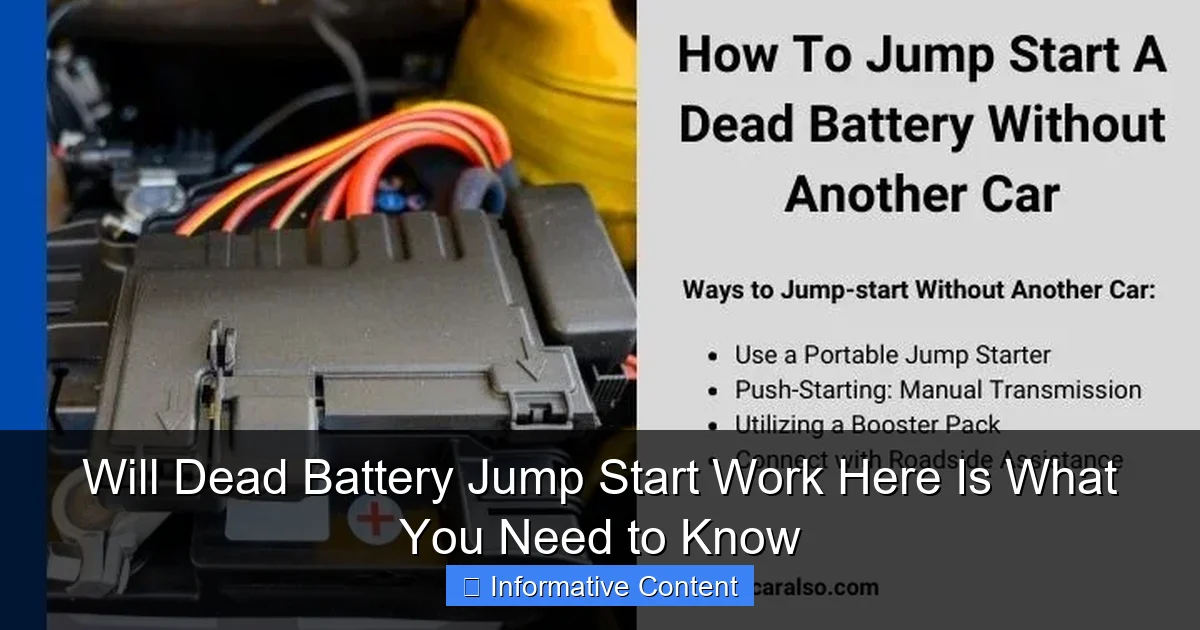
Featured image for will dead battery jump start
Image source: caralso.com
Yes, a dead battery jump start can work—if done correctly and the battery isn’t beyond recovery. Key factors like battery age, underlying electrical issues, and proper jumper cable use determine success, so always check for corrosion, secure connections, and let the donor vehicle run for several minutes. But if the battery is deeply discharged or damaged, a jump may only offer a temporary fix—replacement is the safer long-term solution.
Key Takeaways
- Jump starts work if the battery is truly dead, not damaged.
- Use proper cables and connect terminals in the correct order.
- Run the engine 15–30 minutes post-jump to recharge the battery.
- Repeated jump needs signal a failing battery—replace it soon.
- Check for corrosion or loose connections before attempting a jump.
- Safety first: Wear gloves and goggles to avoid sparks or acid.
📑 Table of Contents
- Understanding Dead Batteries: What Happens When Your Car Won’t Start
- How Jump Starting Works: The Science Behind the Spark
- When a Jump Start Will (and Won’t) Work: Key Scenarios
- How to Jump Start a Dead Battery Safely and Effectively
- Common Jump Start Mistakes (And How to Avoid Them)
- When to Skip the Jump and Call for Help
- Prevention and Maintenance: How to Avoid Dead Batteries
Understanding Dead Batteries: What Happens When Your Car Won’t Start
We’ve all been there—rushing to get to work, the airport, or a family event, and the car just won’t start. The dreaded silence after turning the key, the dim headlights, or that slow, groaning crank. It’s a frustrating moment, and your first thought is probably: Will a dead battery jump start work? You’re not alone. This is one of the most common car troubles drivers face, especially in extreme weather or after leaving the lights on overnight.
The good news is, in many cases, yes—a jump start can get you back on the road. But it’s not always that simple. Not all dead batteries are created equal, and not every jump start will work. Some batteries are beyond revival, while others just need a little boost to get the alternator running again. The key is understanding why the battery died, how a jump start works, and when it’s worth trying versus when it’s time to call for a replacement.
Think of it like giving someone CPR. If the heart is still intact and just needs a jump-start (no pun intended), it might work. But if the heart is completely failed, no amount of compressions will help. The same logic applies to car batteries. In this guide, we’ll walk through everything you need to know about dead battery jump starts—what works, what doesn’t, and how to stay safe while doing it.
How Jump Starting Works: The Science Behind the Spark
What Is a Jump Start?
A jump start is a method of starting a vehicle with a dead or weak battery by connecting it to another power source—usually another vehicle’s battery or a portable jump starter—using jumper cables. The idea is simple: transfer electrical energy from the working battery to the dead one, giving it enough voltage to crank the engine.

Visual guide about will dead battery jump start
Image source: cdn.shopify.com
When you connect the two batteries in parallel (positive to positive, negative to negative), the good battery “donates” its charge. Once the engine starts, the alternator takes over, recharging both batteries and powering the vehicle’s electrical systems. It’s like borrowing a friend’s phone charger when yours dies—except in this case, the alternator is the charger, and the engine is the phone.
Electrical Flow and Voltage Requirements
Most car batteries operate at 12 volts. A battery is considered “dead” when its voltage drops below 12 volts, and a fully charged battery reads around 12.6–12.7 volts when the engine is off. A jump start requires the donor battery to be at or near full charge—ideally above 12.4 volts—to deliver enough current to start the engine.
Here’s a simple rule: if the donor battery is weak, the jump may not work. Think of it like trying to pour water from an almost-empty glass into a dry one. There’s just not enough to make a difference. That’s why it’s important to check the health of both batteries before attempting a jump.
Real-Life Example: The Cold Morning Jump
Imagine it’s 20°F outside. You turn the key, and the engine turns over slowly, then stops. This is classic cold-weather battery failure. Cold reduces a battery’s chemical reaction rate, decreasing its ability to deliver current. A jump start often works here because the battery isn’t truly dead—it’s just “sleepy” from the cold. Once warmed up by the running engine, it can often hold a charge again.
When a Jump Start Will (and Won’t) Work: Key Scenarios
Battery Is Discharged, Not Dead
This is the ideal scenario for a jump start. The battery has lost charge due to:
- Leaving headlights or interior lights on overnight
- Using electronics (radio, phone charger) with the engine off
- Short trips that don’t allow the alternator to fully recharge
- Extreme cold or heat reducing charge retention
In these cases, the battery’s internal structure is still intact. It just needs a boost. A jump start is highly likely to work, and after running the engine for 20–30 minutes, the battery may be recharged enough to start the car again later.
Battery Is Old or Degraded
Batteries have a lifespan—typically 3 to 5 years. As they age, their ability to hold a charge diminishes. If your battery is over 4 years old, even a jump start might only give you a temporary fix. The engine may start, but the battery might not recharge properly or could die again the next day.
Tip: If your car starts after a jump but dies again when you turn it off, the battery is likely too far gone. It might start once, but it won’t hold a charge. Time for a replacement.
Battery Has Internal Damage
Some batteries die from internal failure—like a shorted cell, sulfation, or corrosion. These issues can’t be fixed with a jump. A shorted cell means one of the six cells inside the battery has failed, dropping the overall voltage to 10 volts or less. No amount of jump starting will fix that.
Signs of internal damage:
- Swollen or cracked battery case
- Corrosion around terminals (white or blue crust)
- Smell of rotten eggs (sulfur from leaking acid)
- Consistently low voltage even after charging
If you see any of these, a jump start is unlikely to help long-term. It might start the car once, but the battery will fail again.
Alternator Is the Real Problem
Here’s a twist: sometimes the battery isn’t the issue at all. If the alternator isn’t charging the battery while the engine runs, the battery will drain—even if it’s new. In this case, a jump start might get the car running, but it will die again once the engine stops.
How to test: After a successful jump, let the engine run for 10 minutes. Turn off the engine, wait 10 seconds, then try to start it again. If it starts easily, the battery is likely fine. If it struggles or won’t start, the alternator may not be charging it.
Real-World Example: The “Jump and Run” Trap
Sarah jumped her car and drove 10 minutes to work. She turned it off, and it wouldn’t start again. She jumped it again, drove home, and the same thing happened. After testing, she found the alternator was only putting out 12.2 volts (should be 13.5–14.5). The battery was good, but the alternator was failing. A jump start was just a band-aid.
How to Jump Start a Dead Battery Safely and Effectively
Gather the Right Tools
Before you begin, make sure you have:
- Jumper cables (at least 10 feet long, 4-gauge or thicker)
- A second vehicle with a working battery or a portable jump starter
- Rubber gloves and safety glasses (optional but recommended)
- A flashlight (if working in low light)
Pro tip: Keep a portable jump starter in your trunk. They’re safer, easier to use, and don’t require another car. Many models now come with built-in flashlights, USB ports, and even air compressors.
Step-by-Step Jump Start Guide
- Position the vehicles: Park the working car close to the dead one, but don’t let them touch. Turn off both engines and set the parking brakes.
- Connect the cables in order:
- Red (positive) to the dead battery’s positive terminal
- Red to the working battery’s positive terminal
- Black (negative) to the working battery’s negative terminal
- Black to an unpainted metal surface on the dead car’s engine block (not the battery’s negative terminal—this reduces spark risk)
- Start the working car: Let it run for 2–3 minutes to transfer charge.
- Try to start the dead car: If it doesn’t start, wait another 2–3 minutes and try again. Don’t crank for more than 10 seconds at a time.
- Disconnect in reverse order: Remove the black from the engine block, then the black from the good battery, then the reds. Never let the clamps touch each other or any metal while connected.
Warning: Sparks can happen. Always connect in the correct order and avoid flammable materials. If you see smoke or smell something burning, disconnect immediately.
Using a Portable Jump Starter
Portable jump starters (also called jump boxes) are becoming more popular—and for good reason. They’re compact, easy to use, and don’t require another vehicle. Here’s how:
- Charge the jump starter fully before use (most take 3–5 hours)
- Connect the red clamp to the dead battery’s positive terminal
- Connect the black clamp to an unpainted metal surface
- Turn on the jump starter and try to start the car
- Disconnect once the engine is running
Tip: Test your jump starter every 3–6 months. Even if you don’t use it, batteries degrade over time.
Common Jump Start Mistakes (And How to Avoid Them)
Crossing the Cables
This is the #1 mistake. Connecting positive to negative can cause sparks, damage electronics, or even blow the battery. Always follow the color codes: red to positive (+), black to negative (–) or ground.
Connecting to the Wrong Ground
Connecting the final black clamp to the dead battery’s negative terminal increases the risk of hydrogen gas ignition (batteries emit small amounts of gas). Instead, attach it to a clean, unpainted metal part of the engine or frame—this acts as a ground and reduces risk.
Letting the Engine Run Too Long After a Jump
Once the car starts, let it run for 20–30 minutes to recharge the battery. But don’t leave it idling for hours. Overcharging can damage the battery and alternator. If you’re not driving, turn off non-essential electronics (AC, radio, lights).
Jumping a Frozen Battery
Never jump start a frozen battery. If the battery case is bulging or cracked, it may be frozen. Jumping it can cause it to explode. Let the battery thaw in a warm place first—or replace it.
Ignoring Safety Gear
Even though jump starting is generally safe, accidents happen. Wear gloves and glasses to protect against acid or sparks. Keep kids and pets away from the work area.
Real-Life Example: The Exploded Battery
Mike jumped his car in a hurry. He connected the final black clamp to the negative terminal of the dead battery. There was a loud pop, and acid sprayed everywhere. The battery had a hairline crack and was leaking hydrogen. The spark ignited the gas. No one was hurt, but the battery was ruined. Always use a ground point—not the terminal.
When to Skip the Jump and Call for Help
Battery Is Swollen or Leaking
If the battery case looks bloated or there’s fluid leaking, do not attempt a jump. This indicates internal damage or overcharging. The battery could rupture or explode. Replace it immediately.
No Access to a Second Vehicle or Jump Starter
Not everyone has a friend with a car nearby. If you’re in a remote area or don’t own jumper cables, calling roadside assistance is the safest option. Many auto clubs (like AAA) offer free jump start services.
Multiple Failed Jump Attempts
If you’ve tried jumping the car 3–4 times and it still won’t start, the battery may be too far gone—or there’s another issue (bad starter, fuel pump, etc.). Continuing to try can damage the starter motor or drain the donor battery.
Electrical System Warning Lights
If the battery light, check engine light, or alternator light stays on after a jump, there’s likely a deeper problem. The battery might charge, but the system isn’t working properly. Get it checked by a mechanic.
Data Table: Jump Start Success Rates by Battery Condition
| Battery Condition | Jump Start Success Rate | Likelihood of Recharge | Recommended Action |
|---|---|---|---|
| Discharged (lights left on) | 90–95% | High | Jump and drive 20+ minutes |
| Cold weather (below freezing) | 70–80% | Moderate | Jump and warm up engine |
| Old battery (4+ years) | 50–60% | Low | Jump but plan for replacement |
| Shorted or sulfated cell | 10–20% | Very low | Replace battery |
| Alternator failure | 60–70% (temporary) | None | Jump but fix alternator |
Prevention and Maintenance: How to Avoid Dead Batteries
Regular Battery Checks
Check your battery voltage every 3–6 months with a multimeter. A healthy battery should read 12.6+ volts when the engine is off. Below 12.4 volts? Time for a charge or replacement.
Clean the Terminals
Corrosion on battery terminals can prevent proper charging. Clean them with a mix of baking soda and water, then apply anti-corrosion spray or grease.
Drive Regularly
Short trips (under 10 minutes) don’t give the alternator enough time to recharge the battery. Take longer drives weekly, or use a battery maintainer if the car sits for weeks.
Turn Off Electronics
Always double-check that lights, radio, and phone chargers are off before exiting the car. Use a reminder app or checklist if needed.
Use a Battery Maintainer
If you have a classic car, motorcycle, or RV that sits for long periods, a smart battery maintainer keeps the battery charged without overcharging.
At the end of the day, a dead battery jump start can be a lifesaver—but only if used wisely. It’s not a cure-all. Knowing when it will work, how to do it safely, and when to walk away is what separates a quick fix from a costly mistake. Keep your cables or jump starter handy, stay informed, and your car will thank you the next time that engine won’t turn over. After all, a little knowledge goes a long way—especially when you’re standing in the cold, staring at a silent dashboard.
Frequently Asked Questions
Can a completely dead battery be jump started?
Yes, a jump start can often revive a dead battery if the issue is solely from discharge. However, if the battery is damaged or sulfated, the jump may not work, and replacement might be necessary.
How long should I let my car run after a jump start to recharge the battery?
Let your car run for at least 20-30 minutes after a jump start to allow the alternator to recharge the battery. For a full recharge, consider driving for an hour or longer, especially on the highway.
Is it safe to jump start a dead battery in the rain?
Yes, it’s generally safe to jump start a dead battery in the rain, as long as you avoid puddles and keep the jumper cables’ clamps from touching. Modern vehicles are designed to handle minor water exposure during jump starts.
Will a jump start damage my car’s electronics?
Properly performed, a jump start won’t damage your car’s electronics. Always follow the correct sequence (positive first, then negative) and avoid letting the clamps touch to prevent surges.
Can I jump start a dead battery without another car?
Yes, using a portable jump starter (jump box) is a reliable way to jump start a dead battery without another vehicle. Ensure the jump box is charged and rated for your car’s engine size.
Why won’t my car start even after a jump?
If your car won’t start after a jump, the battery may be too degraded, or there could be an issue with the alternator, starter, or electrical system. Have a mechanic diagnose the problem.