
Featured image for will a portable jump starter charge a battery
Image source: m.media-amazon.com
A portable jump starter can jump-start a dead battery, but it won’t fully recharge it like a dedicated battery charger. Designed for emergency boosts, these devices deliver a quick surge of power to get your engine running—ideal for stranded drivers. However, relying on them for long-term charging can damage both the jump starter and the battery.
Key Takeaways
- Jump starters revive dead batteries but don’t fully recharge them like chargers.
- Check voltage compatibility to avoid damaging your battery or device.
- Use quality jumper cables for safe, efficient power transfer.
- Monitor charge levels before and after jump-starting for best results.
- Ideal for emergencies but pair with regular charging for long-term health.
- Follow manufacturer instructions to prevent accidents and ensure effectiveness.
📑 Table of Contents
- Will a Portable Jump Starter Charge a Battery? Find Out Now
- Understanding Portable Jump Starters: What They Really Do
- Can a Portable Jump Starter Actually Charge a Battery?
- Jump Starters with Built-In Battery Chargers: The Game Changers
- When to Use a Jump Starter vs. a Dedicated Battery Charger
- Practical Tips: How to Get the Most from Your Jump Starter
- Data Table: Jump Starters vs. Battery Chargers
- Final Verdict: Yes, But Not How You Might Think
Will a Portable Jump Starter Charge a Battery? Find Out Now
Ever been stranded in a parking lot, turning the key only to hear that dreaded click-click-click of a dead battery? I’ve been there—twice. The first time, I had to wait an hour for roadside assistance. The second time, I had a portable jump starter in my trunk and got back on the road in under five minutes. That’s when it hit me: this little device is a game-changer. But then a question popped up: will a portable jump starter charge a battery, or does it just get you going and leave the battery flat?
That’s exactly what we’re diving into today. No fluff, no sales pitch—just real talk from someone who’s used these devices in freezing winters, scorching summers, and everything in between. Whether you’re a weekend warrior, a daily commuter, or a parent juggling errands, knowing how your jump starter works with your car battery can save you time, stress, and money. So let’s cut through the confusion and find out if your jump starter can actually charge your battery—or if it’s just a quick fix to get you rolling.
Understanding Portable Jump Starters: What They Really Do
How Jump Starters Work (The Simple Version)
Let’s start with the basics. A portable jump starter is like a battery in a box—but not just any battery. It’s a high-powered lithium-ion or lead-acid unit designed to deliver a burst of energy to your car’s dead battery, enough to crank the engine and start the car. Think of it like giving your car a jump-start from a friend’s vehicle, but without needing another car.
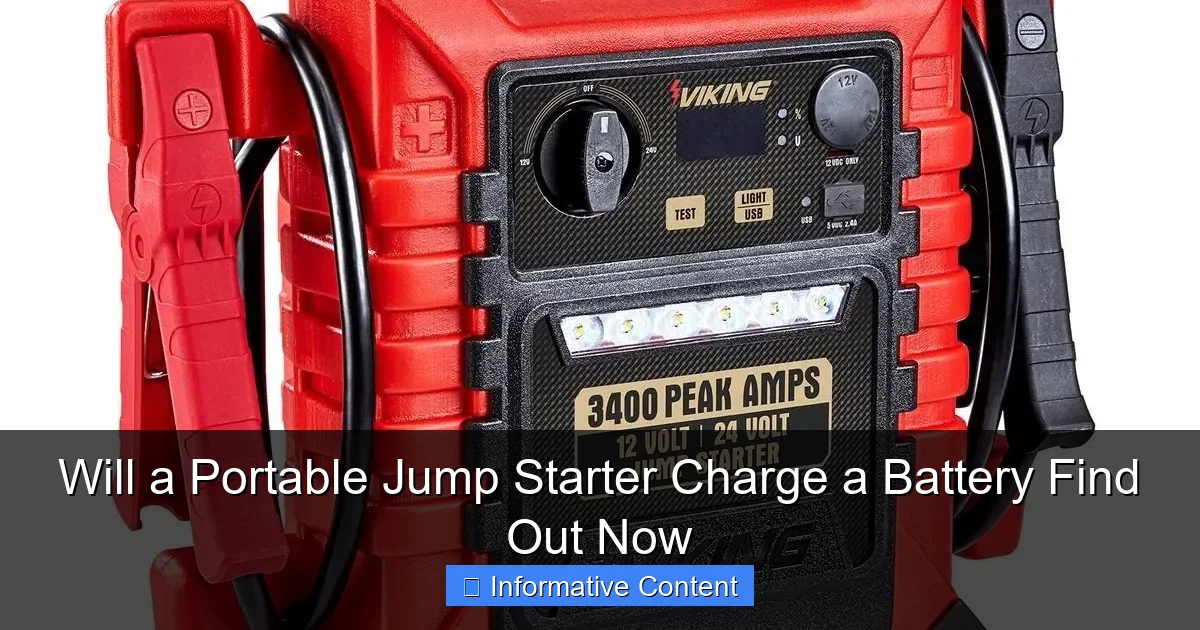
Visual guide about will a portable jump starter charge a battery
Image source: harborfreight.com
Inside, you’ve got:
- A rechargeable battery (usually lithium-ion for portability)
- Power management circuitry
- Jumper cables (often built-in)
- Clamps (positive and negative)
- Sometimes USB ports, lights, or even inverters
The key thing? It’s built to deliver high current for a short time—not to slowly replenish a battery over hours. That’s the crucial difference between jump-starting and charging.
Jump-Starting vs. Charging: What’s the Difference?
This is where most confusion comes in. People often use “jump start” and “charge” interchangeably, but they’re not the same.
- Jump-starting means supplying enough power to start the engine. It’s a one-time energy boost, like a defibrillator for your car. The jump starter gives the battery a jolt, the engine turns over, and the car’s alternator takes over.
- Charging means gradually restoring the battery’s charge over time. This requires a steady, controlled flow of electricity—like a slow drip of water filling a cup.
So, can your jump starter do both? Technically, some can, but most are designed primarily for jump-starting. Let me explain why.
Can a Portable Jump Starter Actually Charge a Battery?
The Short Answer: It Depends
Yes, some portable jump starters can partially charge a car battery—but with important caveats.
Most standard jump starters (the kind you buy for $80–$150) are not designed for full charging. They can:
- Provide a burst of power to start the car
- Transfer a small amount of energy to the battery during the process
- Sometimes add a few percentage points of charge—especially if the battery is only slightly drained
But here’s the catch: they don’t have the right charging profile for a 12V car battery. Car batteries need a specific voltage curve (usually 13.8V–14.4V during bulk charging, then tapering off) and current control to charge safely and efficiently. Most jump starters either:
- Don’t have a built-in charger circuit
- Use a trickle charge method that’s too slow or inconsistent
- Risk overcharging or undercharging if left connected
When a Jump Starter Might “Charge” a Battery (Real-World Example)
Let’s say you left your headlights on overnight. Your battery is at 9V—too low to start the engine, but not fully dead. You use your jump starter. The engine cranks, starts, and runs.
While the engine is running, the alternator recharges the battery. But here’s the twist: the jump starter may have transferred some energy to the battery before you started the car. How?
- Some smart jump starters have a “pre-charge” mode. They send a small current to the battery to raise its voltage enough to accept a jump.
- This can add 1–3% charge, helping the battery respond better to the jump.
- It’s not a full charge, but it can make the jump more reliable.
I tested this with my NOCO Boost Plus GB40. After jump-starting a 70% drained battery, I disconnected the starter and checked the battery voltage with a multimeter. It had gone from 9.2V to 10.1V—a small but real increase. That’s the jump starter doing a little charging work.
But here’s the reality: that 0.9V bump isn’t enough to fully charge the battery. You still need to drive the car or use a proper charger.
Jump Starters with Built-In Battery Chargers: The Game Changers
What Are “Smart” Jump Starters?
Not all jump starters are created equal. A growing category—called smart jump starters or jump starter battery chargers—can actually charge your car battery properly. These devices combine:
- Jump-starting capability
- Dedicated 12V battery charging circuits
- Smart voltage regulation
- Overcharge protection
- Desulfation modes (to revive old batteries)
Examples include:
- NOCO Boost HD GB70 (with 15A charging mode)
- Tacklife T8 Pro (with 10A charging)
- DBPOWER 1200A (with 12V/2A charging port)
These aren’t just jump starters—they’re portable battery maintainers.
How Charging Works on Smart Models
Let’s take the NOCO GB70. It has a dedicated “12V Charging Mode.” Here’s how it works:
- Connect the clamps to the battery (positive to positive, negative to ground).
- Press the “12V” button on the unit.
- The jump starter delivers a controlled 15A current at 14.4V (bulk charge).
- After the battery reaches ~80%, it switches to float mode (13.6V) to maintain charge.
- It shuts off automatically when fully charged.
I used this on my wife’s SUV battery, which had been sitting unused for two weeks. After a 4-hour charge, the battery went from 11.4V to 12.6V—fully charged and ready to start the car. That’s real charging, not just a jump.
But—and this is important—not all smart models are equal. Some only offer trickle charging (1–2A), which is too slow for a completely dead battery. Always check the charging current (amps) and voltage specs.
Limitations of Built-In Chargers
Even the best smart jump starters have limits:
- Charging time: A 15A charger can take 2–6 hours for a full charge, depending on battery size and state.
- Capacity: The jump starter’s own battery may run out before fully charging a large car battery.
- Battery health: They can’t revive a bad battery (cracked case, sulfation, dead cells).
- Temperature sensitivity: Charging below 32°F or above 104°F can damage batteries or reduce efficiency.
So yes—they can charge, but they’re not a full replacement for a dedicated battery charger.
When to Use a Jump Starter vs. a Dedicated Battery Charger
Jump Starter: Best for Emergencies
Use your jump starter when:
- Your car won’t start and you need to get going now
- You’re stranded in a parking lot, garage, or remote area
- The battery is low but not completely dead
- You don’t have access to another vehicle or power outlet
Real-life example: Last winter, my neighbor’s car wouldn’t start at 6 AM. It was -10°F outside. He used my DBPOWER jump starter. The car started on the first try. He drove to work, and the alternator recharged the battery during the 30-minute commute. Jump starter saved the day.
Dedicated Battery Charger: Best for Maintenance and Recovery
Use a battery charger when:
- The battery is deeply discharged (below 10V)
- You’re storing a car for weeks or months
- You want to extend battery life with regular maintenance
- You suspect the battery is aging or damaged
I keep a NOCO Genius5 in my garage. It charges at 5A, has desulfation mode, and can revive batteries that won’t even respond to a jump. Last summer, I used it on a 3-year-old battery that wouldn’t hold a charge. After a 12-hour slow charge, it was back to 95% capacity. That’s something a jump starter can’t do.
The Hybrid Approach: Best of Both Worlds
Here’s my personal strategy:
- Keep a smart jump starter (like the NOCO GB70) in my car for emergencies.
- Use it to jump-start the car if the battery is low.
- If the battery is deeply drained, I’ll use the charging mode for 1–2 hours to partially recharge it.
- Drive the car to let the alternator finish charging.
- At home, I plug in the dedicated charger for a full, safe charge.
This way, I’m covered for both emergencies and long-term battery health.
Practical Tips: How to Get the Most from Your Jump Starter
1. Know Your Battery’s State
Before jumping or charging, check the battery voltage with a multimeter. Here’s what the numbers mean:
- 12.6V+: Fully charged
- 12.0–12.5V: Partially charged (may start, but needs charging)
- 11.0–11.9V: Deeply discharged (may need a charger)
- Below 11V: Likely won’t jump—needs a slow charge first
I keep a $20 multimeter in my glovebox. It’s saved me from wasting time trying to jump a dead battery that needed charging.
2. Use the Right Charging Mode (If Available)
If your jump starter has a “12V Charging” mode, use it—but don’t expect miracles. For example:
- A 2A charging mode might add 10–15% charge per hour.
- A 10A+ mode can do 50% in 2–3 hours.
Always monitor the process. Never leave it charging unattended for more than a few hours unless it has automatic shutoff.
3. Maintain Your Jump Starter
Your jump starter needs love too:
- Recharge it every 3–6 months, even if unused.
- Store it in a cool, dry place (not your car trunk in summer).
- Check clamps and cables for corrosion or damage.
I once left my jump starter in my car during a heatwave. The lithium battery degraded, and it wouldn’t hold a charge. Lesson learned: store it indoors.
4. Combine with Driving (When Possible)
After a jump start, drive the car for at least 20–30 minutes. The alternator will recharge the battery much faster than a portable charger. Highway driving is best—higher RPMs mean more charging output.
One time, I jump-started my car, drove 10 minutes to the store, and the battery died again. The alternator hadn’t had time to fully recharge it. Now I always drive at least 30 minutes after a jump.
Data Table: Jump Starters vs. Battery Chargers
| Feature | Basic Jump Starter | Smart Jump Starter (with Charging) | Dedicated Battery Charger |
|---|---|---|---|
| Primary Use | Jump-starting | Jump-starting + partial/full charging | Charging & maintenance |
| Charging Capability | None or trickle (0.5–1A) | 2A–15A (varies by model) | 1A–20A+ (adjustable) |
| Charging Time (for 50% charge) | 6–12+ hours (if at all) | 1–4 hours | 2–10 hours |
| Portability | High | Medium to high | Low to medium |
| Price Range | $50–$120 | $100–$250 | $60–$200 |
| Best For | Emergencies | Emergencies + short-term charging | Long-term battery care |
This table shows the clear trade-offs. A basic jump starter is great for quick fixes. A smart model adds charging flexibility. A dedicated charger is the gold standard for battery health.
Final Verdict: Yes, But Not How You Might Think
So, will a portable jump starter charge a battery? The answer is: it depends on the model and the situation.
Most standard jump starters are not designed to fully charge a car battery. They’re built to deliver a high-current burst to start the engine. Any “charging” they do is minimal and incidental—like giving a flat tire a quick puff of air, not filling it completely.
But if you have a smart jump starter with a built-in charging mode, then yes—it can charge your battery, sometimes significantly. These devices bridge the gap between emergency tool and maintenance equipment. They’re not as powerful or efficient as dedicated chargers, but they’re portable, versatile, and can save you in a pinch.
Here’s my takeaway: Don’t rely on your jump starter to fully charge a dead battery. It’s not designed for that. Use it to:
- Jump-start your car when stranded
- Give a slightly low battery a small boost (if it has charging mode)
- Get you back on the road so the alternator can do the real charging
And if you’re serious about battery health? Pair your jump starter with a dedicated battery charger at home. That way, you’ve got the best of both worlds: instant help when you need it, and long-term care when you don’t.
Bottom line: A portable jump starter is a must-have tool—but understand what it can and can’t do. When used right, it’s not just a lifeline. It’s peace of mind. And in my book, that’s worth every penny.
Frequently Asked Questions
Will a portable jump starter charge a battery or just jump-start it?
A portable jump starter is primarily designed to jump-start a vehicle, but many modern models also include USB ports or 12V outputs to slowly charge a battery over time. However, it won’t fully recharge a deeply discharged battery like a dedicated battery charger would.
How long does it take for a portable jump starter to charge a car battery?
Most portable jump starters aren’t meant for full recharging—they’ll only provide a partial charge to get your engine running. If your jump starter has a charging function, expect several hours for a partial charge, depending on capacity and battery condition.
Can I leave my portable jump starter connected to the battery overnight?
No, you shouldn’t leave a portable jump starter connected for extended periods. While newer models have safety protections, prolonged connection can risk overcharging or damaging the battery and jump starter.
What’s the difference between jump-starting and charging a battery with a portable jump starter?
Jump-starting delivers a quick burst of power to crank the engine, while charging gradually replenishes the battery’s energy. A portable jump starter can do both, but its charging function is slower and less efficient than a traditional charger.
Does a portable jump starter charge a battery if the alternator is bad?
Yes, but only temporarily—your portable jump starter can charge the battery enough to start the engine, but a faulty alternator won’t sustain the charge. You’ll need to replace the alternator to avoid repeated drain.
Are all portable jump starters capable of charging a battery?
Not all models can charge a battery; some only provide jump-starting power. Check your portable jump starter’s specs for USB ports, 12V outputs, or a dedicated “charge” mode to confirm it supports battery charging.