
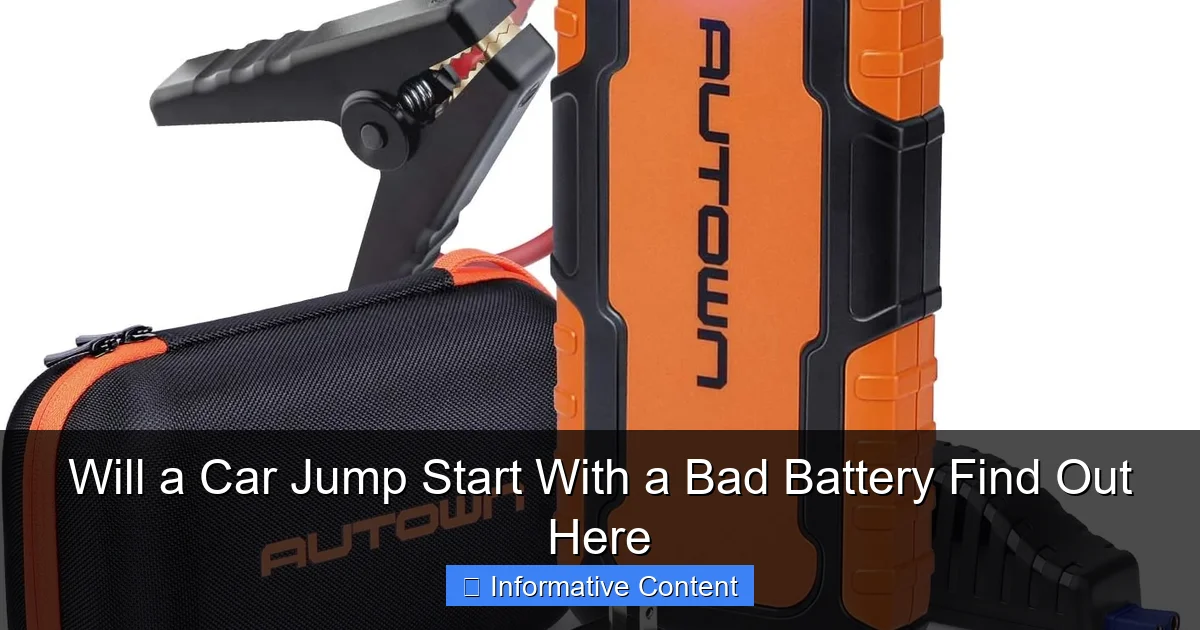
Featured image for will a car jump start with a bad battery
Image source: images-na.ssl-images-amazon.com
A car with a bad battery may still jump start, but success depends on the extent of the damage. If the battery is completely dead or has internal failure, a jump start likely won’t work—even if the engine cranks, underlying issues like sulfation or cell damage can prevent proper charging. Always test the battery after a jump to avoid repeated breakdowns.
Key Takeaways
- Jump-starting may fail if the battery is completely dead or damaged.
- Check battery voltage first—below 12V often means replacement is needed.
- Corrosion or loose terminals can prevent a successful jump—clean and tighten them.
- Jump-start temporarily works for weak batteries but doesn’t fix underlying issues.
- Repeated jump-starts signal a failing battery—test and replace it promptly.
- Use proper cables and follow safety steps to avoid damage or injury.
📑 Table of Contents
- Will a Car Jump Start With a Bad Battery? Find Out Here
- Understanding Your Car Battery: The Heart of the System
- Can You Jump-Start a Car With a Bad Battery? The Real Answer
- How to Jump-Start a Car Safely (Step-by-Step)
- When a Jump Start Won’t Help (And What to Do Instead)
- Battery Maintenance Tips: Preventing Future Failures
- Data Table: Battery Health Indicators
- Final Thoughts: Jump-Start Smart, Stay Safe
Will a Car Jump Start With a Bad Battery? Find Out Here
Picture this: You’re running late for work, the morning coffee hasn’t kicked in yet, and you slide into the driver’s seat, turn the key, and… nothing. Not even a click. Just silence. Your heart sinks. You’ve heard about jump-starting a car, but now you’re wondering: will a car jump start with a bad battery? It’s a question we’ve all asked at some point, especially when the car won’t start and the battery is the prime suspect.
Let’s be honest—car troubles are stressful. Whether you’re stranded in a parking lot or just trying to get to an appointment, a dead battery can throw a wrench into your day. But here’s the good news: in many cases, a car with a bad battery can still be jump-started. The key is understanding what “bad” means, why the battery failed, and whether a jump is a temporary fix or a sign of a bigger issue. In this guide, I’ll walk you through everything you need to know—from how jump-starting works to when you should just bite the bullet and replace the battery. Think of it as a friendly chat between two car owners who’ve both been there, done that, and learned the hard way (so you don’t have to).
Understanding Your Car Battery: The Heart of the System
What Does a Car Battery Actually Do?
Before we dive into jump-starting, let’s talk about the battery itself. It’s not just a power source for the starter motor—it’s the heart of your car’s electrical system. When you turn the key, the battery sends a surge of power to the starter, which cranks the engine. It also powers your lights, radio, climate control, and onboard computers—even when the engine is off.
Think of it like this: the alternator (which we’ll cover later) is the “long-term energy provider,” but the battery is the “emergency power pack.” Without it, your car can’t start. But here’s the catch: a battery doesn’t have to be completely dead to cause problems. A weak battery—one that’s lost capacity due to age, cold weather, or frequent short trips—might not deliver enough power to start the engine, even if it shows a charge on a multimeter.
Signs Your Battery Might Be “Bad”
- Slow cranking: The engine turns over slowly, like it’s struggling.
- Clicking sound: You hear a rapid clicking when turning the key, but no crank.
- Dim lights: Headlights or interior lights are noticeably dimmer.
- Electrical issues: Radio resets, windows move slowly, or warning lights flicker.
- Swollen battery case: A bulging battery is a red flag—it’s likely overcharged or damaged.
I once had a car where the battery looked fine, but it would die after sitting overnight. A load test revealed it was only holding 30% of its capacity. That’s when I learned: a battery can be “bad” even if it’s not completely dead. So, will a car jump start with a bad battery? It depends on the type of “bad” and the root cause.
Can You Jump-Start a Car With a Bad Battery? The Real Answer
Yes, But With Conditions
The short answer: yes, you can often jump-start a car with a bad battery—but it’s not a guaranteed fix. Here’s why:
- If the battery is weak but still functional: A jump provides the extra power needed to start the engine. Once running, the alternator takes over and keeps the battery charged (assuming it’s working).
- If the battery is completely dead (sulfated or internally damaged): A jump might work once, but the battery won’t hold a charge. The car may stall as soon as you turn off the engine.
- If the issue isn’t the battery: A jump won’t help if the problem is the starter, alternator, or wiring.
Let me share a personal example. Last winter, my old Honda Civic wouldn’t start. The battery was three years old, and it was -10°C outside. I jumped it, and the engine fired up. But when I turned it off, it wouldn’t restart. The battery was toast—it couldn’t hold a charge in the cold. The jump was a temporary lifeline, not a solution.
Why Jump-Starting Works (and When It Won’t)
Jump-starting works because it bypasses the weak battery temporarily. The donor car’s battery (or a portable jump starter) supplies the high current needed to crank the engine. Once the engine is running, the alternator generates electricity and powers the car’s systems—including recharging the battery (if it’s still capable of holding a charge).
But here’s the catch: if the battery is internally damaged—say, from deep discharge, corrosion, or a shorted cell—it won’t recharge properly. The alternator can’t fix a broken battery. In fact, trying to charge a bad battery can be dangerous. I once had a friend who jump-started a car, drove 20 minutes, and then the battery started smoking under the hood. Scary stuff.
So, will a car jump start with a bad battery? It can, but only if the battery is still capable of accepting a charge. If it’s beyond repair, the jump is just delaying the inevitable.
How to Jump-Start a Car Safely (Step-by-Step)
Gather Your Tools
Before you start, make sure you have:
- Jumper cables (at least 10 feet long, 4-6 gauge)
- A working donor car (or a portable jump starter)
- Rubber gloves (optional, but recommended)
- Safety glasses (for extra protection)
Pro tip: Keep a set of jumper cables in your trunk. I learned this the hard way after getting stranded at 7 a.m. with no cables and no cell service. Now, my emergency kit includes cables, a flashlight, and a portable jump starter.
The Right Way to Connect the Cables
Follow these steps exactly to avoid sparks, short circuits, or damage to the electrical systems:
- Park the donor car close (but not touching): Turn off both engines and set the parking brakes.
- Connect the red (positive) clamp to the dead battery’s positive terminal (+).
- Connect the other red clamp to the donor battery’s positive terminal (+).
- Connect the black (negative) clamp to the donor battery’s negative terminal (-).
- Connect the other black clamp to an unpainted metal surface on the dead car (e.g., a bolt or bracket). Never connect it directly to the dead battery’s negative terminal—this can cause sparks and ignite hydrogen gas.
- Start the donor car and let it run for 2–3 minutes. This charges the dead battery slightly.
- Try starting the dead car. If it doesn’t start, wait another minute and try again.
- Once the car starts, let it run for at least 10–15 minutes. This allows the alternator to recharge the battery.
- Disconnect the cables in reverse order: Remove the black clamp from the dead car first, then the black from the donor, then the reds. Keep the clamps from touching each other or metal.
Warning: If you see sparks, smoke, or a strange smell, disconnect immediately. Safety first!
What to Do After a Jump Start
Don’t just drive off and assume everything’s fine. A jump is a temporary fix. Here’s what to do next:
- Drive for at least 20–30 minutes. This gives the alternator time to recharge the battery.
- Test the battery with a multimeter. A healthy battery should read 12.6 volts when the car is off and 13.8–14.4 volts when running.
- Get a load test. Auto parts stores like AutoZone or O’Reilly often do this for free.
- Replace the battery if needed. If it fails the test, don’t wait—replace it soon.
When a Jump Start Won’t Help (And What to Do Instead)
Beyond the Battery: Other Common Culprits
Sometimes, the battery isn’t the real problem. Here are other issues that won’t be fixed by a jump:
- Bad starter motor: If you hear a single click (or no sound at all), the starter might be dead. A jump won’t help—you’ll need a mechanic.
- Faulty alternator: If the battery keeps dying even after a jump, the alternator might not be charging it. This is dangerous—your car could stall while driving.
- Loose or corroded connections: Check the battery terminals. If they’re corroded (white or green crust), clean them with a wire brush and try starting again.
- Parasitic drain: Something is drawing power when the car is off (e.g., a glovebox light, aftermarket radio). A mechanic can diagnose this with a multimeter.
I once had a car that kept dying after a jump. I replaced the battery, but the problem persisted. Turns out, the alternator was only putting out 12 volts (should be 13.8–14.4). The battery was fine—it just wasn’t getting charged. Replacing the alternator fixed it.
When to Call for Help
If you’ve tried jumping the car and:
- The engine cranks but doesn’t start,
- The car starts but stalls immediately,
- You see warning lights (e.g., battery or check engine),
- The battery keeps dying after multiple jumps,
…it’s time to call a mechanic or roadside assistance. Don’t keep driving—you could be risking a breakdown or electrical fire.
Battery Maintenance Tips: Preventing Future Failures
Extend Your Battery’s Life
A car battery typically lasts 3–5 years. But with good care, you can push it to 6 or even 7 years. Here’s how:
- Keep terminals clean: Clean corrosion with a baking soda and water solution. Dry thoroughly.
- Drive regularly: Short trips don’t give the alternator time to fully recharge the battery. Take a 20-minute highway drive once a week.
- Turn off accessories when parked: Lights, radio, and phone chargers drain the battery.
- Check the battery case: Look for cracks, leaks, or bulging. These are signs of failure.
- Use a battery maintainer: If you store your car for weeks, use a trickle charger to keep the battery topped up.
Winter Care: Cold Weather Kills Batteries
Cold weather is a battery’s worst enemy. At -18°C (0°F), a battery can lose up to 60% of its power. Here’s what to do:
- Park in a garage: Even a unheated garage is better than outside.
- Use a battery blanket: These keep the battery warm and improve starting power.
- Turn off everything before exiting: Lights and heaters drain the battery faster in cold weather.
Pro tip: I keep a portable jump starter in my car during winter. It’s saved me more than once when the battery couldn’t handle the cold.
Data Table: Battery Health Indicators
| Condition | Voltage (Engine Off) | Voltage (Engine Running) | Action Needed |
|---|---|---|---|
| Healthy | 12.6V | 13.8–14.4V | None |
| Weak (needs charge) | 12.0–12.5V | 13.8–14.4V | Charge or jump-start |
| Bad (won’t hold charge) | Below 12.0V | Below 13.5V | Replace battery |
| Alternator issue | 12.6V | Below 13.5V | Check alternator |
Use this table to diagnose your battery. A multimeter is your best friend here. You can pick one up for under $20 at any hardware store.
Final Thoughts: Jump-Start Smart, Stay Safe
So, will a car jump start with a bad battery? The answer is: sometimes. A jump can save the day if the battery is weak but still functional. But if it’s truly dead—damaged, sulfated, or beyond repair—the jump is just a temporary fix. The real solution is to test the battery, identify the root cause, and take action.
Remember: jump-starting is a skill every driver should know, but it’s not a cure-all. Treat it as a stopgap, not a long-term solution. And above all, prioritize safety. A little prevention—like regular battery checks and winter care—can save you from being stranded in the first place.
Next time your car won’t start, don’t panic. Grab your jumper cables, follow the steps, and get moving. But don’t forget to test that battery soon. Your future self will thank you.
Frequently Asked Questions
Will a car jump start with a bad battery?
A car with a bad battery may jump start if the issue is a temporary voltage drop (e.g., from leaving lights on). However, if the battery is old, damaged, or unable to hold a charge, a jump start likely won’t work long-term.
How do I know if my battery is too bad to jump start?
Signs of a severely bad battery include no response after jump attempts, visible corrosion, or a battery older than 3–5 years. A mechanic can test the battery’s health to confirm if replacement is needed.
Can a jump start damage a car with a bad battery?
Jump starting is generally safe, but repeated attempts on a severely damaged battery (e.g., cracked case or leaking acid) can cause electrical issues or safety risks. Always inspect the battery first.
Why does my car stall after a jump start with a bad battery?
If the battery can’t hold a charge, the alternator may struggle to power the vehicle alone, causing stalling. This confirms the battery needs replacement to restore proper charging system function.
How long should I drive after a jump start to recharge a bad battery?
Driving for 20–30 minutes at highway speeds can help recharge a weak battery, but a “bad battery” (unable to hold a charge) won’t improve significantly. A battery test or replacement is the real solution.
What’s the difference between a dead battery and a bad battery?
A dead battery has no charge (often fixable with a jump), while a bad battery is physically degraded (sulfation, internal damage) and won’t hold a charge even after recharging. The keyword “bad battery” often refers to this irreversible condition.