
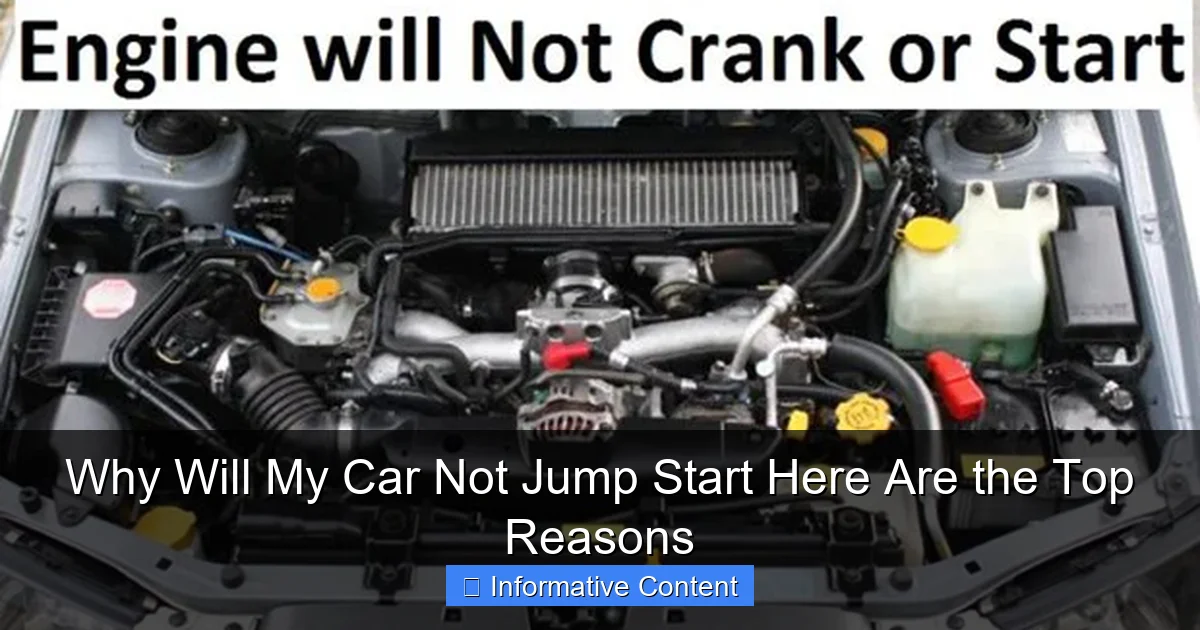
Featured image for why will my car not jump start
Image source: myvehicle.ie
A dead or faulty battery is the most common reason your car won’t jump start, even when connected to another vehicle or a portable jump starter. Corroded terminals, loose connections, or a failing alternator can also prevent proper power flow, making jump-starting ineffective despite apparent effort.
Key Takeaways
- Check battery connections: Clean and tighten corroded or loose terminals before jump-starting.
- Test the battery: A dead or weak battery may need replacement, not just a jump.
- Inspect alternator: A faulty alternator won’t charge the battery while driving.
- Verify jump leads: Faulty cables or incorrect polarity can prevent a successful jump.
- Look for parasitic drain: Hidden electrical drains can kill a battery overnight.
- Assess starter motor: A failing starter may need professional repair, not a jump.
📑 Table of Contents
- Why Will My Car Not Jump Start Here Are the Top Reasons
- 1. The Battery Is Beyond Recovery
- 2. Poor or Incorrect Jumper Cable Connection
- 3. A Faulty Alternator Is Preventing the Jump
- 4. Starter Motor or Solenoid Failure
- 5. Ignition Switch or Electrical System Issues
- 6. Fuel or Mechanical Problems (Not Electrical at All)
- Conclusion
Why Will My Car Not Jump Start Here Are the Top Reasons
It’s one of those mornings. You’re running late, coffee in hand, keys ready—only to find your car won’t start. You call a friend or grab your trusty jumper cables, hook everything up, and… nothing. No crank, no spark, just silence. You’ve done this before, and it’s worked. So why won’t your car jump start this time?
If you’re asking yourself, “Why will my car not jump start?”—you’re not alone. Thousands of drivers face this frustrating scenario every day. Jump-starting is supposed to be a quick fix, but sometimes, even with a fully charged donor battery, the car just won’t turn over. The truth is, a failed jump start usually means the issue isn’t just the battery. It could be something deeper in your vehicle’s electrical system, a mechanical fault, or even a simple human error. In this guide, we’ll walk through the most common reasons why your car won’t jump start, what you can do about it, and how to avoid getting stranded again.
1. The Battery Is Beyond Recovery
Let’s start with the obvious: the battery. Most people assume a jump start should work if the battery is “just dead.” But here’s the catch—some batteries are so far gone that even a strong donor car can’t revive them.

Visual guide about why will my car not jump start
Image source: autotechiq.com
Signs of a Completely Dead or Damaged Battery
Not all dead batteries are equal. A battery that’s simply discharged (from leaving lights on or a parasitic draw) can usually be jump-started. But if the battery is physically damaged, sulfated, or has reached the end of its lifespan (typically 3–5 years), jump-starting won’t help.
- Swollen or bloated case: This often means the battery overheated or froze, damaging internal plates.
- Leaking acid: Corrosion around terminals or visible leaks mean the battery is compromised.
- Cracked casing: Even small cracks can expose internal components and prevent proper current flow.
- Age: If your battery is over 4 years old, it may not hold a charge even after a jump.
For example, I once tried to jump a 2015 sedan with a 7-year-old battery. The donor car was running, cables were connected correctly—but nothing. A quick voltage test showed the battery was at 10.8 volts (below the 11.9V threshold for recovery). It had simply reached its end of life.
How to Test If the Battery Is the Real Problem
Before assuming the battery is dead, do a quick test:
- After jump-starting, disconnect the donor cables and let your car idle for 5–10 minutes.
- Turn the engine off and try restarting. If it starts easily, the battery might just be low. If not, the battery is likely shot.
- Use a multimeter: A healthy battery should read 12.6V when off and 13.7–14.7V when running.
Tip: If the battery is old or showing signs of damage, replace it instead of trying to jump it repeatedly. A new battery (around $100–$200) is cheaper than towing and repeated frustration.
2. Poor or Incorrect Jumper Cable Connection
Even the best battery won’t jump if the connections aren’t solid. This is one of the most common—and avoidable—reasons why a jump start fails.
Common Connection Mistakes
Let’s be honest: we’ve all rushed through a jump start. But skipping steps can cost you time and damage your car.
- Connecting to the wrong terminals: Red to positive (+), black to negative (-). Reversing them can fry electronics.
- Connecting to corroded terminals: Dirt, grime, or corrosion acts like insulation, blocking current.
- Using damaged or undersized cables: Thin or frayed cables can’t deliver enough amperage.
- Not grounding properly: The black clamp should go to a metal, unpainted part of the engine block—not the dead battery’s negative terminal.
I once saw a guy connect the black clamp directly to the dead battery’s negative post. The jump didn’t work, and the cables sparked like fireworks. Why? The dead battery’s internal resistance was so high that current couldn’t flow. The proper ground point (engine block) bypasses this.
Step-by-Step: Correct Jump-Start Procedure
Follow this to avoid connection issues:
- Park the donor car close, but not touching. Turn both engines off.
- Connect red clamp to the dead battery’s positive (+) terminal.
- Connect the other red clamp to the donor battery’s positive (+) terminal.
- Connect black clamp to the donor battery’s negative (-) terminal.
- Connect the final black clamp to an unpainted metal part on the dead car’s engine (e.g., bolt, bracket).
- Start the donor car and let it run for 2–3 minutes.
- Try starting the dead car. If it starts, let both idle for a few minutes.
- Disconnect cables in reverse order (black ground first, then reds).
Pro Tip: If the car starts but dies immediately, it’s likely not the jump—it’s a deeper issue (like the alternator or fuel system).
3. A Faulty Alternator Is Preventing the Jump
Here’s a tricky one: your car won’t jump start, not because the battery is dead, but because the alternator—the device that charges the battery while the engine runs—is broken.
How the Alternator Affects Jump Starting
The alternator generates electricity to power the car and recharge the battery. If it’s faulty, the battery won’t hold a charge, even after a jump. Worse, a bad alternator can prevent the engine from staying running after a jump.
- If the alternator isn’t working, the jump start might get the engine to turn over, but the car dies as soon as the donor cables are removed.
- A failing alternator often causes dim lights, a battery warning light, or a burning smell.
For example, a friend of mine jumped his SUV, and it started perfectly. But when he disconnected the cables, the engine sputtered and died. The alternator was producing only 11.2V (should be 13.7–14.7V), so the battery couldn’t recharge.
Testing the Alternator After a Jump
Don’t assume the battery is the only problem. After a successful jump:
- Use a multimeter to check voltage at the battery terminals while the engine is running. It should be 13.7–14.7V.
- If it’s below 13V, the alternator isn’t charging.
- Listen for a whining or grinding noise—a sign of a failing alternator bearing.
- Watch the battery warning light. If it flickers or stays on, the alternator is likely the culprit.
Tip: If the alternator is bad, jump-starting won’t solve the problem. You’ll need to replace it (cost: $300–$600) or get a tow.
4. Starter Motor or Solenoid Failure
You’ve got a good battery, solid connections, and a working alternator—but the engine won’t crank. This points to the starter motor or its solenoid.
Signs of a Failing Starter
The starter is the electric motor that turns the engine over. If it’s dead, no amount of jump-starting will help.
- Clicking sound: One or multiple clicks when turning the key—often a sign the solenoid is trying to engage, but the motor isn’t spinning.
- No sound at all: No click, no crank—could be a dead starter or a wiring issue.
- Grinding noise: The starter gear is damaged or not disengaging properly.
I once had a car that made a single loud click and nothing else. The battery was strong, jump-start didn’t help. A mechanic found the starter motor’s internal brushes were worn out—no current could reach the armature.
Quick Fixes and Diagnostics
Before replacing the starter, try these:
- Tap the starter lightly: Use a wrench or rubber mallet to gently tap the starter housing. Sometimes, worn brushes can be jarred back into contact.
- Check the starter relay: Swap it with an identical relay (e.g., horn relay) to test.
- Inspect wiring: Look for loose, corroded, or broken wires between the battery, starter, and ignition.
Note: Starter replacement is labor-intensive (often $200–$400 in labor alone). If the car is old, consider whether it’s worth the cost.
5. Ignition Switch or Electrical System Issues
Sometimes, the problem isn’t mechanical—it’s electrical. The ignition switch, fuses, or wiring can prevent the car from starting, even with a jump.
Ignition Switch Failure
The ignition switch sends power to the starter, fuel pump, and other systems when you turn the key. If it’s faulty, nothing happens.
- You turn the key, but the dash lights don’t come on, or they flicker.
- The car cranks but won’t fire—suggesting the switch isn’t sending power to the fuel system.
- You have to jiggle the key to start the car (common in older models).
My sister’s 2008 Honda Accord had this issue. She could jump it, but the engine wouldn’t turn over. The ignition switch was corroded and needed replacement.
Other Electrical Culprits
Beyond the ignition switch, check these:
- Blown fuses: A fuse for the starter circuit or ECU could be blown. Check the fuse box (often under the dash or hood).
- Bad ground connections: Poor grounding can disrupt the entire electrical system. Look for loose or corroded ground straps (usually from engine to chassis).
- Immobilizer system: If the car has a key fob or chip, a dead fob battery or faulty receiver can prevent starting.
Tip: Use a test light or multimeter to check for voltage at the starter solenoid wire when turning the key. No voltage? The issue is upstream (ignition, relay, wiring).
6. Fuel or Mechanical Problems (Not Electrical at All)
Here’s a twist: your car won’t start, but it’s not the battery, starter, or alternator. The problem might be fuel delivery or a mechanical failure.
Fuel System Issues
Even with a perfect electrical system, no fuel = no start.
- Empty fuel tank: It happens! Check the gauge or try adding a gallon of gas.
- Failing fuel pump: Listen for a humming noise from the fuel tank when turning the key to “on.” No sound? The pump may be dead.
- Clogged fuel filter: Restricts fuel flow. Common in older cars or those with dirty fuel.
- Faulty fuel injectors: Rare, but possible. Causes hard starting or no start.
I once helped a neighbor whose car wouldn’t start after a jump. It cranked fine, but no ignition. We checked the fuel pump—it was silent. A new pump fixed it.
Mechanical Failures
Sometimes, the engine itself is the problem.
- Timing belt/chain failure: If the timing belt breaks, the engine can’t compress air/fuel. No crank, or a loud clunk.
- Seized engine: Oil loss or overheating can cause the engine to lock up. You’ll hear a clunk or no crank at all.
- Broken timing chain: Common in high-mileage engines. Causes misfires or no start.
Note: These issues require a mechanic. A jump start won’t help—and could damage the engine further.
| Issue | Symptoms | Likely Fix | Estimated Cost |
|---|---|---|---|
| Dead Battery | No crank, dim lights, old battery | Replace battery | $100–$200 |
| Faulty Alternator | Starts but dies, warning light | Replace alternator | $300–$600 |
| Bad Starter | Clicking, no crank | Replace starter | $200–$500 |
| Ignition Switch | No dash lights, no crank | Replace switch | $150–$300 |
| Fuel Pump Failure | No hum, cranks but no start | Replace pump | $250–$600 |
| Timing Belt Broken | No compression, loud noise | Engine repair | $1,000+ |
Conclusion
So, why will my car not jump start? It’s rarely just one thing. The battery might be the first suspect, but as we’ve seen, the issue could be the alternator, starter, ignition switch, fuel system, or even a mechanical failure. The key is to diagnose systematically: check connections, test voltage, listen for sounds, and rule out one possibility at a time.
Remember: a jump start is a temporary fix for a weak battery. If it fails, don’t keep trying—it could damage your car’s electronics or leave you stranded. Instead, use the steps in this guide to pinpoint the real problem. And if you’re ever unsure, don’t hesitate to call a professional. Your car (and your sanity) will thank you.
Next time your car won’t start, don’t panic. Take a breath, grab your multimeter, and work through the list. You’ve got this. And if all else fails? Maybe it’s time for that morning coffee run—on foot.
Frequently Asked Questions
Why will my car not jump start even with jumper cables?
If your car won’t jump start despite using jumper cables, the issue could be corroded or loose cable connections. Ensure the clamps are clean, secure, and making direct contact with bare metal on both batteries.
Can a dead battery be too far gone to jump start?
Yes, if the battery is severely sulfated or has internal damage, it may not accept a jump. This is a common reason why your car will not jump start, and the battery will need replacement.
Why won’t my car start after multiple jump attempts?
Repeated jump attempts without success may point to a faulty alternator, parasitic drain, or damaged starter. These components prevent the battery from holding a charge, so a mechanic should inspect them.
Is a bad alternator why my car won’t jump start?
While a bad alternator won’t prevent a jump start itself, it can cause the car to die again immediately. If your car starts but won’t stay running, the alternator is likely why your car won’t jump start long-term.
Could extreme cold be why my car won’t jump start?
Yes, freezing temperatures reduce battery efficiency and can thicken engine oil, making cranking difficult. Even with a jump, cold weather can be why your car will not jump start until warmed.
Why does my car click but not start when I try to jump it?
A clicking sound during a jump attempt often indicates a weak battery or poor connection. Check the battery voltage and ensure the jumper cables are properly connected to rule out connection issues.