

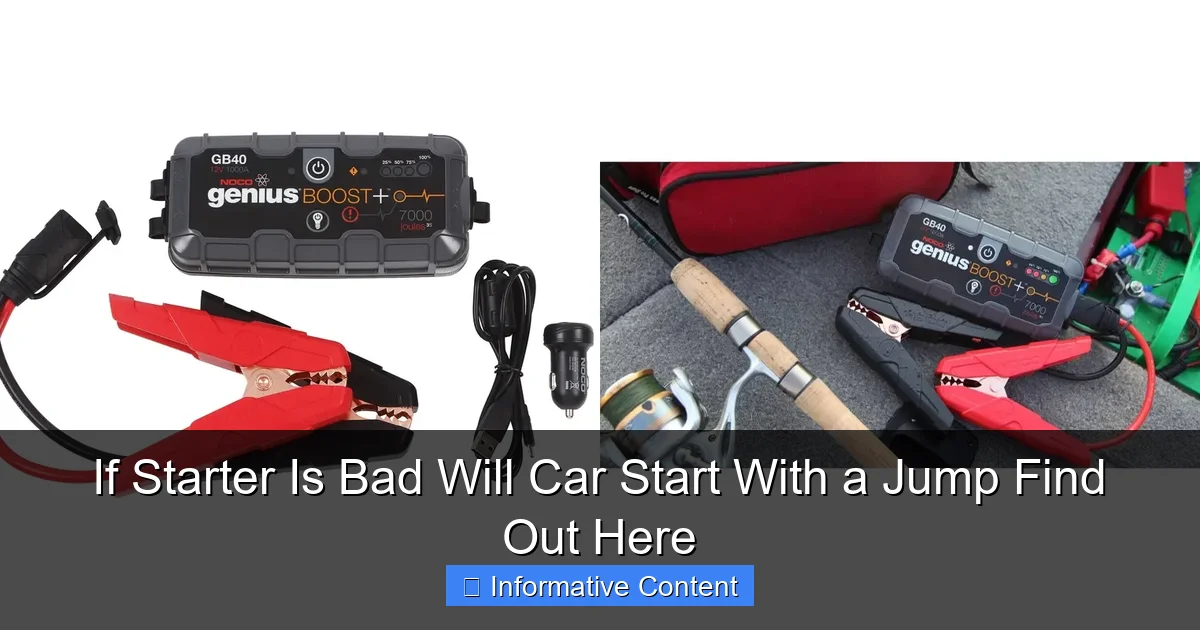
Featured image for if starter is bad will car start with a jump
Image source: everstartjumpstarter.com
A bad starter often prevents a car from starting, even with a jump. While a jump can revive a weak battery, it won’t fix a failed starter motor—the root cause must be diagnosed and repaired for reliable ignition.
Key Takeaways
- Jump-starting won’t fix a bad starter: It only powers the battery, not the starter motor.
- Listen for clicking sounds: A rapid click often means a failing starter, not a dead battery.
- Check battery connections first: Corroded or loose terminals can mimic starter issues.
- Test the battery voltage: Below 12.4V? Recharge or replace before blaming the starter.
- Try tapping the starter: Lightly hitting it may temporarily restore function if worn.
- Diagnose with a multimeter: Verify voltage reaches the starter during ignition attempts.
📑 Table of Contents
- Will a Bad Starter Let a Car Start With a Jump? Let’s Settle This
- How the Starter and Battery Work Together (And Why It Matters)
- Can a Jump-Start Fix a Bad Starter? (The Truth)
- How to Diagnose a Bad Starter vs. a Dead Battery
- What to Do If the Starter Is Bad (And How to Avoid Costly Mistakes)
- Preventing Starter Problems: Maintenance and Early Warning Signs
- Data Table: Starter vs. Battery Failure Symptoms
- Final Thoughts: Don’t Jump to Conclusions
Will a Bad Starter Let a Car Start With a Jump? Let’s Settle This
Imagine this: You’re rushing to get to work, and your car won’t start. You turn the key, and instead of the engine roaring to life, you hear a faint click—or worse, nothing at all. Your mind races: “Is it the battery? The starter? Can I fix this with a jump?” If you’ve ever been in this situation, you’re not alone. A dead battery and a failing starter can look nearly identical, leaving drivers confused and stranded. But here’s the real question: If the starter is bad, will a car start with a jump?
The short answer? Probably not. But the long answer is a bit more nuanced. A jump-start can help if the battery is weak or dead, but if the starter itself is failing, you’ll need more than just a boost. In this guide, we’ll break down exactly how the starter and battery work, why they’re often confused, and what your options are when your car refuses to start. Whether you’re a seasoned DIYer or just trying to avoid a costly tow, this post will give you the clarity you need—no fluff, no jargon, just real talk.
How the Starter and Battery Work Together (And Why It Matters)
To understand why a jump might or might not help, you need to know how the starter and battery team up to get your engine running. Think of them as two players on the same team: the battery is the energy source, and the starter is the muscle that uses that energy to crank the engine.
Visual guide about if starter is bad will car start with a jump
Image source: docerp.s3.amazonaws.com
The Battery: Your Car’s Energy Reservoir
The battery stores electrical power and delivers it to various systems when the engine isn’t running. When you turn the key, the battery sends a high-voltage current to the starter motor. A healthy battery should provide enough voltage (usually 12.6V when fully charged) to activate the starter and get the engine turning over.
- Signs of a weak battery: Slow cranking, dim lights, clicking noises, or no response at all.
- Jump-start effectiveness: A jump can revive a dead or drained battery, giving it enough power to send current to the starter.
The Starter: The Engine’s Personal Cranker
The starter is a small electric motor that physically turns the engine over. When the ignition switch is turned, the starter solenoid engages, connecting the starter motor to the flywheel (a large gear ring on the engine). The motor then spins the engine, allowing the combustion process to begin.
- Signs of a failing starter: A single loud click, grinding noises, or no noise at all when turning the key.
- Jump-start effectiveness: If the starter is broken, it won’t matter how much power the battery has—it simply won’t turn the engine.
Why People Confuse the Two
It’s easy to blame the battery because it’s the most common culprit. But here’s the catch: a bad starter can mimic a dead battery. Both issues prevent the engine from cranking, and both can produce similar symptoms. For example, if the starter solenoid is faulty, it might make a clicking noise—just like a weak battery. This confusion is why many drivers waste time and money jumping a car that actually has a starter problem.
Pro tip: If your car starts fine after a jump but dies again the next day, the battery is likely the issue. If it still won’t start even with a strong jump, the starter is probably to blame.
Can a Jump-Start Fix a Bad Starter? (The Truth)
Now, let’s tackle the main question head-on: Will a car with a bad starter start with a jump? The answer depends on the type of starter failure, but in most cases, the answer is no. Here’s why.
When a Jump Might Work (Rare Cases)
There are a few scenarios where a jump could temporarily help a car with a failing starter:
- Loose or corroded connections: If the starter’s electrical connections are dirty or loose, a jump might provide enough extra current to overcome resistance and engage the starter. This is rare, but it happens.
- Weak starter motor (early stages): In some cases, a starter on its last legs might still have enough life to work with a strong battery or a jump. Think of it like an old flashlight that only works with fresh batteries.
- Faulty solenoid (not the motor itself): If the solenoid is the problem, a jump might give it the boost it needs to engage. But if the motor is dead, no amount of juice will help.
Real-world example: A friend once had a car that wouldn’t start. We jumped it, and it fired up. But the next day, it was dead again. We replaced the battery, and the same thing happened. Turns out, the starter was drawing too much current, draining the battery overnight. A jump didn’t fix the root cause—it just masked it.
When a Jump Won’t Work (Most Common)
In the majority of cases, a jump won’t help if the starter is truly bad. Here’s why:
- Internal motor failure: If the starter’s internal windings or brushes are worn out, it won’t spin—no matter how much power it receives.
- Broken starter gear: If the gear that meshes with the flywheel is damaged, the starter can’t turn the engine, even with full voltage.
- Starter relay issues: The relay sends power to the starter. If it’s faulty, a jump won’t bypass it.
Key takeaway: A jump gives the starter more power, but it doesn’t fix mechanical or electrical failures inside the starter itself.
The “Click of Death”
One of the most telling signs of a bad starter is the single, loud click when you turn the key. This usually means the solenoid is engaging, but the starter motor isn’t turning. A jump won’t help here because the motor is dead.
Pro tip: If you hear a rapid clicking, it’s almost always the battery. If it’s a single click, suspect the starter.
How to Diagnose a Bad Starter vs. a Dead Battery
Before you waste time or money, you need to figure out what’s actually wrong. Here’s a step-by-step method to diagnose the problem.
Step 1: Check the Battery Voltage
Use a multimeter or a battery tester to check the voltage. A fully charged battery should read around 12.6V. Below 12V? It’s likely the battery.
- Below 10V: Definitely a battery issue.
- 12V+ but no start: The battery might be okay—check the starter.
Step 2: Listen for Clues
Turn the key and listen carefully:
- Rapid clicking: Battery or connection issue.
- Single click: Starter solenoid or motor problem.
- Grinding noise: Starter gear is worn or misaligned.
- No noise: Could be the battery, starter, or ignition switch.
Step 3: Test the Lights and Accessories
If the headlights, radio, and dash lights work normally, the battery is probably fine. If they’re dim or flickering, it’s likely the battery.
Step 4: Try a Jump-Start
Jump the car and see what happens:
- Starts fine after jump: Battery or connection issue.
- Still won’t start: Likely the starter, ignition switch, or another electrical problem.
Step 5: Tap the Starter (Old-School Trick)
While someone turns the key, gently tap the starter with a wrench or hammer. Sometimes, a stuck starter will free up and work. If it starts after tapping, the starter is failing and needs replacement.
Pro tip: This only works with certain starter designs. If it doesn’t work, don’t assume the starter is fine—it’s just not stuck.
Step 6: Check the Starter Connections
Inspect the cables and terminals for corrosion, looseness, or damage. Clean and tighten them if needed. A bad connection can mimic a starter problem.
What to Do If the Starter Is Bad (And How to Avoid Costly Mistakes)
If you’ve confirmed the starter is bad, here’s what you should (and shouldn’t) do.
Option 1: Replace the Starter Yourself (DIY)
If you’re handy with tools, replacing the starter is a manageable DIY job. Here’s what to know:
- Cost: $100–$300 for the part, plus tools you might already have.
- Time: 1–3 hours, depending on your car.
- Tools needed: Wrenches, sockets, jack stands, and possibly a torque wrench.
Pro tip: Watch a YouTube video for your specific car model first. Some starters are easy to access; others require removing the wheel or exhaust components.
Option 2: Pay a Mechanic (For Most People)
If you’re not comfortable with DIY, get a professional. Here’s how to avoid being overcharged:
- Get multiple quotes: Compare prices from local shops and dealerships.
- Ask for a diagnosis first: Some shops charge a fee, but it’s worth it to confirm the problem.
- Buy your own part: Starters are often cheaper online. Just make sure it fits your car.
Option 3: Try a Starter Relay Swap (If You’re Lucky)
Sometimes, the starter relay (a small switch that sends power to the starter) is the issue. Many cars have identical relays for the starter and other systems (like the horn or lights). Swap them and see if the car starts. If it does, replace the relay—it’s a $10 fix.
Common Mistakes to Avoid
- Jumping repeatedly: If the starter is bad, jumping won’t help. You’ll just drain the donor battery.
- Ignoring the battery: A weak battery can damage a new starter. Test the battery before replacing the starter.
- Using cheap aftermarket parts: A $50 starter might fail in months. Invest in a quality part or OEM.
- Not testing connections: A bad ground or power wire can prevent the new starter from working.
Preventing Starter Problems: Maintenance and Early Warning Signs
The best way to avoid a bad starter is to catch issues early and maintain your car properly.
Regular Maintenance Tips
- Check battery health: Test your battery every 6 months, especially before winter.
- Clean connections: Remove corrosion from battery terminals and starter wires.
- Inspect belts and pulleys: A seized pulley can strain the starter.
- Listen for changes: If the engine cranks slower than usual, get it checked.
Early Warning Signs of a Failing Starter
- Intermittent starting: The car starts fine one day but not the next.
- Unusual noises: Grinding, whining, or clicking when turning the key.
- Burning smell: A failing starter can overheat and emit a burning odor.
- Dashboard lights flicker: This could indicate a power drain from the starter.
When to Replace the Starter (Proactively)
Starters typically last 100,000–150,000 miles. If your car is approaching this range and shows any of the above signs, consider replacing it before it leaves you stranded.
Data Table: Starter vs. Battery Failure Symptoms
| Symptom | Battery Issue | Starter Issue |
|---|---|---|
| Clicking noise | Rapid clicks | Single loud click |
| Engine cranks slowly | Yes | Rare (if motor is weak) |
| No cranking | Possible (if very low voltage) | Yes |
| Lights and accessories work | Yes | Yes |
| Starts after jump | Yes | No |
| Grinding noise | No | Yes |
| Starter tap fixes it | No | Sometimes |
Final Thoughts: Don’t Jump to Conclusions
So, if the starter is bad, will a car start with a jump? In almost all cases, the answer is no. A jump can help with battery or connection issues, but it won’t fix a broken starter. The key is diagnosing the problem correctly—don’t waste time jumping a car with a bad starter. Instead, use the steps we covered to identify the issue and act accordingly.
Remember, a failing starter isn’t the end of the world. With the right knowledge, you can either fix it yourself or avoid being overcharged by a mechanic. And by catching early warning signs, you might even prevent the problem entirely. Whether you’re a DIY enthusiast or just want to understand your car better, this knowledge will save you time, money, and frustration down the road. Now, the next time your car won’t start, you’ll know exactly what to do—and what not to do. Happy driving!
Frequently Asked Questions
Can a bad starter still allow a car to start with a jump?
If the starter is bad, your car likely won’t start—even with a jump—because the starter motor needs electrical power to turn the engine. A jump provides battery power, but if the starter is faulty, it won’t engage to crank the engine.
Why won’t my car start with a jump if the starter is bad?
A jump start delivers power to the battery, but a failing starter motor may not convert that power into mechanical action. If the starter is dead or severely damaged, no amount of jump-starting will trigger ignition.
Is a jump start effective when the starter is the issue?
No, a jump start won’t fix a bad starter since it doesn’t repair mechanical or electrical faults in the starter motor. The keyword “if starter is bad will car start with a jump” highlights this key limitation of jump-starting.
What are signs that a bad starter is preventing a jump start from working?
Clicking noises, no engine crank, or dashboard lights illuminating but the engine not turning over suggest a bad starter. Even with a jump, these symptoms persist if the starter is the root cause.
Can jump-starting damage a car with a bad starter?
Jump-starting itself won’t damage the car, but repeatedly trying to start a vehicle with a faulty starter may strain the battery and alternator. Focus on diagnosing and replacing the starter instead.
How do you tell if it’s the battery or the starter when the car won’t start?
If your car starts with a jump but dies later, it’s likely a battery or alternator issue. If it doesn’t crank at all—even with a jump—the “if starter is bad will car start with a jump” rule points to starter failure.