
Featured image for will a bad battery jump start
Image source: batteryrite.com.au
A bad battery can sometimes be jump-started, but it’s not a guaranteed fix and often leads to repeated failures. Jump-starting provides a temporary power boost, but if the battery is old, damaged, or unable to hold a charge, the underlying issue remains—leaving you stranded again. Always test the battery and charging system afterward to avoid future breakdowns.
Key Takeaways
- Jump-starting can work even with a bad battery if it has enough charge to engage the starter.
- Repeated jump-starts signal it’s time to test or replace the battery to avoid breakdowns.
- Parasitic drain or alternator issues may mimic a bad battery—diagnose the real cause first.
- Use proper jumper cable connections to prevent damage to electrical systems during a jump.
- Drive for 20+ minutes after a jump to help recharge the battery safely.
📑 Table of Contents
- Will a Bad Battery Jump Start Your Car? Here’s What Happens
- How Jump-Starting Works (And Why It Matters)
- When a Bad Battery *Can* Be Jump-Started (And When It Can’t)
- How to Safely Attempt a Jump Start on a Bad Battery
- What Happens After the Jump Start?
- Preventing Future Battery Failures
- Final Thoughts: Is It Worth Trying?
Will a Bad Battery Jump Start Your Car? Here’s What Happens
It’s a cold winter morning. You’re running late for work, and as you turn the key in your car, all you hear is a faint *click… click… click*. The engine doesn’t turn over. The lights flicker, and the radio stays silent. You’ve got a dead battery — again. Your mind races: Can I still jump-start this car, even if the battery is bad? Maybe you’ve seen someone do it before, or a friend swore it worked once. But is it safe? Is it effective? Or are you just delaying the inevitable?
We’ve all been there. A dead car battery is one of the most frustrating — and surprisingly common — automotive issues. Whether it’s due to leaving the headlights on, extreme weather, or just an aging battery, the question of whether a bad battery jump start will actually work is one that comes up time and again. The short answer? It depends. But the real answer is deeper, involving how batteries fail, how jump-starting works, and what you can realistically expect. In this guide, we’ll walk through everything you need to know — from the science behind jump-starting to real-world scenarios, safety tips, and when it’s time to stop trying and just replace the battery.
How Jump-Starting Works (And Why It Matters)
The Basics of Jump-Starting
Jump-starting is a temporary solution that uses another vehicle’s battery (or a portable jump starter) to provide the necessary electrical power to crank your engine. The idea is simple: connect two batteries in parallel (positive to positive, negative to negative), so the healthy battery “donates” current to the weak or dead one. Once the engine starts, your car’s alternator takes over, recharging the battery and powering the electrical system.
Visual guide about will a bad battery jump start
Image source: tomobriengreenwood.com
But here’s the catch: a bad battery jump start only works if the battery can still accept and hold a charge — even temporarily. Think of it like trying to fill a cracked water bottle. If the bottle has a tiny hole, you might get a few sips before it leaks out. But if the bottle is shattered, no amount of pouring will help. The same goes for a severely degraded battery.
What Makes a Battery “Bad”?
Not all “bad” batteries are the same. Some fail suddenly; others degrade slowly. Here are the most common types of battery failure:
- Sulfation: Lead sulfate crystals build up on the plates when the battery sits discharged for too long. This reduces its ability to accept a charge.
- Internal Short Circuit: A physical breakdown causes plates to touch, draining the battery even when the car is off.
- Corroded Terminals: While not a battery failure per se, corrosion can prevent proper current flow — often mistaken for a dead battery.
- Low Electrolyte Level: In older batteries, evaporated or low fluid levels reduce capacity.
- Age-Related Degradation: Most car batteries last 3–5 years. After that, capacity drops, even if it still “works.”
So, can a jump start help with any of these? Sometimes. But if the battery is physically damaged or has a short, jump-starting may do more harm than good.
Real-World Example: The “Clicking” Car
Let’s say you try to jump-start your car. You connect the cables, wait a minute, and try to start it. The starter motor makes a loud *click* but nothing else. This usually means the battery can’t deliver enough current — even with help. It might be too degraded to hold a charge long enough to engage the starter. In this case, the bad battery jump start attempt fails because the battery is beyond temporary recovery.
When a Bad Battery *Can* Be Jump-Started (And When It Can’t)
Scenarios Where Jump-Starting Works
Not every bad battery is beyond saving — at least for a short while. Here are situations where a bad battery jump start is likely to succeed:
- Recent Discharge (e.g., headlights left on): The battery is drained but not damaged. A jump start should work fine, and the alternator will recharge it as you drive.
- Cold Weather Slowdown: Batteries lose power in cold temperatures. A weak battery might start with a jump, even if it struggles in the cold.
- Surface Corrosion: Clean the terminals, and the battery might respond to a jump.
- Low State of Charge (Not Fully Dead): If the battery still shows some voltage (e.g., 9–10V), it might accept a temporary boost.
Pro Tip: Use a multimeter to check battery voltage before jumping. A reading above 10V is a good sign. Below 9V, the battery may be too far gone.
When Jump-Starting Is a Waste of Time
Unfortunately, some battery problems can’t be fixed with a jump. If you’re dealing with any of the following, a bad battery jump start is unlikely to work:
- Internal Short or Open Circuit: The battery is essentially “dead inside.” No amount of charging will revive it.
- Severe Sulfation: If the battery has been discharged for weeks or months, the sulfation may be irreversible.
- Cracked Case or Leaking Acid: This is dangerous and requires immediate replacement.
- Zero Voltage Reading: A completely flat battery (0V) often indicates a short or internal failure.
- Repeated Jump-Starts in a Week: If you’ve jumped the car three times already, the battery is likely at the end of its life.
Case Study: The “It Worked Last Time” Trap
Sarah had a 2018 Honda Civic. Last winter, she left the dome light on overnight and had to jump-start it. It worked — no problem. The next month, same thing. By the third time, the car wouldn’t start even with a jump. The battery was only 4 years old, but repeated deep discharges had caused irreversible sulfation. The jump cables couldn’t overcome the internal resistance. Sarah learned the hard way: a bad battery jump start is a temporary fix, not a long-term solution.
Moral of the story? If you’re jump-starting more than once or twice a year, it’s time to test or replace the battery — no matter how old it is.
How to Safely Attempt a Jump Start on a Bad Battery
Step-by-Step Jump-Start Guide
Even if you suspect your battery is bad, it’s worth a careful attempt. Here’s how to do it safely:
- Park the Vehicles Close: Position the working car close (but not touching) so jumper cables can reach both batteries.
- Turn Off Both Engines: Safety first. No sparks while connecting.
- Clean the Terminals: Use a wire brush to remove corrosion. This ensures a good connection.
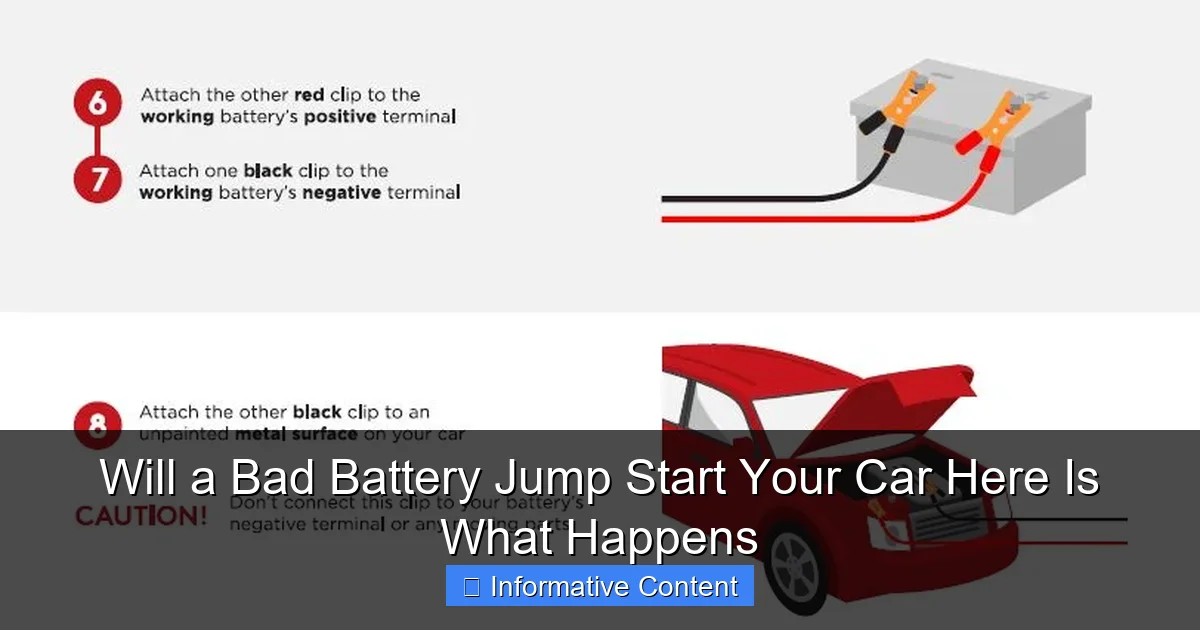
- Connect Cables in Order:
- Red (positive) to dead battery’s positive terminal.
- Red to good battery’s positive terminal.
- Black (negative) to good battery’s negative terminal.
- Black to an unpainted metal part on the dead car (e.g., engine block). This grounds the circuit and reduces spark risk.
- Start the Working Car: Let it run for 2–3 minutes to transfer charge.
- Try Starting the Dead Car: Turn the key. If it starts, let it run for 10–15 minutes to charge the battery.
- Disconnect in Reverse Order: Remove the black cable first (from the ground), then the reds.
Common Mistakes to Avoid
- Connecting Negative to Dead Battery: This can cause sparks and, in rare cases, ignite hydrogen gas. Always ground on the engine block.
- Reversing Polarity: Connecting red to negative and black to positive can fry the car’s electrical system. Double-check!
- Jumping a Frozen Battery: If the battery case is cracked or bulging, it may be frozen. Jumping it could cause an explosion. Replace it immediately.
- Leaving Cables Connected Too Long: More than 10–15 minutes can overcharge the dead battery or damage the good one.
Using a Portable Jump Starter
Portable jump starters (also called battery boosters) are a great alternative. They’re compact, don’t require another car, and many have safety features like reverse polarity protection. But they have limits:
- They work best on batteries with at least 50% capacity.
- They can’t fix a shorted or sulfated battery.
- They need to be recharged after use.
Tip: Keep a portable jump starter in your trunk, especially if you drive an older car or live in a cold climate. It’s a lifesaver — literally.
What Happens After the Jump Start?
Can the Alternator Recharge a Bad Battery?
Yes — but only if the battery can accept a charge. The alternator generates electricity to power the car and recharge the battery while driving. However:
- A severely degraded battery may charge slowly or not at all.
- The alternator has to work harder, which can shorten its lifespan.
- If the battery is shorted, it can overheat the alternator or drain it.
So, after a successful bad battery jump start, don’t just drive to work and forget about it. Drive for at least 20–30 minutes to give the battery a good charge. Then, test it with a multimeter or take it to an auto parts store (many offer free battery testing).
Signs You Should Replace the Battery (Even After a Jump)
Here’s how to tell if your battery is on its last legs — even if the jump worked:
- Slow Cranking: The engine turns over sluggishly, even after driving.
- Dim Lights or Electrical Issues: Headlights flicker, radio resets, or dashboard lights dim when starting.
- Check Engine Light or Battery Warning Light: The car’s system detects a charging problem.
- Frequent Jump-Starts: As mentioned, more than once or twice is a red flag.
- Age Over 3 Years: Older batteries are more likely to fail suddenly.
Data Table: Battery Health Indicators
| Indicator | Healthy Battery | Bad Battery (Jumpable) | Bad Battery (Unjumpable) |
|---|---|---|---|
| Voltage (Resting) | 12.6V – 12.8V | 10V – 12.4V | Below 10V or 0V |
| Cranking Speed | Fast, smooth | Slow but starts | No crank or single click |
| Terminal Condition | Clean, no corrosion | Mild corrosion (cleanable) | Severe corrosion or damage |
| Case Appearance | Intact, no bulging | Minor swelling | Cracked or leaking |
| Jump-Start Success | Works easily | Works after waiting | Fails repeatedly |
This table can help you assess whether your battery is worth saving or needs to go.
Preventing Future Battery Failures
Tips to Extend Your Battery’s Life
Avoiding the need for a bad battery jump start starts with prevention. Here’s how to keep your battery healthy:
- Drive Regularly: Short trips don’t fully charge the battery. Take longer drives (20+ minutes) weekly.
- Turn Off Accessories: Make sure lights, radio, and phone chargers are off when the engine is off.
- Clean Terminals Monthly: Use baking soda and water to neutralize corrosion.
- Use a Battery Tender: If you store your car, a trickle charger keeps the battery charged.
- Check for Parasitic Drain: Some electronics (e.g., alarm systems) draw power when the car is off. A mechanic can test for this.
When to Test or Replace Your Battery
- Every 6 Months: Get a free battery test at auto parts stores (AutoZone, O’Reilly, etc.).
- Before Winter: Cold weather is tough on batteries. Test it in fall.
- After 3 Years: Even if it works, consider replacement. Batteries degrade over time.
- If You’ve Jumped It More Than Twice: This is a clear sign of decline.
Choosing a Replacement Battery
When it’s time to replace, don’t just grab the cheapest one. Consider:
- Size and Terminal Type: Match your car’s specifications.
- Reserve Capacity (RC): How long it can power the car if the alternator fails.
- Cranking Amps (CA) and Cold Cranking Amps (CCA): Higher CCA is better for cold climates.
- Warranty: Look for at least a 3-year free-replacement warranty.
Brands like Optima, ACDelco, and DieHard are reliable, but even mid-range batteries from AutoZone or Walmart can last 4–5 years with proper care.
Final Thoughts: Is It Worth Trying?
So, will a bad battery jump start work? The answer isn’t black and white. If the battery is merely discharged — from leaving the lights on or a cold night — a jump start is likely to succeed. It’s a quick, effective fix that can get you back on the road.
But if the battery is truly bad — shorted, sulfated, or physically damaged — jumping it is like putting a band-aid on a broken leg. It might work once, maybe twice, but eventually, you’ll be stranded. And in some cases, attempting a jump on a severely damaged battery can lead to safety hazards like sparks, acid leaks, or even explosions.
The key is knowing the difference. Use a multimeter. Look for physical signs. Pay attention to how your car behaves. And remember: a jump start is a temporary solution. It’s not a substitute for maintenance or replacement.
Think of your car battery like a heart. A jump start is like CPR — it can save a life in an emergency. But if the heart is too damaged, no amount of CPR will help. Eventually, you need a new heart — or in this case, a new battery.
So the next time you’re staring at a silent dashboard, take a breath. Try the jump — carefully. But if it doesn’t work, or if it works but the car struggles afterward, don’t keep pushing your luck. Replace the battery, drive safely, and keep a portable jump starter in your trunk just in case.
Because when it comes to car batteries, the best jump start is the one you never have to make.
Frequently Asked Questions
Can a bad battery be jump started successfully?
Yes, a bad battery can often be jump started if the issue is due to a temporary drain or low charge. However, if the battery is old, damaged, or has internal failure, a jump may not work or only provide a short-term fix.
Will a bad battery hold a charge after being jumped?
It depends on the battery’s condition—some weak batteries will hold a charge after a jump, but severely degraded ones won’t. If your battery consistently fails to hold a charge, replacement is likely needed.
How long should I drive after a jump start to recharge a bad battery?
Drive for at least 30 minutes at highway speeds to allow the alternator to recharge the battery. For deeply drained or bad batteries, longer drives or a battery charger may be necessary.
Is jump starting a bad battery safe for my car’s electrical system?
Jump starting is generally safe if done correctly, but repeated jumping of a failing battery can strain your alternator and electronics. Always inspect the battery and charging system after multiple jump starts.
Why does my car die again after a jump start?
This usually means your battery is unable to hold a charge or your alternator isn’t recharging it. A bad battery or faulty charging system is likely the culprit.
What are the signs a bad battery won’t jump start my car?
If the car clicks but doesn’t crank, or lights dim severely during a jump attempt, the battery may be too far gone. Sulfation, cracks, or visible leaks also indicate a battery that won’t respond to a jump.