
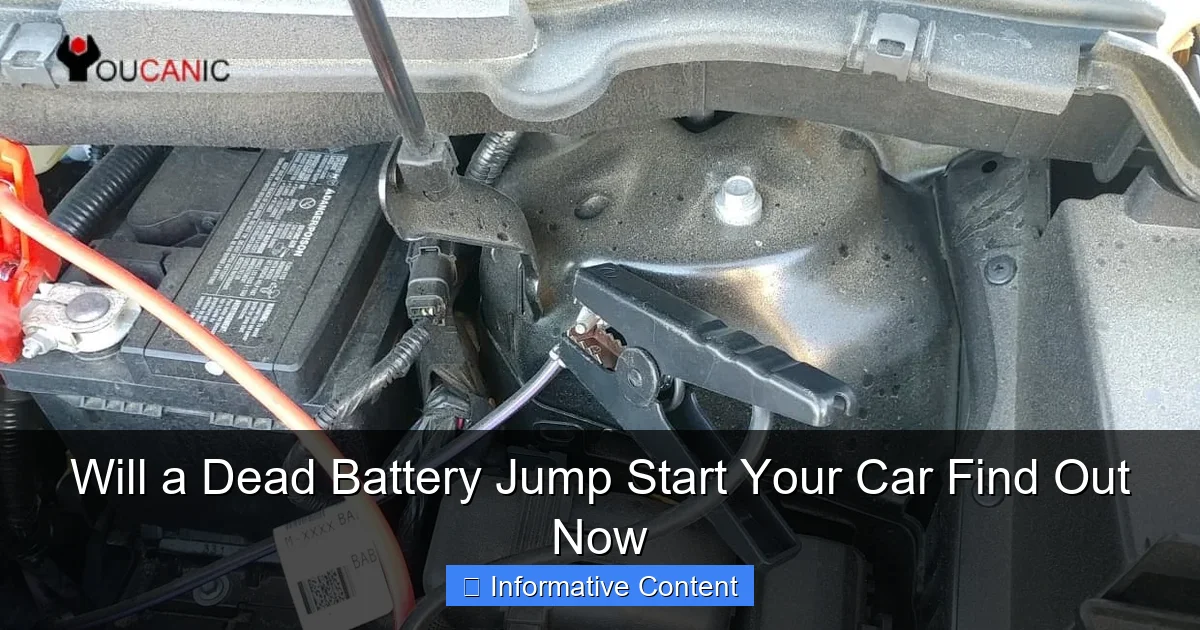
Featured image for will a dead battery jump start
Image source: youcanic.com
Yes, a dead battery can often be jump-started using jumper cables and a functioning vehicle or portable jump starter, providing a quick boost to get your engine running. Success depends on the battery’s condition—if it’s simply drained (not fully failed)—but repeated jump-starts may signal it’s time for a replacement. Always follow safety precautions to avoid damage or injury.
Key Takeaways
- Jump starters work: A dead battery can often be revived with a proper jump start.
- Safety first: Always connect cables in the correct order to avoid damage or injury.
- Check battery health: Frequent jump starts signal it’s time for a battery replacement.
- Use quality equipment: Invest in reliable jumper cables or a portable jump starter.
- Run the engine: After jumping, drive for 20+ minutes to fully recharge the battery.
- Prevent future issues: Regularly inspect terminals and keep battery connections clean.
📑 Table of Contents
- Will a Dead Battery Jump Start Your Car? Find Out Now
- How Car Batteries Work (And Why They Die)
- Can You Jump Start a Dead Battery? The Truth
- How to Jump Start a Car Safely (Step-by-Step)
- Portable Jump Starters vs. Traditional Jump-Starts
- When to Replace Your Battery (Instead of Jump-Starting)
- Prevention: How to Avoid a Dead Battery in the First Place
Will a Dead Battery Jump Start Your Car? Find Out Now
Picture this: You’re running late for work, your coffee hasn’t kicked in yet, and you hop into your car, turn the key… and nothing. No crank. No engine roar. Just silence. Your heart sinks as you realize—your battery is dead. Again. You’ve heard about jump-starting, maybe even tried it before, but now you’re wondering: Will a dead battery jump start your car? Or is it already too late?
We’ve all been there. Whether it’s from leaving the lights on, extreme weather, or just an aging battery, a dead car battery is one of the most common (and frustrating) automotive issues. The good news? Jump-starting is often the quick fix you need. But it’s not always a guaranteed solution. Sometimes, a jump start works like magic. Other times, it’s like trying to wake someone who’s already gone—no response, no matter how hard you try. In this guide, we’ll walk through everything you need to know: what happens when a battery dies, whether a jump start can save the day, how to do it safely, and when it’s time to call it quits and replace the battery. Think of this as your friendly, no-nonsense roadmap to getting back on the road—or knowing when it’s time to walk.
How Car Batteries Work (And Why They Die)
What’s Inside a Car Battery?
Before we dive into jump-starting, let’s talk about what’s actually happening under the hood. A car battery isn’t just a box of power—it’s a chemical factory. Most cars use a lead-acid battery, which contains lead plates submerged in a sulfuric acid and water solution (called electrolyte). When you turn the key, a chemical reaction between the lead and acid produces electricity. This electricity powers the starter motor, which cranks the engine, and also runs your lights, radio, and other electronics when the engine isn’t running.

Visual guide about will a dead battery jump start
Image source: youcanic.com
Here’s the catch: this chemical reaction isn’t infinite. Over time, the plates corrode, the electrolyte weakens, and the battery loses its ability to hold a charge. Think of it like a sponge—it can only absorb so much water before it’s saturated. Once it’s “full” of damage, it can’t deliver the jolt of energy your car needs to start.
Common Reasons Batteries Die
So why does a battery die? It’s rarely just one thing. Here are the top culprits:
- Leaving lights or electronics on: This is the #1 cause. Even small drains—like interior lights, phone chargers, or a trunk light—can drain a healthy battery in 12–24 hours.
- Short trips: If you only drive for 5–10 minutes at a time, your alternator (the part that recharges the battery while driving) never gets a chance to fully replenish it. Over time, the battery slowly depletes.
- Extreme temperatures: Both heat and cold are battery killers. In hot weather, the electrolyte evaporates, and internal corrosion speeds up. In cold weather, the chemical reaction slows down, reducing power output. A battery rated for 500 cold-cranking amps (CCA) might only deliver 300 CCA at 0°F (-18°C).
- Aging: Most car batteries last 3–5 years. After that, their internal components degrade, and they can’t hold a charge effectively.
- Faulty charging system: If your alternator or voltage regulator fails, the battery won’t recharge properly—even on long drives.
Here’s a real-world example: A friend of mine once left her car in an airport parking lot for two weeks. When she returned, the battery was completely dead. Why? The car’s security system, GPS, and other electronics kept drawing small amounts of power. By the time she got back, the battery was drained. A jump start brought it back to life—but only temporarily. A week later, it died again. The battery was already 6 years old and couldn’t hold a charge. The jump start was just a Band-Aid.
Can You Jump Start a Dead Battery? The Truth
What “Dead” Really Means
First, let’s clear up a common myth: a “dead” battery isn’t always completely dead. In automotive terms, a battery is considered “dead” when its voltage drops below what’s needed to start the engine—usually around 10.5 volts or less. But that doesn’t mean there’s zero power left. Think of it like a phone battery at 5%. It won’t power the screen, but it still has some juice.
A jump start works by connecting your battery to a working battery (or jump starter pack) with jumper cables. The good battery transfers its voltage to your weak one, giving it enough power to turn the starter motor. Once the engine runs, the alternator takes over and recharges the battery.
When a Jump Start Works (And When It Doesn’t)
So, will a dead battery jump start your car? The answer is: usually yes—but with caveats.
- ✅ It works when: The battery is simply discharged (low on charge) but still functional. This happens from leaving lights on, short trips, or cold weather. The internal chemistry is intact, and it just needs a boost.
- ❌ It won’t work when: The battery is physically damaged or has failed internally. This includes:
- Sulfation: When lead sulfate crystals build up on the plates, reducing conductivity.
- Internal short circuits: Caused by plate warping or debris bridging the plates.
- Broken connections or casing: Visible cracks, leaks, or corrosion on terminals.
- Old age (5+ years): Even if it holds a charge, it may not deliver enough cranking amps.
Here’s a practical example: I once tried to jump start a car that wouldn’t start in a freezing parking lot. I connected the cables, waited a few minutes, and the car started right up. Success! But a month later, the same thing happened. And again. I took the battery to a shop, and they tested it—voltage was good, but the internal resistance was high. The battery was worn out. The jump starts were just delaying the inevitable.
Pro tip: If your car starts after a jump but dies again the next day, the battery is likely failing. A jump start is a temporary fix—not a long-term solution.
How to Jump Start a Car Safely (Step-by-Step)
Gather the Right Tools
Before you begin, make sure you have:
- Jumper cables: Look for thick, 4–6 gauge cables (the lower the gauge, the better). Cheap, thin cables can’t deliver enough current.
- A working car with a healthy battery (or a portable jump starter pack).
- Protective gloves and safety glasses (optional but recommended).
- Owner’s manual (in case your car has special jump-starting instructions).
Never use a damaged battery or frayed cables. Sparks can ignite hydrogen gas, which batteries emit—especially when charging. For a detailed guide, see our step-by-step tutorial for beginners.
Step-by-Step Jump-Start Process
Follow these steps carefully:
- Park the cars close—but not touching. Turn off both engines, set parking brakes, and put both cars in Park (or Neutral for manual transmissions).
- Turn off all electronics in both cars (lights, radio, AC, etc.). This reduces the load on the batteries.
- Connect the cables in this order:
- Red (+) clamp to the dead battery’s positive terminal.
- Red (+) clamp to the good battery’s positive terminal.
- Black (-) clamp to the good battery’s negative terminal.
- Black (-) clamp to an unpainted metal surface on the dead car (like a bolt or bracket). This acts as a ground and reduces sparking near the battery.
- Start the working car and let it run for 2–3 minutes. This gives the dead battery time to absorb some charge.
- Try starting the dead car. If it doesn’t start, wait another minute and try again. Don’t crank for more than 10–15 seconds at a time—this can overheat the starter.
- Once the car starts, let it run for at least 10–15 minutes to recharge the battery. Keep the RPMs slightly above idle (1,500–2,000 RPM) to help the alternator charge faster.
- Disconnect the cables in reverse order:
- Remove the black (-) clamp from the ground point.
- Remove the black (-) clamp from the good battery.
- Remove the red (+) clamp from the good battery.
- Remove the red (+) clamp from the now-running car.
Warning: Never let the clamps touch each other while connected—this can cause a short circuit and sparks. Also, avoid leaning over the battery when starting the car. Hydrogen gas can explode.
What If It Still Doesn’t Start?
If the car won’t start after 2–3 attempts:
- Check that the cables are securely connected.
- Make sure the working car’s battery isn’t also weak (test with a multimeter—should be 12.6V or higher).
- Listen for a clicking sound. If you hear a rapid click, the battery may be too weak. If there’s no sound, the issue might be the starter or ignition switch.
- Consider using a portable jump starter—they’re more powerful than jumper cables and don’t require another car.
Portable Jump Starters vs. Traditional Jump-Starts
The Rise of Portable Jump Starters
Remember the days of flagging down a stranger for a jump? Not anymore. Portable jump starters (also called jump boxes or battery boosters) have revolutionized roadside assistance. These compact devices contain a lithium-ion battery and can deliver 1,000–3,000 amps of power—enough to start most cars, trucks, and SUVs.
Here’s why they’re a game-changer:
- No need for another car: You can use them anywhere—parking lots, remote roads, even your garage.
- Safer than cables: Most have safety features like reverse polarity protection, spark-proof clamps, and overload protection.
- Multi-function: Many include USB ports for charging phones, built-in flashlights, and air compressors.
- Compact and lightweight: Easy to store in a trunk or glovebox.
Comparing Jump Starters and Cables
| Feature | Jumper Cables | Portable Jump Starter |
|---|---|---|
| Cost | $20–$50 | $80–$200+ |
| Power Source | Another car’s battery | Internal lithium battery |
| Portability | Bulky; requires another car | Compact; works anywhere |
| Safety | Risk of sparks, short circuits | Built-in protections; spark-proof |
| Lifespan | Unlimited (if cables are intact) | 3–5 years (battery degrades) |
| Best For | Emergency use with another car | Frequent travelers, solo drivers, peace of mind |
I keep a jump starter in my trunk after a scary experience in a snowy parking lot. No one was around to help, and my phone was dying. The jump starter saved me—and my phone, thanks to its USB port. It’s now my go-to tool.
When to Replace Your Battery (Instead of Jump-Starting)
Signs Your Battery Is Beyond Saving
Jump-starting is great for short-term fixes, but it’s not a cure-all. If you notice any of these signs, it’s time to replace the battery:
- Age: 5+ years old. Even if it works, it’s living on borrowed time.
- Slow cranking: The engine turns over slowly, even after a jump.
- Swollen or leaking case: Bulging, cracks, or acid leaks mean internal damage.
- Frequent jump-starts: If you need to jump more than once a month, the battery is failing.
- Corroded terminals: Thick, white, or green buildup can block connections. Clean with baking soda and water, but if it’s severe, the battery may be compromised.
- Dashboard warnings: Some cars have battery or charging system warning lights.
Also, consider an emergency jump starter for winter preparedness and roadside safety. You don’t need a shop to check your battery. Here are two easy methods:
How to Test a Battery (Without a Mechanic)
You don’t need a shop to check your battery. Here are two easy methods:
1. Voltage Test (with a multimeter):
- Turn off the car and let it sit for 2–3 hours (so the surface charge dissipates).
- Set the multimeter to DC voltage (20V range).
- Connect the red probe to the positive (+) terminal and black to negative (-).
- Read the voltage:
- 12.6V or higher: Fully charged.
- 12.4V: 75% charged.
- 12.2V: 50% charged (needs charging).
- Below 11.9V: Dead or failing.
2. Load Test (DIY):
- Start the car and let it run for 10 minutes.
- Turn on headlights, AC, and radio (high electrical load).
- Rev the engine to 2,000 RPM and check voltage:
- 13.8–14.4V: Alternator is charging properly.
- Below 13.5V: Alternator or battery issue.
If your battery fails either test, replace it. Most auto parts stores do free battery testing and installation.
Prevention: How to Avoid a Dead Battery in the First Place
Smart Habits for Battery Longevity
You don’t have to live in fear of a dead battery. A few simple habits can add years to its life:
- Drive regularly: Aim for 20–30 minutes of driving at least 3 times a week. This keeps the alternator charging the battery.
- Turn off everything before exiting: Double-check lights, radio, and electronics. Consider a battery disconnect switch for long-term parking.
- Keep terminals clean: Clean corrosion with a wire brush and baking soda/water solution every 6–12 months.
- Check the charging system: If your car struggles to start after a long drive, the alternator might be failing.
- Use a battery tender: For infrequently driven cars (like classics or second vehicles), a smart charger maintains the battery without overcharging.
Weather-Specific Tips
- In cold climates: Park in a garage if possible. Use a battery blanket or engine block heater to keep the battery warm.
- In hot climates: Park in shade. Heat accelerates corrosion and evaporation. Check electrolyte levels (for non-sealed batteries) every few months.
I learned this the hard way. My old battery died in a Texas summer after 4 years. The heat had dried out the electrolyte. Now I keep a battery tender for my weekend car—and it’s still going strong at 6 years old.
So, will a dead battery jump start your car? Most of the time, yes—if the battery is just discharged. But if it’s old, damaged, or failing internally, a jump start is only a temporary fix. The real answer lies in understanding your battery’s condition and taking proactive steps to maintain it.
Think of your battery like a phone battery. A quick charge (jump start) can get you through the day, but if it’s old or damaged, you’ll eventually need a replacement. By learning how to jump safely, testing your battery, and adopting smart habits, you’ll spend less time stranded—and more time on the road.
Next time your car won’t start, don’t panic. Grab those cables or your jump starter, follow the steps, and get back in action. But if it keeps happening, don’t ignore the warning signs. Your battery—and your sanity—will thank you.
Frequently Asked Questions
Will a dead battery jump start my car?
Yes, a dead battery can often be jump-started using jumper cables and another vehicle or a portable jump starter. However, if the battery is severely damaged or sulfated, jump-starting may not work, and replacement could be necessary.
How long should I let the car run after a jump start?
After a successful jump start, let your car run for at least 20–30 minutes to allow the alternator to recharge the battery. For best results, take a longer drive to ensure the battery reaches full charge.
Can jump-starting a dead battery cause damage?
When done correctly, jump-starting is safe and won’t damage your vehicle. However, improper connections or reversed polarity can harm the electrical system, so always follow safety guidelines and use quality jumper cables.
Why won’t my car start even after a jump?
If your car won’t start after a jump, the battery may be too far gone, or there could be an issue with the alternator, starter, or other components. A mechanic should inspect the charging system to identify the root cause.
Is it better to use a jump starter or another car to jump-start a dead battery?
Both methods work, but a portable jump starter is safer and more convenient since it doesn’t rely on another vehicle. Using another car is effective but requires proper cable connection and poses more risk if done incorrectly.
How often can I jump-start a dead battery before replacing it?
Repeated jump-starts suggest the battery is failing and should be tested. Most batteries last 3–5 years; if yours requires frequent jump-starts, it’s likely time for a replacement to avoid future breakdowns.