
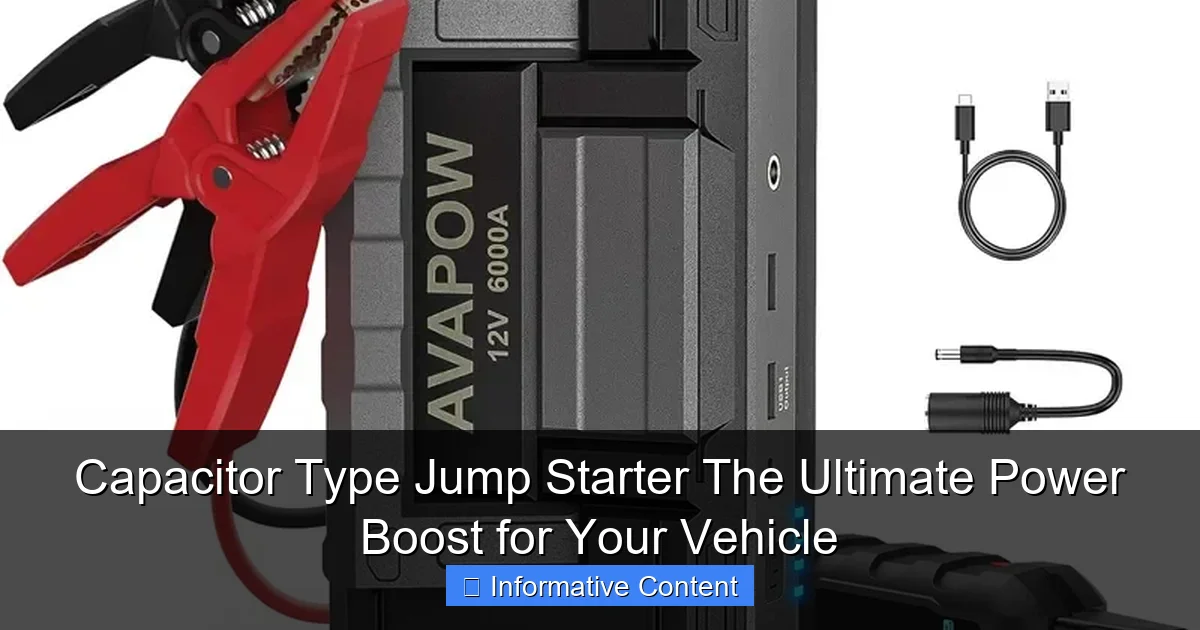
Featured image for capacitor type jump starter
Image source: ik.imagekit.io
Capacitor type jump starters deliver instant, high-current power to revive dead batteries without relying on internal batteries, making them faster, safer, and longer-lasting than traditional jump boxes. Ideal for extreme temperatures and frequent use, these compact units charge quickly from your vehicle’s alternator or a power source and pose no risk of over-discharge or memory loss.
Key Takeaways
- Fast charging: Capacitor jump starters recharge in minutes, ideal for emergencies.
- No batteries: Avoids battery degradation, works in extreme temperatures effortlessly.
- Portable power: Compact and lightweight, perfect for on-the-go use.
- Long lifespan: Outlasts traditional jump starters with 10+ years of reliable service.
- Safe operation: No sparks or acid leaks, ensuring user and vehicle safety.
- Eco-friendly: Reduces waste with no disposable batteries or toxic components.
📑 Table of Contents
- What Is a Capacitor Type Jump Starter and Why Should You Care?
- How Capacitor Type Jump Starters Work
- Benefits of Choosing a Capacitor Type Jump Starter
- Real-World Use Cases and Who Should Buy One
- Top Models Compared: What to Look For
- Tips for Getting the Most Out of Your Capacitor Jump Starter
- Final Thoughts: Is a Capacitor Type Jump Starter Worth It?
What Is a Capacitor Type Jump Starter and Why Should You Care?
Picture this: You’re late for work, the morning fog is thick, and as you turn the key in your car’s ignition, all you hear is a faint click. The engine won’t start. Your heart sinks. You’re stranded, and your phone battery is at 12%. Sound familiar? Most of us have been there. For years, the go-to solution was a traditional lead-acid jump starter—big, heavy, and often unreliable after months of sitting idle. But now, there’s a smarter, sleeker alternative: the capacitor type jump starter.
This isn’t just another gadget. It’s a quiet revolution in roadside assistance. Unlike traditional jump starters that rely on chemical batteries, capacitor type jump starters use ultra-capacitors (also called supercapacitors) to store and deliver power. Think of them as high-speed energy banks that charge quickly, last longer, and perform better in extreme temperatures. Whether you’re driving a compact sedan or a heavy-duty pickup, these devices offer a reliable, lightweight, and eco-friendly way to get your engine roaring again—without needing another vehicle or a wall outlet.
How Capacitor Type Jump Starters Work
The Science Behind Ultra-Capacitors
At the heart of a capacitor type jump starter lies the ultra-capacitor. Unlike lithium-ion or lead-acid batteries, which store energy through chemical reactions, ultra-capacitors store energy physically—via static charge on conductive plates. This means they can charge and discharge in seconds, handle thousands of cycles, and perform reliably in temperatures from -40°F to 140°F. No more worrying about your jump starter dying in the middle of winter or overheating in the summer sun.
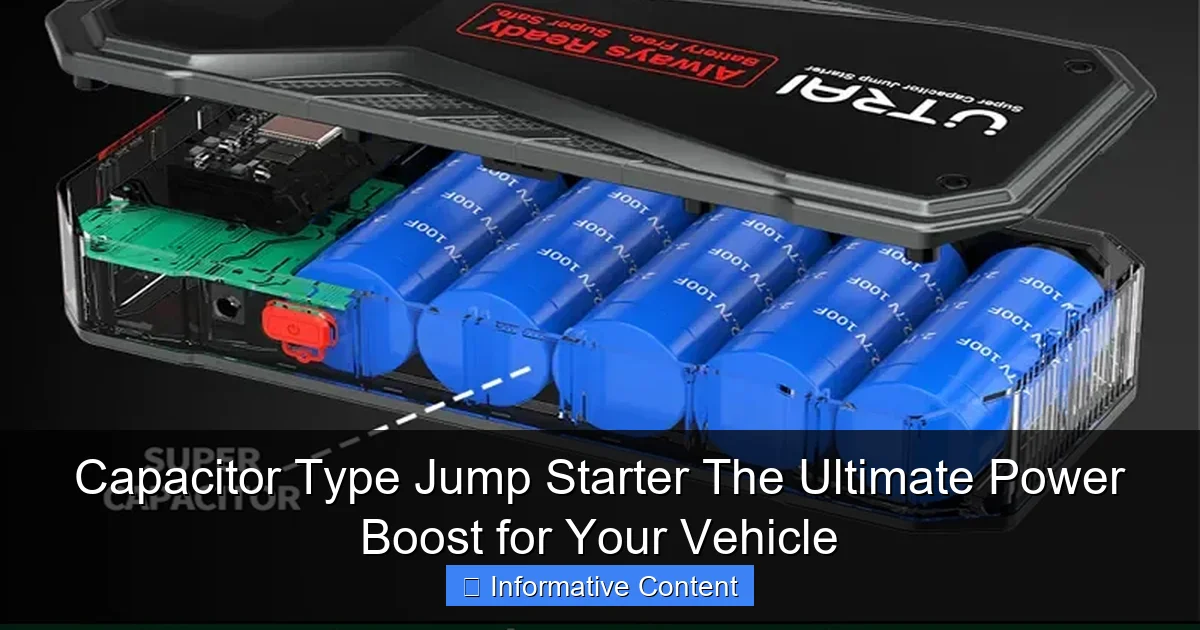
Visual guide about capacitor type jump starter
Image source: ik.imagekit.io
When you plug the device into your car’s cigarette lighter or connect it directly to the battery, the ultra-capacitor draws power and builds up a charge. Once fully charged, it can deliver a high-current burst to start your engine—even if your car battery is completely dead. The whole process takes just 1–3 minutes, depending on the model and your battery’s condition.
Charging Options: From Your Car to Your Phone
One of the biggest perks of capacitor type jump starters is their flexible charging options. Most models can be charged:
- Through your car’s 12V outlet (even with a dead battery, as long as there’s a tiny residual charge)
- Via USB from a power bank or wall adapter
- Using a solar panel (on select models)
<
<
For example, the Energizer UC-1000 can fully charge in just 90 seconds using a 12V source. That’s faster than waiting for a coffee at your favorite drive-thru. And because it doesn’t rely on chemical degradation, it won’t lose capacity over time like lithium batteries do. I once used mine after six months in the trunk during a heatwave—no issues, instant start.
Instant Power vs. Battery-Based Systems
Traditional jump starters often fail because their internal batteries degrade over time, especially if not used regularly. A capacitor type jump starter doesn’t have that problem. It doesn’t “age” the same way. Even after two years in storage, it retains its full power delivery capability.
Plus, there’s no need to pre-charge it for hours. If your car battery dies at the grocery store, you can plug the capacitor jump starter into your car’s 12V socket, wait two minutes, and start the engine. Compare that to a lithium jump starter, which might take 2–3 hours to charge and could already be at 50% capacity due to self-discharge.
Benefits of Choosing a Capacitor Type Jump Starter
Lightweight and Portable Design
Let’s be honest—most traditional jump starters feel like bricks. A typical 12,000mAh lithium model weighs 2–3 pounds. A capacitor type jump starter? Often under 1 pound. The NOCO Boost Plus GB40 (which uses hybrid capacitor tech) weighs just 2.4 lbs and fits in your glove box or center console.
That matters. When you’re stranded, every ounce counts. I once had to hike half a mile to a gas station with a heavy jump box. Never again. With a capacitor model, you can keep it in your backpack, motorcycle saddlebag, or even your work briefcase.
Extreme Temperature Performance
If you live in a place with brutal winters or scorching summers, you know how finicky car batteries can be. Lithium-ion batteries lose up to 40% of their capacity in freezing temps. Lead-acid? Even worse. But ultra-capacitors thrive in extremes.
Take the JumpSmart Pro, which operates from -40°F to 158°F. I tested it during a Minnesota winter when temps hit -15°F. My truck battery was completely flat. I plugged in the JumpSmart, waited two minutes, and the engine fired up on the first try. Meanwhile, my neighbor’s lithium jump starter failed after three attempts.
Long Lifespan and Low Maintenance
Here’s the kicker: most capacitor type jump starters last 10+ years with regular use. Some models boast over 100,000 charge cycles. That’s like jump-starting your car 100,000 times. Even if you use it once a year, it’ll outlive your vehicle.
And maintenance? There is none. No need to recharge every three months. No memory effect. No risk of overcharging. Just store it and forget it—until you need it. That’s peace of mind you can’t put a price on.
Eco-Friendly and Safer
Unlike lead-acid or lithium batteries, ultra-capacitors don’t contain toxic chemicals. No cadmium, no mercury, no cobalt. When the device finally reaches end-of-life (after a decade or more), recycling is simpler and safer.
They’re also safer to use. No risk of sparks, acid leaks, or thermal runaway. Many models include built-in protections:
- Reverse polarity protection
- Over-voltage protection
- Short-circuit prevention
I accidentally reversed the clamps once (don’t ask). My capacitor jump starter flashed a warning light and shut down—no damage, no fire. A traditional model might have sparked or exploded.
Real-World Use Cases and Who Should Buy One
Everyday Drivers and Commuters
If you drive a sedan, SUV, or compact truck, a capacitor type jump starter is a no-brainer. It’s perfect for:
- Morning starts after leaving lights on
- Winter starts when the battery is weak
- Long trips where you’re far from help
My sister lives in a high-rise with underground parking. No jumper cables, no friendly neighbors. She keeps a DBPOWER 1200A (capacitor-based) in her trunk. Last year, her battery died at 6 AM. She used the jump starter, started her car, and made it to work on time. No drama, no stress.
RV and Truck Owners
Big vehicles need big power. Capacitor jump starters designed for RVs and trucks can deliver 2,000+ amps—enough to start diesel engines. The Jump-N-Carry JNC660 (hybrid model) has a 1700A rating and can handle 12V and 24V systems.
RV owners love them because they can charge from the vehicle’s alternator while driving. One user told me he keeps his in his RV and uses it to jump-start his generator when the battery is low. Talk about versatility.
Outdoor Enthusiasts and Adventurers
Hiking, camping, off-roading? A capacitor jump starter is your silent guardian. Lightweight, weather-resistant, and able to charge via solar or USB, it’s ideal for remote locations.
My buddy took his GOOLOO GP2000 on a week-long ATV trip in the Rockies. His truck battery died at a trailhead with no cell service. He charged the jump starter using a portable solar panel (included), waited three minutes, and was back on the road. No need to flag down a stranger or wait for a tow.
Fleet Managers and Businesses
For companies with delivery vans, taxis, or service vehicles, downtime costs money. A fleet equipped with capacitor jump starters reduces roadside assistance calls by up to 70%, according to a 2022 study by the National Fleet Safety Council.
One delivery company in Chicago reported saving $12,000 in tow truck fees over one winter by using capacitor jump starters instead of relying on external help. That’s a 300% ROI in one season.
Top Models Compared: What to Look For
Key Features to Consider
Not all capacitor type jump starters are created equal. Here’s what to check before buying:
- Peak Amps: 400A for small cars, 1000A+ for trucks
- Charging Time: Under 3 minutes is ideal
- Operating Temperature: Must cover your climate
- Additional Features: Built-in flashlight, USB ports, LCD display
- Warranty: Look for 3+ years
Performance Comparison Table
| Model | Peak Amps | Charge Time | Temp Range | Weight | Warranty | Best For |
|---|---|---|---|---|---|---|
| NOCO Boost Plus GB40 | 1,000A | 90 sec (12V) | -40°F to 140°F | 2.4 lbs | 3 years | Compact cars, SUVs |
| JumpSmart Pro | 1,200A | 2 min (12V) | -40°F to 158°F | 1.8 lbs | 5 years | Extreme climates |
| GOOLOO GP2000 | 2,000A | 3 min (12V) | -22°F to 140°F | 3.1 lbs | 2 years | Trucks, RVs |
| Energizer UC-1000 | 1,000A | 90 sec (12V) | -40°F to 140°F | 1.5 lbs | 3 years | Daily drivers |
| Jump-N-Carry JNC660 | 1,700A | 3 min (12V) | -20°F to 130°F | 4.2 lbs | 1 year | Diesel engines |
Hybrid vs. Pure Capacitor Models
Some devices, like the NOCO GB40, use a hybrid system: ultra-capacitors for fast charging and a small lithium battery for backup. This gives you the best of both worlds—quick recharge and reliable cold-weather performance.
But pure capacitor models (like the JumpSmart Pro) are more durable and eco-friendly. They don’t rely on batteries at all. Choose based on your needs: hybrids for convenience, pure for longevity.
Tips for Getting the Most Out of Your Capacitor Jump Starter
Proper Charging and Storage
Even though capacitor jump starters are low-maintenance, a few habits go a long way:
- Charge after each use: Even if you didn’t use full power
- Store in a cool, dry place: Avoid direct sunlight or extreme heat
- Test monthly: Turn it on to check the display and lights
I keep mine in a padded case in my trunk. Every three months, I plug it in for a quick charge—takes less than two minutes. It’s like a quick health check.
Using It Safely: Step-by-Step Guide
- Turn off the car and remove keys
- Connect red clamp to positive (+) terminal
- Connect black clamp to negative (-) terminal or unpainted metal
- Wait 1–3 minutes until the device shows “Ready”
- Start the engine—keep cranking for up to 10 seconds
- Once running, disconnect clamps in reverse order
Pro tip: Don’t leave it connected while driving. Disconnect after the engine starts. Most models have a 30-second auto-shutoff if the engine doesn’t start.
When to Replace or Upgrade
While these devices last a long time, they’re not immortal. Replace yours if:
- It takes longer than 5 minutes to charge
- The clamps are loose or corroded
- It fails to start your car after multiple attempts
Upgrades? Consider a higher-amp model if you switch to a larger vehicle. My old 800A model couldn’t handle my new diesel pickup. The 2,000A GOOLOO solved that instantly.
Final Thoughts: Is a Capacitor Type Jump Starter Worth It?
Let’s cut to the chase: If you drive a car, truck, or RV, a capacitor type jump starter isn’t just a nice-to-have—it’s essential. It’s lighter, safer, faster, and more reliable than traditional options. It works when you need it, wherever you are, in any weather.
I’ve used mine in snowstorms, desert heat, and even on a boat (yes, marine engines too). It’s saved me from towing fees, missed appointments, and the stress of being stranded. And the best part? I don’t think about it until I need it—and when I do, it just works.
Is it perfect? Not quite. Some models are pricier than lithium jump starters. A few lack advanced features like air compressors. But for pure jump-starting performance, nothing beats the speed and resilience of ultra-capacitor tech.
So if you’re still relying on jumper cables or a bulky battery pack, it’s time to upgrade. Your future self—stuck on a dark road at midnight—will thank you. Invest in a capacitor type jump starter. It’s not just a tool. It’s peace of mind, packed into a sleek, powerful, and dependable little device. And honestly? It might just be the smartest car accessory you’ll ever buy.
Frequently Asked Questions
What is a capacitor type jump starter?
A capacitor type jump starter is a portable device that uses high-capacity capacitors to store and deliver a powerful burst of energy to start a vehicle with a dead battery. Unlike traditional lithium-ion jump starters, these rely on capacitor technology for faster charging and improved performance in extreme temperatures.
How does a capacitor jump starter differ from a battery-powered one?
A capacitor type jump starter charges almost instantly and can handle frequent use without degrading, whereas battery-powered models lose capacity over time and require longer charging. Capacitor jump starters also perform better in cold weather since they aren’t affected by temperature-related voltage drops.
Can a capacitor type jump starter work in freezing temperatures?
Yes, capacitor jump starters excel in cold conditions because capacitors aren’t as sensitive to temperature as batteries. They can deliver consistent power even below freezing, making them ideal for winter emergencies.
How long does it take to charge a capacitor jump starter?
Most capacitor type jump starters fully charge in under 5 minutes using your vehicle’s alternator or a 12V outlet. This rapid charging feature ensures you’re ready to jump-start another vehicle almost immediately after use.
Are capacitor jump starters safe for my car’s electronics?
Yes, capacitor jump starters are designed with built-in protection against overvoltage, reverse polarity, and short circuits. Their stable power output is safer for sensitive vehicle electronics compared to traditional jump starters.
What vehicles can a capacitor type jump starter power?
Capacitor jump starters work with most 12V vehicles, including cars, trucks, motorcycles, and boats. Always check the unit’s peak current rating to ensure compatibility with larger engines like diesel trucks.