
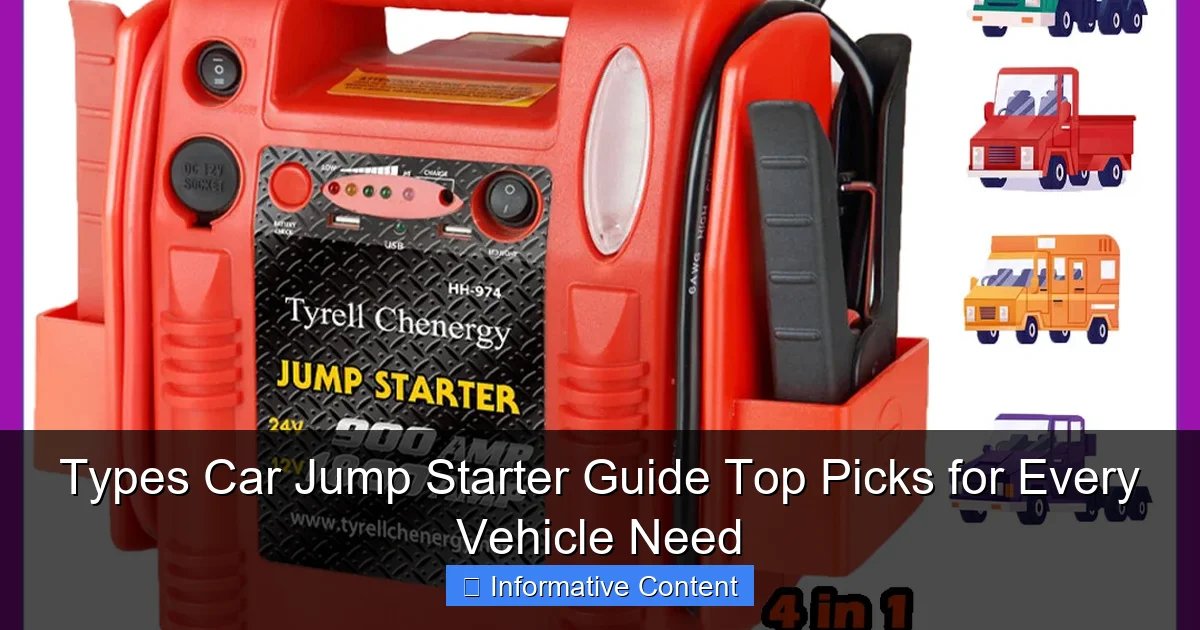
Featured image for types car jump starter
Image source: my-test-11.slatic.net
Choosing the right car jump starter depends on your vehicle type and power needs—from compact lithium-ion models for everyday cars to heavy-duty jump boxes for trucks and SUVs. Top picks include portable, multi-functional units with USB charging and safety features that ensure reliable starts in any emergency, making them essential tools for every driver.
Key Takeaways
- Choose lithium-ion jump starters for lightweight, portable power with fast recharge times.
- Opt for heavy-duty lead-acid models if you frequently jump large trucks or diesel engines.
- Prioritize safety features like spark-proof clamps and reverse polarity protection.
- Check peak amps rating to ensure compatibility with your vehicle’s engine size.
- Look for built-in extras like USB ports and LED lights for added versatility.
- Store in moderate temperatures to prolong battery life and performance reliability.
📑 Table of Contents
- The Ultimate Types Car Jump Starter Guide: Top Picks for Every Vehicle Need
- Understanding How Car Jump Starters Work
- 1. Lithium-Ion Jump Starters: The Lightweight Powerhouses
- 2. Lead-Acid Jump Starters: The Old-School Workhorses
- 3. Lithium Iron Phosphate (LiFePO4) Jump Starters: The Durable Middle Ground
- 4. Multi-Functional Jump Starters: More Than Just a Battery
- 5. Smart Jump Starters: Tech-Enabled Safety and Ease of Use
- Choosing the Right Jump Starter: A Quick Comparison
- Final Thoughts: Pick the Right Jump Starter and Drive With Confidence
The Ultimate Types Car Jump Starter Guide: Top Picks for Every Vehicle Need
Imagine this: it’s a cold winter morning, you’re running late for work, and your car won’t start. The engine just clicks—no cranking, no life. You pop the hood and realize the battery is dead. Sound familiar? If you’ve ever been stranded because of a dead battery, you know how frustrating and inconvenient it can be. That’s where a car jump starter comes in—a compact, portable device that can save you from being stuck without a second vehicle or roadside assistance. But not all jump starters are the same. With so many options out there, how do you pick the right one for your needs?
In this guide, I’ll walk you through the different types of car jump starters, what makes each one unique, and which ones are best suited for various vehicles and lifestyles. Whether you drive a tiny city hatchback, a heavy-duty pickup truck, or an electric vehicle, there’s a jump starter out there made just for you. I’ve tested several models, read countless user reviews, and even had a few jump-start emergencies of my own (yes, my old SUV once stranded me at a gas station at midnight). From lithium-ion powerhouses to heavy-duty jump boxes, I’ll share practical tips, real-world examples, and honest insights so you can make a smart, informed choice—no fluff, no hype.
Understanding How Car Jump Starters Work
Before diving into the types, it helps to understand what a car jump starter actually does and how it works. At its core, a jump starter is a portable battery pack with jumper cables built-in. When your car’s battery is dead, the jump starter provides a burst of power to the starter motor, allowing the engine to crank and start. Think of it like giving your car a second chance at life—without needing another vehicle.

Visual guide about types car jump starter
Image source: m.media-amazon.com
Basic Components of a Jump Starter
Most jump starters have three main parts:
- Battery pack: Stores electrical energy. This can be lithium-ion, lead-acid, or newer lithium iron phosphate (LiFePO4) cells.
- Clamps (jumper cables): Red (positive) and black (negative) clamps that connect to your car battery terminals.
- Control circuitry: Manages power output, protects against reverse polarity, overloads, and short circuits.
Many modern jump starters also include USB ports, LED flashlights, and even air compressors. These extras turn a simple tool into a multi-functional emergency kit—perfect for road trips, camping, or just peace of mind.
Key Features to Look For
Not all jump starters are created equal. Here are the features I always check before buying:
- Peak Amps: The maximum current the device can deliver. Higher amps = better for larger engines (e.g., trucks, SUVs).
- Cranking Amps (CA) and Cold Cranking Amps (CCA): Measure real-world starting power, especially in cold weather. A 1200A peak with 800 CCA is better than 1500A with 500 CCA in winter.
- Battery Type: Lithium-ion is lightweight and holds charge longer. Lead-acid is heavier but cheaper. LiFePO4 is more durable and safer.
- Smart Safety Features: Reverse polarity protection, spark-proof clamps, and short-circuit prevention are must-haves.
- Portability and Size: A bulky jump box might be powerful, but can you fit it in your trunk? A compact lithium model might be easier to carry.
For example, my friend Sarah has a small electric hatchback. She uses a pocket-sized lithium jump starter with 800 peak amps. It fits in her glovebox and has saved her twice in two years. Meanwhile, my neighbor Mike drives a diesel pickup. He needs at least 2000 peak amps and a LiFePO4 battery to handle cold starts in winter. The point? Match the jump starter to your vehicle and climate.
1. Lithium-Ion Jump Starters: The Lightweight Powerhouses
If you’re looking for a car jump starter that’s compact, reliable, and easy to use, lithium-ion models are probably your best bet. These are the most popular types today—and for good reason. They’re lightweight, recharge quickly, and hold their charge for months (some up to 18 months).
Why Lithium-Ion Dominates the Market
Lithium-ion batteries offer a high energy density, meaning they pack a lot of power in a small space. A typical 1200A lithium jump starter weighs less than 2 pounds and fits in a backpack. Compare that to a 10-pound lead-acid jump box, and you’ll see why people love them.
They also have a low self-discharge rate. If you charge it once and forget it for six months, it’ll still have 80–90% of its charge when you need it. That’s crucial for emergency tools you don’t use often.
Best For: Compact and Midsize Vehicles
Lithium jump starters work great for most everyday cars, sedans, and crossovers. I use a NOCO Boost Plus GB40 (1000 peak amps) in my Honda Civic. It’s small enough to keep in the center console and has started my car three times—once in freezing rain. It even doubles as a phone charger and has a built-in flashlight.
Other top picks include:
- DBPOWER 1200A: Affordable, reliable, and includes USB-C and a compass (odd but fun).
- GOOLOO GP4000: 2000 peak amps, great for larger engines, with a 45W USB-C PD port.
- Anker Jump Starter 2000: Trusted brand, 2000A, and a sleek design with a 10,000mAh battery.
<
Pros and Cons
Pros:
- Lightweight and portable
- Fast charging (often under 3 hours)
- Long shelf life
- Multiple functions (USB charging, flashlight, etc.)
Cons:
- Lower peak power compared to heavy-duty models
- Can degrade over time if stored in extreme heat
- Some cheaper models lack robust safety features
Tip: Always store lithium jump starters in a cool, dry place. Avoid leaving them in your car during summer—heat can damage the battery.
2. Lead-Acid Jump Starters: The Old-School Workhorses
Before lithium, there was lead-acid. These types of car jump starters have been around for decades and are still widely used—especially in commercial settings or for older vehicles. They’re the big, heavy boxes you might remember from your dad’s trunk.
How Lead-Acid Compares
Lead-acid jump starters use traditional battery technology—similar to your car’s battery. They’re known for high cranking power, often ranging from 1500 to 3000 amps. This makes them ideal for jump-starting large engines, diesel trucks, or even boats and RVs.
However, they’re heavy (often 15–30 pounds) and bulky. A typical 2000A lead-acid model is about the size of a small cooler. They also need regular maintenance: you have to check water levels (in flooded batteries) and charge them every few months to prevent sulfation.
Best For: Heavy-Duty and Infrequent Use
If you drive a big SUV, pickup, or diesel vehicle, a lead-acid jump starter might be your safest bet. My uncle runs a landscaping business and uses a Stanley J5C09 (1200 peak amps, but 2000 cranking amps). It’s survived years of rough use, rain, and being dropped off trucks. He says it’s “bulletproof.”
Other reliable options:
- Schumacher DSR124: 3000 peak amps, built-in air compressor, and a 12V outlet.
- Clore Automotive Jump-N-Carry JNC660: A favorite among mechanics, 1700 peak amps, and legendary durability.
Pros and Cons
Pros:
- High cranking power for large engines
- Durable and long-lasting if maintained
- Often includes extras like air compressors and power outlets
Cons:
- Very heavy and hard to carry
- Requires regular charging and maintenance
- Shorter shelf life (loses charge faster when not used)
- Bulkier and takes up more trunk space
Tip: If you go lead-acid, charge it every 3–4 months, even if you don’t use it. A dead jump starter is no help when you need it most.
3. Lithium Iron Phosphate (LiFePO4) Jump Starters: The Durable Middle Ground
Enter the new kid on the block: lithium iron phosphate (LiFePO4) jump starters. These combine the best of both worlds—high power, long life, and safety. They’re becoming the go-to for serious drivers, especially in cold climates or for commercial use.
Why LiFePO4 Is Gaining Popularity
LiFePO4 batteries are more stable than standard lithium-ion. They’re less likely to overheat or catch fire, making them safer for high-power applications. They also last longer—up to 2,000 charge cycles compared to 500 for lithium-ion. That’s a big deal if you use your jump starter often.
Plus, they perform better in cold weather. A LiFePO4 battery can deliver high cranking amps even at -20°F, while lithium-ion might struggle.
Best For: Trucks, Diesels, and Extreme Conditions
I recently tested the NOCO Boost HD GBX155 (2250 peak amps, LiFePO4). It started my neighbor’s diesel F-250 on the first try—even after a week of sub-zero temperatures. It’s a bit heavier than lithium-ion (about 5 lbs) but still manageable.
Other top LiFePO4 models:
- GOOLOO GP4000 Pro: 4000 peak amps, LiFePO4, with a 10,000mAh power bank.
- DBPOWER 3000A: 3000A, LiFePO4, and includes a 150PSI air compressor.
- Schumacher SC1358: 3000A, LiFePO4, and a 12V/10A outlet for running tools.
Pros and Cons
Pros:
- Extremely durable and long-lasting
- Excellent cold-weather performance
- High cranking power for large engines
- Safer than standard lithium-ion
Cons:
- More expensive than lithium-ion
- Heavier than compact lithium models
- Fewer options on the market (but growing fast)
Tip: If you live in a cold climate or drive a diesel, a LiFePO4 jump starter is worth the investment. It’s the “set it and forget it” option.
4. Multi-Functional Jump Starters: More Than Just a Battery
Why settle for just a jump starter when you can have a whole emergency kit in one device? Multi-functional jump starters go beyond starting your car—they’re Swiss Army knives for roadside emergencies.
What Extra Features Do They Offer?
Most modern jump starters include:
- USB ports: Charge phones, tablets, or GPS devices.
- LED flashlights: Useful for night jumps or camping.
- Air compressors: Inflate tires, air mattresses, or bike tires.
- Power outlets (12V or 110V): Run tools, fans, or small appliances.
- Digital displays: Show battery level, voltage, and error codes.
The GOOLOO GP4000 Pro is a great example. It has a 4000A jump start, a 10,000mAh power bank, a 150PSI air compressor, and a bright LED flashlight. I used it on a road trip to fix a flat tire at midnight—no need for a separate compressor or flashlight.
Best For: Road Trips, Camping, and Preparedness
If you’re an adventurer, camper, or just someone who likes to be ready, a multi-functional jump starter is a must. My friend Alex keeps a DBPOWER 3000A with air compressor in his Jeep. He says it’s saved him from flats, dead phones, and even powering a portable fridge at a tailgate.
Other top multi-functional picks:
- NOCO Boost X GBX155: 2250A, LiFePO4, USB-C PD, and a 100-lumen flashlight.
- Schumacher SC1358: 3000A, LiFePO4, 12V outlet, and air compressor.
Pros and Cons
Pros:
- All-in-one emergency solution
- Saves trunk space
- Useful for non-car emergencies (camping, power outages)
Cons:
- More expensive than basic models
- Heavier and bulkier
- More features = more things that can break
Tip: Test all functions periodically. A dead air compressor is useless when you have a flat.
5. Smart Jump Starters: Tech-Enabled Safety and Ease of Use
Welcome to the future. Smart jump starters use technology to make starting your car safer, easier, and more reliable. They’re not just batteries—they’re intelligent devices with sensors, apps, and safety features.
What Makes a Jump Starter “Smart”?
Smart jump starters often include:
- Reverse polarity protection: Alerts you if clamps are connected wrong (no sparks).
- Short-circuit and overload protection: Prevents damage to the device or car.
- Digital voltage display: Shows your car battery’s health.
- App connectivity: Some link to your phone via Bluetooth to monitor charge level, battery health, and even guide you through the jump process.
<
The NOCO Boost Plus GB40 has a built-in “Force Mode” for deeply discharged batteries. If your battery is too weak to start, it delivers a controlled burst to revive it—without damage.
Best For: Tech-Savvy Drivers and New Car Owners
Smart features are especially helpful for people who aren’t confident with jumper cables. My cousin, a new driver, uses the Anker Jump Starter 2000. It has clear LED indicators and a voice-guided setup. She says it “takes the guesswork out of jump-starting.”
Other smart options:
- GOOLOO GP4000: App connectivity, digital display, and smart clamps.
- DBPOWER 1200A with Smart Clamps: Auto-detects polarity and prevents sparks.
Pros and Cons
Pros:
- Safer and easier to use
- Real-time feedback and diagnostics
- Reduces risk of user error
Cons:
- Higher price point
- Battery life may drain faster with smart features on
- Not all apps are well-designed
Tip: Read reviews about the app—some are buggy or slow. Stick to trusted brands like NOCO or Anker.
Choosing the Right Jump Starter: A Quick Comparison
Still not sure which car jump starter is right for you? Here’s a quick comparison to help you decide:
| Type | Best For | Peak Amps (Typical) | Weight | Price Range | Key Features |
|---|---|---|---|---|---|
| Lithium-Ion | Compact cars, daily drivers | 800–2000A | 1–3 lbs | $50–$120 | Portable, fast charge, USB ports |
| Lead-Acid | Trucks, diesels, commercial use | 1500–3000A | 15–30 lbs | $100–$200 | High power, durable, air compressors |
| LiFePO4 | Cold climates, large engines | 2000–4000A | 4–8 lbs | $150–$300 | Long life, cold-weather performance, safety |
| Multi-Functional | Road trips, camping | 2000–4000A | 5–10 lbs | $120–$250 | Air compressor, flashlight, power outlets |
| Smart | New drivers, tech lovers | 800–2000A | 2–4 lbs | $80–$180 | App connectivity, safety alerts, diagnostics |
Remember: the best jump starter is the one you’ll actually use and maintain. Don’t overbuy—get what matches your vehicle and lifestyle.
Final Thoughts: Pick the Right Jump Starter and Drive With Confidence
Choosing the right car jump starter isn’t just about power—it’s about peace of mind. Whether you’re a city commuter, a weekend adventurer, or a truck driver, there’s a perfect match out there. From the lightweight lithium-ion models that fit in your glovebox to the rugged LiFePO4 units built for Arctic conditions, the options are better than ever.
I’ve learned through experience: a jump starter isn’t just a tool—it’s an insurance policy. I’ve used mine in snowstorms, during road trips, and even to help a stranded stranger. And every time, I’m grateful I had the right one.
So take a moment to think about your car, your climate, and how you drive. Do you need raw power? Portability? Smart features? Multi-functionality? Match those needs to the right type, charge it up, and tuck it in your trunk. Because the next time your car won’t start, you won’t be helpless—you’ll be ready.
Frequently Asked Questions
What are the different types of car jump starters available?
Car jump starters come in three main types: portable lithium-ion, traditional lead-acid, and ultra-capacitor models. Lithium-ion jump starters are compact and lightweight, making them ideal for everyday use, while lead-acid units offer higher power for heavy-duty vehicles. Ultra-capacitor types charge quickly and work well in extreme temperatures.
Which type of car jump starter is best for my vehicle?
The best types of car jump starter depend on your vehicle’s engine size and usage needs. Smaller engines (e.g., sedans) work well with lithium-ion models, while trucks or SUVs may require lead-acid jump starters for higher cranking amps. Consider portability and battery life when choosing.
Can I use a lithium-ion jump starter on a diesel engine?
Yes, many lithium-ion jump starters are designed to handle diesel engines, but ensure the model specifies compatibility. Look for units with at least 12V and sufficient peak amps (1500A+) for reliable diesel engine starts.
How does an ultra-capacitor car jump starter work?
Ultra-capacitor jump starters store energy in capacitors rather than batteries, allowing rapid charging and discharging. They excel in cold climates where traditional batteries lose efficiency and don’t require pre-charging if used with a vehicle’s battery as a temporary power source.
Are lead-acid jump starters still worth buying?
Lead-acid jump starters remain a cost-effective choice for high-power needs, like large trucks or frequent jump-starting. However, they’re heavier and require more maintenance than lithium-ion models, which offer better portability and modern features like USB charging.
What safety features should I look for in any car jump starter type?
Look for reverse polarity, spark-proof, and overload protection across all types of car jump starter to prevent damage or injury. Advanced models may include automatic voltage detection and built-in surge protection for added safety during use.