
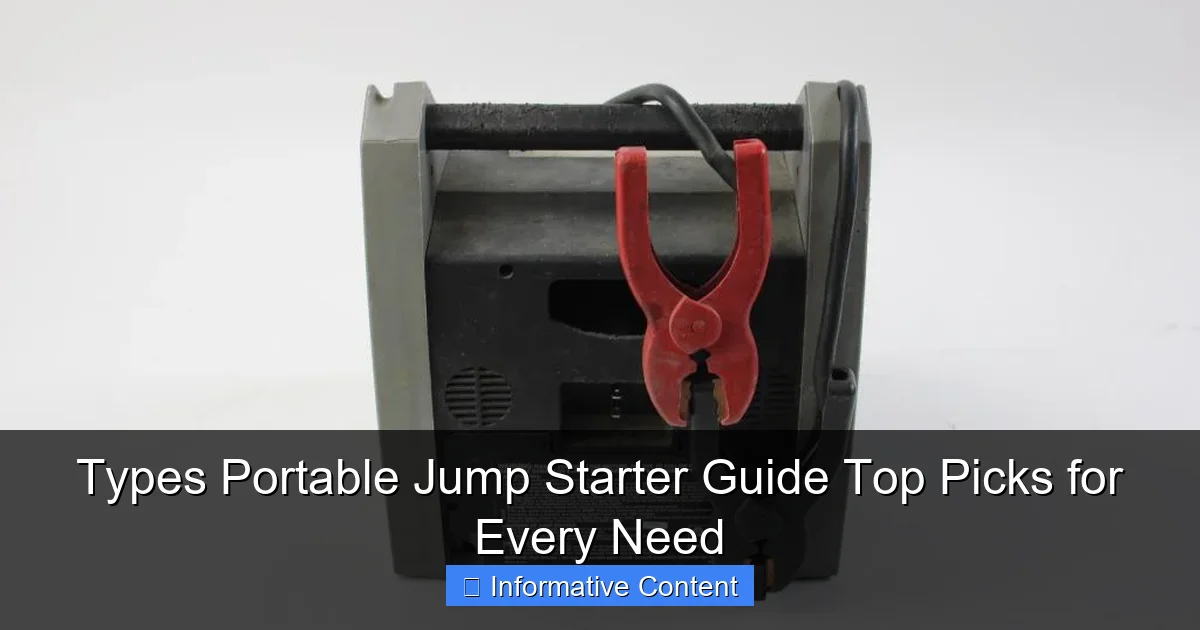
Featured image for types portable jump starter
Image source: content.propertyroom.com
Portable jump starters come in three main types—lithium-ion, lead-acid, and ultra-capacitor—each offering unique advantages for different needs. Lithium-ion models are compact and powerful, ideal for everyday vehicles and emergency kits, while lead-acid units deliver high cranking power for larger engines but are bulkier. Ultra-capacitor jump starters stand out by requiring no internal battery, making them reliable in extreme temperatures and perfect for long-term storage.
Key Takeaways
- Choose lithium-ion jump starters for lightweight, compact, and reliable performance in most vehicles.
- Opt for high-CCA models if you drive trucks or SUVs in cold climates.
- Prioritize safety features like spark-proof tech and reverse polarity protection.
- Pick multi-function units with USB ports and air compressors for emergency versatility.
- Check battery capacity (measured in peak amps) to match your engine size.
- Store in a dry, cool place to extend lifespan and ensure reliability.
📑 Table of Contents
- The Lifesaving Gadget Every Driver Should Own
- 1. Lithium-Ion Jump Starters: The Lightweight Champions
- 2. Lead-Acid Jump Starters: The Old-School Powerhouses
- 3. Ultra-Capacitor Jump Starters: The Cold Weather Specialists
- 4. Multi-Function Jump Starters: The Swiss Army Knives of Car Tools
- 5. Compact and Keychain Jump Starters: The Minimalist Option
- 6. Choosing the Right Jump Starter: Your Perfect Match
The Lifesaving Gadget Every Driver Should Own
Imagine this: you’re late for work, the car won’t start, and your phone is already at 10%. You pop the hood, see a battery that looks fine, and realize you’re stranded—no jumper cables, no helpful passerby. Sound familiar? That’s where a portable jump starter becomes your best friend. These compact, powerful devices have saved me more times than I can count, especially during cold winter mornings when my old sedan just won’t wake up.
But here’s the catch: not all portable jump starters are created equal. Some are built for tiny compacts, others for heavy-duty trucks, and a few can even charge your phone or power a mini-fridge. With so many options, it’s easy to end up with a device that’s overkill or underpowered. Whether you’re a city commuter, an off-road adventurer, or a parent with a minivan full of kids, there’s a perfect match out there. This guide breaks down the different types of portable jump starters, so you can pick the right one—no more guessing, no more frustration.
1. Lithium-Ion Jump Starters: The Lightweight Champions
Lithium-ion jump starters are the most popular type, and for good reason. They’re small, lightweight, and pack a serious punch. Think of them as the “Swiss Army knife” of car batteries—versatile, easy to carry, and always ready when you need them.
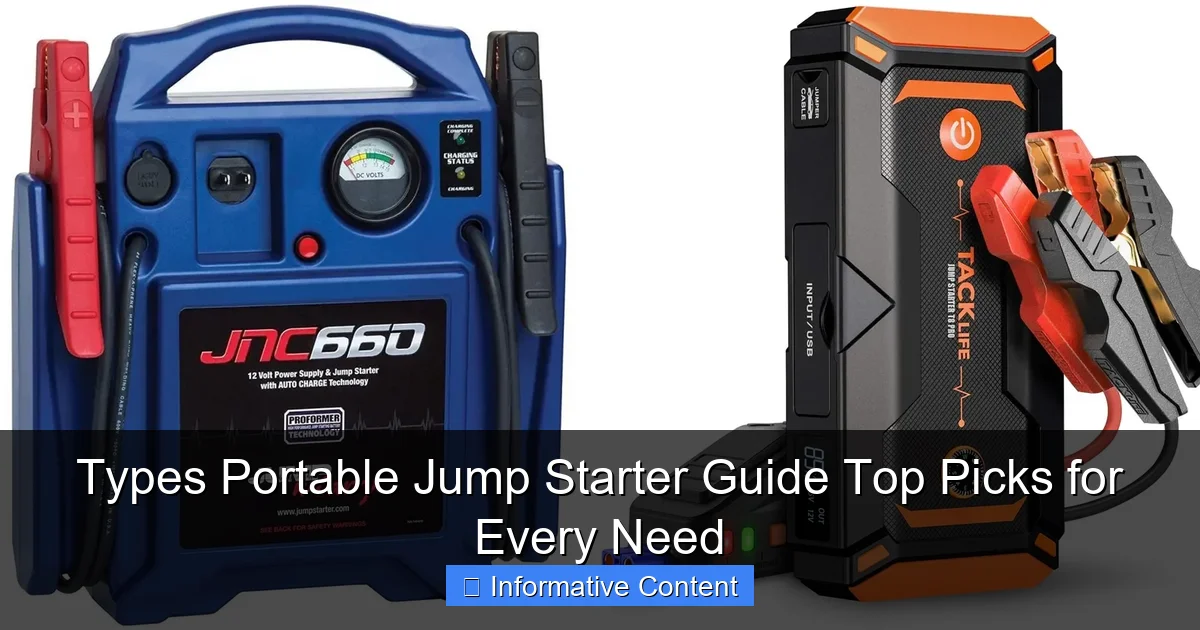
Visual guide about types portable jump starter
Image source: docerp.s3.amazonaws.com
How They Work and Why They’re Great
These jump starters use lithium-ion batteries, the same tech found in smartphones and electric cars. Their high energy density means they deliver a lot of power without adding bulk. Most weigh less than 2 pounds and fit in your glovebox or center console.
- Fast charging: Many models fully recharge in 3–5 hours.
- Long shelf life: Retain charge for months, even without use.
- Built-in safety: Overcharge, short-circuit, and reverse polarity protection.
- Extra features: USB ports, LED flashlights, and even air compressors on some models.
For example, the NOCO Boost Plus GB40 (1,000 amps) can jump-start a 6.0L gas or 3.0L diesel engine up to 20 times on a single charge. It’s about the size of a large smartphone and includes a bright LED flashlight—perfect for nighttime emergencies.
Who Should Buy a Lithium-Ion Jump Starter?
This type is ideal for:
- Daily drivers with standard gas or small diesel engines.
- Urban commuters who want something compact and easy to store.
- People who also want a backup power bank for phones or tablets.
My sister keeps one in her hatchback. Last winter, it revived her car three times in one week during an ice storm. She even used it to charge her phone while waiting for roadside assistance. That’s the beauty of lithium-ion: it’s not just a jump starter—it’s a multi-tool for modern drivers.
Things to Watch Out For
While lithium-ion jump starters are fantastic, they’re not perfect:
- Performance in extreme cold: Below 32°F (0°C), battery output drops. Some models have “cold weather” modes, but it’s still a limitation.
- Lifespan: Most last 3–5 years with regular use. After that, capacity fades.
- Price: Higher-quality models can cost $80–$150, but you’re paying for reliability.
Tip: If you live in a cold climate, look for models with “low-temperature performance” ratings or keep the jump starter inside your home or garage when possible. A device that’s warm will work much better than one left in a freezing trunk.
2. Lead-Acid Jump Starters: The Old-School Powerhouses
Before lithium-ion took over, lead-acid jump starters ruled the market. These are the bulky, heavy units you might remember from your dad’s toolbox—often called “jump boxes” or “battery boosters.” They’re still around for a reason: raw power.
Strengths: Why They’re Still Relevant
Lead-acid jump starters use the same battery technology as your car. That means they’re built to handle high-current bursts, making them excellent for:
- Large engines: V8 trucks, SUVs, and diesel vehicles that need 1,500+ amps.
- Commercial use: Mechanics, fleet operators, or roadside assistance teams.
- Long-term storage: Can sit for years with minimal self-discharge.
Take the Schumacher DSR115—a 3000-amp beast that can jump-start a Class A motorhome or a construction vehicle. It weighs over 20 pounds and includes a built-in air compressor and work light. It’s not something you’d carry in your backpack, but it’s a workshop essential.
Drawbacks: The Trade-Offs
Of course, lead-acid has downsides:
- Weight and size: Most weigh 15–30 pounds. Not practical for daily carry.
- Recharge time: Takes 12–24 hours to fully charge, and you need a wall outlet.
- Shorter shelf life: Can lose charge faster if not used regularly.
- No extra features: Rarely include USB ports or flashlights.
I used a lead-acid unit at a family farm last summer. It jump-started a 1970s tractor with a dead battery in one try. But lugging it from the barn to the field? Not fun. If you need brute force and don’t mind the weight, it’s a solid choice. But for everyday use, most people prefer lighter options.
When to Choose Lead-Acid
Stick with lead-acid if:
- You drive large diesel trucks, RVs, or heavy equipment.
- You want a backup for your garage or shop.
- You’re on a tight budget—some models cost under $100.
<
Just remember: it’s a “set it and forget it” tool. Charge it monthly, and it’ll be ready when you need it.
3. Ultra-Capacitor Jump Starters: The Cold Weather Specialists
Here’s a lesser-known but brilliant option: ultra-capacitor jump starters. These use capacitors instead of batteries, which means they charge and discharge almost instantly. And they work *incredibly* well in freezing temperatures.
How Ultra-Capacitors Work (And Why They’re Cool)
Unlike batteries, which store energy chemically, capacitors store energy physically. This gives them two huge advantages:
- Instant charging: Plug into a working car’s battery for 1–5 minutes, and it’s ready to jump-start another.
- Cold weather performance: Works down to -40°F (-40°C). No battery degradation in cold.
The Clore Automotive Jump-N-Carry JNC300 is a classic example. It has a 12-volt capacitor bank and can jump-start a dead battery even if the donor car’s battery is weak. No waiting, no wall charger needed.
Best Use Cases
Ultra-capacitor jump starters shine in these situations:
- Extreme climates: Perfect for Alaska, Canada, or mountain towns.
- Emergency services: Police, firefighters, or roadside crews who need fast, reliable jumps.
- Fleet operations: Jump-start multiple vehicles in a row without recharging.
My cousin, a mechanic in Colorado, uses one daily. He says, “I jump three trucks before my coffee’s even cold. No battery to charge, no worries about freezing.” It’s a game-changer in cold environments.
Limitations to Consider
But ultra-capacitors aren’t for everyone:
- No standalone power: Can’t charge from a wall outlet—needs another car’s battery to charge up.
- Lower capacity: Not ideal for multiple jumps or large engines.
- Higher cost: Often $150+ due to advanced tech.
If you live in a warm area and just need a backup for your daily driver, a lithium-ion unit is probably better. But if you’re in a cold climate or need rapid-fire jumps, ultra-capacitors are worth the investment.
4. Multi-Function Jump Starters: The Swiss Army Knives of Car Tools
Why carry three devices when one can do it all? Multi-function jump starters bundle jump-starting with other tools like air compressors, power banks, flashlights, and even tire inflators. They’re the ultimate “just in case” gadgets.
What’s Included (And Why It Matters)
These units typically offer:
- Jump-starting: 600–2,000 amps for most passenger vehicles.
- Air compressor: Inflate tires, sports gear, or air mattresses.
- USB ports: Charge phones, tablets, or GPS devices.
- LED lights: Flashlight, strobe, or SOS mode for emergencies.
- 12V outlet: Power small appliances like coolers or fans.
The DBPOWER 2000A Portable Jump Starter is a great example. It has a 2000-amp jump capacity, a built-in air pump (up to 150 PSI), and dual USB ports. I used it to jump my car *and* inflate a flat bike tire during a road trip. Saved me a trip to the mechanic.
Who Benefits Most?
Multi-function jump starters are perfect for:
- Road trippers: Handle car, phone, and tire issues in one device.
- Outdoor enthusiasts: Campers, hikers, or boaters who need versatile tools.
- Parents: Keep kids’ tablets charged during long drives.
One friend uses hers to power a mini-fridge in her SUV during soccer tournaments. “It’s like a tiny generator,” she says. “I jump-start the car, then keep the snacks cold.”
Trade-Offs and Tips
But more features mean more complexity:
- Size and weight: Heavier than basic jump starters (3–5 pounds).
- Battery drain: Using the air compressor or lights reduces jump-start capacity.
- Cost: $100–$200, but you’re paying for versatility.
Tip: If you buy a multi-function unit, test *all* features before you need them. I once had a model where the air compressor failed mid-inflation—lesson learned. Always keep a manual pump as backup.
5. Compact and Keychain Jump Starters: The Minimalist Option
For drivers who want the ultimate in convenience, compact jump starters are a game-changer. These tiny devices (some smaller than a deck of cards) are designed for quick, light-duty jumps. Think of them as the “emergency backup” for your emergency backup.
Size, Power, and Use Cases
Compact models typically offer:
- 300–600 amps: Enough for 4-cylinder cars and small SUVs.
- Keychain or pocket-sized: Easy to carry everywhere.
- USB charging: Recharge via car outlet or wall adapter.
The GOOLOO GP400 is a favorite. It’s 6.5 inches long, weighs 1 pound, and fits in a glovebox. It can jump-start a 5.0L gas engine up to 10 times. I keep one in my backpack—it’s saved me twice when my car died in parking garages.
Ideal for These Drivers
Choose a compact model if:
- You drive a small car or hybrid.
- You want a backup for your main jump starter.
- You hate clutter in your car.
<
My neighbor, a city driver, says, “I don’t need a 20-pound brick. My car’s tiny, and I just want something that works.” That’s the mindset here—minimalist, reliable, and always ready.
Limitations: Know the Boundaries
But compact units have limits:
- Not for large engines: Struggle with V6s, V8s, or diesel trucks.
- Shorter lifespan: Smaller batteries degrade faster.
- Fewer features: Rarely include compressors or work lights.
Tip: Pair a compact jump starter with a traditional lithium-ion unit for the best of both worlds. Keep the small one in your bag and the larger one in the car.
6. Choosing the Right Jump Starter: Your Perfect Match
Now that you know the types, how do you pick the right one? It comes down to your vehicle, lifestyle, and needs. Here’s a quick guide.
Step 1: Match the Amps to Your Engine
Check your car’s manual or battery label. As a rule:
- 4-cylinder gas: 400–600 amps.
- V6 gas: 600–1,000 amps.
- V8 gas or small diesel: 1,000–1,500 amps.
- Large diesel or heavy equipment: 1,500+ amps (lead-acid or commercial models).
Step 2: Consider Your Climate and Lifestyle
- Cold areas: Ultra-capacitor or lithium-ion with cold-weather mode.
- Warm areas: Any lithium-ion model.
- Road trips: Multi-function with air compressor.
- Daily commute: Compact or standard lithium-ion.
Step 3: Check Safety and Warranty
Always look for:
- Safety certifications: UL, CE, or FCC.
- Reverse polarity protection: Prevents damage if cables are reversed.
- Warranty: At least 1–2 years.
Comparison Table: Top Picks by Type
| Type | Best For | Top Model | Price Range | Key Features |
|---|---|---|---|---|
| Lithium-Ion | Daily drivers, small to mid-size vehicles | NOCO GB40 | $80–$120 | 1,000A, USB, flashlight, 20 jumps |
| Lead-Acid | Large trucks, RVs, heavy equipment | Schumacher DSR115 | $100–$200 | 3,000A, air compressor, 20+ lbs |
| Ultra-Capacitor | Extreme cold, rapid jumps | Clore JNC300 | $150–$200 | No battery, -40°F, 5-min charge |
| Multi-Function | Road trips, outdoor adventures | DBPOWER 2000A | $120–$180 | 2,000A, air pump, USB, flashlight |
| Compact | Minimalist, small cars | GOOLOO GP400 | $60–$100 | 600A, keychain size, 10 jumps |
Remember: the best portable jump starter is the one you have when you need it. Don’t wait until your car won’t start to buy one. Test it every few months, keep it charged, and store it where you can reach it fast.
Whether you’re a city dweller, a truck driver, or a weekend warrior, there’s a jump starter that fits your life. And when that moment comes—the one where your car clicks and dies—you’ll be ready. No more panic, no more waiting. Just pop the hood, connect the clamps, and drive away. That’s peace of mind in a box.
Frequently Asked Questions
What are the main types of portable jump starters available?
Portable jump starters come in three primary types: lithium-ion (lightweight and compact), lead-acid (heavy-duty with higher cranking power), and capacitor-based (ultra-fast charging). Each type suits different needs, from daily drivers to heavy trucks.
Which portable jump starter type is best for cold weather?
Lithium-ion jump starters with cold-cranking amps (CCA) ratings above 1,000 are ideal for freezing conditions. They outperform lead-acid in sub-zero temperatures due to better battery chemistry.
Can a portable jump starter work with diesel engines?
Yes, but you’ll need a high-amp model (2,000+ peak amps) like heavy-duty lithium-ion or lead-acid types. Always verify compatibility with your diesel engine’s requirements.
Are lithium-ion jump starters safer than lead-acid types?
Lithium-ion types are generally safer, with built-in protections against overheating and short circuits. Lead-acid models require more caution due to their bulk and acid content.
How do I choose the right portable jump starter for my car?
Match the starter to your engine size (e.g., 400-600A for sedans, 1,000A+ for SUVs). Consider portability, extra features (USB ports, lights), and the types of vehicles you own.
Do portable jump starters require maintenance?
Lithium-ion types are maintenance-free, while lead-acid models need occasional charging if unused. Capacitor-based starters require no maintenance but degrade faster over time.