
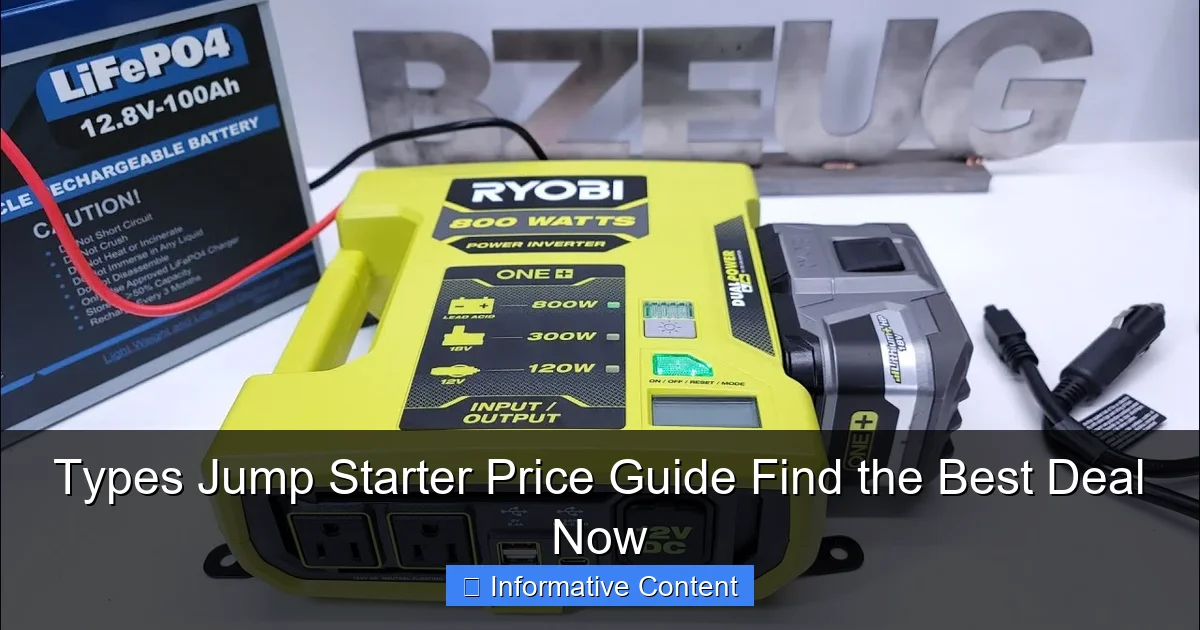
Featured image for types jump starter price
Image source: everstartjumpstarter.com
Jump starter prices vary widely—from $50 for basic models to over $300 for high-capacity, multi-function units—so knowing the types helps you avoid overpaying. Key factors like peak amps, battery type (lithium vs. lead-acid), and added features (USB ports, air compressors) directly impact cost and performance. Choose wisely: affordable options work for emergencies, but invest more for frequent use or larger vehicles.
Key Takeaways
- Compare types: Lithium-ion jump starters cost more but are compact and efficient.
- Budget wisely: Basic lead-acid models offer affordability for occasional use.
- Check peak amps: Higher amps deliver faster starts but increase price.
- Prioritize safety: Smart clamps and overload protection justify premium prices.
- Evaluate extras: Built-in flashlights and USB ports add value to mid-range models.
- Read reviews: Real-world performance often reveals better deals than specs alone.
📑 Table of Contents
- Why Jump Starters Are a Lifesaver (And What They Cost)
- Understanding the Different Types of Jump Starters
- What Influences Jump Starter Prices? (Beyond Just the Type)
- Price Ranges for Every Budget (And Who They’re For)
- Hidden Costs and Long-Term Value: What You’re Really Paying For
- Data Table: Comparing Top Jump Starters by Price and Features
- Conclusion: Finding Your Perfect Jump Starter (Without Overpaying)
Why Jump Starters Are a Lifesaver (And What They Cost)
Remember the last time your car battery died at the worst possible moment? Maybe it was early in the morning before work, or worse—during a cold winter night when you were already running late. That helpless feeling, standing by a silent car with a dead battery, is something no driver should have to endure. Enter the jump starter: a portable device that can bring your car back to life without needing another vehicle or a tow truck. It’s like having a personal roadside rescue team in your trunk.
Jump starters have come a long way from the bulky, unreliable units of the past. Today, they’re compact, powerful, and packed with features like USB charging ports, LED flashlights, and even air compressors. But with so many options on the market, how do you choose the right one? More importantly, how much should you expect to spend? The types jump starter price varies widely based on features, capacity, and brand. In this guide, we’ll break down everything you need to know to find the best deal—no fluff, no sales pitch, just honest advice to help you make a smart purchase.
Understanding the Different Types of Jump Starters
Not all jump starters are created equal. The types jump starter price depends heavily on the technology and design behind each model. Let’s dive into the most common types you’ll encounter, along with their pros, cons, and what they typically cost.

Visual guide about types jump starter price
Image source: d3j17a2r8lnfte.cloudfront.net
Traditional Lead-Acid Jump Starters (Heavy-Duty)
These are the old-school units you might remember from your dad’s garage. They use lead-acid batteries, the same type found in most car batteries. They’re bulky, heavy (often 15–30 pounds), and require regular charging to stay ready. But they’re also known for their high cranking power—perfect for large engines like trucks, SUVs, or boats.
- Price Range: $50–$150
- Best For: Drivers with large vehicles, frequent use, or those who don’t mind the weight
- Pros: High power, durable, can jump-start multiple vehicles on one charge
- Cons: Heavy, slow to recharge, not ideal for daily carry
Example: The Schumacher DSR115 is a popular lead-acid model priced around $120. It delivers 2200 peak amps and includes a built-in air compressor—great for roadside emergencies.
Portable Lithium-Ion Jump Starters (Compact and Convenient)
These are the modern go-to for most drivers. Lightweight (often under 2 pounds), compact enough to fit in a glovebox, and powered by lithium-ion batteries, they’re the Swiss Army knives of jump starters. They’re ideal for cars, motorcycles, and small boats.
- Price Range: $60–$200
- Best For: Everyday drivers, commuters, and those who want a lightweight, easy-to-use option
- Pros: Compact, fast recharge, often includes USB ports and flashlights
- Cons: Lower cranking power than lead-acid, battery life degrades over time
Tip: Look for models with at least 1000 peak amps for reliable performance on most 4- to 6-cylinder engines. The Noco Boost Plus GB40 ($100) is a favorite—compact, powerful, and packed with features.
Smart Jump Starters (Tech-Enhanced)
These are lithium-ion jump starters with added intelligence. They feature built-in safety systems (like reverse polarity protection), digital displays, and even smartphone app connectivity. Some can monitor battery health and provide real-time diagnostics.
- Price Range: $100–$300+
- Best For: Tech-savvy drivers, those who want extra safety and convenience
- Pros: Safer to use, advanced features, often more reliable
- Cons: Higher cost, some features may be overkill for casual users
Example: The GOOLOO GP4000 ($150) includes a 400-lumen LED light, USB-C charging, and a digital display showing remaining power. It’s a great middle-ground between performance and tech.
Jump Starters with Air Compressors (Multi-Functional)
Why carry two devices when one can do both? These models combine a jump starter with a built-in air compressor, letting you inflate tires, sports equipment, or air mattresses. They’re a bit heavier but incredibly versatile.
- Price Range: $100–$250
- Best For: Drivers who frequently deal with flat tires or outdoor gear
- Pros: Two tools in one, saves space, great for road trips
- Cons: Slower to jump-start due to shared power, bulkier than standard models
Tip: If you camp or bike often, this could be a game-changer. The DEWALT DXAEJ14 ($180) offers 1400 peak amps and a 120 PSI air compressor—perfect for trucks and SUVs.
What Influences Jump Starter Prices? (Beyond Just the Type)
You might be wondering: “Why do two lithium-ion jump starters with similar specs have such different price tags?” The types jump starter price isn’t just about the battery type—it’s shaped by several hidden factors. Let’s break them down.
Peak Amps vs. Cranking Amps: What Matters Most?
You’ll often see two numbers on a jump starter’s label: peak amps and cranking amps. Here’s the difference:
- Peak Amps: The maximum power the device can deliver in a burst (usually for 3–5 seconds). This is what helps start a dead engine.
- Cranking Amps (CA) / Cold Cranking Amps (CCA): The power delivered over a longer period (30 seconds), measured at room temperature (CA) or in freezing conditions (CCA). This matters more in cold weather.
Higher amps = more power, but not always better. A 1000-amp jump starter might cost $80, while a 2000-amp model costs $150—even if your car only needs 800 amps. Match the power to your vehicle: most sedans and compacts need 600–1000 amps, while trucks and SUVs may require 1200+.
Tip: Check your car’s manual for the recommended CCA. Don’t overspend on power you won’t use.
Battery Capacity (mAh) and Recharge Cycles
The battery’s capacity, measured in milliamp-hours (mAh), affects how many jumps you can get on one charge and how long it lasts. A 10,000 mAh battery might cost less than a 20,000 mAh one, but it also holds less charge.
- Low-capacity (8,000–12,000 mAh): Good for 2–3 jumps. Often cheaper ($60–$100).
- High-capacity (15,000–20,000+ mAh): Can handle 5–10 jumps. Pricier ($120–$200+).
Also consider recharge cycles—how many times the battery can be charged before degrading. A $100 jump starter might offer 500 cycles, while a $200 model offers 1,000. Over time, that’s a better value.
Safety Features and Smart Technology
Cheaper jump starters often lack critical safety features. For example:
- Reverse Polarity Protection: Prevents damage if you connect the clamps backward.
- Overcharge/Overheat Protection: Stops charging when the battery is full or too hot.
- Short-Circuit Protection: Avoids sparks if the clamps touch.
These features add cost but are worth it. A $50 jump starter without protection could damage your car’s electronics—or worse, cause a fire. Spend a little more for peace of mind.
Brand Reputation and Warranty
You might pay more for a Noco or GOOLOO because they’re trusted brands with excellent customer support and longer warranties (often 2–3 years). A no-name brand might cost half as much but could fail when you need it most.
Pro Tip: Look for a warranty of at least 1 year. If a company offers 3 years, they likely stand behind their product.
Price Ranges for Every Budget (And Who They’re For)
Let’s get real: how much should you spend? The types jump starter price can range from $40 to $300+, but you don’t need to break the bank. Here’s a breakdown by budget and use case.
Budget-Friendly Options ($40–$80)
These are great for occasional use or as a backup. They’re compact, lightweight, and perfect for small cars.
- Best For: City drivers, commuters, or as a secondary device
- What to Expect: 600–1000 peak amps, 8,000–12,000 mAh, basic safety features
- Examples:
- DBPOWER 800A ($50): 12,000 mAh, USB charging, LED flashlight
- Clore Automotive Jump-N-Carry JNC300XL ($75): 800 peak amps, compact design
Note: These may struggle with cold starts or large engines. But for a quick jump in mild weather? They work.
Mid-Range Jump Starters ($80–$150)
The sweet spot for most drivers. You get more power, better safety, and extra features like USB ports and flashlights.
- Best For: Everyday use, SUVs, trucks, and cold climates
- What to Expect: 1000–2000 peak amps, 12,000–18,000 mAh, advanced safety features
- Examples:
- Noco Boost Plus GB40 ($100): 1000 peak amps, 12,000 mAh, reverse polarity protection
- GOOLOO GP2000 ($130): 2000 peak amps, 18,000 mAh, built-in air compressor
Tip: This range often includes models with smart technology—great if you want extra peace of mind.
Premium Jump Starters ($150–$300+)
For drivers who want the best: maximum power, advanced features, and long-term reliability.
- Best For: Large vehicles, frequent use, tech enthusiasts, or as a primary emergency tool
- What to Expect: 2000–4000+ peak amps, 18,000–30,000+ mAh, app connectivity, air compressors, 3+ year warranties
- Examples:
- Noco Boost HD GB70 ($200): 2000 peak amps, 24,000 mAh, 3-year warranty
- DEWALT DXAEJ14 ($180): 1400 peak amps, 120 PSI air compressor
Pro Insight: Premium models often last 5+ years with proper care. If you drive often or live in a cold climate, they’re worth the investment.
Hidden Costs and Long-Term Value: What You’re Really Paying For
When comparing jump starters, it’s easy to focus on the sticker price. But the types jump starter price isn’t just about the initial cost—it’s about value over time. Let’s look at the hidden factors that affect your long-term satisfaction.
Battery Degradation and Replacement
Lithium-ion batteries degrade over time, even if you don’t use the jump starter. Most lose about 5–10% of their capacity per year. A $100 model might last 3 years before needing a battery replacement (if that’s even possible). A $200 model with a high-quality battery could last 5+ years.
Tip: Store your jump starter at 50% charge in a cool, dry place. Avoid extreme temperatures—heat accelerates degradation.
Recharge Time and Charging Methods
How long does it take to recharge? A cheap model might take 6–8 hours with a wall charger. A premium model could recharge in 2–3 hours—or even faster with USB-C. Faster recharge = more convenience.
Also consider charging options: Can you charge it in your car (via 12V outlet), or do you need a wall plug? Some models include both.
Durability and Build Quality
A $50 jump starter might feel plasticky and fragile. A $150+ model often uses rugged, shock-resistant materials. If you toss it in your trunk or take it camping, durability matters.
- Cheap: May crack if dropped
- Premium: Often water-resistant, drop-tested, and designed for harsh conditions
Extra Features: Are They Worth It?
Many jump starters include extras like:
- USB Ports: Charge your phone, tablet, or GPS
- LED Flashlight: Useful during nighttime jumps
- Air Compressor: Inflate tires or sports gear
- Digital Display: Shows battery level, voltage, or error codes
These features add cost, but they can save you from carrying multiple devices. If you’re a road-tripper or outdoor enthusiast, they’re worth the extra $20–$50.
Data Table: Comparing Top Jump Starters by Price and Features
| Model | Type | Peak Amps | Capacity (mAh) | Key Features | Price |
|---|---|---|---|---|---|
| DBPOWER 800A | Lithium-Ion | 800 | 12,000 | USB ports, LED light | $50 |
| Noco Boost Plus GB40 | Lithium-Ion | 1000 | 12,000 | Reverse polarity protection, compact | $100 |
| GOOLOO GP2000 | Lithium-Ion | 2000 | 18,000 | Air compressor, digital display | $130 |
| Schumacher DSR115 | Lead-Acid | 2200 | N/A | Air compressor, heavy-duty | $120 |
| Noco Boost HD GB70 | Lithium-Ion | 2000 | 24,000 | 3-year warranty, rugged build | $200 |
| DEWALT DXAEJ14 | Lithium-Ion | 1400 | 15,000 | 120 PSI air compressor, durable | $180 |
Conclusion: Finding Your Perfect Jump Starter (Without Overpaying)
Choosing the right jump starter isn’t just about finding the cheapest option—it’s about matching the device to your needs, vehicle, and lifestyle. The types jump starter price varies widely, but with this guide, you now know what to look for: battery type, power, safety features, and long-term value.
Start by asking yourself:
- What type of vehicle do I drive? (Small car vs. SUV/truck)
- How often will I use it? (Occasional backup vs. daily driver)
- What features matter most? (USB ports, flashlight, air compressor)
- What’s my budget? (And am I okay with paying more for durability?)
For most drivers, a mid-range lithium-ion jump starter ($80–$150) offers the best balance of power, portability, and features. If you have a large vehicle or live in a cold climate, consider a premium model. And if you’re on a tight budget, a basic lithium-ion unit will still get the job done—just don’t expect it to last a decade.
Remember: a jump starter isn’t just a tool—it’s peace of mind. The next time your battery dies, you’ll be ready. No more waiting for a jump, no more calling a tow truck. Just grab your jump starter, connect the clamps, and get back on the road.
So, what are you waiting for? Use this guide to find the best deal on the perfect jump starter for you. Your future self (and your car) will thank you.
Frequently Asked Questions
What are the different types of jump starter prices on the market?
Jump starter prices vary widely based on type: portable lithium-ion models range from $50-$200, traditional lead-acid units cost $80-$300, while high-end smart jump starters with USB ports and safety features can reach $400+. Your budget and needs will determine the best value.
How does the price of lithium jump starters compare to lead-acid types?
Lithium jump starters are generally 20-40% more expensive than lead-acid types of the same power capacity, but they offer lighter weight, faster charging, and longer lifespans – making them cost-effective over time.
Are expensive jump starters worth the higher price tag?
Premium jump starters ($200+) often justify their price with advanced features like battery health detection, surge protection, built-in air compressors, and smartphone connectivity. For frequent users or harsh climates, these features can be worth the investment.
What factors most affect types of jump starter prices?
The main price drivers are battery chemistry (lithium vs lead-acid), peak amperage (300A-4000A), included accessories (air pumps, lights), and smart features. Higher cranking power and additional functions always increase the types jump starter price.
Where can I find the best deals on quality jump starters?
Check automotive retailers during seasonal sales (Black Friday, spring maintenance events) and compare prices across Amazon, Walmart, and specialized tool sites. Many brands offer holiday discounts on their websites for first-time buyers.
Do I really need to pay more for a jump starter with safety features?
Yes – models with spark-proof technology, reverse polarity protection, and automatic shutoff may cost 15-25% more but prevent costly damage to your vehicle’s electrical system and enhance user safety during emergencies.