
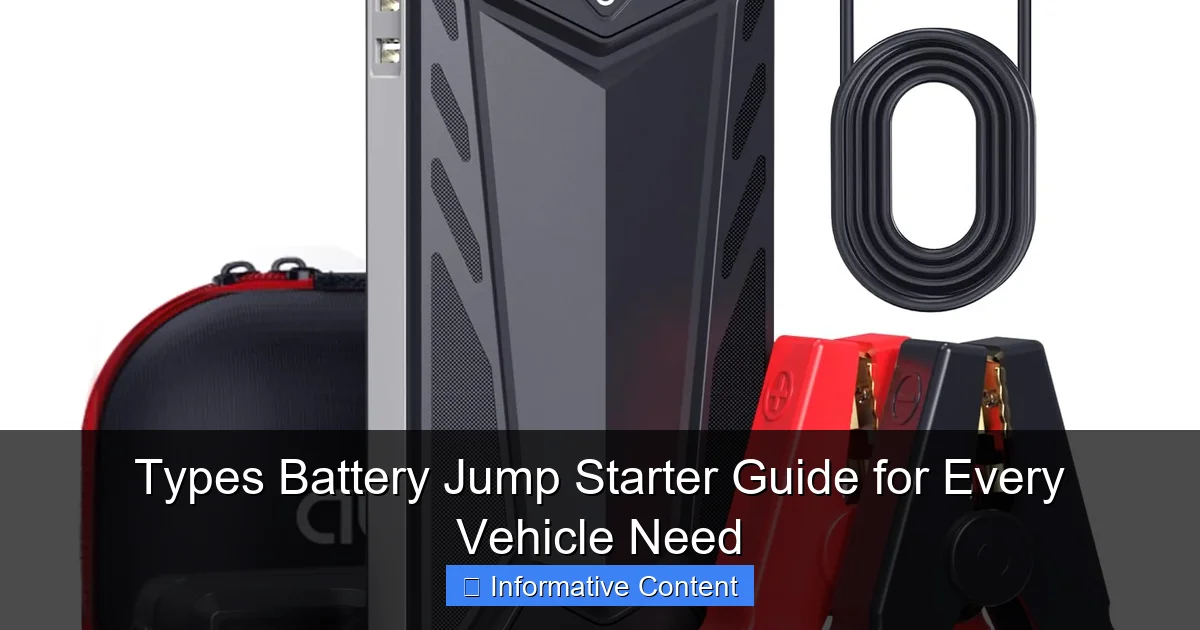
Featured image for types battery jump starter
Image source: m.media-amazon.com
Choosing the right battery jump starter depends on your vehicle type and power needs—from compact lithium-ion models ideal for small cars to heavy-duty jump boxes with high cranking amps for trucks and SUVs. Portable, rechargeable units offer convenience and safety features like reverse polarity protection, making them a smart investment for roadside emergencies and everyday peace of mind.
Key Takeaways
- Choose lithium-ion jump starters for portability and quick engine starts in most vehicles.
- Opt for lead-acid models if you need higher cranking power for large engines.
- Check peak amperage ratings to ensure compatibility with your vehicle’s engine size.
- Prioritize safety features like reverse polarity protection and spark-proof clamps.
- Look for multi-function units with USB ports and LED lights for added utility.
- Store in a dry, cool place to prolong battery life and performance.
📑 Table of Contents
Why a Battery Jump Starter Is a Must-Have in Your Vehicle
We’ve all been there—turning the key in the ignition and hearing nothing but a faint click. Or worse, the engine groans, sputters, and dies. A dead battery doesn’t care if you’re late for work, rushing to a doctor’s appointment, or stranded in a dark parking lot. It happens to everyone, from seasoned road warriors to first-time car owners. That’s where a battery jump starter becomes more than just a handy tool—it’s a lifeline.
I remember a cold winter morning when my car refused to start. I was alone, with no jumper cables, and the nearest mechanic was 20 miles away. A kind stranger stopped to help, but his jumper cables were too short. It was only after he pulled out a compact jump starter that I realized how much I’d been missing. No waiting. No awkward coordination. Just a quick connection and a roar of the engine. That day taught me: a reliable battery jump starter isn’t a luxury—it’s essential. But not all jump starters are created equal. Knowing the types of battery jump starters can mean the difference between a quick fix and another stressful delay.
Understanding How Jump Starters Work
Basic Functionality of Jump Starters
At its core, a battery jump starter is a portable power bank designed to deliver a high burst of current to a vehicle’s dead battery. Unlike traditional jumper cables that rely on another vehicle’s battery, a jump starter is self-contained. It stores energy in internal lithium-ion or lead-acid cells and releases it when needed through clamps connected to your car’s battery terminals.
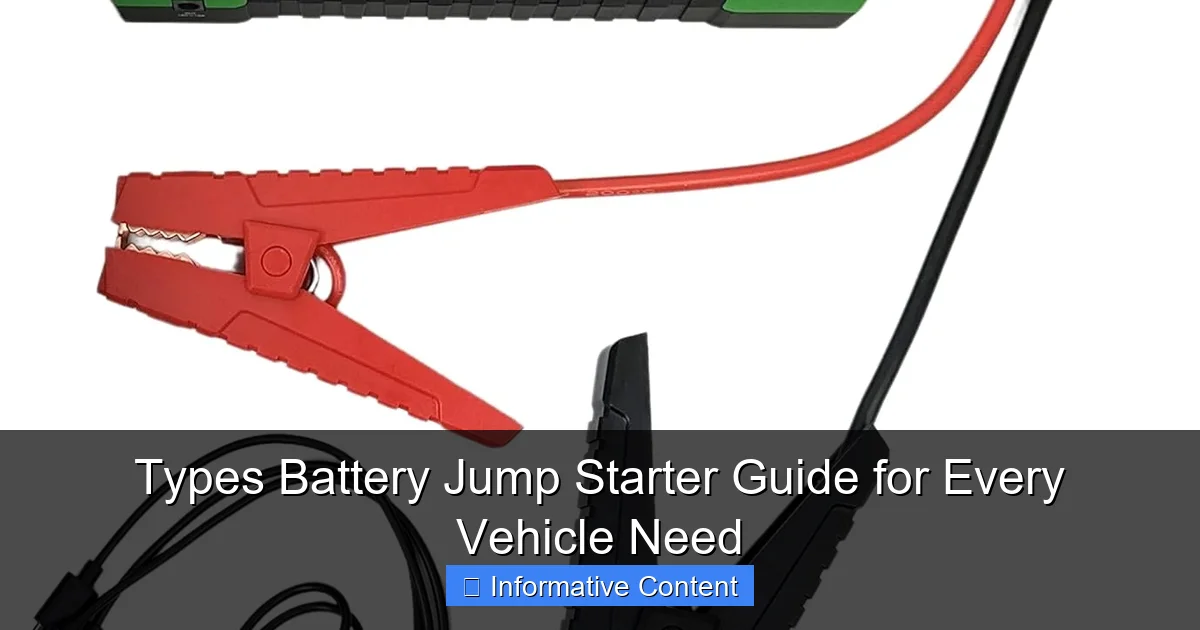
Visual guide about types battery jump starter
Image source: m.media-amazon.com
The process is simple: connect the positive (red) clamp to the positive terminal, the negative (black) to a grounded metal surface (not the negative terminal), and power on the device. Once activated, the jump starter sends a surge of electricity—typically between 12V and 24V—to “jump” the starter motor and crank the engine. Some models even have built-in safety features like reverse polarity protection, spark-proof connections, and overload warnings.
Key Components That Make a Difference
- Battery Type: Determines longevity, recharge time, and performance in extreme temperatures. Lithium-ion batteries are lighter and more efficient, while lead-acid units are heavier but often more affordable.
- Peak and Cranking Amps: Peak amps measure the maximum output during startup. Cranking amps (CA) and cold-cranking amps (CCA) tell you how well the unit performs in warm and cold weather. For example, a 1,500-peak-amp jump starter can handle most sedans, but larger trucks or SUVs may need 2,000+ amps.
- Power Bank Features: Many modern jump starters double as USB power banks. Look for models with 5V/2.1A or higher output for charging phones, tablets, and even laptops.
- Built-in Flashlight: A small but invaluable feature, especially if you’re stranded at night. Some offer SOS modes or strobe lights for emergencies.
- Safety Protections: Reverse polarity, short-circuit, over-charge, and over-current protection are non-negotiable for safe use.
Understanding these components helps you avoid buying a jump starter that’s underpowered or unsafe. For instance, I once bought a cheap model online that claimed 1,200 peak amps. When I tried to jump my SUV in freezing temperatures, it barely made a dent—turns out, it had low CCA and no cold-weather optimization. Lesson learned: specs matter.
Types of Battery Jump Starters: A Detailed Breakdown
Lithium-Ion Jump Starters (Portable Power Packs)
The most popular types of battery jump starters today are lithium-ion portable units. These compact, lightweight devices are perfect for everyday drivers, commuters, and those who value convenience.
Lithium-ion jump starters typically range from 500 to 3,000 peak amps, with most falling between 1,000 and 1,500. They’re rechargeable via USB-C, micro-USB, or wall adapters and can hold a charge for up to 12 months. Their small size—often no bigger than a paperback book—makes them easy to store in a glovebox or under a seat.
Pros:
- Lightweight (1–3 lbs)
- Fast recharge (2–4 hours)
- Multiple USB ports for device charging
- Built-in LED flashlight and safety features
- Great for sedans, hatchbacks, and small SUVs
Cons:
- May struggle with large V6/V8 engines in cold weather
- Performance degrades over time (battery lifespan: 3–5 years)
- Higher initial cost compared to lead-acid
Real-world example: My friend Sarah keeps a NOCO Boost Plus GB40 in her sedan. It’s saved her twice—once when she left her lights on overnight and once during a sudden cold snap. She also uses it to charge her phone on road trips. “It’s like a Swiss Army knife for emergencies,” she says.
Lead-Acid Jump Starters (Heavy-Duty Units)
Lead-acid jump starters are the older, bulkier cousins of lithium-ion models. They’re often found in garages, service vans, and commercial fleets. These units are built like tanks—durable, powerful, and capable of handling multiple jump starts in a row.
They typically offer higher peak amps (up to 5,000+) and are better suited for large vehicles: trucks, RVs, boats, and heavy machinery. However, they’re heavier (10–25 lbs), slower to recharge (8–12 hours), and less portable.
Pros:
- High cranking power (ideal for diesel engines)
- Can jump-start multiple vehicles in succession
- Long shelf life when maintained
- Often include built-in air compressors and work lights
Cons:
- Heavy and bulky
- Longer recharge time
- Require periodic maintenance (topping off electrolyte levels)
- Less safe if dropped or mishandled (contains sulfuric acid)
Practical tip: If you own a diesel pickup or work in construction, a lead-acid unit like the Schumacher DSR115 is worth the investment. Just remember: store it upright, charge it every 3–6 months, and never leave it in extreme heat.
Dual-Battery Jump Starters
For those who want the best of both worlds, dual-battery jump starters combine lithium-ion and lead-acid technology. These units often have a small lithium pack for everyday use and a larger lead-acid backup for heavy-duty needs.
They’re ideal for fleet operators, emergency responders, or off-roaders who need reliability in unpredictable conditions. Some models even allow you to switch between battery types depending on the situation.
Pros:
- Versatile: use lithium for quick jumps, lead-acid for power-hungry engines
- Redundancy: if one battery fails, the other can still work
- Longer overall lifespan
Cons:
- More complex and expensive
- Heavier than standard lithium units
- Require more maintenance
Example: A mechanic I know uses a dual-battery unit from DB Power. He keeps the lithium side charged for daily use and the lead-acid side as a backup during busy weeks. “It’s like having two lifelines,” he jokes.
Smart Jump Starters with Digital Features
Welcome to the future: smart jump starters with digital displays, Bluetooth connectivity, and app integration. These high-tech units go beyond just starting engines—they diagnose battery health, monitor charge levels, and even send alerts to your phone.
Features include:
- LCD screen showing voltage, charge level, and error codes
- App-based diagnostics (e.g., NOCO Genius App)
- Auto-shutoff to prevent over-discharge
- Voice-guided startup instructions
- GPS tracking (in premium models)
Pros:
- User-friendly for non-mechanics
- Proactive battery monitoring
- Reduces user error
- Great for tech-savvy drivers or seniors
Cons:
- Higher price point
- App dependency (what if your phone dies?)
- More components = more potential failure points
Tip: If you’re new to jump starters or often forget to charge your device, a smart model like the Clore Automotive Jump-N-Carry JNC660 with digital readout can be a game-changer. It tells you exactly how much power is left and warns you before it’s too late.
Jump Starters with Air Compressors (2-in-1 Tools)
Flat tire? Dead battery? Why carry two tools when one can do both? Jump starters with built-in air compressors are becoming increasingly popular, especially among SUV and truck owners.
These units combine a standard jump starter with a 12V air pump. Most can inflate car tires, bike tires, sports equipment, and even air mattresses. Some even have preset PSI settings and auto-stop functions.
Pros:
- Two tools in one = less clutter
- Perfect for roadside emergencies
- Useful for outdoor enthusiasts (camping, biking, boating)
Cons:
- Heavier than standard jump starters
- Compressor may drain battery faster
- Less powerful than dedicated air pumps
Real-life use: My brother-in-law keeps a DEWALT DCP580B in his truck. He’s used it to jump-start his diesel engine and inflate his off-road tires on a camping trip. “I’ve saved myself from calling roadside assistance at least three times,” he says. “It’s the ultimate peace-of-mind tool.”
Choosing the Right Jump Starter for Your Vehicle Type
Compact Cars and Sedans
If you drive a Honda Civic, Toyota Corolla, or similar compact vehicle, a lithium-ion jump starter with 800–1,200 peak amps is more than enough. These cars have small 12V batteries and don’t require massive power surges.
Look for models with USB ports and flashlights—bonus points if they’re under 2 pounds. The NOCO Boost HD GB70 (1,500 amps) or the Tacklife T8 (1,800 amps) are excellent choices.
SUVs, Crossovers, and V6 Engines
SUVs like the Toyota RAV4 or Ford Explorer often have larger engines and higher CCA requirements. A jump starter with 1,500–2,000 peak amps and at least 800 CCA is recommended.
Consider models with safety features like spark-proof clamps and reverse polarity alerts. The DB Power DJS50 (2,000 amps) or the Beatit BT-D11 (2,000 amps) handle these vehicles well, even in cold weather.
Trucks, Diesels, and Heavy-Duty Vehicles
For trucks (F-150, Silverado), diesel engines, or commercial vehicles, you need serious power. Aim for 2,500+ peak amps and 1,000+ CCA. Lead-acid or dual-battery units are often the best fit.
The Schumacher DSR115 (3,000 amps) or the Clore Automotive JNC770R (2,000 amps) are trusted by mechanics and truckers alike. They can jump-start multiple vehicles in a row and handle extreme cold.
Motorcycles and ATVs
Motorcycles have smaller batteries (often 12V, 5–12 Ah), so a high-amp jump starter is overkill. Instead, look for compact, low-amperage models designed for bikes.
Units like the NOCO Boost Sport GB20 (500 amps) or the Tacklife T6 (800 amps) are lightweight and safe for 2-wheelers. They’re also great for ATVs, jet skis, and lawn equipment.
Boats and Marine Use
Marine batteries are different from car batteries—they’re deep-cycle and designed for steady power, not short bursts. Still, a jump starter can save you if your boat’s starter battery dies.
Choose a waterproof or water-resistant model with marine-grade clamps. The NOCO Boost Marine GB150 (1,500 amps) is IP65-rated and works in wet conditions. Avoid cheap models with exposed electronics.
Data Table: Jump Starter Comparison by Type
| Type | Peak Amps (Typical) | Weight | Best For | Recharge Time | Lifespan |
|---|---|---|---|---|---|
| Lithium-Ion | 800–2,000 | 1–3 lbs | Sedans, hatchbacks, small SUVs | 2–4 hours | 3–5 years |
| Lead-Acid | 1,500–5,000 | 10–25 lbs | Trucks, RVs, diesel engines | 8–12 hours | 5–7 years (with care) |
| Dual-Battery | 1,000–3,000 | 5–15 lbs | Fleet vehicles, off-roaders | 4–10 hours | 4–6 years |
| Smart Digital | 1,000–2,000 | 2–4 lbs | Tech users, seniors, beginners | 3–5 hours | 3–5 years |
| With Air Compressor | 1,200–2,500 | 4–12 lbs | SUVs, trucks, outdoor use | 4–8 hours | 3–6 years |
Final Thoughts: Pick the Right Tool for Peace of Mind
Choosing the right type of battery jump starter isn’t about buying the most expensive or most powerful model. It’s about matching your needs—your vehicle, your driving habits, and your environment. A city commuter might never need 3,000 amps, but a farmer in rural Alaska definitely will.
From compact lithium-ion units that fit in your glovebox to rugged lead-acid giants that can start a semi-truck, the types of battery jump starters available today are more diverse and capable than ever. Whether you’re a solo driver, a parent with a minivan, or an off-road adventurer, there’s a jump starter that fits your life.
My advice? Don’t wait until you’re stranded. Buy one now, charge it, and test it. Keep it in your car, boat, or garage. Teach your family how to use it. And when that dreaded “click” happens, you’ll be ready—calm, confident, and in control.
Because the best kind of jump starter isn’t just the one that works. It’s the one that gives you peace of mind, every time you turn the key.
Frequently Asked Questions
What are the main types of battery jump starters available?
Battery jump starters come in three primary types: portable lithium-ion, traditional lead-acid, and capacitor-based models. Lithium-ion units are lightweight and ideal for most modern vehicles, while lead-acid offers higher cranking power for heavy-duty needs. Capacitor-based starters are eco-friendly and don’t require charging but are less common.
Which type of battery jump starter is best for cold weather?
Lithium-ion jump starters with low-temperature protection (e.g., Arctic-rated models) are ideal for cold climates. They maintain performance better than lead-acid in freezing conditions, which can reduce traditional batteries’ output by up to 60%.
Can a battery jump starter damage my vehicle’s electronics?
Quality jump starters include safety features like reverse polarity and surge protection to prevent damage. Always choose a reputable brand with built-in safeguards, especially for modern vehicles with sensitive ECUs.
How do capacitor-based jump starters differ from battery-powered ones?
Capacitor-based starters store energy in electrostatic fields, requiring no internal battery—they’re charged via the vehicle’s alternator or a power source. Unlike battery-powered types, they last longer in extreme temperatures but may struggle with high-compression engines.
What’s the best battery jump starter for trucks and SUVs?
Heavy-duty lead-acid or high-amp lithium-ion jump starters (with 2000+ peak amps) are recommended for trucks and SUVs. Look for models with dual battery technology to handle larger engines and frequent use.
Are multi-function jump starters worth the extra cost?
Yes, if you need added features like USB charging, air compressors, or LED lights. Multi-function models combine utility and convenience, making them ideal for road trips or emergency preparedness beyond just jump-starting.