
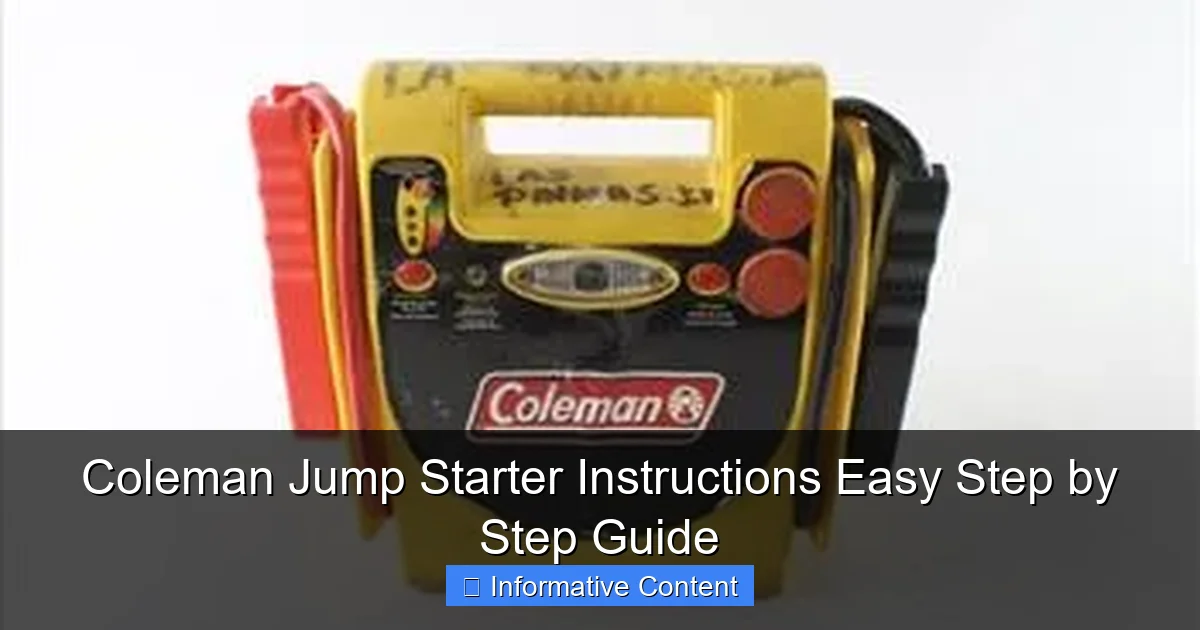
Featured image for coleman jump starter instructions
Image source: content.propertyroom.com
Master your Coleman jump starter in minutes with our clear, step-by-step instructions designed for safe and reliable vehicle jump-starting. From proper cable connection to power activation, this guide ensures you avoid common mistakes and get back on the road fast—no prior experience needed.
Key Takeaways
- Read the manual first: Always review safety guidelines before using your Coleman jump starter.
- Charge fully before use: Ensure the unit is 100% charged for maximum jump-start power.
- Connect red to positive: Attach the red clamp to the battery’s positive terminal securely.
- Black to ground only: Connect black clamp to unpainted metal, never the battery’s negative post.
- Wait 3 minutes: Let the jump starter stabilize before attempting to start the vehicle.
- Turn off accessories: Disable lights, radio, and other electronics during the jump-start process.
📑 Table of Contents
- Why You Need a Reliable Jump Starter (And How to Use It Right)
- Getting to Know Your Coleman Jump Starter
- Step-by-Step: How to Jump-Start Your Car Safely
- Charging and Maintaining Your Jump Starter
- Safety Tips and Common Mistakes to Avoid
- Comparing Top Coleman Jump Starter Models
- Final Thoughts: Be Prepared, Not Stressed
Why You Need a Reliable Jump Starter (And How to Use It Right)
Imagine this: you’re rushing to get to work, late for an important meeting, and your car won’t start. The engine cranks weakly, or worse—there’s just a sad click. The battery is dead, and you don’t have jumper cables or another car nearby. This is where a Coleman jump starter becomes your new best friend. It’s not just a backup plan—it’s peace of mind in a compact, portable device.
Coleman, a brand trusted for decades in outdoor and emergency gear, has designed jump starters that are user-friendly, powerful, and packed with safety features. Whether you’re an experienced driver or someone who’s never touched a car battery, the Coleman jump starter instructions are straightforward enough to follow, even under stress. But like any tool, knowing how to use it properly makes all the difference. In this guide, I’ll walk you through everything—from unboxing to jump-starting safely—using simple, real-world language. No tech jargon, no fluff. Just what you need to get back on the road fast.
Getting to Know Your Coleman Jump Starter
Before you even think about using your jump starter, take a moment to get familiar with it. Think of it like meeting a new tool—you wouldn’t hand a chef a knife without showing them how to hold it, right? The same goes here.
Visual guide about coleman jump starter instructions
Image source: content.propertyroom.com
What’s in the Box?
When you open the package, you’ll typically find:
- The jump starter unit (usually 12V)
- Heavy-duty clamps (red for positive, black for negative)
- USB charging cable and AC adapter
- User manual (but don’t worry—we’ve got you covered!)
- Carrying case or storage bag (on most models)
Some higher-end models may also include a 12V DC car charger, LED flashlight, or air compressor. I once bought the Coleman CT1000, which has a built-in flashlight—super handy during nighttime emergencies.
Key Features to Understand
Let’s break down what makes these units special. Most Coleman jump starters include:
- Peak Current (e.g., 1000A, 1500A): This is the maximum power it can deliver to start your engine. Higher amps = better for larger engines (SUVs, trucks).
- Capacity (measured in mAh): This tells you how much charge it holds. A 12,000 mAh unit can jump-start a car multiple times before needing a recharge.
- Safety Protections: Reverse polarity, overload, and short-circuit protection are standard. These prevent damage to your car or the device if you hook it up wrong.
- USB Ports: Perfect for charging your phone, tablet, or GPS while on the go.
- LED Indicators: Show battery level and charging status. Green = ready, red = low, blinking = charging.
I learned this the hard way: one winter morning, I tried to use a cheap jump starter with no safety features. I accidentally reversed the clamps and fried the unit. Coleman’s protection features would’ve prevented that—and saved me $60.
How to Check the Battery Level
Before relying on your jump starter, always check the charge. Here’s how:
- Press the power button on the unit.
- Look at the LED indicators. Most have 4 lights—each represents 25% charge.
- If only one light is on, plug it in for a full recharge before use.
Tip: I keep mine in my trunk with a sticky note: “Charge every 3 months.” Batteries degrade if left unused, even if they’re lithium-ion.
Step-by-Step: How to Jump-Start Your Car Safely
Now for the main event. Using a Coleman jump starter is easier than you think—if you follow the right steps. I’ve used mine over 20 times (yes, my old truck was a battery killer), and these steps work every time.
Step 1: Park Safely and Turn Off the Engine
- Pull over to a safe spot—away from traffic, if possible.
- Turn off the ignition and remove the keys.
- Engage the parking brake. This prevents the car from rolling during the jump.
Real talk: I once tried to jump-start on a slight hill. The car rolled a few inches and hit my friend’s bumper. Not cool. Always use the brake!
Step 2: Locate the Battery (and Ground Point)
- Pop the hood and find the battery. It’s usually in the engine bay—a plastic box with two metal terminals (red “+” and black “-”).
- If the battery is under the seat (common in some European cars), check your manual.
- Find a clean, unpainted metal surface for the black clamp. This is your ground point. I use a bolt on the engine block—never the battery’s negative terminal.
Why not the battery’s negative? Hydrogen gas from the battery can ignite from sparks. Grounding to the engine block is safer.
Step 3: Connect the Clamps (Order Matters!)
- Red to Battery Positive: Attach the red clamp to the “+” terminal. It should click or feel secure.
- Black to Ground: Attach the black clamp to your chosen metal point. Again, make sure it’s tight and clean.
Pro tip: Wiggle the clamps to ensure they’re not loose. I’ve seen people connect them, only to have them fall off mid-start.
Step 4: Turn On the Jump Starter
- Press and hold the power button for 2–3 seconds until the LED lights up.
- Some models have a “Boost” mode—use it if your engine is very weak.
- Wait 30 seconds. This lets the jump starter send power to the battery.
Note: Don’t start the car yet. Let the unit stabilize first.
Step 5: Start the Engine
- Enter the car and turn the key. The engine should crank and start.
- If it doesn’t start on the first try, wait 20–30 seconds before trying again.
- Never crank for more than 5–7 seconds at a time. Let the engine rest to avoid overheating.
My experience: Once, my truck needed two attempts. I waited 30 seconds, tried again, and it fired up. Patience is key!
Step 6: Disconnect in Reverse Order
- Turn off the jump starter.
- Remove the black clamp first (from the ground point).
- Remove the red clamp (from the battery).
- Stow the clamps and unit safely.
Why reverse order? It minimizes sparking near the battery. Safety first, always.
Charging and Maintaining Your Jump Starter
A jump starter is only as good as its charge. Think of it like your phone—you wouldn’t let it die and expect it to work when needed. Here’s how to keep yours in top shape.
How to Charge It Properly
- Use the included AC adapter or 12V car charger.
- Plug into a wall outlet or car’s cigarette lighter.
- Charge until all LED lights are solid green (usually 4–6 hours).
- Unplug once fully charged. Overcharging can shorten battery life.
Real-world tip: I keep mine plugged in overnight once a month, even if it’s 50% charged. Lithium-ion batteries prefer partial discharges over full ones.
How Often Should You Recharge?
Even if unused, recharge every 3 months. Lithium-ion batteries lose 2–5% charge per month. Here’s a simple schedule:
- After each use: Recharge fully.
- Every 90 days: Top up, even if unused.
- Before winter: Full charge—cold drains batteries fast.
I once left mine uncharged for 6 months. It worked, but took longer to start the car. Lesson learned.
Storage Tips
- Store in a cool, dry place (not in a hot trunk).
- Keep away from water or extreme temperatures.
- Use the carrying case to protect clamps and ports.
Bonus: I keep mine in the same bin as my emergency kit—flashlight, gloves, jumper cables. One grab, and I’m ready.
Safety Tips and Common Mistakes to Avoid
Jump-starting isn’t dangerous if done right, but a few mistakes can ruin your day—or your car. Let’s cover what to watch for.
Don’t Reverse the Clamps
- Red always to positive, black to ground.
- If you connect them backward, most Coleman units have reverse polarity protection. But why risk it?
- If sparks fly, disconnect immediately and check connections.
My mistake: I once connected the black clamp to the battery’s negative terminal (instead of ground). The unit flashed an error—safety feature saved me.
Don’t Use on a Damaged Battery
If your battery is cracked, leaking, or bulging, do not jump-start. It could explode. Replace the battery first.
Don’t Leave Clamps Connected After Starting
- Once the car runs, disconnect immediately.
- Leaving them on can drain the jump starter or cause a short.
Tip: Set a 30-second timer on your phone after the engine starts. It reminds me to disconnect.
Don’t Use in Wet Conditions (If Possible)
Water and electricity don’t mix. If it’s raining, use a tarp or umbrella to cover the battery area. But if you’re stuck, it’s safer to jump than wait.
Don’t Force It
- If the engine doesn’t start after 2–3 tries, stop.
- Let the jump starter cool for 5 minutes.
- Check connections and try again.
Why? Overheating can damage the unit. I once tried 5 times in a row—the unit shut off automatically. Safety feature worked!
Comparing Top Coleman Jump Starter Models
Not all jump starters are equal. Here’s a quick comparison of popular models to help you pick the right one.
Model Comparison Table
| Model | Peak Amps | Battery Capacity | USB Ports | Extras | Best For |
|---|---|---|---|---|---|
| Coleman CT1000 | 1000A | 12,000 mAh | 2 (1A & 2.1A) | LED flashlight, reverse protection | Sedans, compact cars |
| Coleman CT1500 | 1500A | 16,000 mAh | 2 (1A & 2.4A) | Air compressor, LCD screen | SUVs, trucks, vans |
| Coleman CT800 | 800A | 10,000 mAh | 1 (2.1A) | Compact size, lightweight | Motorcycles, small engines |
| Coleman CT2000 | 2000A | 20,000 mAh | 3 (up to 3A) | Jump start + power bank, jump start + tire inflator | Large trucks, RVs, boats |
My pick: The CT1500 is my go-to. It handled my 3.6L V6 SUV with ease. The air compressor saved me when a tire went flat in a remote area.
Choosing the Right Model for Your Needs
- Small cars: CT800 or CT1000 (lightweight, affordable).
- Mid-size SUVs: CT1500 (balanced power and features).
- Large trucks/RVs: CT2000 (high amps, extra capacity).
- Multi-use: Models with USB ports and air compressors (great for camping trips).
Final Thoughts: Be Prepared, Not Stressed
Using a Coleman jump starter isn’t just about fixing a dead battery—it’s about taking control of your safety and independence. I can’t count how many times mine rescued me from a parking lot at midnight or helped a stranded driver on the side of the road.
Remember, the key is preparation. Keep your unit charged, know the steps, and respect the safety rules. The Coleman jump starter instructions are simple, but they work—because they’re built on real-world experience, not marketing fluff.
So, whether you’re a daily commuter, a weekend adventurer, or a parent shuttling kids around, this tool belongs in your car. It’s not a luxury—it’s a necessity. And now, with this guide, you’re ready to use it with confidence. Stay safe, stay charged, and never get stranded again.
Frequently Asked Questions
How do I use the Coleman jump starter for the first time?
To use your Coleman jump starter, first fully charge it using the included AC or DC adapter. Connect the clamps to your vehicle’s battery (red to positive, black to negative), then turn on the jump starter and start your engine. Always follow the safety instructions in the manual.
What should I do if my Coleman jump starter won’t power on?
If your jump starter doesn’t turn on, ensure it’s fully charged and check the battery level indicator. If the issue persists, reset the device by holding the power button for 10 seconds or consult the Coleman jump starter instructions for troubleshooting.
Can I charge my phone with a Coleman jump starter?
Yes, most Coleman jump starters include USB ports for charging devices like phones or tablets. Simply connect your device using a USB cable while the jump starter is powered on. Refer to your model’s manual for specific port output details.
How long does it take to fully charge a Coleman jump starter?
Charging time varies by model but typically takes 3–5 hours via AC outlet or 8–12 hours via DC car charger. Always check the Coleman jump starter instructions for exact charging times and avoid overcharging.
Is it safe to use the jump starter in the rain?
No, never use your Coleman jump starter in wet or rainy conditions, as this can damage the unit or cause electrical hazards. Store and operate it in a dry, well-ventilated area for safety.
How do I maintain my Coleman jump starter for long-term use?
Recharge the jump starter every 3–6 months to maintain battery health, and store it in a cool, dry place. Regularly inspect cables and clamps for damage, and follow the maintenance guidelines in the instructions.