
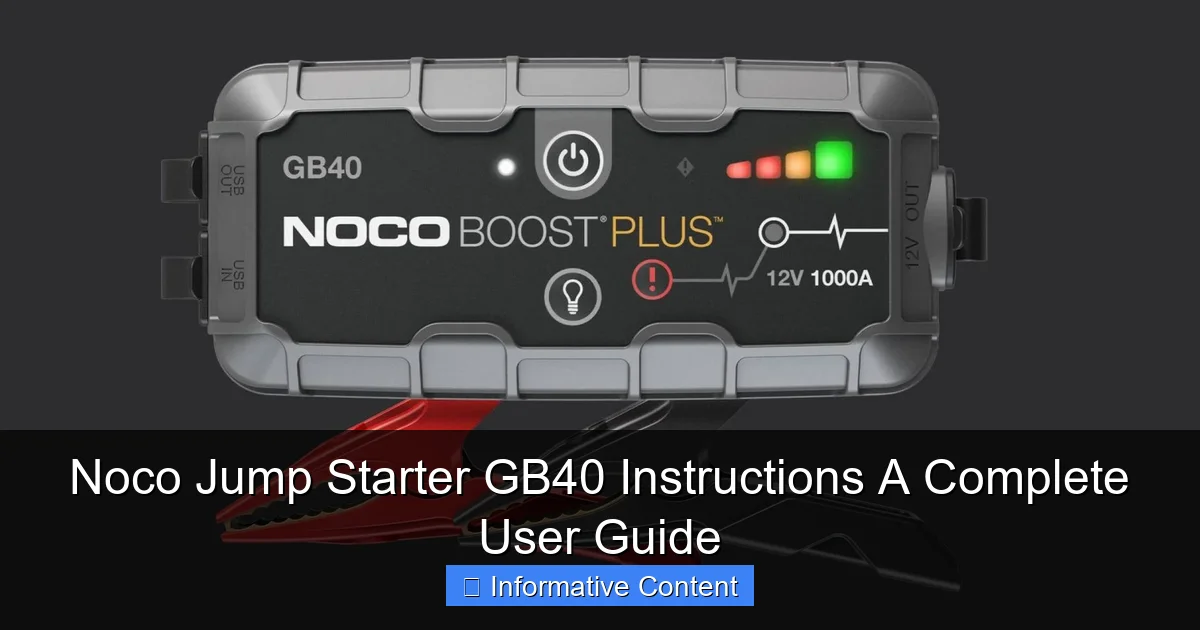
Featured image for noco jump starter gb40 instructions
Image source: batterysales.com
The Noco Jump Starter GB40 delivers powerful, safe jump-starting with simple, foolproof instructions for any 12V vehicle. Just connect the clamps, power on the unit, and start your engine—no guesswork or complicated steps required. Its built-in safety features and clear LED indicators make it ideal for emergencies, even for first-time users.
Key Takeaways
- Charge fully before use: Ensure 100% battery for reliable jump-starting performance.
- Connect red to positive (+): Always attach red clamp to battery’s positive terminal first.
- Use safety gloves: Protect hands from sparks and electrical hazards during connection.
- Wait 30 seconds: Allow Noco GB40 to stabilize before starting the engine.
- Store in cool, dry place: Prevent battery degradation and extend device lifespan.
- Check charge monthly: Maintain battery health during long-term storage or infrequent use.
📑 Table of Contents
- Why the Noco Jump Starter GB40 Deserves a Spot in Your Car
- Getting Started: Unboxing and Initial Setup
- How to Jump Start a Car: Step-by-Step with the GB40
- Using the GB40 as a Power Bank and 12V Supply
- Maintenance, Troubleshooting, and Safety
- Comparing the GB40 to Other Noco Models and Alternatives
- Final Thoughts: Is the GB40 Worth It?
Why the Noco Jump Starter GB40 Deserves a Spot in Your Car
Imagine this: You’re late for an important meeting, your car won’t start, and the battery is completely dead. You frantically call for a jump, but no one’s available. That’s when you remember the compact, unassuming Noco Jump Starter GB40 sitting in your trunk. Within minutes, you’re back on the road—no jumper cables, no waiting, no stress.
The GB40 isn’t just a jump starter; it’s peace of mind in a small, sleek package. Whether you’re a daily commuter, a weekend adventurer, or someone who just wants to be prepared, this little powerhouse has earned its place in thousands of glove compartments and emergency kits. But to get the most out of it, you need to understand how to use it properly. That’s where this Noco Jump Starter GB40 instructions guide comes in. I’ve used this device for years, and I’ll walk you through every step—from first charge to jump-starting a stubborn engine—with real-world tips, safety reminders, and a few “I wish I knew that sooner” moments.
Getting Started: Unboxing and Initial Setup
What’s in the Box?
When you first open the Noco GB40 package, here’s what you’ll find:

Visual guide about noco jump starter gb40 instructions
Image source: images-na.ssl-images-amazon.com
- Noco GB40 Jump Starter (12V, 1000 peak amps)
- Smart Jumper Cables (with clamps)
- USB-A to Micro-USB Charging Cable
- Wall Charger (120V AC)
- User Manual (with safety warnings and diagrams)
- Soft Carrying Case
The first thing you’ll notice is how compact it is—about the size of a large smartphone, but a bit thicker. The rubberized finish gives it a grippy, durable feel. Don’t let the size fool you: this thing packs a punch.
First Charge: The Most Important Step
Before you even think about using the GB40, fully charge it. This isn’t optional. A new unit may have some residual charge, but it won’t last long. Here’s how to do it right:
- Plug the wall charger into a standard 120V outlet.
- Connect the micro-USB end to the port on the side of the GB40 (marked “DC IN”).
- Press and hold the power button for 3 seconds to turn it on.
- Watch the LED battery indicator. It has four lights: each represents 25% charge.
- Charging from 0% to 100% takes about 3–4 hours. Don’t leave it plugged in overnight—once it hits 100%, it stops charging automatically, but it’s best to unplug it.
Pro tip: I keep mine on a shelf near my garage outlet. Every 3 months, I plug it in for a full recharge—even if I haven’t used it. Lithium-ion batteries degrade faster when left fully discharged for long periods.
Understanding the Buttons and LEDs
The GB40 has three main controls:
- Power Button (top): Press once to check battery level. Hold for 3 seconds to turn on/off. In jump mode, it activates the jump-start sequence.
- Mode Button (side): Cycles through modes: Jump Start, 12V DC, USB-A, USB-C (if your model has it). Each mode lights up a different LED.
- LED Indicators: Show battery level (4 lights), charging status (flashing when charging), and mode selection.
When you press the power button, the battery lights blink. If all four are solid, you’re good to go. If only one is on, charge it soon.
How to Jump Start a Car: Step-by-Step with the GB40
Pre-Jump Safety Checks
Before you connect the GB40, do these quick checks:
- Turn off the car: Remove the keys from the ignition. If the car is in gear (manual) or in “Park” (automatic), that’s fine—just don’t start it yet.
- Check the battery terminals: Look for corrosion (white/green powder). If there’s buildup, clean it gently with a wire brush. The GB40 has reverse polarity protection, but clean connections help it work better.
- Verify the battery voltage: The GB40 works on 12V systems (most cars, trucks, motorcycles). It won’t work on 6V or 24V systems (some older vehicles or commercial trucks).
- Ensure the GB40 has at least 50% charge: You don’t need 100%, but below 50%, it may not deliver enough power.
I once tried to jump a car with a GB40 at 25% charge—it powered on, but the engine cranked slowly and died. Lesson learned: charge it first.
Connecting the Clamps: The Right Way
Now, let’s connect the smart cables:
- Plug the smart cable into the GB40: Match the red (positive) and black (negative) connectors to the ports on the unit. They’re labeled clearly.
- Connect the red clamp to the positive terminal (+): This is usually marked with a “+” sign and has a red cover. Wiggle it to ensure it’s snug.
- Connect the black clamp to the negative terminal (-): But—here’s the trick—don’t connect it to the battery’s negative post. Instead, attach it to a bare metal ground point on the engine block, chassis, or strut tower. This reduces the risk of sparks near the battery, where hydrogen gas could be present.
Real-life example: I once connected the black clamp directly to the battery. The GB40’s safety system kicked in—no power, no jump. I moved the clamp to the engine block, and boom—engine started. The smart cables detect reverse polarity and spark risk, so they’re designed to fail safely.
Starting the Engine and Disconnecting
Now the moment of truth:
- Press the power button on the GB40: The jump mode LED should light up (usually a car icon).
- Enter the car and turn the key: Turn it to “Start.” The engine should crank and fire up. If it doesn’t start on the first try, wait 30 seconds, then try again. The GB40 has spark-proof technology, but repeated attempts can overheat it.
- Once the engine runs, disconnect in this order:
- Black clamp (ground)
- Red clamp (positive)
- Unplug the smart cable from the GB40
Never disconnect the red clamp first! It can create a spark that damages the GB40 or the car’s electronics. I’ve seen this mistake ruin units—don’t be that person.
Using the GB40 as a Power Bank and 12V Supply
Charging Phones, Tablets, and Other Devices
The GB40 isn’t just for jump-starting. It doubles as a powerful power bank:
- USB-A Port (5V/2.1A): Great for older phones, Bluetooth headphones, or GPS units. Just plug in your cable, press the mode button until the USB LED lights up, and charge away.
- USB-C Port (on some models): Faster charging for modern phones, tablets, and even laptops (if they support 12V charging). I used it to charge my MacBook Air during a camping trip—worked like a charm.
Tip: The GB40 delivers up to 18W via USB-C. If your phone charges slowly, check if it supports Power Delivery (PD) mode. The GB40 automatically negotiates the best speed.
Powering 12V Accessories (Air Compressors, Fans, etc.)
Need to inflate a flat tire or run a 12V fan on a hot day? The GB40 has a 12V DC port:
- Press the mode button until the 12V LED lights up.
- Plug in your 12V accessory (make sure it’s compatible with 12V/10A max).
- Turn on the accessory. The GB40 will power it until the battery drops below 20%.
Example: I used it to power a 12V air compressor to fix a slow leak. It ran for 15 minutes straight—plenty of time to get to a repair shop.
Battery Conservation Tips
To extend usage between charges:
- Turn off unused modes: If you’re not using USB or 12V, press the mode button to cycle back to “off” (no LED lit).
- Use lower-power devices: A 5W phone charger drains the GB40 slower than a 18W laptop charger.
- Store it charged: Keep it at 50–80% if storing for months. Fully charged or fully discharged batteries degrade faster.
Maintenance, Troubleshooting, and Safety
Routine Maintenance for Longevity
The GB40 is low-maintenance, but a little care goes a long way:
- Charge every 3 months: Even if unused. Lithium-ion batteries lose ~5% charge per month.
- Clean the clamps: Wipe off dirt or corrosion with a dry cloth. Don’t submerge the unit.
- Store in a cool, dry place: Avoid extreme heat (e.g., hot car trunks in summer) or cold (below 32°F). The operating range is 32°F to 122°F (0°C to 50°C).
- Check the cables: Look for fraying or loose connections. If damaged, replace them—Noco sells replacements.
I once left mine in my trunk all summer. When I tried to use it in winter, the battery was dead. After a full recharge, it worked fine, but it took a hit to its lifespan. Lesson: store it indoors.
Common Issues and Fixes
Here are problems I’ve faced—and how to solve them:
- “It won’t turn on”: Try a full charge. If it still doesn’t work, the battery may be deeply discharged. Leave it plugged in for 24 hours—sometimes it “wakes up.”
- “The clamps spark when connecting”: Move the black clamp to a ground point (engine block), not the battery. Sparking near the battery is dangerous.
- “Jump start failed”: Check the battery terminals, ensure the GB40 has >50% charge, and try again after 30 seconds. If it fails 3 times, the car battery may be too far gone—call a mechanic.
- “USB port not charging”: Try a different cable or device. Some cheap cables don’t carry data/power properly.
Safety First: What NOT to Do
The GB40 is safe, but misuse can cause damage or injury:
- Never jump a 6V or 24V system: It’s designed for 12V only.
- Don’t use it on a damaged battery: Swollen, leaking, or cracked batteries can explode.
- Avoid jump-starting diesel engines: They require higher cranking amps (2000+). The GB40 is for gas engines up to 6L.
- Don’t disassemble the unit: No user-serviceable parts inside.
Comparing the GB40 to Other Noco Models and Alternatives
GB40 vs. GB70 vs. GBX45: Which One Do You Need?
Noco makes several jump starters. Here’s how they stack up:
| Model | Peak Amps | Engine Size | Battery Capacity | USB-C | Price Range |
|---|---|---|---|---|---|
| GB40 | 1000 | Up to 6L gas | 12V/18Ah | Yes (on newer models) | $100–$120 |
| GB70 | 2000 | Up to 8L gas, 6L diesel | 12V/24Ah | Yes | $150–$180 |
| GBX45 | 1250 | Up to 7L gas | 12V/20Ah | Yes | $130–$150 |
The GB40 is perfect for most cars and small trucks. If you drive a diesel or a large SUV, consider the GB70. The GBX45 is a mid-tier option with more power and a built-in flashlight.
How It Stands Against Competitors
Compared to brands like NOCO (same company—confusing, right?), DBPOWER, and Tacklife, the GB40 wins on:
- Safety: Reverse polarity, spark-proof, and thermal protection.
- Build quality: Rugged, waterproof (IP65), and reliable.
- Smart features: The “intelligent” clamps detect connection errors.
Downsides? It’s pricier than budget brands, and the charging cable is short (3 feet). But for the peace of mind, I’d pay extra.
Final Thoughts: Is the GB40 Worth It?
After years of using the Noco Jump Starter GB40, I can confidently say it’s one of the best car gadgets I’ve ever owned. It’s saved me from dead batteries in freezing winters, helped me jump a friend’s car on a remote trail, and even powered my phone during a blackout. The Noco Jump Starter GB40 instructions might seem simple, but mastering the nuances—like ground connections, battery maintenance, and mode switching—makes all the difference.
Is it perfect? Not quite. The short charging cable is annoying, and I wish it had a built-in flashlight (like the GBX45). But for under $120, it delivers unmatched reliability, safety, and versatility. Whether you’re a road warrior or just want to avoid the embarrassment of a dead battery in a parking lot, the GB40 is a worthy investment.
So, charge it, store it, and keep it close. When you need it, you’ll be glad you did.
Frequently Asked Questions
How do I use the Noco Jump Starter GB40 for the first time?
Before first use, fully charge the GB40 using the included 12V USB-C cable. To jump-start, connect the clamps to the corresponding battery terminals (red to positive, black to negative), then press the power button to activate the boost mode.
What are the safety precautions in the Noco Jump Starter GB40 instructions?
Always wear protective eyewear and avoid smoking near the battery. The GB40 features spark-proof technology and reverse polarity protection, but double-check clamp connections to prevent damage or injury.
How long does the GB40 take to fully charge?
The Noco Jump Starter GB40 typically takes 3-4 hours to charge via a 12V USB-C port. A built-in LED indicator shows the charging status, with solid green indicating a full charge.
Can I charge my phone with the Noco GB40?
Yes! The GB40 has a 2.1A USB output port to charge smartphones, tablets, and other USB devices. Use your own cable to connect the device while the jump starter is powered on.
What does the “Error” LED mean on my Noco GB40?
The red “Error” LED indicates reverse polarity (clamps connected incorrectly) or a low internal battery. Reconnect the clamps correctly or recharge the unit per the Noco Jump Starter GB40 instructions.
How often should I recharge the GB40 when not in use?
Recharge the unit every 3-6 months during storage to maintain battery health. The GB40 holds a charge for months, but periodic charging ensures peak performance when needed.