
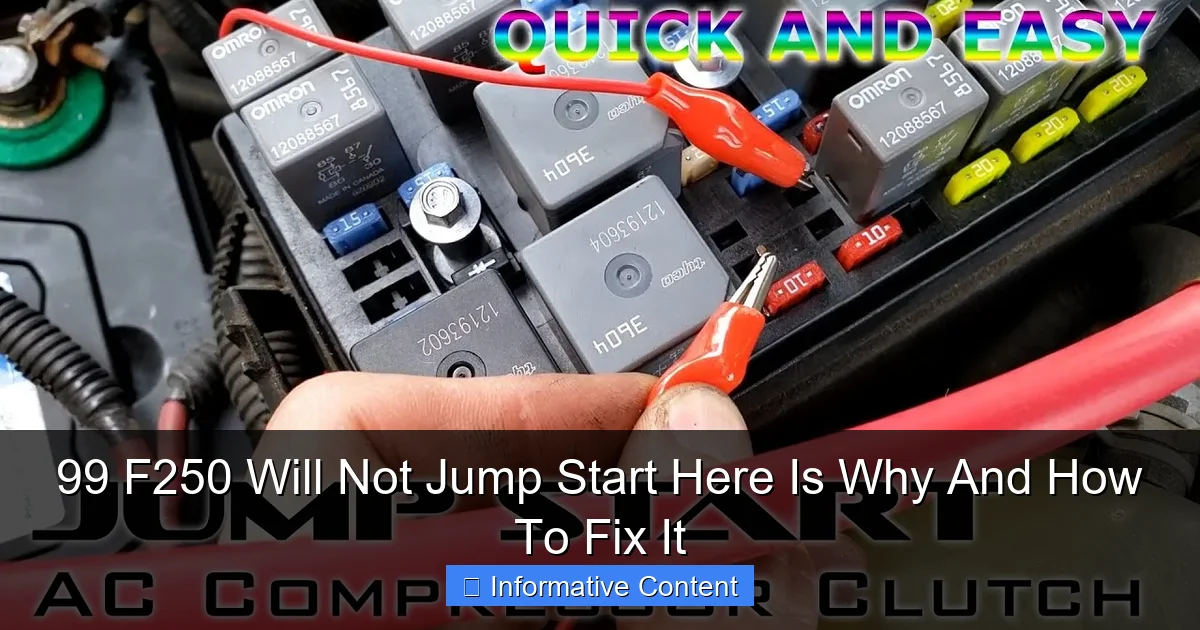
Featured image for 99 f250 will not jump start
Image source: i.ytimg.com
A 1999 Ford F250 that won’t jump start is often caused by a faulty ground connection, a dead battery, or corroded terminals—issues that prevent proper current flow. These common culprits can mimic a failed starter or alternator, but a quick inspection of the battery, cables, and chassis grounds usually reveals the real problem. Cleaning connections, testing the battery, and ensuring solid ground contact often restores jump-starting capability without costly repairs.
Key Takeaways
- Check battery connections: Clean and tighten terminals to ensure proper contact.
- Test the battery: Use a multimeter to confirm voltage is above 12.4V.
- Inspect alternator: Ensure it’s charging the battery correctly while running.
- Verify ground connections: Secure and clean all ground points to prevent issues.
- Try a portable jump starter: Bypass traditional methods to rule out donor vehicle problems.
- Examine starter motor: Listen for clicks—replace if it fails to engage.
📑 Table of Contents
Why Your 99 F250 Won’t Jump Start: The Real Story
You’ve been there before—rushing to get to work, late for an appointment, or just trying to get the day started. You hop into your trusty 1999 Ford F250, turn the key, and… nothing. Not even a click. You grab the jumper cables, hook it up to a running vehicle, wait a few minutes, and try again. Still nothing. Your 99 F250 will not jump start, and now you’re stuck, frustrated, and wondering what went wrong.
This is more common than you think. The 1999 F250 is a rugged, reliable workhorse, but like any vehicle over two decades old, it has quirks. When jump-starting fails, it’s not always about the battery. In fact, many people jump to conclusions—blaming the battery, the alternator, or the starter—without understanding the full picture. The truth? A 99 F250 will not jump start due to a mix of electrical, mechanical, and even environmental factors. And the fix? It’s often simpler than you’d expect—if you know where to look.
Common Causes: Why Your 99 F250 Refuses to Turn Over
When your 99 F250 will not jump start, the problem isn’t always the battery. Jump-starting works by bypassing a weak or dead battery to deliver power directly to the starter and ignition system. But if the jump itself fails, something else is blocking the flow of power or preventing the engine from cranking. Let’s break down the most common culprits—many of which are overlooked.

Visual guide about 99 f250 will not jump start
Image source: i.ytimg.com
1. Poor or Corroded Battery Connections
Even with jumper cables connected, if your battery terminals are caked with corrosion (that white, green, or blue crusty stuff), electricity won’t flow properly. Think of it like trying to drink through a clogged straw. The power might be there, but it can’t get through.
- Signs: Visible corrosion, loose or wobbly terminals, cables that look frayed.
- Real-world example: A buddy of mine once spent 45 minutes trying to jump his F250. After cleaning the terminals with a wire brush and baking soda, it fired up on the first try. The cables were fine—it was the connection that failed.
- Quick fix: Disconnect the battery, scrub the terminals with a wire brush, and apply anti-corrosion spray or petroleum jelly.
2. Ground Connection Issues
The ground wire (usually black) connects the battery to the truck’s frame or engine block. If this connection is loose, rusted, or disconnected, the electrical circuit is incomplete. No ground = no power flow, even with a jump.
- Signs: The engine doesn’t crank at all, or you see flickering lights when turning the key.
- Tip: Check the ground strap from the battery to the chassis and the engine-to-frame ground. These often get overlooked during routine maintenance.
- Pro tip: Use a multimeter to test continuity between the negative terminal and a bare metal spot on the engine. If there’s no connection, you’ve found the issue.
3. Bad or Failing Starter Motor
If the starter is failing, it won’t engage—even with full power from a jump. You might hear a single loud *click* when turning the key, or nothing at all. This is a classic sign the starter solenoid or motor is shot.
- Signs: Clicking noise, slow cranking, or no response despite good battery voltage.
- Test it: Tap the starter lightly with a wrench or hammer while someone turns the key. If it starts, the starter is likely failing (but not dead yet).
- Note: This is a temporary fix—replace the starter soon to avoid getting stranded.
4. Faulty Ignition Switch
The ignition switch sends power to the starter solenoid when you turn the key. If it’s worn out or broken, it won’t send the signal—even if power is available.
- Signs: No dash lights, no fuel pump hum, or intermittent starting issues.
- Real-world example: A friend’s 99 F250 wouldn’t start after a jump. We tested the starter with direct 12V—it worked. Then we bypassed the ignition switch using a screwdriver on the starter solenoid. Engine fired right up. The switch was the culprit.
Electrical System Deep Dive: Beyond the Obvious
When your 99 F250 will not jump start, it’s easy to blame the battery or starter. But the electrical system is more complex than it seems. The 1999 F250 uses a network of fuses, relays, and control modules. If any of these fail, the truck won’t start—even with a jump.
Fuse Box and Power Distribution
The F250 has two main fuse boxes: one under the hood (Power Distribution Box) and one inside the cab (Instrument Panel Fuse Panel). A blown fuse—especially for the ignition, fuel pump, or starter circuit—can prevent the engine from cranking.
- Check these fuses first:
- Ignition Relay (Fuse 12, 15A) – Controls power to the ignition switch.
- Starter Relay (Fuse 13, 15A) – Sends power to the starter solenoid.
- Fuel Pump Relay (Fuse 14, 15A) – Powers the fuel pump. Even if the engine cranks, no fuel = no start.
- Tip: Use a fuse puller or needle-nose pliers. Look for a broken wire inside the fuse. Replace with the correct amperage—never “upgrade” to a higher amp fuse.
- Pro tip: Keep a fuse kit in your glove box. They’re cheap and can save you hours of frustration.
Relay Failures: Silent Killers
Relays are electromagnetic switches that control high-current circuits. The starter relay is especially prone to failure in older trucks. If it’s dead, no power reaches the starter—even with a jump.
- Signs: No click when turning the key, no power to the starter solenoid.
- Test it: Swap the starter relay with an identical one (like the horn or AC relay). If the truck starts, the relay is bad.
- Note: The 1999 F250 uses standard Bosch-style relays. Keep a spare in your tool kit.
Neutral Safety Switch (Clutch or Gear Position)
This safety feature prevents the engine from starting unless the transmission is in Park (automatic) or the clutch is depressed (manual). If the switch is misaligned or faulty, the starter won’t engage.
- Signs: No crank, no click, even with a jump. Sometimes it works intermittently.
- Workaround: For automatics, try starting in Neutral instead of Park. For manuals, press the clutch hard and wiggle the shift lever.
- Fix: The switch is usually near the shifter or clutch pedal. Adjust or replace as needed. A mechanic can diagnose this quickly.
Starter and Solenoid: The Heart of the Crank
When your 99 F250 will not jump start, the starter and solenoid are prime suspects. These components are under heavy strain every time you start the engine. Over time, heat, vibration, and age take their toll.
How the Starter System Works
The starter motor is a powerful electric motor that turns the engine’s flywheel. When you turn the key, the ignition switch sends a small current to the starter solenoid. The solenoid then engages a lever that pushes the starter gear (bendix) into the flywheel and sends a high-current signal to the starter motor. If either part fails, no crank.
- Key components:
- Starter Motor: Does the actual cranking.
- Solenoid: Acts as a relay and mechanical actuator.
- Bendix Drive: The gear that meshes with the flywheel.
Signs of a Failing Starter
- Grinding noise: The bendix isn’t engaging or disengaging properly.
- Clicking but no crank: Solenoid is working, but motor isn’t.
- Intermittent starting: Works sometimes, fails other times.
- Hot start issues: Starts when cold, won’t start when warm.
Example: A reader once wrote in—his F250 would start fine in the morning but died after a 20-minute drive. We tested the starter with a remote switch. It worked when cold but failed when hot. The starter motor was overheating. Replacing it solved the issue.
Testing the Starter with a Multimeter
You don’t need a mechanic to test your starter. Here’s how:
- Set your multimeter to DC volts (20V range).
- Connect the red probe to the positive terminal on the starter.
- Connect the black probe to a clean metal spot on the engine.
- Turn the key to “start.” You should see 10+ volts.
- If voltage is low or zero, the problem is upstream (relay, switch, battery).
- If voltage is good but no crank, the starter is likely dead.
Tip: If you’re jump-starting and the voltage drops below 10V, the cables or donor battery might be weak. Try a different vehicle or heavier-duty cables.
Environmental and Hidden Factors That Sabotage Jump Starts
Sometimes, the reason your 99 F250 will not jump start has nothing to do with the truck—it’s the environment or hidden conditions. These are the sneaky issues that catch people off guard.
Extreme Cold Weather
Cold thickens engine oil, making it harder to crank. Batteries also lose capacity in the cold. Even with a jump, the starter may not turn the engine fast enough to ignite.
- Signs: Slow cranking, no start below 20°F (-7°C).
- Fix:
- Use a block heater or battery blanket.
- Switch to a lower-viscosity oil (e.g., 5W-30 instead of 15W-40).
- Park in a garage or use a windbreak.
- Real-world tip: A friend in Minnesota kept a small electric heater under his truck’s hood. It made cold starts much easier.
Moisture and Corrosion in Harsh Conditions
If you drive in rain, snow, or near the ocean, moisture can seep into electrical connectors and cause corrosion. The starter solenoid, ignition switch, and ground points are especially vulnerable.
- Signs: Intermittent starting, flickering lights, musty smell under the hood.
- Fix:
- Inspect all electrical connectors. Clean with electrical contact cleaner.
- Apply dielectric grease to prevent moisture buildup.
- Use heat shrink tubing on exposed wires.
Parasitic Drain: The Silent Battery Killer
Even when parked, some systems (like the clock, alarm, or radio memory) draw small amounts of power. If there’s a faulty circuit or short, this drain can kill the battery overnight.
- Signs: Battery dies after sitting 24+ hours, jump-start works but dies again.
- Test: Use a multimeter in series with the negative battery cable. A healthy draw is under 50 milliamps. If it’s higher, unplug fuses one by one to find the culprit.
- Common causes: Bad glove box light switch, faulty door locks, aftermarket alarms, or a stuck relay.
Step-by-Step Troubleshooting Guide
Now that you know the possible causes, let’s walk through a clear, logical process to diagnose and fix the problem when your 99 F250 will not jump start. This is the same method I use with my own trucks and recommend to friends.
Step 1: Inspect the Basics
- Check battery terminals—clean and tight?
- Inspect ground connections—firm and corrosion-free?
- Look at the battery cables—no fraying or breaks?
- Ensure the transmission is in Park/Neutral and the parking brake is on.
Step 2: Test with a Multimeter
- Measure battery voltage: Should be 12.6V+ when off, 13.5V+ when running.
- Test voltage at the starter solenoid during crank: Should be 10V+.
- Check ground continuity: Should be 0 ohms between negative terminal and engine.
Step 3: Bypass Key Systems
- Swap the starter relay with a known-good one.
- Bypass the ignition switch: Use a screwdriver to short the two large terminals on the starter solenoid (wear gloves!).
- Test the neutral safety switch: Try starting in Neutral (auto) or wiggle the clutch pedal (manual).
Step 4: Check Fuses and Relays
- Inspect the Power Distribution Box and Instrument Panel fuses.
- Test the fuel pump relay—listen for a hum when turning the key to “on.”
- Replace any blown fuses with the correct amperage.
Step 5: Evaluate the Starter
- Tap the starter with a tool while someone turns the key.
- If it starts, replace the starter soon.
- If no response, remove and bench-test the starter (auto parts stores often do this for free).
Step 6: Consider the Environment
- Is it very cold? Use a block heater or battery warmer.
- Is there moisture? Dry out the engine bay and apply dielectric grease.
- Has the truck sat? Check for parasitic drain.
| Symptom | Likely Cause | Quick Test | Solution |
|---|---|---|---|
| No crank, no click | Bad connection, relay, or switch | Check voltage at starter solenoid | Clean terminals, swap relay, bypass ignition |
| Click but no crank | Failing starter motor | Tap starter with tool | Replace starter |
| Crank but no start | Fuel, spark, or sensor issue | Listen for fuel pump hum | Check fuel pressure, spark, and fuses |
| Works with jump but dies | Parasitic drain or bad alternator | Check voltage with engine running | Test alternator, fix drain |
| Intermittent starting | Loose connection or failing switch | Wiggle wires, check continuity | Secure connections, replace switch |
When your 99 F250 will not jump start, it’s easy to feel helpless. But with the right approach, you can diagnose the issue in under an hour—often with basic tools. Remember: it’s rarely just the battery. The problem could be a corroded ground, a blown fuse, a bad relay, or even the weather.
The key is to stay calm and work methodically. Start with the simplest checks—battery connections, grounds, and fuses—before moving to more complex components. Use a multimeter to verify power flow. And don’t forget the environment—cold, moisture, and long sits can all sabotage a jump.
Your 1999 F250 is a tough truck. With a little patience and the right knowledge, you can get it running again—and avoid the same issue in the future. Keep a basic toolkit, spare fuses, and jumper cables in your truck. And next time someone says, “My 99 F250 will not jump start,” you’ll know exactly what to check—and how to fix it.
Frequently Asked Questions
Why won’t my 99 F250 jump start even with a good battery?
If your 99 F250 will not jump start despite a functional battery, the issue could be a faulty starter, corroded connections, or a bad ground. Check the battery terminals, cables, and starter relay for damage or looseness.
What are common causes when a 1999 Ford F250 won’t jump start?
Common causes include a dead battery, damaged alternator, faulty ignition switch, or a malfunctioning starter motor. Electrical issues like blown fuses or corroded wiring can also prevent the jump start from working.
How do I troubleshoot a 99 F250 that will not jump start?
First, inspect the battery, cables, and connections for corrosion or wear. Then, test the starter, alternator, and ignition switch. If the 99 F250 will not jump start after these checks, consult a mechanic for deeper diagnostics.
Can a bad alternator cause my 99 F250 not to jump start?
Yes, a failing alternator may prevent the battery from charging properly, making jump-starting ineffective. Even with a jump, the truck may stall if the alternator can’t sustain the electrical load.
Why does my 1999 F250 click but won’t start when I try to jump it?
A clicking sound usually points to a weak battery or a failing starter motor. Ensure the battery has enough charge and test the starter solenoid—corroded connections or a bad starter often cause this issue.
What should I do if my 99 F250 won’t jump start after multiple attempts?
Repeated jump-start failures suggest deeper electrical or mechanical problems. Inspect the fuel system, ignition system, and wiring harness. If unresolved, have a professional diagnose the vehicle to pinpoint the root cause.