
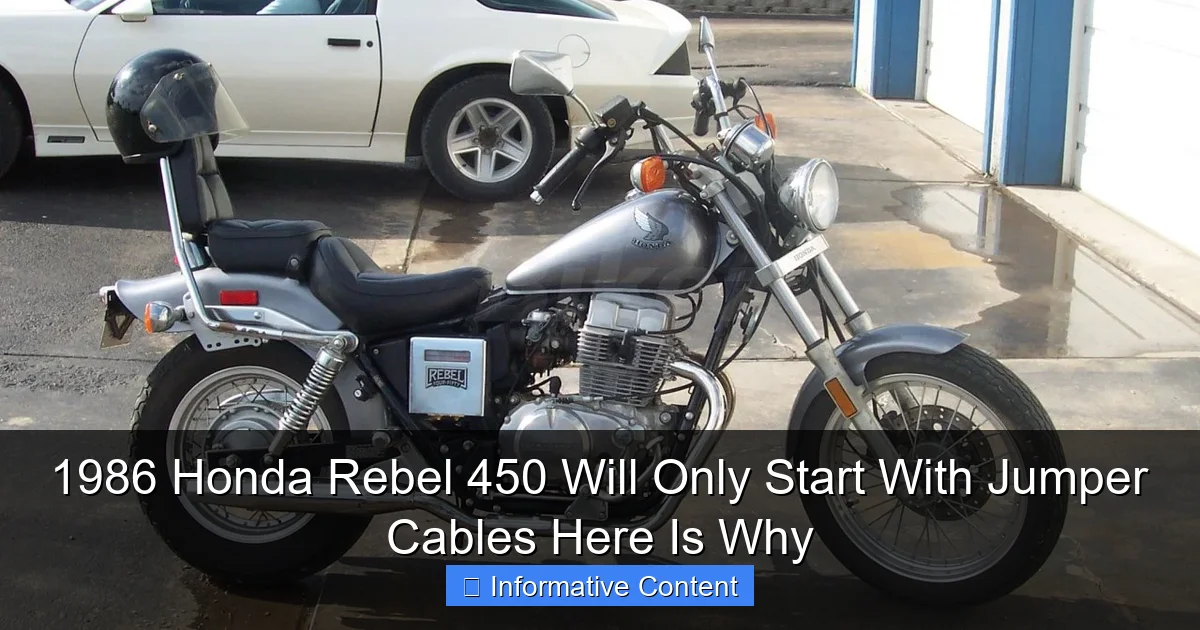
Featured image for 1986 honda rebel 450 will only start with jumper cables
Image source: bikez.com
A failing stator or weak battery is often why your 1986 Honda Rebel 450 only starts with jumper cables, indicating the charging system isn’t replenishing power as it should. Ignoring this issue risks stranding you mid-ride, so test the stator output and regulator/rectifier immediately to avoid costly repairs or unsafe breakdowns.
Key Takeaways
- Weak battery? Test and replace if voltage is below 12.6V.
- Faulty stator? Check AC output; should exceed 40V at 5,000 RPM.
- Bad regulator? Inspect for consistent 14.2V DC output.
- Loose connections? Clean and tighten all ground and battery terminals.
- Parasitic drain? Measure draw; should be under 50mA with ignition off.
- Starter issues? Test for 10V minimum at starter solenoid during cranking.
📑 Table of Contents
- Why Your 1986 Honda Rebel 450 Only Starts With Jumper Cables
- Understanding the Symptoms: What the Jumper Cable Dependency Tells You
- The Battery: First Line of Defense (and Most Common Culprit)
- The Charging System: Why the Battery Isn’t Getting Charged
- Corrosion and Loose Connections: The Silent Killers
- Advanced Diagnostics: When the Basics Don’t Fix It
- Data Table: Common Causes and Fixes for 1986 Honda Rebel 450 Starting Issues
- Conclusion: You Don’t Need Jumper Cables—Just the Right Fix
Why Your 1986 Honda Rebel 450 Only Starts With Jumper Cables
If you’ve ever stood in your garage, jumper cables in hand, trying to bring your 1986 Honda Rebel 450 back to life, you’re not alone. This iconic cruiser, known for its smooth ride and beginner-friendly handling, has a few quirks—one of the most common being that it refuses to start without a little extra help from jumper cables. It’s frustrating, sure, but it’s also a clue. The fact that the bike starts fine with cables tells us something important: the engine and ignition system are functional. The issue lies somewhere in the electrical or charging system. And the good news? It’s usually fixable without a full engine rebuild.
I remember my first encounter with this exact problem. I’d just bought a well-kept 1986 Honda Rebel 450 from a friend who swore it was “perfect.” The first few rides were smooth. Then, one morning, nothing—just a weak click when I turned the key. Jumper cables? Boom, it fired right up. After a weekend of troubleshooting, I learned more about this bike’s electrical system than I ever thought possible. If you’re dealing with the same issue, this post is for you. We’ll walk through the most likely causes, how to diagnose them, and how to fix them—so you can stop relying on jumper cables and get back to riding with confidence.
Understanding the Symptoms: What the Jumper Cable Dependency Tells You
When your 1986 Honda Rebel 450 will only start with jumper cables, it’s not random. It’s a symptom with a clear message: your bike’s internal electrical system isn’t delivering enough power to start the engine on its own. But why? Let’s break it down.

Visual guide about 1986 honda rebel 450 will only start with jumper cables
Image source: storage.googleapis.com
The Role of the Battery in Starting
The battery is the heart of your motorcycle’s starting system. When you turn the key, the battery sends a high-current signal to the starter solenoid, which engages the starter motor. That motor spins the engine, and the ignition system (spark plugs, CDI, coils) takes over. If the battery is weak, old, or not being charged properly, it can’t deliver the necessary current. Jumper cables bypass the weak battery by supplying power directly from a healthy source—like a car or another motorcycle.
Why It Starts With Jumper Cables (and Dies Without)
This is key: if the bike starts with jumper cables and runs fine, the engine, carburetor, and ignition system are likely working. The problem is upstream—before the spark and fuel. The battery isn’t holding a charge, or it’s not being charged while riding. Think of it like a phone that only turns on when plugged in. The phone works, but the battery isn’t holding a charge. Same idea here.
Common Misdiagnoses to Avoid
- Blaming the starter motor: If the starter clicks or turns slowly, it’s tempting to replace it. But a bad starter usually won’t work even with jumper cables.
- Assuming the fuel system is the culprit: If the bike runs smoothly after starting, fuel delivery isn’t the issue. Focus on electricity.
- Overlooking the charging system: Many riders assume a dead battery means replace it. But if the charging system (stator, regulator/rectifier) isn’t working, the new battery will die too.
Tip: Always test the battery voltage before and after riding. A healthy battery should read 12.6–12.8 volts when off and 13.5–14.5 volts when the engine is running. If it’s not charging, you’ve found your culprit.
The Battery: First Line of Defense (and Most Common Culprit)
The battery is the most obvious suspect—and often the real problem. But not always. Let’s explore why and how to test it properly.
Signs of a Failing Battery
Even if your battery looks fine, age and wear can degrade internal plates and reduce capacity. Here’s what to watch for:
- Slow cranking or a single “click” when you press the starter button
- Dim headlights or instrument lights when the engine is off
- Needing to jump-start more than once in a week
- A battery older than 3–5 years (typical lifespan)
How to Test the Battery Properly
Don’t just rely on a multimeter at rest. A weak battery can show 12.6 volts when off but drop below 9 volts under load—which is what happens when you try to start the bike. Here’s how to test it correctly:
- Set your multimeter to DC voltage (20V range).
- Measure voltage with the engine off: should be 12.6–12.8V.
- Have someone hold the starter button while you watch the meter. A healthy battery should stay above 9.6V. If it drops below 9V, the battery is failing.
- Charge the battery fully (use a smart charger) and repeat the test. If it still fails, replace it.
Choosing the Right Replacement Battery
The 1986 Honda Rebel 450 uses a 12V, 14Ah (ampere-hour) battery. Common types include:
- Flooded lead-acid: Traditional, affordable, but requires maintenance (adding water).
- Sealed AGM (Absorbent Glass Mat): Maintenance-free, vibration-resistant, better for older bikes. Recommended for reliability.
Pro tip: Brands like Yuasa, Shorai (lithium), and Deka are trusted. Avoid cheap no-name batteries—they often fail within a year.
Real-world example: One rider replaced his battery with a cheap $40 unit. It lasted four months. He switched to a Yuasa YTX14-BS (AGM), and it’s been going strong for three years—no more jump starts.
The Charging System: Why the Battery Isn’t Getting Charged
If your battery tests fine but keeps dying, the issue is likely the charging system. The 1986 Honda Rebel 450 relies on a three-phase charging setup: the stator, the regulator/rectifier, and the battery. If any part fails, the battery won’t charge while riding—eventually leaving you stranded.
How the Charging System Works
The engine spins a rotor (magnets) inside the stator (coils), generating AC voltage. The regulator/rectifier converts AC to DC and limits voltage to 13.5–14.5V to charge the battery. If this system fails, the battery drains over time.
Testing the Stator
The stator is located behind the engine’s left side cover. To test it:
- Disconnect the stator’s three-wire connector (usually yellow wires).
- Set your multimeter to AC voltage (200V range).
- Start the engine and rev to 3,000–4,000 RPM. Each wire should show 20–30V AC. Low or zero voltage = bad stator.
- Check resistance between each pair of wires (set meter to ohms). Should be 0.5–2 ohms. Infinite resistance = open circuit (bad).
Note: A shorted stator can also cause low output. If resistance is near zero, the stator may be shorted.
Testing the Regulator/Rectifier
This unit is usually mounted near the battery or under the seat. To test:
- With the engine running, check battery voltage at the terminals. Should be 13.5–14.5V. Below 13V = undercharging. Above 15V = overcharging (can fry the battery).
- Check for heat: a failing regulator/rectifier often gets very hot.
- Use a multimeter to test diode function (if you’re comfortable). A bad unit may show continuity in both directions (should be one-way only).
Tip: If you’re unsure, swap in a known-good regulator/rectifier (borrow from a friend or buy a cheap used one). If the battery starts charging, you’ve found the problem.
Real-world example: A rider noticed his battery voltage was only 12.8V at idle and 13.0V at 4,000 RPM. The stator tested fine. He replaced the regulator/rectifier with an aftermarket unit (~$40), and voltage jumped to 14.2V. Problem solved.
Corrosion and Loose Connections: The Silent Killers
Even with a good battery and charging system, bad connections can starve your starter and ignition system of power. Corrosion, loose terminals, and damaged wiring are common on 35+ year-old bikes like the 1986 Honda Rebel 450.
Inspecting Battery Terminals and Cables
- Remove the battery and inspect terminals. White or green crust? That’s corrosion. Clean with baking soda and water, then a wire brush.
- Check cable integrity. Look for fraying, brittleness, or melted insulation (a sign of high resistance).
- Ensure terminals are tight. Loose connections can cause intermittent starting.
Pro tip: Apply dielectric grease to terminals after cleaning. It prevents future corrosion and improves conductivity.
Checking Ground Connections
Grounds are just as important as positive connections. A poor ground can cause:
- Weak spark
- Dim lights
- Intermittent starting
Common ground points:
- Battery to frame (usually a short strap near the battery)
- Engine to frame (often a braided wire near the engine mount)
- Regulator/rectifier to frame
Inspect each ground: remove, clean, and re-tighten. Use a multimeter to check continuity between the battery negative and the engine/frame (should be near 0 ohms).
Wiring Harness and Starter Circuit
Check the starter solenoid (mounted near the battery) for corrosion or loose wires. Also, inspect the kill switch, starter button, and ignition switch. A faulty switch or corroded connector can prevent full current from reaching the starter.
Real-world example: A rider had a perfectly good battery and charging system but still needed jumps. After tracing the wiring, he found a corroded ground strap under the seat. Replacing it with a new braided strap solved the issue.
Advanced Diagnostics: When the Basics Don’t Fix It
If you’ve checked the battery, charging system, and connections—and your 1986 Honda Rebel 450 still only starts with jumper cables—it’s time for deeper investigation. These less common issues can be tricky but are fixable.
Starter Solenoid Failure
The solenoid is a relay that connects the battery to the starter motor. If the internal contacts are worn, it may pass current when jump-started (due to higher voltage) but fail with the bike’s battery. Symptoms:
- Clicking sound when pressing the starter button
- Starter doesn’t engage
- Works only with jumper cables
Test: Tap the solenoid lightly with a wrench while someone presses the starter. If it engages, the solenoid is weak. Replace it (~$20–$40).
Ignition Switch or Key Cylinder Issues
Worn contacts inside the ignition switch can limit current to the starter circuit. Try turning the key to “ON” and wiggling it. If the lights flicker or the starter works intermittently, the switch is likely failing. Replacement switches are available online or at motorcycle shops.
Voltage Drop Testing (Pro-Level Diagnosis)
This method measures how much voltage is lost across connections and components. It’s the gold standard for diagnosing electrical gremlins.
- Set your multimeter to DC voltage (2V range).
- Connect the negative probe to the battery’s negative terminal.
- Connect the positive probe to the starter motor’s positive terminal.
- Have someone press the starter. A healthy connection should show less than 0.5V drop. More than 1V? There’s a problem in the circuit (corrosion, loose wire, etc.).
- Repeat between the solenoid and battery, and between the battery and frame ground.
This test can pinpoint exactly where the power loss occurs—saving hours of guesswork.
Data Table: Common Causes and Fixes for 1986 Honda Rebel 450 Starting Issues
| Issue | Symptoms | Test Method | Fix | Estimated Cost |
|---|---|---|---|---|
| Weak or Dead Battery | Slow cranking, dim lights, needs jump-start | Voltage under load (below 9V) | Replace with AGM battery | $80–$150 |
| Bad Stator | Battery not charging, voltage stays ~12.6V | AC voltage at stator (0–10V at 4,000 RPM) | Replace stator | $100–$200 (used), $250+ (new) |
| Faulty Regulator/Rectifier | Over/undercharging (below 13V or above 15V) | Battery voltage while running | Replace unit | $40–$80 |
| Corroded Terminals or Cables | Intermittent starting, flickering lights | Visual inspection, voltage drop test | Clean or replace cables/terminals | $10–$50 |
| Starter Solenoid Failure | Clicking, works only with jumpers | Tap test, voltage drop | Replace solenoid | $20–$40 |
| Poor Grounds | Weak spark, dim lights, no start | Continuity test (0 ohms to frame) | Clean or replace ground straps | $5–$20 |
Conclusion: You Don’t Need Jumper Cables—Just the Right Fix
Let’s face it: relying on jumper cables to start your 1986 Honda Rebel 450 is a temporary fix, not a solution. But the good news is that this problem is almost always fixable—and often for less than $100. Whether it’s a tired battery, a failing stator, or corroded connections, the root cause is usually straightforward once you know where to look.
Start with the battery. Test it under load. If it fails, replace it with a quality AGM unit. Then check the charging system: stator and regulator/rectifier. Use your multimeter to verify output. Don’t skip the connections—clean every terminal, tighten every ground, and inspect the wiring. And if you’re still stuck, voltage drop testing can save you from endless frustration.
Remember, this bike is a classic for a reason. It’s reliable, easy to work on, and built to last. With a little patience and the right tools, you can get it starting strong—without needing jumper cables. So grab your multimeter, roll up your sleeves, and give your Rebel the attention it deserves. The open road is waiting.
Frequently Asked Questions
Why does my 1986 Honda Rebel 450 only start with jumper cables?
This issue is often caused by a weak or failing battery that can’t hold a charge, even if it appears functional. The 1986 Honda Rebel 450 relies heavily on a healthy battery for proper ignition, and jumper cables temporarily compensate for the lack of voltage.
Could a bad stator or regulator be causing my 1986 Honda Rebel 450 to need jumper cables?
Yes, a faulty stator or voltage regulator can prevent the battery from charging while riding, leading to a drained battery that requires jumper cables to start. Test the charging system output with a multimeter to confirm if it’s delivering the correct voltage (13.5–14.5V).
Is a dead battery the only reason my Rebel 450 won’t start without jumper cables?
While a dead or dying battery is the most common culprit, corroded connections, a failing starter motor, or a bad main relay can also cause this problem. Inspect wiring and connections first before assuming the battery is at fault.
How do I diagnose if the battery is the issue on my 1986 Honda Rebel 450?
Try charging the battery fully with a smart charger, then test it with a load tester to see if it holds voltage under demand. If the battery fails the test or drains quickly, replacement is necessary to resolve the jumper cable dependency.
Why does my Honda Rebel 450 lose power overnight and need a jump?
This points to a parasitic drain or a battery that’s no longer holding a charge. Common causes include a short circuit, faulty accessories, or a battery older than 3–5 years. A multimeter can help identify excessive draw when the bike is off.
Can a bad ground connection cause my 1986 Honda Rebel 450 to only start with jumper cables?
Absolutely—poor grounding can disrupt the electrical circuit, mimicking a weak battery. Check the battery ground cable, frame grounds, and engine connections for rust or looseness, as these are critical for proper starting.